
Who this guide is for
- Operators and entrepreneurs scoping a new commercial padel venue
- Existing sports facilities weighing whether to add padel courts
- Sponsors and investors who need a structured go, adjust or pause framework
- Project leads coordinating designers, suppliers and operational planning
- Landowners considering whether a site might suit a padel facility
- Anyone wanting to test a padel idea before committing budget
Planning diagram
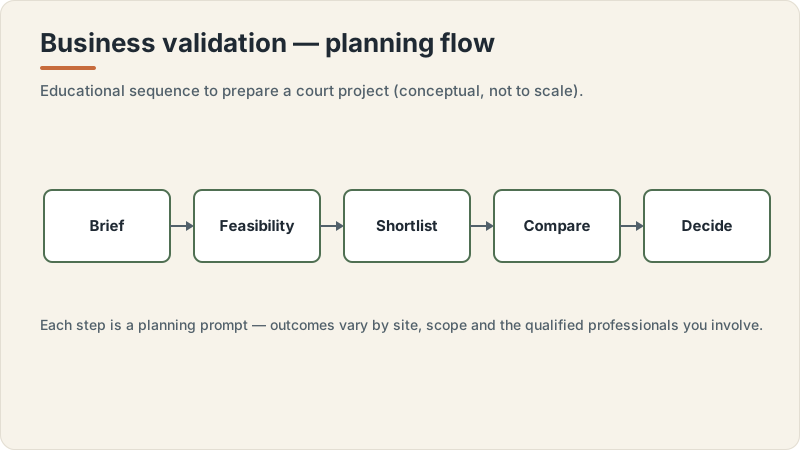
Business validation planning flow
Conceptual editorial diagram — not a construction drawing, specification or to-scale plan. Official court dimensions, standards, drainage, structure and lighting requirements vary by sport, site and location and are confirmed with the relevant federation, supplier and qualified professionals.
What this resource helps you prepare
This brief helps you assemble the questions and considerations behind a commercial padel facility at a conceptual level, before any design, quoting or commitment. It is a framework for structured thinking, not an estimate, a forecast or a recommendation to proceed.
It walks through location and site, the number of courts as a planning variable, the supporting amenities a public-facing venue implies, operating considerations and the advisors you may need. Throughout, it keeps to the planning and question level rather than offering figures, technical instructions or regulatory certainty.
- A vocabulary for discussing the project with designers, suppliers and operators
- A way to separate what you can decide from what needs professional input
- Prompts on location, site, court count, amenities and operations
- Clarity on which questions to take to qualified advisors and authorities
Location and site as the starting point
Feasibility begins with where and on what ground. A site that fights you on access, shape, slope, ground conditions, drainage or surrounding space signals complexity early, and that is a prompt for investigation rather than a reason to push past. Visibility, catchment and how easily players reach the venue are part of the same conversation, but the underlying numbers are yours to develop with advisers, not to assume.
Whether a particular site can support a padel facility depends on conditions that only a qualified professional can assess on the ground. Treat any repeated difficulty as a question to investigate rather than a problem to design around without help.
- How players would reach, enter and leave the site
- Whether the site shape and space suit the intended layout
- Ground, slope and drainage signals that warrant a professional assessment
- Surroundings, neighbours and visual or noise impact to raise with local authorities
Number of courts and supporting amenities
Court count is a planning variable, not a fixed answer. More courts change spacing, circulation, the size of supporting spaces and the way the venue feels at busy times, and they interact with the site you have. Rather than fixing on a number, treat it as something to test against the site, the operating model and your own demand analysis carried out with advisers.
A public-facing venue implies amenities beyond the courts: reception or check-in, changing and welfare facilities, somewhere to wait or watch, and parking and arrival. Sizing and placing these is part of feasibility. Official court dimensions and spacing, and accessibility requirements, vary and should be confirmed with the relevant federation, suppliers, designers and local authorities.
- Court count as a variable to test, not a figure to assume
- Spacing, circulation and how the venue feels at peak times
- Reception, changing, welfare and spectator or waiting space
- Parking, arrival and accessibility to confirm with professionals and authorities
Operating considerations to think through early
How a venue is booked, staffed and turned around between sessions shapes whether a busy facility runs smoothly, and it is closely tied to the physical layout. Planning the operating model alongside the design avoids creating spaces that frustrate staff and players. Maintenance, supervision and lifecycle thinking belong here too, because a court in regular commercial use needs to be run and kept in good condition over time.
Any view of costs, demand, occupancy or revenue should come from your own professional advisers. This resource keeps to the questions worth asking, because the figures vary by usage, surface, drainage, lighting, location and operating choices.
- How courts would be booked and turned around between sessions
- Staffing across operating hours and supervision needs
- Maintenance, cleaning and lifecycle responsibilities over time
- How operations and the physical layout depend on each other
Questions to ask qualified professionals
The most useful outcome of a feasibility brief is a clear list of questions for the right specialists. Use the prompts below to open conversations with designers, engineers, suppliers, operators and local authorities, and adapt them to your project. The aim is better questions, not answers a guide could invent.
- What does the site assessment reveal about ground, slope, access and drainage?
- What court layout and spacing do current sport and federation requirements imply, and how should I confirm them?
- What permits, zoning, noise, lighting and accessibility requirements apply here, and which authority confirms them?
- How should reception, changing, welfare and spectator areas be sized for the intended use?
- What does a realistic operating and maintenance model look like for this venue?
- What demand, cost and viability analysis would you carry out, and what would it depend on?
- Which specialists should sit on the professional team, and how should their work be coordinated?
What this does not replace
This is an educational preparation resource. It is not an estimate, not a forecast, not a recommendation to proceed, not contractor matching, and not a substitute for legal, engineering, architectural, design, inspection or safety advice. It does not verify, rank, endorse or connect you to any contractor or supplier.
Requirements and costs vary by location, site, scope, supplier, access, drainage, lighting and surface, and official sport or federation requirements must be confirmed with the relevant bodies. Consult qualified designers, engineers, contractors, lighting and drainage specialists, local authorities and legal or professional advisors where appropriate. Build Design Hub does not provide contractor matching or professional recommendations; HELPERG LLC is publisher and operator only.
Commercial padel feasibility brief worksheet
- 1Have you described the location, catchment and how players would reach the site?
- 2Have you noted site signals, access, shape, slope and drainage, that need professional assessment?
- 3Have you treated court count as a variable to test rather than a fixed number?
- 4Have you considered spacing, circulation and how the venue feels at busy times?
- 5Have you listed the amenities a public-facing venue implies, including parking and accessibility?
- 6Have you thought through booking, staffing and turnaround as an operating model?
- 7Have you considered ongoing maintenance, supervision and lifecycle responsibilities?
- 8Have you noted which sport, permit, zoning, noise and accessibility requirements need confirming with authorities?
- 9Have you separated what you can decide from what needs professional input?
- 10Have you drafted the questions to take to designers, engineers, suppliers and advisors?
Common mistakes to avoid
- Fixing on a number of courts before testing it against the site and operating model
- Treating the project as a set of courts rather than a venue people arrive at and use
- Pushing past clear site warning signs on access, slope or drainage to keep momentum
- Undersizing reception, changing, welfare and spectator areas for busy periods
- Planning the layout separately from how the venue would actually be run
- Overlooking parking, arrival and accessibility until late in the process
- Assuming sport, permit and accessibility requirements instead of confirming them with the relevant bodies
- Relying on guessed demand, cost or revenue figures rather than professional analysis
When to involve a professional
- Engage a qualified professional to assess the site, including ground, slope, access and drainage, since feasibility depends on conditions that vary and must be judged on the ground.
- Confirm official padel court dimensions, spacing and sport requirements with the relevant federation, suppliers or designers rather than assuming them.
- Check permit, zoning, noise, lighting and accessibility requirements with the relevant local authorities, as these vary by location and may require local review.
- Have any demand, cost, occupancy or viability analysis carried out by your own financial and professional advisers, not derived from this educational guide.
- Involve designers, engineers, lighting and drainage specialists and operators when defining layout, amenities and the operating model for a public-facing venue.
- Coordinate the professional team and route specialist work appropriately as the project moves from concept toward design.
Frequently asked questions
Questions readers ask about this topic
Does this brief tell me whether a padel facility will be profitable?
No. It is an educational planning framework, not a forecast. Any view of demand, costs, occupancy or revenue varies by location, site, scope and operating model and should come from your own professional advisers, not from this resource.
How many courts should a commercial padel facility have?
Court count is a planning variable rather than a fixed answer. It interacts with the site, spacing, amenities and the operating model. Test it against your own analysis and confirm layout and spacing with the relevant federation, suppliers or designers.
What should I confirm about requirements before proceeding?
Treat sport, permit, zoning, noise, lighting and accessibility requirements as things that vary by location and must be confirmed with the relevant authorities and federation. This guide does not state them as fact; it points to the questions to ask.
Does Build Design Hub recommend padel contractors or suppliers?
No. Build Design Hub does not provide contractor matching, recommendations, rankings or endorsements, and HELPERG LLC is publisher and operator only. Selecting and verifying any contractor or supplier is your responsibility, with qualified professional support.
What is the best next step after this brief?
Use it to organise your thinking and to draft the questions you cannot answer yourself, then take those questions to qualified designers, engineers, suppliers, operators and local authorities for site-specific input.
Keep reading