
Who this guide is for
- Homeowners weighing a court as part of a wider outdoor or property project
- Clubs and facility operators scoping a new or replacement court
- Project sponsors who need a planning vocabulary before briefing professionals
- Anyone comparing court types and wanting a neutral planning framework
Planning diagram
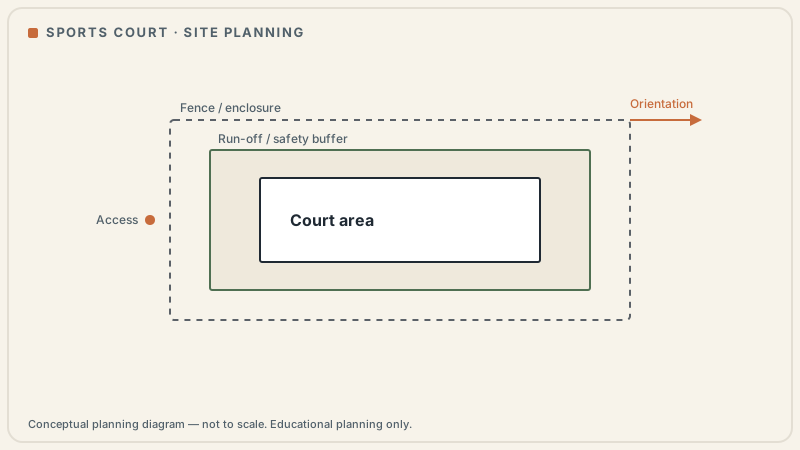
Sports court site-planning concept
Conceptual editorial diagram — not a construction drawing, specification or to-scale plan. Official court dimensions, standards, drainage, structure and lighting requirements vary by sport, site and location and are confirmed with the relevant federation, supplier and qualified professionals.
Start with the sport and the use case
Different sports place different demands on a court, so the first planning step is to be clear about what will be played, how often, and by whom. A surface intended for casual family use is framed differently from one expected to host club sessions, and that distinction shapes almost every later decision.
Official court dimensions and layout standards vary by sport and should be confirmed with the relevant federation, supplier or designer rather than assumed. What you can do at planning stage is record the intended sport, the level of play, and whether multi-sport use is a goal, so professionals can advise on what is realistic for your site.
- Primary sport and any secondary sports you hope to share the court
- Level of play, from recreational to competitive practice
- Expected frequency and number of simultaneous users
- Whether spectators, coaching or lessons are part of the picture
Map the planning sequence
A useful way to plan is to follow the natural order of construction: site suitability first, then base and sub-base, then surface, then enclosure and lighting, then the surroundings. Decisions made early constrain later ones, so revisiting the sequence helps you spot conflicts before they become costly.
Each stage involves specialist work that should be reviewed and performed by qualified professionals. Your job at planning stage is to understand how the stages connect, not to design any of them.
Understand what drives complexity
Some sites are straightforward; others carry conditions that complicate everything downstream. Slope, ground conditions, access for materials and machinery, existing drainage and proximity to neighbours all influence how involved a project becomes.
Recognising these factors early lets you raise them with professionals rather than discovering them mid-project. Feasibility depends on site conditions and professional review, and an honest look at complexity is part of responsible planning.
- Ground slope and how level the area naturally is
- Soil and ground conditions that affect the base
- Access routes for deliveries and equipment
- How surface water currently moves across the site
Set a clear brief before you call anyone
The most productive conversations with designers and suppliers happen when you can describe your goals, constraints and priorities in plain terms. A short written brief covering intended use, the site, your must-haves and your open questions saves everyone time.
A brief also makes it easier to compare proposals on a like-for-like basis, because you are measuring each against the same starting point rather than against whatever each provider chooses to emphasise.
Sports court planning starter checklist
- 1Have you defined the primary sport and intended level of play?
- 2Have you noted whether multi-sport or future expansion matters?
- 3Have you walked the site and recorded slope, access and surroundings?
- 4Have you listed open questions about drainage and surface to raise with professionals?
- 5Have you considered how lighting and noise might affect neighbours?
- 6Have you written a short brief describing goals and constraints?
- 7Have you identified which decisions need specialist review?
- 8Have you set aside contingency thinking for site surprises?
Common mistakes to avoid
- Choosing a surface before confirming the site can support a level, well-drained court
- Assuming official court dimensions without confirming them with a federation, supplier or designer
- Underestimating how access and ground conditions complicate the work
- Treating drainage as an afterthought rather than a core planning topic
- Comparing supplier proposals without a shared brief to measure them against
When to involve a professional
- Site suitability, base, drainage, lighting and enclosure work should be reviewed and performed by qualified professionals appropriate to each trade.
- Official court dimensions and standards vary by sport and should be confirmed with the relevant federation, supplier or designer.
- Requirements for noise, drainage, lighting and neighbourhood impact vary by location and may require local review.
- Use this guide to prepare questions, not as a substitute for professional design, engineering or contractor advice.
Frequently asked questions
Questions readers ask about this topic
Where should sports court planning begin?
Begin by defining the sport, level of play and intended use, then assess whether your site can realistically support a court. Surface and enclosure choices follow from that, and specialist work should be reviewed by qualified professionals.
Do I need to know official court dimensions to start planning?
No. At planning stage you describe intended use and site constraints. Official dimensions and standards vary by sport and should be confirmed with the relevant federation, supplier or designer before any layout is fixed.
What most often complicates a sports court project?
Slope, ground conditions, access for materials and machinery, existing drainage and proximity to neighbours are common complicating factors. Raising them early with professionals helps avoid surprises later.
How detailed should my brief be before contacting suppliers?
A short brief covering intended sport, the site, your priorities and open questions is enough. It lets you compare proposals on a like-for-like basis and helps professionals advise on what is realistic.
Keep reading