
Who this guide is for
- Homeowners considering a private or backyard tennis court who want to understand the full scope before talking to suppliers
- Clubs and facility owners scoping a new court or a court replacement
- Property developers evaluating whether a tennis court fits a wider site
- Anyone preparing a brief so professionals can give comparable, well-informed proposals
Planning diagram
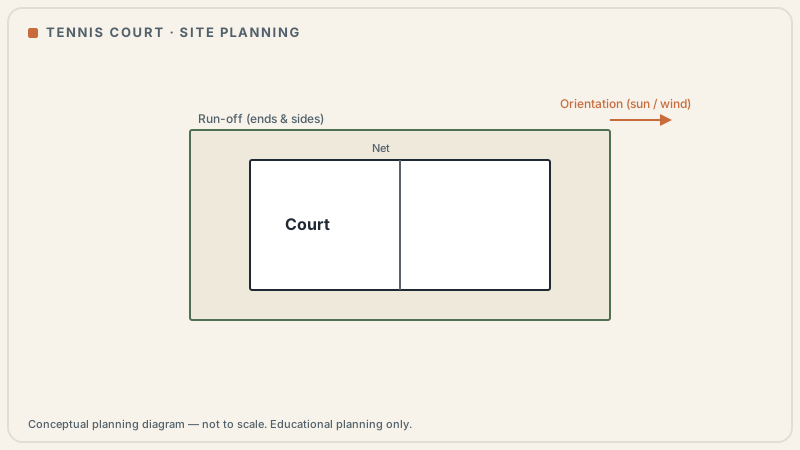
Tennis court site-planning concept
Conceptual editorial diagram — not a construction drawing, specification or to-scale plan. Official court dimensions, standards, drainage, structure and lighting requirements vary by sport, site and location and are confirmed with the relevant federation, supplier and qualified professionals.
Why construction sequence matters
A tennis court is built from the ground up, and each layer depends on the one below it. Site preparation and drainage come before the base; the base sets the platform for the surface; fencing and lighting are usually planned around the finished playing area. If any stage is rushed or skipped, problems tend to surface later as ponding, cracking or uneven play.
Planning the sequence early helps you understand which decisions are hard to reverse. Base and drainage choices, for example, are far cheaper to get right at the planning stage than to correct after surfacing.
Defining the project scope
Scope is the single most useful thing to nail down before approaching suppliers. A clear scope says whether you want a single court or several, indoor or outdoor, which surface category you are leaning toward, and whether lighting, fencing, seating or storage are in or out of the project.
- Single court versus multiple courts and shared infrastructure
- Indoor versus outdoor, which changes structure and lighting entirely
- Surface category you are exploring (to be confirmed with a supplier)
- Whether fencing, lighting, seating and access paths are included
- Future expansion you may want to leave room for
Site, base and drainage as a system
Site assessment, base construction and drainage are best thought of as one connected system rather than three separate line items. Water has to be managed across the whole platform, and the base has to stay stable through wet and dry cycles. A professional site assessment looks at slope, soil, access and how water currently moves across the area.
Because these elements are buried once the court is finished, they are the parts most worth getting independent professional input on before committing.
Surface, fencing and lighting choices
Surface category, fencing and lighting shape how the court plays, looks and lasts. Surface choice interacts with climate, maintenance appetite and intended use. Fencing relates to ball containment and the surrounding space, while lighting determines whether the court is usable after dark and how light may spill toward neighbours.
- Surface category and its maintenance implications
- Fence height, openness and ball-containment approach
- Whether lighting is needed now or wired for later
- How each choice affects neighbours and the wider site
Tennis court construction planning checklist
- 1Have you written a clear scope describing court count, indoor/outdoor and included elements?
- 2Has a qualified professional assessed the site for slope, soil and access?
- 3Do you understand how drainage and the base work together on your site?
- 4Have you explored surface categories with a supplier rather than assuming a 'best' one?
- 5Have you considered fencing and lighting at the planning stage, not as afterthoughts?
- 6Have you confirmed that official dimensions and clearances will be verified with a federation, supplier or designer?
- 7Have you asked how requirements may vary with your location and project type?
- 8Have you allowed for future maintenance access in the layout?
Common mistakes to avoid
- Treating the court as a surface only and underestimating site, base and drainage work
- Assuming official dimensions from memory instead of confirming them with a supplier or federation
- Leaving fencing and lighting out of the early scope and bolting them on later
- Skipping a professional site assessment and discovering drainage problems after surfacing
- Comparing supplier proposals that cover different scopes as if they were equivalent
When to involve a professional
- Site assessment, excavation and base construction should be reviewed and carried out by qualified professionals familiar with local ground conditions
- Drainage design depends on site conditions and should be planned with a suitable specialist
- Any lighting and electrical work should be handled by qualified professionals
- Official court dimensions, clearances and standards should be confirmed with the relevant federation, supplier or designer
- Requirements vary by location and project, and noise, lighting and drainage impacts may require local review
Frequently asked questions
Questions readers ask about this topic
What is the right order to plan a tennis court build?
A useful planning order is site assessment first, then drainage and base, then surface, then fencing and lighting. Each stage informs the next, and early decisions about the base and drainage are the hardest to change later, so they deserve the most professional attention.
Do I need a professional site assessment before building?
A professional site assessment is strongly worth considering because feasibility depends on slope, soil, access and how water moves across the area. These factors shape almost every later decision and are difficult to judge accurately without on-site expertise.
How do I decide between indoor and outdoor?
Indoor and outdoor courts differ in structure, lighting and cost drivers, so the decision is best made early. Indoor adds a building envelope and its own lighting and ventilation considerations, while outdoor depends more on orientation, weather exposure and drainage.
Are official court dimensions something I can assume?
No. Official court dimensions and standards vary by sport and context and should be confirmed with the relevant federation, supplier or designer rather than assumed, so that the finished court matches your intended use.
Keep reading