
Who this guide is for
- Owners who have already sourced two or more court contractors and need to compare them
- Sponsors weighing proposals that are hard to line up side by side
- Project managers organizing notes from several contractor conversations
- Anyone wanting a consistent structure rather than ad hoc comparisons
- Owners preparing for a decision meeting and needing clear, organized notes
Planning diagram
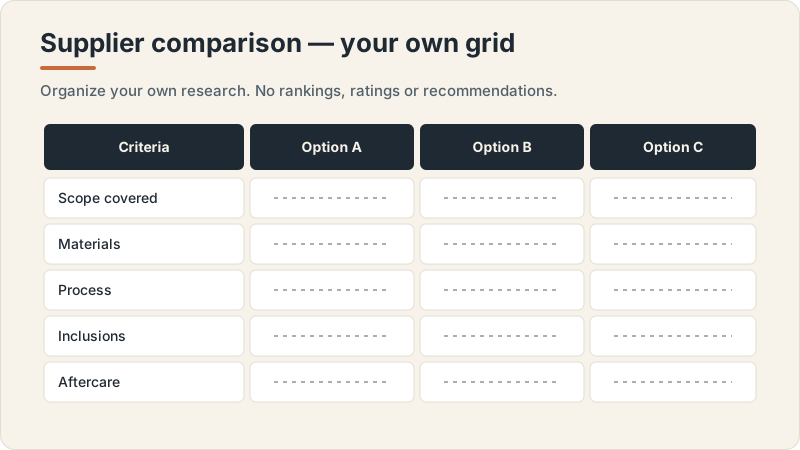
Supplier comparison grid concept
Conceptual editorial diagram — not a construction drawing, specification or to-scale plan. Official court dimensions, standards, drainage, structure and lighting requirements vary by sport, site and location and are confirmed with the relevant federation, supplier and qualified professionals.
What this resource helps you prepare
This resource helps you build a comparison worksheet for contractors you have found and approached yourself. The goal is a simple, consistent structure: the same dimensions, the same questions and the same note format applied to each contractor, so you are comparing equivalent things rather than mismatched impressions.
It is a preparation and organization tool, not an evaluation engine. It will not tell you which contractor is best, assign scores, or rank anyone, because that judgement is yours to make with qualified professionals. What it does is reduce the chance that an important difference slips through because one proposal was more polished than another.
- A consistent set of comparison dimensions to apply to every contractor
- A place to record questions asked and answers given, in the contractor's own words
- A way to note what is included, excluded or left unclear in each proposal
- Space to flag gaps and follow-up questions before any decision
Choosing comparison dimensions
Decide your comparison dimensions before you start filling anything in, and use the same ones for everyone. Useful dimensions usually include relevant experience, how scope is defined, how site works and drainage are approached, surface and enclosure options, lighting, communication style, aftercare, and how changes and decisions are recorded. Keep cost and timeline as qualitative notes about what drives them, not as figures, since these vary widely by site, scope, access and supplier.
Resist the urge to collapse everything into a single number or grade. A column that says variable or unclear is more honest, and more useful, than a score that implies false precision. The aim is to surface where contractors genuinely differ in approach.
- Relevant experience with comparable courts, sports and site conditions
- How each defines scope, with inclusions and exclusions
- Approach to site preparation, base and drainage
- Surface, enclosure and lighting options and trade-offs offered
- Communication, record-keeping and how changes are handled
- Aftercare and maintenance guidance offered
- Drivers behind cost and timeline, kept as notes rather than figures
Organizing your notes consistently
Structure matters as much as content. A simple grid, with contractors as rows or columns and your chosen dimensions as the other axis, lets you scan across and spot where answers diverge. Capture answers in the contractor's own words where you can, and date your notes so you remember when something was said and whether it was later revised.
Keep a separate column or section for open questions and things that were vague. Treat anything you could not pin down as a follow-up rather than an assumption. When a proposal is silent on a point, record it as a gap to confirm, because silence is easy to misread as agreement.
- Use the same template for every contractor, with no blank dimensions
- Record answers verbatim where possible, and date each note
- Mark vague or missing answers clearly as gaps to follow up
- Keep proposals, emails and notes together so you can trace claims
Questions to ask qualified professionals
A comparison worksheet is a prompt for better conversations, not a replacement for professional judgement. Use the questions below to guide discussions with the designers, engineers, drainage and lighting specialists, contractors, local authorities and legal or professional advisors you choose to involve, and to test whether differences between contractors are substantive or merely presentational.
- How should I weigh differences in how each contractor defines scope?
- What groundwork, base and drainage details should I confirm before comparing?
- Which surface, enclosure and lighting trade-offs matter most for my site?
- What official sport or federation requirements should I confirm, and with whom?
- How do I sense-check what drives the cost and timeline differences I am seeing?
- What should I verify independently before relying on any proposal?
- Which gaps in my notes most need closing before a decision?
Turning the comparison into a decision
When the worksheet is complete, look first at where contractors differ on the dimensions that matter most for your project, rather than at any overall impression. Differences in how scope, groundwork and aftercare are handled often reveal more than headline presentation. Use the gaps you flagged as a list of follow-up questions before you commit to anything.
Remember the worksheet is your organized input, not an authority. Verification of experience, claims and credentials remains your responsibility, ideally with professional support. This resource does not rate, rank or recommend, so the conclusion you draw is your own, made with the qualified advisors you engage.
- Compare on the dimensions that matter most before any overall feel
- Close flagged gaps with follow-up questions before committing
- Verify experience and claims independently, with professional help
- Treat the worksheet as input, not as a ranking or recommendation
What this does not replace
This worksheet is an educational preparation resource only. It is not an estimate, not a recommendation, not a ranking or rating, and not contractor matching. It is not legal, engineering, architectural, inspection, design or safety advice, and it does not verify or endorse any contractor.
Requirements and costs vary by location, site, scope, surface, drainage, lighting, access and supplier, and official sport or federation requirements must be confirmed with the relevant bodies. Consult qualified designers, engineers, contractors, lighting and drainage specialists, local authorities and legal or professional advisors where appropriate. Build Design Hub does not provide contractor matching or professional recommendations, and HELPERG LLC is the publisher and operator only.
Contractor comparison worksheet
- 1Have you chosen comparison dimensions and applied the same ones to every contractor?
- 2Have you recorded relevant experience for each, in comparable terms?
- 3Have you captured how each defines scope, with inclusions and exclusions?
- 4Have you noted how each approaches site works, base and drainage?
- 5Have you recorded surface, enclosure and lighting options and trade-offs offered?
- 6Have you noted communication style and how changes and decisions are recorded?
- 7Have you captured aftercare and maintenance guidance for each?
- 8Have you kept cost and timeline as drivers and notes rather than figures?
- 9Have you flagged every vague or missing answer as a follow-up question?
- 10Have you dated your notes and kept proposals and emails together?
- 11Have you planned to verify experience and claims independently?
- 12Have you identified which professionals you will review the comparison with?
Common mistakes to avoid
- Comparing contractors on different dimensions instead of one consistent set
- Collapsing everything into a single score that implies false precision
- Treating silence in a proposal as agreement rather than a gap to confirm
- Letting a polished presentation outweigh substance on scope and groundwork
- Recording impressions instead of what was actually said, undated and unsourced
- Putting invented cost or timeline figures into the worksheet rather than drivers
- Skipping independent verification because a proposal looks professional
- Treating the completed worksheet as a ranking rather than as input to a decision
When to involve a professional
- Involve qualified professionals to interpret differences in scope, groundwork, drainage, lighting and surface across the contractors you compare.
- Confirm official sport or federation requirements with the relevant bodies, since dimensions and standards vary by sport and location.
- Seek professional support to verify experience and claims, as this resource does not rate, rank, recommend or verify contractors.
- Engage legal or professional advisors before relying on any proposal or committing to an agreement.
- Where your notes reveal gaps or concerns, seek a second opinion from a specialist in the relevant trade before deciding.
Frequently asked questions
Questions readers ask about this topic
Does this worksheet rank or score contractors for me?
No. It gives you a consistent structure to organize your own notes and observations. It does not assign scores, rank, rate, endorse or recommend anyone, and it does not match you with contractors. The judgement remains yours, ideally made with qualified professional support.
Should I include prices and timelines in the comparison?
Record what drives cost and timeline rather than inventing figures, because both vary widely by location, site, scope, surface, drainage, access and supplier. Keep them as qualitative notes and confirm actual numbers directly with each contractor and with qualified professionals.
What comparison dimensions should I use?
Choose dimensions that matter for your project, such as relevant experience, how scope is defined, approach to site works and drainage, surface and enclosure options, lighting, communication, and aftercare. The important thing is applying the same dimensions consistently to every contractor.
How do I handle a proposal that is silent on something?
Treat silence as a gap to confirm, not as agreement. Record it clearly as a follow-up question and resolve it before any decision. Verification of what each contractor offers is your responsibility, ideally with professional help.
Is a completed worksheet enough to choose a contractor?
It is organized input, not a verdict. Use it to guide conversations and close gaps, then make your decision with qualified designers, engineers, contractors and legal or professional advisors. Build Design Hub does not provide matching or recommendations.
Keep reading