
Who this guide is for
- Prospective court owners testing an idea before committing
- Operators weighing a new court against other options for a site
- Project sponsors who need a structured go, adjust or pause view
- Owners preparing to brief designers, engineers and contractors
- Anyone assembling background before requesting professional input
Planning diagram
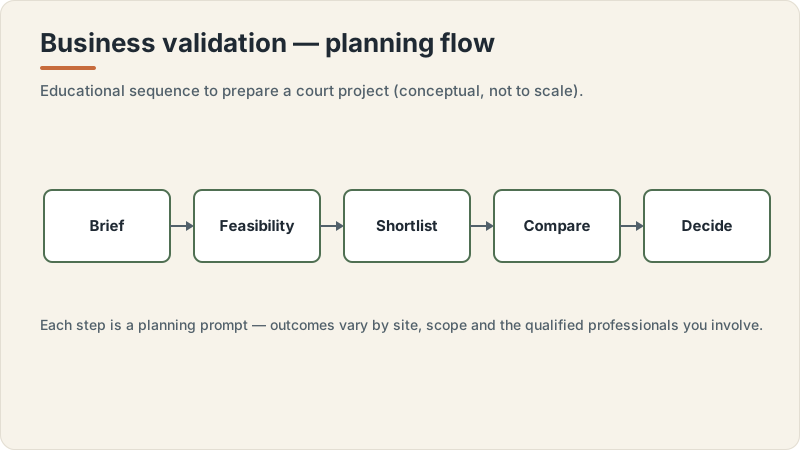
Business validation planning flow
Conceptual editorial diagram — not a construction drawing, specification or to-scale plan. Official court dimensions, standards, drainage, structure and lighting requirements vary by sport, site and location and are confirmed with the relevant federation, supplier and qualified professionals.
What this resource helps you prepare
This resource helps you assemble a feasibility brief: a concise summary of the project idea, the site, the intended use, the people who need to be involved and the questions still to be answered. The aim is a document that captures your thinking clearly enough that qualified professionals can respond to it without guessing what you mean.
It is a thinking and organising tool, not a decision in itself and not a technical or financial study. Where the brief surfaces uncertainty, that is the point: it shows you where professional analysis is needed before you can sensibly proceed.
- A plain summary of the project idea and intended use
- A record of what you currently know about the site
- An honest list of open questions and unknowns
- A note of which professionals each question points toward
- A starting point for briefing designers, engineers and contractors
Capturing site suitability factors
The site shapes almost everything that follows, so a feasibility brief records what you can observe and what you cannot. Space and orientation, slope and ground conditions, access for deliveries and machinery, existing drainage and surrounding features all influence whether a court can be built well and how complex the work becomes. A brief notes these factors plainly and flags where a site raises repeated concerns.
You are not diagnosing the ground or specifying solutions; that is for qualified professionals. The brief simply gathers observations and turns persistent worries into investigation items. Site suitability varies by location and must be confirmed through professional assessment rather than judged from a guide.
- Available space, shape and orientation of the area
- Visible slope, levels and apparent ground conditions
- Access routes for deliveries, plant and machinery
- Existing drainage, services and surrounding features
- Anything that raises repeated doubt and needs investigation
Clarifying scope and intended use
A court that is technically possible may still not match what you want, so the brief states the intended use, the level of play and the supporting spaces alongside the site picture. Aligning the goal with a realistic scope, and noting where they pull apart, is central to a useful feasibility brief.
Keep this at the level of goals and boundaries rather than specifications. The brief records what you are trying to achieve and what the use case implies, leaving technical detail to the professionals who will design and deliver each element. Where goals and constraints conflict, the brief makes the trade-off visible so it can be discussed deliberately.
- The primary intended use and who will use the court
- The level of play or standard you are aiming for
- Supporting spaces the use case implies
- Where the goal and the achievable scope appear to diverge
- Which compromises you would and would not accept
Identifying who needs to be involved
A realistic brief names the kinds of people the project will need rather than leaving it vague. Depending on the project that may include designers, engineers, contractors, drainage and lighting specialists, surveyors, local authorities and legal or professional advisors. Listing them early helps you see the shape of the team and the conversations you will need to have.
Build Design Hub does not match you with professionals, recommend specific firms or rank suppliers; the brief is yours to take to people you select and vet independently. Naming roles against open questions also helps you sequence who to approach first.
- Design and engineering input the project may require
- Specialists for drainage, lighting, surfacing or enclosure
- Surveying or site investigation that may be needed
- Local authorities and any bodies whose requirements apply
- Legal, financial or other professional advisors as appropriate
Questions to ask qualified professionals
The strongest part of a feasibility brief is its list of questions for the people you engage. Rather than seeking answers from a guide, the brief routes each uncertainty to the right professional and records what you still need to confirm. Requirements and costs vary by location, site and scope, so these are prompts for confirmation, not statements of fact.
Use the prompts below as a starting point and adapt them to your project and location. Confirm official sport or federation requirements with the relevant bodies, and treat anything affecting permits, drainage, lighting, noise or accessibility as something to verify with the appropriate authority and qualified professionals.
- What site investigation would you recommend before any decision?
- How do the site conditions affect what is realistic to build here?
- Which approvals, permissions or requirements might apply, and who confirms them?
- What official sport or federation standards should we confirm, and with whom?
- Which drivers will most influence cost and timeline for a project like this?
- What aspects of operation and maintenance should we plan for from the start?
- Which specialists should be involved, and at what stage?
What this does not replace
This resource is an educational planning aid, not an estimate, not a recommendation, not contractor matching and not a substitute for qualified professional review. It does not provide costs, demand figures, returns, timelines or regulatory certainty, and nothing here should be read as legal, engineering, architectural, inspection, design or safety advice.
Requirements and costs vary by location, site, scope, surface, access, drainage, lighting and supplier, and must be confirmed with the relevant authorities, federations and qualified professionals. Build Design Hub does not design, build, engineer, inspect, certify, verify, recommend or rank anyone, and does not connect you with contractors or suppliers. HELPERG LLC is the publisher and operator of this resource only.
Feasibility brief worksheet
- 1Have you written a plain summary of the project idea and intended use?
- 2Have you recorded what you can observe about the site?
- 3Have you noted space, slope, access and drainage observations?
- 4Have you flagged site concerns that need professional investigation?
- 5Have you stated the intended use and the standard you are aiming for?
- 6Have you checked the goal against what the site realistically allows?
- 7Have you listed the supporting spaces the use case implies?
- 8Have you named the kinds of professionals the project will need?
- 9Have you matched each open question to the right professional?
- 10Have you listed approvals and requirements to confirm with authorities?
- 11Have you noted operation and maintenance questions to explore early?
- 12Have you kept all costs, demand and timeline questions for your advisers?
Common mistakes to avoid
- Treating a feasibility brief as a decision rather than a tool for surfacing questions
- Confusing what is technically possible on a site with what matches the goal
- Recording optimistic assumptions about the ground or access instead of flagging them for investigation
- Leaving the brief vague so professionals cannot respond consistently
- Filling the brief with invented costs, demand or timeline figures instead of routing them to advisers
- Omitting neighbour, boundary, noise and visual impact from the picture
- Naming no one, so it is unclear which professionals the project actually needs
- Skipping operation and maintenance because the focus is only on building the court
When to involve a professional
- Involve qualified professionals to assess site, ground, drainage and access conditions, since suitability varies by location and cannot be judged from a guide.
- Engage designers and engineers to test whether the intended scope is realistic on the site before any commitment.
- Confirm official sport or federation dimensions and standards with the relevant bodies, suppliers or designers.
- Check permits, zoning, noise, lighting, drainage and accessibility requirements with the appropriate local authority and qualified professionals, as these vary by project.
- Rely on your own financial, demand and viability advisers for any cost, return or timeline analysis, which this educational resource does not provide.
- Seek legal or professional advice where boundaries, approvals or contracts are involved.
Frequently asked questions
Questions readers ask about this topic
What is a sports court feasibility brief?
It is a short working document that gathers the project idea, the site picture, the intended use, the people who need to be involved and the open questions in one place. It helps you examine whether a court is realistic and gives qualified professionals a clear, consistent picture to respond to. It is a preparation aid, not a financial forecast or a decision.
Does the brief tell me if my project is affordable or profitable?
No. It deliberately avoids prices, demand figures, returns and timelines, because those vary by site, scope, surface, drainage, lighting, access and supplier. Any financial or viability view should come from your own qualified advisers, not from this educational resource.
How do I know if my site is suitable?
The brief helps you record observations such as space, slope, access and drainage, and to flag anything that raises repeated concern. Whether a site is suitable must be confirmed through professional assessment, since conditions vary by location and cannot be judged from a guide.
Will Build Design Hub help me find contractors for my project?
No. Build Design Hub does not provide contractor matching, recommendations or rankings, and does not connect you with suppliers. The brief is yours to take to professionals you select and vet independently. HELPERG LLC is the publisher and operator of this resource only.
What should I do once the brief is drafted?
Use it to identify which questions you cannot answer yourself and route each to the appropriate professional or authority. Confirm official sport requirements with the relevant bodies, and consult qualified designers, engineers, contractors and advisors before making decisions.
Keep reading