
Who this guide is for
- Owners taking a long-term view of a court
- Facility managers planning across years, not just seasons
- Club committees coordinating maintenance and renewal
- Anyone connecting build decisions to future upkeep
Planning diagram
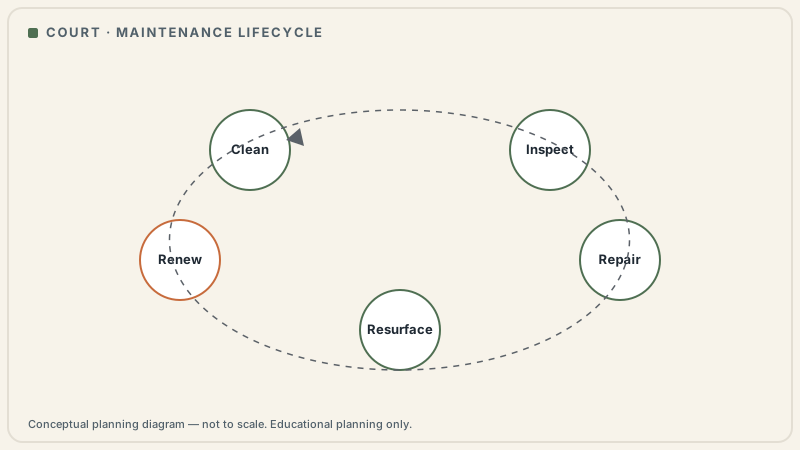
Court maintenance lifecycle concept
Conceptual editorial diagram — not a construction drawing, specification or to-scale plan. Official court dimensions, standards, drainage, structure and lighting requirements vary by sport, site and location and are confirmed with the relevant federation, supplier and qualified professionals.
Thinking in phases, not events
A court moves through phases: construction, settling-in, steady use with routine care, periodic renewal, and eventually major renovation or replacement. Seeing these as connected phases rather than isolated events helps you anticipate needs and plan ahead rather than react.
The pace through these phases varies by court and care, so observe and adjust rather than assuming fixed durations.
- View build, care, renewal and renovation as connected
- Anticipate that different elements age differently
- Plan ahead rather than reacting to each problem
- Adjust the plan as the court ages
How build choices shape later upkeep
Decisions made at construction echo through a court's life. Surface, drainage, lighting and enclosure choices influence how much upkeep is needed and when renewal arrives. Recognizing this at the planning stage helps you make choices with their whole-life implications in mind.
Suppliers and professionals can explain how specific choices affect future maintenance.
- Recognize that build choices affect future upkeep
- Consider whole-life implications, not just upfront fit
- Discuss maintenance implications with suppliers
- Record assumptions to revisit later
Maintenance and renewal over time
Routine maintenance, periodic renewal such as resurfacing, and component replacement all sit within the lifecycle. Coordinating them, rather than treating each in isolation, smooths effort and keeps the court performing. A simple long-term record supports these decisions.
Appropriate renewal points vary and should be confirmed with specialists rather than assumed.
Approaching renovation and replacement
Toward the end of a phase, the renovation-or-replacement question returns. Approaching it with a lifecycle record and professional assessment leads to clearer decisions. Lifecycle planning makes these moments anticipated rather than sudden.
Major works and assessments should be reviewed and performed by qualified professionals, and official standards confirmed with the relevant federation, supplier or designer.
Lifecycle planning checklist
- 1Have you mapped the court's phases from build to renewal?
- 2Have you noted that elements age at different rates?
- 3Have you considered how build choices affect future upkeep?
- 4Have you recorded assumptions to revisit over time?
- 5Have you coordinated maintenance and renewal rather than isolating them?
- 6Have you kept a long-term record to support decisions?
- 7Have you anticipated the renovation-or-replacement question?
- 8Have you planned to confirm renewal points with specialists?
Common mistakes to avoid
- Reacting to each problem instead of planning ahead
- Ignoring how build choices shape future upkeep
- Assuming fixed lifespans for surfaces or components
- Treating maintenance and renewal as unrelated
- Letting the renovation question arrive as a surprise
When to involve a professional
- Confirm appropriate renewal points and lifespans with suppliers and qualified professionals, as they vary by surface, climate and use.
- Route major works and condition assessment to qualified professionals.
- Confirm local requirements affecting works with appropriate advisers, since they vary by location.
- Confirm official court dimensions and standards with the relevant federation, supplier or designer for renewed surfaces.
Frequently asked questions
Questions readers ask about this topic
How long does a court last?
We do not give lifespans. Longevity varies widely by surface, climate, use and care. Confirm expectations for specific elements with suppliers and qualified professionals for your situation.
Why think about lifecycle at the build stage?
Build choices shape how much upkeep is needed and when renewal arrives. Considering whole-life implications early helps you make choices you will be comfortable maintaining.
What is the benefit of a lifecycle record?
It supports decisions about maintenance, renewal and eventual renovation by revealing how the court has aged. It turns scattered events into a coherent picture over time.
When does renovation enter the lifecycle?
Toward the end of a phase, when condition and use suggest it. Approaching it with a lifecycle record and professional assessment makes the decision anticipated rather than sudden.
Keep reading