
Who this guide is for
- Owners building a maintenance plan for a new or existing court
- Facility managers documenting how care will be organized
- Club committees assigning upkeep responsibilities
- Operators preparing to brief maintenance specialists with a clear plan
- Anyone wanting a structure to record inspections and care over time
Planning diagram
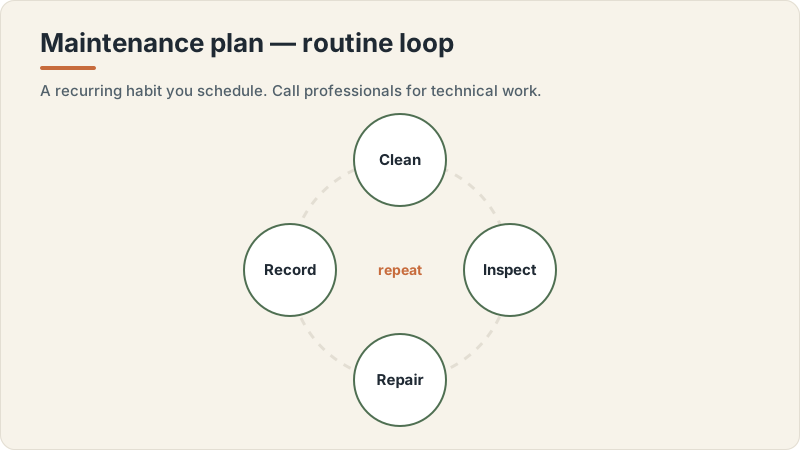
Maintenance routine loop concept
Conceptual editorial diagram — not a construction drawing, specification or to-scale plan. Official court dimensions, standards, drainage, structure and lighting requirements vary by sport, site and location and are confirmed with the relevant federation, supplier and qualified professionals.
What this resource helps you prepare
This resource helps you assemble the skeleton of your own maintenance plan: the elements to cover, the kinds of routine tasks to schedule, the inspection prompts to use, the records to keep and the point at which a task should move to a qualified specialist. The goal is a plan you can hand to whoever maintains the court and update as conditions change.
It does not prescribe how often to do anything, which products to use, or how to perform any task. Those decisions depend on your surface, climate, usage and supplier guidance, and should be confirmed with the relevant professionals before your plan is finalized.
- A structure for listing every court element that needs care
- Prompts for the routine tasks you may want to schedule
- Inspection cues to capture in a repeatable form
- A simple approach to record-keeping and responsibility
- A clear marker for where specialist work begins
Structuring the plan around court elements
A durable plan starts by naming each part of the court separately, because each one ages and needs attention differently. The surface, drainage paths, lighting, fencing, enclosures and surrounding landscaping all belong in the plan, even if some need little routine attention. Giving each element its own line keeps anything from being silently overlooked.
Against each element, a template invites you to note its general care theme, who is responsible, and whether a task is routine or specialist. Avoid committing to fixed frequencies in the template itself; instead leave space to record the timing your supplier or specialist confirms for your situation.
- List surface, drainage, lighting, fencing, enclosure and surroundings
- Note the general care theme for each, not fixed intervals
- Record who is responsible for each element
- Flag each task as routine or specialist
Building routine task and inspection prompts
The working heart of the plan is a set of repeatable prompts rather than a calendar of guaranteed dates. For routine tasks, capture what should happen and who does it, leaving timing to be confirmed for your surface and climate. For inspection, a consistent set of cues, such as surface wear, slow-clearing drainage, fading markings and signs of movement or impact, lets different people record the same things over time.
Designing these prompts once means anyone can follow the plan and produce comparable notes. Coordinating any maintenance windows with play, so care and bookings do not clash, is worth building into the structure from the start.
- Write routine task prompts that anyone can follow
- Use a fixed set of inspection cues for consistency
- Leave timing open to confirm with suppliers and specialists
- Plan maintenance windows around court use
Record-keeping that reveals trends
A plan is far more useful when it captures what was actually done and observed. A simple log of inspections and completed tasks, with dates and notes, lets you see trends, such as a surface area wearing faster or drainage clearing more slowly, before they become urgent. Records also help any specialist you engage understand the court's history.
The template can be as simple as a shared sheet, as long as it is used consistently. The discipline of recording matters more than the format, and it supports better decisions about repair, resurfacing or renovation later.
- Log inspections and completed tasks with dates
- Capture observations so trends become visible
- Keep records in one accessible, consistent place
- Use the history to inform future decisions
Questions to ask qualified professionals
Once your plan structure exists, use it as the basis for conversations with suppliers, contractors and specialists. The questions below help you confirm the specifics your template deliberately leaves open, so the plan reflects your actual surface, site and conditions rather than assumptions.
Bringing a drafted plan to these conversations tends to produce clearer answers, because professionals can react to a concrete structure. Requirements and appropriate care vary, so confirm rather than assume.
- What routine care does our specific surface need, and how often, given our climate and usage?
- Which cleaning or care methods are suitable, and which could damage our surface?
- Which tasks should always be handled by a qualified specialist rather than in-house?
- What should our inspection cues focus on for this court type?
- Which signs indicate that surface, drainage or lighting work is becoming necessary?
- Are there local requirements affecting any works, water use or disposal we should confirm?
- When markings or surfaces are renewed, whom do we confirm official court standards with?
What this does not replace
This template framework is educational preparation only. It is not a maintenance estimate, not a recommendation, not contractor matching, and not legal, engineering, design or safety advice. It does not specify how often to do anything, which products to use, or how any task should be performed.
Requirements, appropriate care and costs vary by court, surface, climate, usage, supplier and location, and must be confirmed with suppliers, qualified designers, engineers, contractors, drainage and lighting specialists, local authorities and relevant federations as appropriate. Build Design Hub does not provide contractor matching or professional recommendations, and HELPERG LLC is the publisher and operator only.
Maintenance plan template worksheet
- 1Have you listed every court element on its own line in the plan?
- 2Have you noted a general care theme for each element rather than fixed intervals?
- 3Have you assigned a responsible person to each task?
- 4Have you marked each task as routine or specialist?
- 5Have you written inspection cues anyone can follow consistently?
- 6Have you left space to record timing confirmed by suppliers or specialists?
- 7Have you set up a log for inspections and completed tasks?
- 8Have you planned maintenance windows so they do not clash with play?
- 9Have you defined where in-house care ends and specialist work begins?
- 10Have you noted which official standards and local requirements to confirm, and with whom?
Common mistakes to avoid
- Building a calendar of fixed dates instead of confirming timing for your surface and climate
- Writing the plan around the surface alone and omitting drainage, lighting or fencing
- Leaving inspection vague so different people record different things
- Keeping no log, so trends and history are lost
- Not naming who is responsible for each task
- Putting specialist work into the routine in-house section
- Treating the template as finished without confirming specifics with suppliers and professionals
When to involve a professional
- Confirm appropriate routine care and timing with the surface supplier or a qualified specialist, since these vary by surface, climate and usage.
- Route surface refinishing, drainage, lighting and structural work to qualified professionals rather than scheduling it as in-house care.
- Ask specialists to help shape inspection cues suited to your specific court type.
- Confirm local requirements affecting works, water use or disposal with appropriate advisers, as they vary by location.
- Confirm official court dimensions and standards with the relevant federation, supplier or designer when surfaces or markings are renewed.
Frequently asked questions
Questions readers ask about this topic
Does this template tell me how often to maintain my court?
No. It deliberately leaves timing open because appropriate intervals vary by surface, climate and usage. Confirm suitable timing with your supplier or a qualified specialist and record it in your own plan.
What should go into the plan for each court element?
Generally a general care theme, who is responsible, whether the task is routine or specialist, and space to record confirmed timing. Keep figures and fixed dates out until professionals confirm them for your situation.
What inspection cues should the plan use?
Common cues include surface wear, slow-clearing drainage, fading markings and signs of movement or impact. The right focus varies by court type, so ask a specialist to help tailor your cues.
Why bother keeping maintenance records?
A consistent log reveals trends before they become urgent and gives any specialist you engage the court's history. It also supports better decisions about repair, resurfacing or renovation over time.
Can this template replace professional advice?
No. It is an educational structure for organizing your own plan. The specifics must be confirmed with suppliers and qualified professionals, and Build Design Hub does not provide contractor matching or recommendations.
Keep reading