
Who this guide is for
- Owners who want a structured view of what could go wrong before committing
- Project leads setting up a register for a new or ongoing court project
- Club committees or boards wanting visibility of how risks are being managed
- Anyone preparing risk questions to discuss with designers, engineers or contractors
- Readers who want a repeatable method rather than a one-off risk list
Planning diagram
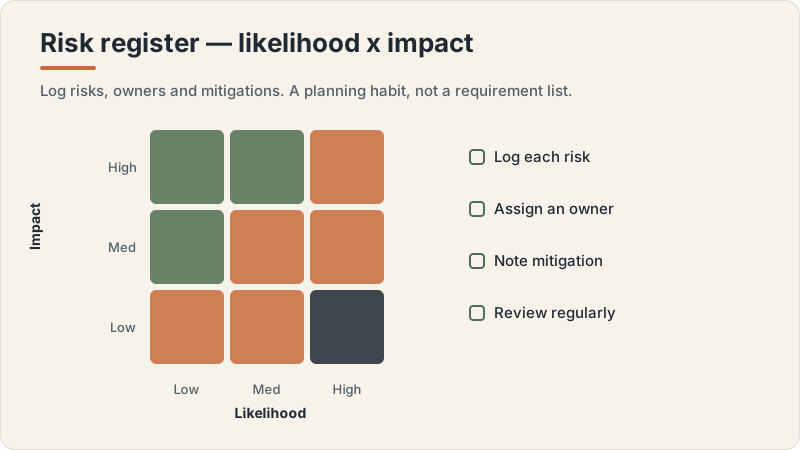
Risk register matrix concept
Conceptual editorial diagram — not a construction drawing, specification or to-scale plan. Official court dimensions, standards, drainage, structure and lighting requirements vary by sport, site and location and are confirmed with the relevant federation, supplier and qualified professionals.
What this resource helps you prepare
This page helps you set up and maintain a risk register for a court project: a clear, organised way to capture risks, rate them in relative terms, assign an owner, and record your intended response. The goal is preparation and visibility, not prediction. Nothing here forecasts costs, durations or outcomes, and no figure or interval is implied.
You will find a way to think about risk categories, the fields a register typically holds, how to keep it alive through a project, and how to use it when talking to specialists. Everything stays at the planning and question level so you arrive at professional conversations organised and informed.
Use it to draft a first register, to sense-check one you already keep, or to prepare for a review meeting. The specific risks, ratings and responses that suit your project depend on your site, scope and circumstances and should be confirmed with qualified professionals.
- Set up a register with clear, consistent fields
- Group risks into categories so none are overlooked
- Rate likelihood and impact in relative, non-numeric terms
- Assign an owner and an intended response to each risk
- Prepare risk topics to raise with qualified professionals
Risk categories to consider
A register is easier to build and review when risks are grouped into themes. Common categories for a court project include site and ground conditions, drainage and water, supply and materials, trade coordination and sequencing, local requirements and approvals, neighbourhood and environmental impact, budget and commercial terms, and operations or handover once the court is in use. Categories act as prompts so a whole area is not missed.
No list is exhaustive, and the categories that matter most differ by project. Site and drainage conditions, for example, vary from one location to another and need specialist judgment. Treat the headings below as starting points and add categories that fit your situation rather than forcing your project into a fixed template.
- Site and ground conditions, including slope, access and unknowns below the surface
- Drainage and water movement across and around the area
- Supply and materials availability, lead items and substitutions
- Trade coordination, sequencing and dependencies between works
- Local requirements, approvals and official sport or federation standards to confirm
- Noise, lighting and neighbourhood or environmental impact
- Budget, scope and commercial or contract terms
- Operations, maintenance and handover once the court is in use
Fields to log for each risk
A useful register captures more than a description. For each risk, it helps to note a short description, the category, a relative sense of likelihood and impact, an owner who watches it, your intended response, and a status you update over time. The likelihood and impact ratings are comparative labels such as low, medium or high used to sort attention, not probabilities, scores or percentages, and they imply no numbers.
The owner field matters more than people expect. A risk without a named owner tends to drift, because everyone assumes someone else is watching it. Recording an intended response, whether to monitor, mitigate, transfer through a contract or escalate for specialist input, turns the register from a list of worries into a plan of action.
Keep entries short and plain so the register stays readable. The point is clarity, not completeness for its own sake. Any cost or timing implications of a risk should be discussed with the relevant professionals and confirmed through quotes, never estimated here.
- Description: a plain sentence on what could go wrong
- Category: the theme it belongs to
- Likelihood and impact: relative labels, not numbers or scores
- Owner: the named person watching the risk
- Response: monitor, mitigate, transfer or escalate
- Status and notes: updated as the project moves on
Keeping the register alive
A register only works if it is revisited. Risks change as a project moves from concept to site, and new ones appear while others fade. Setting a habit of reviewing the register at key moments, such as before commissioning assessments, before committing to a supplier, or before work starts on site, keeps it relevant rather than letting it become a forgotten file.
Reviewing as a group, including relevant specialists where appropriate, surfaces risks that one person alone might miss. Closing out risks that no longer apply is as valuable as adding new ones, because it keeps attention on what currently matters. A short, current register beats a long, stale one every time.
- Review at decision points, not just at the start
- Add new risks and close ones that no longer apply
- Update owners and responses as roles and scope change
- Invite relevant specialists to review where appropriate
- Keep it short and current rather than long and stale
Questions to ask qualified professionals
A register is most powerful as a conversation tool. Bringing it to designers, engineers, contractors and specialists lets them challenge your assumptions, point out risks you have not named, and explain which items genuinely need their input. The questions below are framed to draw out their judgment, not to extract numbers, and the answers should inform how you rate and respond to each risk.
- Which risks on our register do you think we have under- or over-weighted, and why?
- Are there site, ground or drainage risks we have not captured for a location like this?
- Which items here truly need specialist assessment rather than monitoring?
- What would you treat as the highest-attention risks for a project of this kind?
- Which local requirements or official standards should we confirm, and with whom?
- How would you suggest we sequence works to reduce coordination risk?
- What risks tend to appear late in projects like this that we should pre-empt now?
What this does not replace
This resource is educational preparation material only. It is not an estimate, not a recommendation, not contractor matching, and not a substitute for legal, engineering, design, drainage, lighting or safety advice. It does not assess your site or tell you which risks apply, how likely they are, or how to resolve them.
Requirements and costs vary by location, site, scope, supplier, access, drainage, lighting and surface, and any official sport or federation requirements must be confirmed with the relevant bodies. Specialist site, ground, drainage, lighting, structural and contractual matters should be reviewed by qualified professionals, and decisions about your project remain yours to make with their input.
Build Design Hub does not provide contractor matching or professional recommendations and does not build, design, engineer, inspect, certify or endorse any party. HELPERG LLC is the publisher and operator of this resource only.
Risk register starter worksheet
- 1Have you chosen the risk categories that fit your project?
- 2Have you drafted a plain description for each risk you can foresee?
- 3Have you given each risk a relative likelihood and impact label?
- 4Have you named an owner for every risk on the list?
- 5Have you recorded an intended response for each significant risk?
- 6Have you flagged which risks need specialist assessment to confirm?
- 7Have you marked local requirements and official standards as items to verify?
- 8Have you noted assumptions that remain unconfirmed?
- 9Have you set review points where you will revisit the register?
- 10Have you decided how you will close out risks that no longer apply?
- 11Have you prepared risk questions to raise with qualified professionals?
Common mistakes to avoid
- Building a register once and never revisiting it as the project changes
- Logging risks without naming an owner, so each one quietly drifts
- Listing risks but not recording any intended response to them
- Trying to score risks with invented numbers instead of relative labels
- Assuming the ground and drainage hold no surprises worth logging
- Treating local requirements and official standards as settled rather than as risks to confirm
- Making the register so long and detailed that nobody reads or updates it
- Keeping the register private rather than using it to drive professional conversations
When to involve a professional
- Involve qualified site, ground and drainage specialists to assess risks that depend on conditions that vary by location and cannot be judged from a desk.
- Ask designers and engineers to review your register and identify risks you have not named and items that genuinely need their assessment.
- Confirm local requirements, approvals and official sport or federation standards with the relevant authorities and bodies, since these vary and should not be assumed.
- Seek independent advice on contracts, scope and commercial terms to manage the risks a register cannot resolve on its own.
- Engage lighting, drainage, surfacing and structural specialists for any risk where the response involves specialist work, as this page is educational only.
Frequently asked questions
Questions readers ask about this topic
How do I score likelihood and impact without using numbers?
Use relative labels such as low, medium and high to sort where attention should go. These are comparative judgments, not probabilities or scores, and they carry no figures. They simply help you and your advisers agree on which risks deserve the most focus.
Which risks should go on the register?
It varies by project. Common themes include site and ground conditions, drainage, supply and coordination, local requirements, impact, budget and operations. Your own circumstances and professional review reveal which risks actually matter for your case, so use the categories here as prompts rather than a fixed list.
Do I need a formal risk register, or is a simple one enough?
For many projects a short, clear register is plenty. The value is in naming risks, assigning owners, recording an intended response and revisiting it, not in formality. A current one-page register is more useful than a long document nobody updates.
Can this tell me how likely a risk is or what it will cost?
No. This is educational planning material and does not predict likelihoods, costs or timelines. Any cost or timing implications vary and should be discussed with qualified professionals and confirmed through quotes, not estimated from a guide.
Does Build Design Hub review my register or match me with contractors?
No. Build Design Hub does not provide contractor matching, professional recommendations, or review of your project. It is an educational resource, and HELPERG LLC is its publisher and operator only. Specialist review should come from qualified professionals you engage.
Keep reading