
Who this guide is for
- Grassroots club committees and volunteers scoping new, replacement or upgraded changing and welfare facilities
- Academy and youth-development staff preparing a brief that reflects safeguarding and age-group needs
- School and college estates teams planning shared football and PE changing provision
- Municipalities and parks departments planning public or multi-club changing pavilions at training grounds
- Developers and owners building a brief before engaging architects, designers or contractors
- Facility managers thinking through cleaning, supervision, turnover and security before committing to a layout
Planning diagram
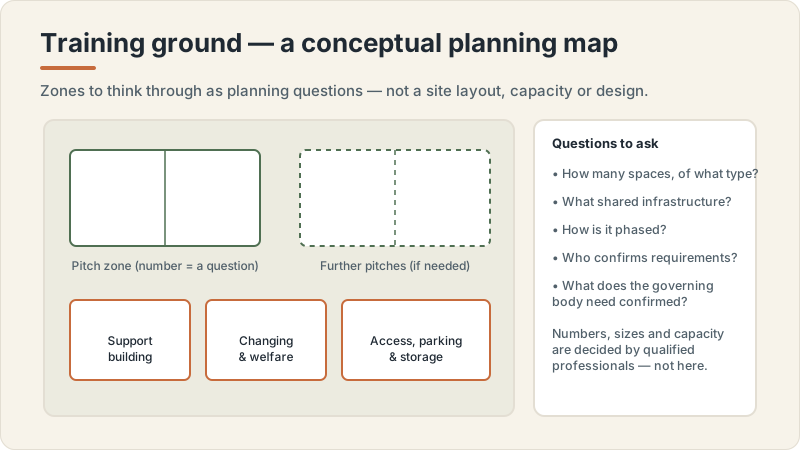
Training ground planning map concept
Conceptual editorial diagram — not a construction drawing, specification, to-scale plan or proof of a real project. It is not engineering, structural, fire/life-safety, crowd-safety or accessibility-compliance guidance. Capacities, dimensions, standards, requirements and costs vary by facility type, audience, site, use case and governing body, and are confirmed with qualified professionals, relevant authorities and governing bodies. Build Design Hub does not design, build, inspect, certify, recommend or match anyone.
What this guide helps you prepare
This guide helps you write a clear brief for a football club's changing rooms and welfare facilities before you engage designers, suppliers or contractors. It concentrates on user needs — who changes, showers, waits, is supervised or is treated for minor knocks, and when — alongside the league, county, federation or governing-body expectations you will need to confirm, and the questions worth taking to qualified professionals. It deliberately stays at planning level: it does not specify plumbing, mechanical, electrical or accessibility solutions, and it does not tell you what your facility must contain.
A strong changing and welfare brief separates what you already know from what still needs verifying. By recording your intended users, matchday and training patterns, separation needs and operational realities, you give professionals a clear picture of intent and give yourself a running list of open items. Fixture counts, room sizes, fittings, accessibility provisions, costs and compliance points are left here as questions, because they vary by location, level of play, governing body and site, and should be confirmed with qualified professionals and the relevant authorities rather than assumed from this guide.
- A plain-language statement of who uses the changing and welfare facilities, and how
- A record of peak demand: which matchdays, training nights, tournaments and events drive the busiest periods
- Notes on separation needs for home and away teams, age groups, genders, officials and visitors
- A list of welfare considerations such as safeguarding, supervision, first-aid space and accessibility to raise
- Rough scope boundaries: what you imagine is in, out or undecided for the project
- The league, county, federation and authority requirements you still need to confirm
Mapping player, official and family needs at a football club
Begin with the people who move through a football site on a busy day. List every group — home and away squads, individual players arriving and leaving, match officials and referees, coaches and team staff, ground and kit staff, accessible users, and the parents, carers and spectators a club inevitably brings. For each group, note when they arrive, how long they stay, whether their use overlaps, and what they reasonably expect from the space. The mix at a single grassroots club, a multi-pitch academy, a school timetable and a community training ground hosting several clubs is very different, so describe your real picture rather than a generic one.
Football welfare reaches well beyond changing. Think about safeguarding for children and young players, the dignity and privacy people expect when changing, separate provision and supervision for youth and mixed-age sessions, somewhere appropriate for minor first-aid or a quiet moment, secure storage for kit and valuables, and how the site serves disabled players, officials and family members. How many changing positions, showers, toilets, treatment or accessible spaces a club needs is not something to assume — it depends on your audience, level of play, governing body and local rules, and must be confirmed with qualified professionals. At brief stage your job is to describe the demand and the welfare context clearly, not to size the rooms.
- List every user group — home, away, officials, coaches, ground staff, families — and where their use overlaps in time
- Describe peak demand: weekend fixtures, midweek training, festivals, trials and tournament days
- Note separation needs for home and away teams, youth age groups, genders, officials and community use
- Record safeguarding and supervision considerations for children and young players to raise with professionals
- Capture first-aid, treatment-space and quiet-space expectations as questions to confirm, not specify
- Flag kit, boot and valuables storage and security expectations that your players and staff describe
League, federation and authority requirements to confirm
Football is organised through leagues, county or regional associations, national federations and competition organisers, and their expectations for player, official and welfare facilities can differ by level of play and change as a club moves up divisions, enters new competitions or hosts sanctioned fixtures. Rather than assuming what applies, build a list of the bodies relevant to your club, level and competitions, and the questions you will put to each. This is one of the most valuable things a brief can do, because facility expectations, separate-official provision, safeguarding and accessibility standards vary by level, location and body and cannot be read off a single source.
Alongside football-specific bodies, there are local and national authorities whose rules may shape welfare provision — accessibility, building, public-health and safeguarding frameworks among them. Treat each as something to verify with the relevant authority and a qualified professional, not as a fact to design around yourself. Record which body owns which question, who confirms it and at what project stage, so nothing critical surfaces late in the process. The brief captures the questions; the governing bodies, authorities and professionals supply the answers.
- Which league, county or regional association and federation set expectations for your level and competitions
- What separate officials' or referees' provision your sanctioning body may expect, to confirm with them
- Whether promotion, new competitions or hosting sanctioned fixtures changes what applies, and who confirms it
- Which local and national accessibility, building and public-health rules to verify with the relevant authority
- How safeguarding standards for children and young players apply, confirmed with the appropriate body
- Who owns each requirement, who signs it off, and at what stage it must be confirmed in writing
Planning questions before speaking with professionals
Before you approach designers or contractors, work through the questions only you and your stakeholders can answer. These define the demand, the constraints and the priorities that a professional then designs around. The clearer you are on your user mix, matchday and training overlaps, separation needs and operational realities, the more useful and comparable the guidance you receive will be. Keep every figure, fixture count and requirement as an open question rather than a decision you have already made.
Spend time on the operational picture too, because football changing and welfare facilities are used hard and need cleaning, fast turnover, supervision and security between sessions and fixtures. Thinking through who manages the rooms, how quickly they must reset between back-to-back games or training groups, and how they stay safe and clean for youth sessions often reveals needs that reshape the brief. Record what you genuinely know, mark the rest as uncertain, and bring those uncertainties to the people qualified to resolve them.
- Who are all our user groups across matchdays and training, and where do their busiest periods overlap?
- What separation do we need between home and away teams, youth age groups, genders, officials and families?
- What safeguarding and supervision expectations apply to our youth players, and who confirms them?
- How are the rooms cleaned, turned around and supervised between back-to-back fixtures and training groups?
- What accessibility, first-aid and family-use needs have our players, officials and visitors actually expressed?
- Which decisions are settled, and which remain open questions for qualified professionals?
Questions for qualified professionals
Your brief is also where you collect the questions to take to the architects, designers, accessibility advisors, safeguarding leads and other professionals you engage. Capturing them now means you arrive with a clear agenda rather than improvising in the room. Keep your questions open and let the professionals supply the figures, fixture counts, accessibility solutions and compliance routes; your role is to ask well, share your player, official and welfare context, and listen carefully. Tailor these prompts to your own level of football, competitions and site.
Let cost, capacity, fixture and requirement questions sit here as questions, never as numbers to assume, because the answers depend on your specific audience, governing body, site and local rules. The same applies to safeguarding and accessibility provision, which should be confirmed with qualified advisors and the relevant authorities rather than estimated from a template or borrowed from another club.
- Given our player, official and family mix and peak demand, what should we ask you to confirm about capacity?
- Which league, federation and accessibility requirements apply to a club like ours, and how are they verified?
- What safeguarding, supervision and youth-session provisions should we be planning to accommodate?
- How do you suggest we handle separation for home, away, officials and community use within the layout?
- What operational factors — cleaning, turnover, durability, security — should shape our brief at a football site?
- What information should our brief contain for you to give reliable, comparable guidance?
What this does not replace
This is an educational project-preparation resource only. It is not a construction manual and not engineering, architectural, turf-installation, drainage-engineering, sports-surface-specification, structural, fire or life-safety, crowd-safety, accessibility-compliance, permit, zoning, legal, tax or procurement advice. It does not design, specify, install, certify, inspect or approve anything, and it is not an estimate, quote, price, capacity recommendation or performance or lifespan guarantee. Requirements, standards, dimensions, surface systems and costs vary by location, use case, governing body, owner, site, climate, maintenance plan, authority and professional team, and are confirmed with qualified professionals, relevant authorities and the sport governing body.
Build Design Hub does not design, build, install, engineer, inspect, certify, recommend, rank, verify, introduce, broker or match suppliers or contractors, and HELPERG LLC is publisher/operator only. Use this resource to prepare your own thinking, then have qualified professionals you engage directly review your project. Decisions about engineering, surface specification, drainage, safety, compliance, procurement and suitability must rest on those professionals, the relevant authorities and the governing body for your sport and location.
- Not a construction manual and not engineering, turf-installation or drainage-engineering instructions
- Not sports-surface specification, structural, fire/life-safety, crowd-safety or accessibility-compliance advice
- Not permit, zoning, legal, tax or procurement advice
- Not a supplier or contractor recommendation, ranking, directory or matching service
- Not an estimate, price, capacity recommendation or performance/lifespan guarantee — requirements and costs vary
- Qualified professional review is required before any project decision
Football club changing and welfare brief worksheet
- 1List every user group: home and away teams, individual players, officials, coaches, ground staff, accessible users and families
- 2Record peak demand by matchday, training night, tournament and festival, and note where groups overlap
- 3Describe separation needs for home and away teams, youth age groups, genders, officials and community use
- 4Capture safeguarding and supervision considerations for children and young players
- 5Note first-aid, treatment and quiet-space expectations as questions to confirm, not to specify
- 6Record kit, boot and valuables storage and security expectations from players and staff
- 7Note accessibility and family-use needs your players, officials and visitors have actually expressed
- 8Identify the league, county or regional association and federation relevant to your level and competitions
- 9List the requirements to confirm with those bodies, including any separate officials' provision
- 10List local and national accessibility, building and public-health rules to verify with the authority
- 11Describe how rooms will be cleaned, turned around and supervised between fixtures and training groups
- 12Name the decision-owners for budget, design sign-off, safeguarding and welfare approval
- 13Sketch rough scope boundaries: what is in, what is out, what is undecided
- 14Mark every fixture count, room size, cost and requirement as something to confirm, then review for anything stated as fact
Common mistakes to avoid
- Designing around a generic squad count instead of your real mix of teams, age groups, officials and families
- Overlooking away teams, match officials or referees when planning separation and privacy
- Assuming fixture numbers or room sizes rather than confirming them with leagues, federations and qualified professionals
- Treating safeguarding and youth-session provision as an afterthought instead of a question to verify early
- Ignoring matchday and training overlaps, so the facility works midweek but not on a busy weekend or festival day
- Forgetting cleaning, fast turnover, supervision and security between back-to-back games and training groups
- Assuming current league requirements stay fixed if the club is promoted, enters new competitions or hosts sanctioned fixtures
- Mistaking this brief for a specification or compliance confirmation rather than a starting point for expert input
When to involve a professional
- When you need to confirm league, county, federation or competition requirements that vary by level and cannot be assumed
- When accessibility, building or public-health rules may apply and must be verified with the relevant authority and a qualified advisor
- When safeguarding and supervision needs for children and young players require specialist input
- When capacity, fixture counts or room sizing move beyond intentions and need professional determination
- When separation, layout or welfare provision for home, away, officials and community use needs design expertise
- When any plumbing, mechanical, electrical, accessibility-compliance or operational question moves beyond planning into specialist territory
Frequently asked questions
Questions readers ask about this topic
What does this football changing room planning guide actually cover?
It helps you prepare a brief: capturing who uses your club's changing and welfare facilities, peak demand across matchdays and training, separation and safeguarding needs, the league and authority requirements to confirm, and the questions for qualified professionals. It is educational preparation, not a design, specification or compliance confirmation.
Will this guide tell me how many showers, toilets or changing spaces my club needs?
No. Fixture numbers, room sizes and provisions vary by audience, level of play, governing body, location and site, and must be confirmed with qualified professionals and the relevant authorities. The guide helps you describe your demand and welfare context clearly so professionals can determine what is appropriate.
How do I find out what my league or federation requires?
Identify the league, county or regional association, federation and competition organisers relevant to your club and level, and put your questions to them directly, since expectations vary by level and location and can change with promotion or new competitions. Treat anything they indicate as something to confirm in writing, alongside local authority rules.
Does Build Design Hub recommend suppliers or contractors, or provide costs and requirements?
No. Build Design Hub publishes educational planning resources only. It does not design, build, inspect, certify, recommend, rank, verify, broker or match suppliers or contractors, and it provides no costs, capacities, requirements, turf specifications or compliance confirmations. HELPERG LLC is the publisher and operator of this resource only.
Should I write this brief before or after talking to a designer?
Before. The brief organises your player, official and welfare needs and your open questions so your first conversations with designers, accessibility advisors and contractors start from a shared understanding. It is fine, and useful, to mark items as undecided and bring those uncertainties to the professionals you engage.
Keep reading