
Who this guide is for
- Club owners and academy directors exploring a youth or development facility and wanting to structure the planning brief before commissioning anyone.
- Schools, colleges and community sports trusts considering a football facility shared across teaching, training and community use.
- Municipalities and local authorities scoping a public or partnership football and training-ground project for development pathways.
- Property developers and landowners evaluating a football academy as part of a wider mixed-use or sports scheme.
- Facility managers and operations leads preparing operating, scheduling and maintenance-planning questions for an academy site.
- Project sponsors and steering groups who need a shared vocabulary before talking to professionals, authorities and governing bodies.
Planning diagram
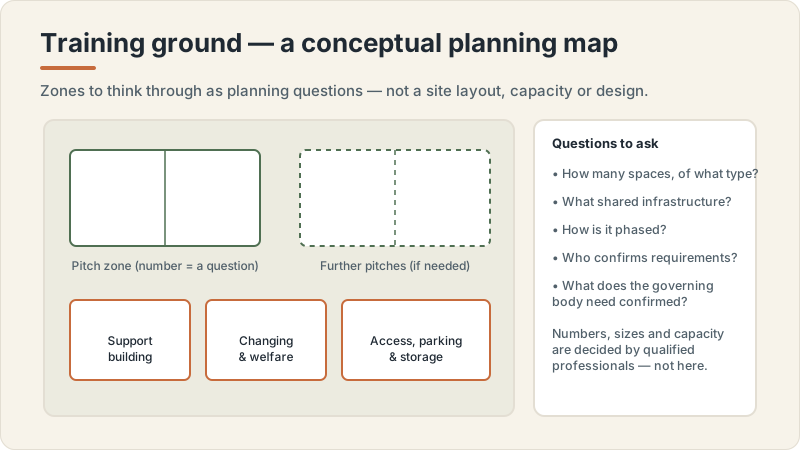
Training ground planning map concept
Conceptual editorial diagram — not a construction drawing, specification, to-scale plan or proof of a real project. It is not engineering, structural, fire/life-safety, crowd-safety or accessibility-compliance guidance. Capacities, dimensions, standards, requirements and costs vary by facility type, audience, site, use case and governing body, and are confirmed with qualified professionals, relevant authorities and governing bodies. Build Design Hub does not design, build, inspect, certify, recommend or match anyone.
What this guide helps you prepare
A football academy facility is rarely a single pitch; it is usually a programme of spaces, schedules and stakeholders that has to serve youth and development use cases over many seasons. This guide helps you turn an early ambition into a structured brief: what the facility is trying to achieve, who will use it and when, which age groups and pathways it supports, and which questions you still need answered before any qualified professional, governing body or authority can give you reliable guidance. The aim is preparation and clarity, not technical direction.
Because requirements vary by location, use case, governing body, owner, site, surface system, maintenance plan, climate, authority and professional team, this guide does not state how anything should be built, surfaced, drained, lit, fenced or certified. Instead it gives you a way to capture assumptions, surface unknowns and frame conversations so that the professionals you eventually engage receive a coherent picture. Everything here is intended to be recorded, discussed and confirmed with the right specialists rather than treated as a specification.
- A short statement of what the academy facility is meant to achieve and for whom, in plain language.
- A list of the youth and development use cases you expect the site to support across a typical week and season.
- An inventory of open questions you cannot yet answer and intend to confirm with qualified professionals.
- A note of which governing bodies, authorities and stakeholders will need to be consulted, and roughly when.
- A clear separation between what you have decided, what you are assuming, and what is still unknown.
- A record of who in your organisation owns which part of the planning conversation.
Framing academy spaces and development use cases as planning questions
A development facility usually has to flex between several uses: structured coaching for different age groups, individual and small-group development, goalkeeping and position-specific work, matchday or fixture use, and quieter periods for recovery and review. Rather than deciding sizes, surfaces or layouts, it is more useful at this stage to write each use case as a planning question: what does this activity need from a space, how often does it happen, and what would have to be true for one space to serve several uses without conflict? These questions are what qualified professionals and governing bodies can then respond to for your specific situation.
Treating spaces as questions also keeps you honest about the difference between aspiration and confirmed need. A facility brief that lists training areas, indoor or covered options, analysis and meeting spaces, changing and welfare areas, equipment storage and parking can quickly drift into assumed specifications. Keep each item descriptive and conditional, note which governing-body or authority requirement might apply, and flag it as something to confirm rather than something you have settled. The relevant standards, dimensions and surface choices depend entirely on factors only your professional team and the applicable governing bodies can assess.
- For each use case, what activity happens, how often, and which age groups or pathways it serves.
- Which uses might share a space, and what would need confirming with professionals for that to work.
- Which spaces are confirmed needs versus aspirations you would review against budget and site.
- Which governing-body or authority considerations you suspect apply, listed as questions to confirm.
- How seasonal and weather variation might change how a space is used through the year.
- Where indoor, covered or alternative spaces appear on the wish list and why.
Stakeholders, governing bodies and the conversations to prepare for
Academy and development projects sit inside a web of stakeholders: owners and sponsors, coaching and sports-science staff, parents and players, schools or community partners, local authorities, and the relevant football governing bodies whose frameworks may shape how a development facility is recognised or used. Preparation here means mapping who has an interest, what each party is likely to ask, and which questions only a governing body or authority can answer for your location and use case. The goal is to arrive at each conversation knowing what you want to learn, not to assume what the answer will be.
Governing-body and authority requirements are a frequent source of false certainty, because they vary by country, level, age group, competition and intended use, and they change over time. Rather than repeating figures or standards you have read elsewhere, prepare a list of the specific points you need to confirm directly with the applicable bodies for your project. Record who you spoke to, when, and what remains open, so that your professional team can build on confirmed information rather than assumptions. Nothing in this guide should be treated as a governing-body requirement.
- A stakeholder map listing each party, their interest, and the questions they are likely to raise.
- A list of governing bodies and authorities you believe are relevant, to confirm scope with directly.
- The specific points you need each governing body or authority to clarify for your use case.
- Which approvals, consultations or engagements might be needed, framed as questions for professionals.
- A simple log of who you have consulted, when, and what is still unresolved.
- How you will keep stakeholders aligned as the brief evolves and assumptions are tested.
Planning questions before speaking with professionals
Before you engage architects, engineers, sports-facility specialists, governing-body contacts or any supplier, it is worth answering the questions that only you and your organisation can answer. These concern purpose, users, budget envelope, site, timeframe and decision-making: who the facility is for, what success looks like, what constraints are non-negotiable, and who can make decisions. Working through these first means professional conversations start from a clear position and are more likely to produce useful, well-scoped advice rather than open-ended exploration.
Equally important is being honest about what you do not yet know, so that you can ask the right specialists the right things. Use the prompts below to record assumptions, mark the items you are unsure about, and identify where you will need confirmation from qualified professionals, governing bodies or authorities. This is preparation, not decision-making; the answers to technical, regulatory and design questions belong with the professionals you engage for your specific project.
- What is the core purpose of the facility, and which youth or development outcomes define success?
- Who are the primary users by age group and pathway, and how might that change over time?
- What budget envelope, funding sources and constraints frame the project at a high level?
- What do you know about the intended site, and what remains unknown or unconfirmed?
- Who holds decision-making authority, and how will competing priorities be resolved?
- Which assumptions are you carrying that you have flagged to confirm with professionals?
Questions for qualified professionals
Once your brief and assumptions are organised, the next step is to bring them to suitably qualified professionals: architects, engineers, sports-facility consultants, planning and regulatory advisers, and contacts at the relevant governing bodies and authorities. The questions below are intended as starting prompts for those conversations, not as a checklist of requirements. Because requirements vary by location, use case, governing body, owner, site, surface system, maintenance plan, climate, authority and professional team, the professionals you engage are the right people to confirm what actually applies to your project.
Use these prompts to test feasibility, surface risks, and understand what a properly scoped engagement would involve, including who you would need on the team and in what order. Ask each professional what falls inside and outside their scope, what they would need from you, and what they would expect to confirm with governing bodies or authorities. Build Design Hub does not provide any of these services and does not recommend, rank, verify, introduce or match the professionals or suppliers you approach; that selection is yours to make with your own due diligence.
- Given our brief, what do you see as the main feasibility, site and regulatory questions to resolve first?
- Which governing-body or authority requirements would you confirm, and how do they apply to our use case?
- What falls inside and outside your scope, and which other professionals would we need to involve?
- What surface, drainage, lighting and layout questions depend on factors specific to our site and climate?
- How would you structure a maintenance and operations plan as part of, or alongside, the design?
- What information do you need from us, and how should we structure quotes or proposals for comparison?
What this does not replace
This is an educational project-preparation resource only. It is not a construction manual and not engineering, architectural, turf-installation, drainage-engineering, sports-surface-specification, structural, fire or life-safety, crowd-safety, accessibility-compliance, permit, zoning, legal, tax or procurement advice. It does not design, specify, install, certify, inspect or approve anything, and it is not an estimate, quote, price, capacity recommendation or performance or lifespan guarantee. Requirements, standards, dimensions, surface systems and costs vary by location, use case, governing body, owner, site, climate, maintenance plan, authority and professional team, and are confirmed with qualified professionals, relevant authorities and the sport governing body.
Build Design Hub does not design, build, install, engineer, inspect, certify, recommend, rank, verify, introduce, broker or match suppliers or contractors, and HELPERG LLC is publisher/operator only. Use this resource to prepare your own thinking, then have qualified professionals you engage directly review your project. Decisions about engineering, surface specification, drainage, safety, compliance, procurement and suitability must rest on those professionals, the relevant authorities and the governing body for your sport and location.
- Not a construction manual and not engineering, turf-installation or drainage-engineering instructions
- Not sports-surface specification, structural, fire/life-safety, crowd-safety or accessibility-compliance advice
- Not permit, zoning, legal, tax or procurement advice
- Not a supplier or contractor recommendation, ranking, directory or matching service
- Not an estimate, price, capacity recommendation or performance/lifespan guarantee — requirements and costs vary
- Qualified professional review is required before any project decision
Academy facility planning worksheet: what to record and confirm
- 1Record a plain-language statement of the facility's purpose and the development outcomes it should support.
- 2List the youth and development use cases you expect, by age group, pathway and frequency.
- 3Note which spaces are confirmed needs and which are aspirations to test against site and budget.
- 4Capture each space as a descriptive planning question rather than a size, surface or specification.
- 5Write down the assumptions you are carrying and mark each one as confirmed, assumed or unknown.
- 6Draft a stakeholder map naming each party, their interest and the questions they are likely to raise.
- 7List the governing bodies and authorities you believe are relevant, to confirm scope with directly.
- 8Record the specific points you need each governing body or authority to clarify for your use case.
- 9Gather what you currently know about the intended site, and flag what remains unconfirmed.
- 10Note your high-level budget envelope, funding sources and any non-negotiable constraints.
- 11Identify who holds decision-making authority and how competing priorities will be resolved.
- 12Prepare your starting questions for each type of qualified professional you intend to approach.
- 13Set up a simple log of who you consulted, when, and what remains open.
- 14Decide how you will structure supplier and contractor research and quote comparison on a like-for-like basis.
Common mistakes to avoid
- Treating sizes, surfaces, lighting or fencing as settled before any qualified professional has reviewed the site and use case.
- Repeating governing-body figures or standards read elsewhere as if they apply, instead of confirming them directly for your country, level and age group.
- Letting a wish list of spaces harden into an assumed specification rather than keeping each item as a question.
- Skipping the stakeholder map and discovering late that a key partner, authority or governing body had different expectations.
- Approaching professionals without a clear brief, so early conversations stay vague and produce little usable guidance.
- Confusing aspiration with confirmed need, so the budget envelope is set against assumptions that have not been tested.
- Assuming one space can serve several uses without checking what would have to be true for that to work.
- Expecting an educational guide or any publisher to recommend, rank or match suppliers and contractors rather than doing your own due diligence.
When to involve a professional
- When you need any surface, drainage, lighting, fencing or layout question answered for your specific site, climate and use case.
- When you need to confirm which governing-body or authority requirements actually apply to your project and age groups.
- When site feasibility, planning, access, environmental or regulatory questions arise that go beyond your own knowledge.
- When use cases conflict or one space must serve several activities and you need to understand whether that is workable.
- When you are ready to scope a maintenance and operations plan and want it grounded in the chosen approach.
- When you need to structure formal supplier or contractor research and quote comparison and want help defining like-for-like scope.
Frequently asked questions
Questions readers ask about this topic
Does this guide tell me how big the pitches should be or which surface and drainage to use?
No. This guide does not state dimensions, surfaces, drainage, lighting, fencing, capacities, standards or any specification as fact. Those depend on your location, use case, governing body, site, climate and other factors, and they can only be confirmed by qualified professionals and the relevant governing bodies and authorities for your project. The guide helps you prepare the questions to take to them.
Will Build Design Hub recommend, rank or connect me with suppliers, contractors or designers?
No. Build Design Hub is an educational publisher and does not design, build, install, engineer, inspect, certify, recommend, rank, verify, introduce, broker or match any suppliers, contractors or professionals, and it gives no costs, requirements or surface specifications. Selecting and engaging professionals is your responsibility, with your own due diligence; this guide only helps you prepare to do that well.
Can you give me a budget, timeline or running cost for an academy facility?
No. This guide does not provide prices, costs, timelines, revenue, payback or performance figures, and it would be misleading to do so without knowing your specific project. You can record a high-level budget envelope as your own planning input, then confirm realistic figures and schedules with qualified professionals scoped to your site and brief.
Which governing bodies do I need to involve for a youth or development facility?
That varies by country, competition level, age group and intended use, and it can change over time, so this guide does not name requirements as fact. Instead, prepare a list of the bodies and authorities you think are relevant and the points you need clarified, then confirm scope directly with them and with your professional team for your situation.
Keep reading