
Who this guide is for
- Football club owners, boards and chief executives scoping a new or expanded first-team or community training base
- Academy and youth-development directors planning training spaces across multiple age groups and squads
- School, college and university administrators preparing a football training facility on or near campus
- Municipal and local-authority officers considering a community or shared-use football training ground
- Property developers and investors assessing a training-ground-anchored site and the information they must gather first
- Facility and operations managers translating a sporting vision into a written brief for qualified professionals
Planning diagram
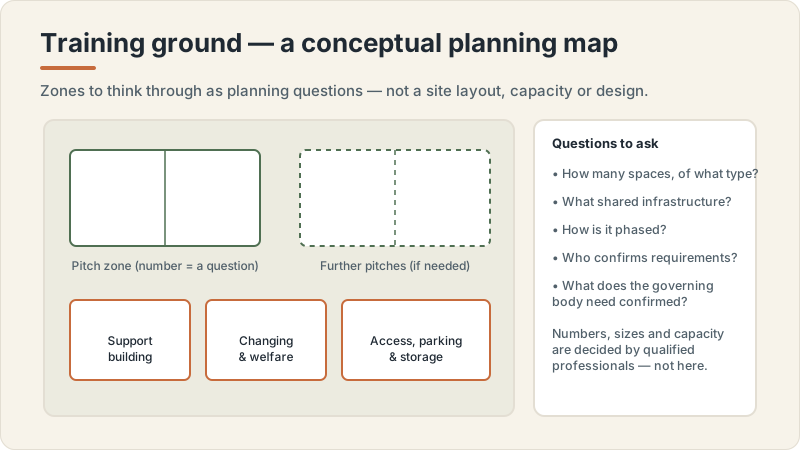
Training ground planning map concept
Conceptual editorial diagram — not a construction drawing, specification, to-scale plan or proof of a real project. It is not engineering, structural, fire/life-safety, crowd-safety or accessibility-compliance guidance. Capacities, dimensions, standards, requirements and costs vary by facility type, audience, site, use case and governing body, and are confirmed with qualified professionals, relevant authorities and governing bodies. Build Design Hub does not design, build, inspect, certify, recommend or match anyone.
What this guide helps you prepare
This guide helps you produce a structured written brief for a football training ground that you can hand to architects, engineers, turf and drainage consultants, cost advisors and other qualified professionals when you begin to engage them. It walks through the categories of information you can usefully capture yourself first: the goals and intended use of the ground, the playing and support spaces you imagine framed deliberately as questions rather than fixed counts, the constraints you already know about, the way you might phase the work, and the people inside your organisation who own each decision. Capturing these in writing gives every later conversation a common reference point and reduces the risk of expensive misunderstanding.
It is important to be clear about what this preparation is not. Writing a brief does not make you the designer, engineer or authority on what is feasible, safe, permitted or compliant. Every technical judgement how many pitches a site can hold, what surface system suits your use, any dimension, drainage approach, lighting level, fencing arrangement, budget figure or programme date must be confirmed by qualified professionals and the relevant authorities and football governing bodies, because such things vary by location, use case, governing body, owner, site, surface system, maintenance plan, climate and professional team. The brief simply organises your intentions and known facts so professionals can respond to them accurately.
- A single, version-controlled document that states why the training ground project exists and what success would look like for your organisation
- A plain-language description of who will train there and how, written as your aspirations rather than as confirmed technical specifications
- The number and type of spaces expressed as open questions for professionals, not as counts or dimensions you have fixed yourself
- An honest map of what you already know about the site and what remains unknown or unverified
- A first view of how the work might be phased, with each phase flagged for professional feasibility input
- A named decision-owner for each major topic, so professionals know whom to ask and who can approve
Framing the playing and support spaces as questions
The heart of a training-ground brief is the mix of spaces, and the most useful way to capture it is as a set of questions rather than a list of pitches and rooms you have already decided on. Start with the playing spaces by describing how you intend to use them: how many squads or age groups train in a typical week, whether sessions run in parallel or in sequence, whether you imagine full-size and smaller training areas, whether goalkeeping, rehabilitation or small-sided work needs dedicated space, and whether any space must double for matches or community use. Resist the urge to assign a pitch count, a surface type or any dimension yourself; instead, record the usage pattern and ask qualified professionals what the site, climate, governing-body guidance and your maintenance intentions actually allow.
Support buildings and shared infrastructure deserve the same questioning treatment, because they often determine whether a training ground works day to day. Think through changing and welfare provision, medical and recovery space, coaching and analysis areas, storage, catering, offices, parking and circulation between buildings and pitches, and how players, staff, visitors and deliveries move around the site without conflict. For each, write what you want it to do and the experience you want people to have, then frame the sizing, adjacency and servicing as questions for the design team. Note too which spaces relate to governing-body or competition considerations at your level, since the bodies that oversee your football may have their own guidance that professionals will help you interpret rather than anything stated here.
- How many squads, age groups or programmes train in a typical week, and whether sessions run in parallel or in sequence?
- What balance of full-size, smaller and specialist training areas does your usage pattern suggest, as a question for professionals?
- Which support functions changing, welfare, medical, recovery, analysis, storage, catering, offices do your activities imply?
- How should players, staff, visitors and deliveries move between buildings and pitches without conflict, and where might pinch-points arise?
- Which spaces may need to flex between training, matches or community use, and what does that flexibility imply for early discussions?
- Which football governing bodies relate to your level of play, and whose guidance will professionals need to consider for the spaces you describe?
Recording phasing, constraints and decision owners
Few training grounds are built all at once, so a brief is more useful when it captures how you might phase the work and why. Describe which spaces you would prioritise first, which could follow in a later phase, and what would have to be true a funding milestone, a squad expansion, a season target for a later phase to proceed. Phasing affects how professionals think about the whole site from the outset, because a sequence chosen well can avoid disruption and rework, while one chosen in isolation can foreclose options later. Frame your phasing as a working preference rather than a committed plan, and ask professionals how a sensible sequence would be developed for your specific site, surface intentions and operational needs, rather than fixing dates or scope yourself.
Alongside phasing, record the constraints you already understand and who owns each decision, but record both honestly. Capture the broad budget envelope your organisation is working within, the programme drivers that matter such as a target season, and any planning, environmental, neighbour, access or community sensitivities you are already aware of, each marked as your current understanding rather than as established fact and flagged for confirmation with qualified professionals and the relevant authorities. Then, for every major topic in the brief, name the individual or body that owns it, the people who must be consulted, and the approval path a recommendation will travel. Training-ground projects stall when no one can approve a change of direction or speak for a key stakeholder group, so settling this before you engage professionals keeps their advice moving.
- Which spaces you would prioritise in an early phase, and which you would defer, framed as preferences for professional review
- What conditions a funding milestone, squad growth, a season target would need to be met before a later phase proceeds
- The budget envelope and funding sources recorded as your working position, not as a fixed cost, and flagged for confirmation
- Planning, environmental, neighbour, access and community sensitivities you already know about, each marked for confirmation
- A decision-owner named for each major topic, with consultees and the approval path identified
- A change-log convention so every revision to goals, spaces, phasing or constraints is dated and attributed
Planning questions before speaking with professionals
Before you sit down with architects, engineers, turf and drainage consultants or other advisors, use a set of internal questions to test whether your brief is genuinely ready. The aim is to find the gaps yourself, while they cost nothing to fix, rather than discovering them in a paid meeting. Ask whether everyone who matters agrees on why the training ground exists, whether the way you have described training use is clear enough for an outsider to understand, and whether the spaces you have framed as questions truly capture how the ground will be used week to week. Where you cannot answer confidently, mark the question as open rather than guessing at a count, a size or a surface.
Use these questions to separate what you actually know from what you are assuming, and to confirm that your decision-making structure can keep pace once professionals start asking for direction. A brief that passes this internal test makes every subsequent conversation shorter and clearer, and it signals that you are an organised client who has thought carefully about the starting point rather than one expecting professionals to invent the intent for you.
- Do all key stakeholders agree on the primary purpose of this training ground, and can we state it in one or two sentences?
- Have we described how squads and programmes will train clearly enough that someone outside our organisation would understand it?
- Which items in our brief are verified facts, and which are assumptions we still need to test with professionals?
- Have we expressed the number and type of spaces as questions rather than fixed counts, sizes or surface choices?
- Is our phasing preference clear, and have we noted the conditions each later phase would depend on?
- Is it clear who owns each decision and how approvals and disputes will be handled once professionals are engaged?
Questions for qualified professionals
Once your brief is drafted, the next step is to ask qualified professionals the right questions rather than to seek confirmation of answers you have pre-decided. Use the brief as the agenda: present your goals, your training usage pattern, the spaces you have framed as questions, your phasing preference and your known constraints, and invite professionals to tell you what is feasible, what is missing, what requirements apply and where your assumptions need testing. Because requirements vary by location, use case, governing body, owner, site, surface system, maintenance plan, climate and professional team, the most valuable thing you can do is ask professionals to confirm the standards, approvals and technical parameters that apply to your specific situation rather than relying on anything stated here or generalised from another ground.
Keep your questions open and exploratory at this stage. You are trying to understand the shape of the work, the disciplines you will need to involve, the approvals you will have to navigate and the early risks worth attention, including how surface choice, drainage and maintenance interact over time. Capture their responses against your brief so it evolves into a shared, professionally informed document. Build Design Hub does not design, engineer, certify, permit or recommend, and it does not introduce, vet, rank or match suppliers or contractors; selecting and appointing professionals is a decision for you to make through your own due-diligence process.
- Given our goals and site, how many and what type of training spaces could the ground realistically support, and how would you assess that?
- Which requirements, standards and football governing-body guidance apply to a training ground at our level of play, and how do we confirm them for our location?
- How do surface system, drainage and our intended maintenance plan interact, and what should we understand before any commitment?
- How would you approach phasing for a site like ours, and what would a sensible early phase avoid foreclosing?
- What early studies or surveys would you recommend before any design or surface commitment is made?
- What information do you still need from us to advise responsibly, and in what form should we provide it?
What this does not replace
This is an educational project-preparation resource only. It is not a construction manual and not engineering, architectural, turf-installation, drainage-engineering, sports-surface-specification, structural, fire or life-safety, crowd-safety, accessibility-compliance, permit, zoning, legal, tax or procurement advice. It does not design, specify, install, certify, inspect or approve anything, and it is not an estimate, quote, price, capacity recommendation or performance or lifespan guarantee. Requirements, standards, dimensions, surface systems and costs vary by location, use case, governing body, owner, site, climate, maintenance plan, authority and professional team, and are confirmed with qualified professionals, relevant authorities and the sport governing body.
Build Design Hub does not design, build, install, engineer, inspect, certify, recommend, rank, verify, introduce, broker or match suppliers or contractors, and HELPERG LLC is publisher/operator only. Use this resource to prepare your own thinking, then have qualified professionals you engage directly review your project. Decisions about engineering, surface specification, drainage, safety, compliance, procurement and suitability must rest on those professionals, the relevant authorities and the governing body for your sport and location.
- Not a construction manual and not engineering, turf-installation or drainage-engineering instructions
- Not sports-surface specification, structural, fire/life-safety, crowd-safety or accessibility-compliance advice
- Not permit, zoning, legal, tax or procurement advice
- Not a supplier or contractor recommendation, ranking, directory or matching service
- Not an estimate, price, capacity recommendation or performance/lifespan guarantee — requirements and costs vary
- Qualified professional review is required before any project decision
Football training ground brief preparation worksheet
- 1Record the primary purpose of the training ground in one or two sentences agreed by key stakeholders
- 2Describe who will train there squads, age groups, programmes and how a typical training week looks
- 3List the playing spaces you imagine as usage questions, not as a fixed pitch count, size or surface choice
- 4List the support functions your activities imply changing, welfare, medical, recovery, analysis, storage, catering, offices
- 5Note how players, staff, visitors and deliveries should move around the site, flagging possible conflicts for professionals
- 6Capture the location or candidate sites, with what you know about ownership, access and neighbours
- 7Mark each piece of site information as verified fact or working assumption
- 8Record your phasing preference and the conditions each later phase would depend on
- 9Note the budget envelope and funding sources as your working position, flagged for confirmation
- 10List planning, environmental, neighbour, access and community sensitivities you already know about
- 11Identify which authorities and football governing bodies you expect will need to be consulted
- 12Name the decision-owner, consultees and approval path for each major topic
- 13Set a change-log convention so revisions are dated and attributed
- 14Compile your open questions to raise with qualified professionals at the first engagement
Common mistakes to avoid
- Writing the brief as a technical specification fixing pitch counts, sizes, surface types or drainage approaches that only qualified professionals and governing bodies can confirm
- Listing rooms and pitches as decisions rather than framing the number and type of spaces as questions about how the ground will be used
- Recording assumptions about the site as if they were verified facts, which leads professionals to advise on a false baseline
- Designing for the spaces you want today without recording how phasing or future squads might change the picture
- Treating support buildings, circulation and deliveries as an afterthought to the pitches rather than part of how the ground works
- Stating a budget or a target season as fixed before any professional feasibility input has been sought
- Assuming requirements or a layout from another club or location transfer to your situation without confirmation
- Leaving decision ownership undefined, so the project stalls when no one can approve a change or speak for a stakeholder group
When to involve a professional
- When you need to know how many and what type of training spaces a specific site can support, which only qualified professionals can assess
- When you need any surface system, drainage, lighting, fencing or other technical parameter considered for your use case, climate and maintenance intentions
- When you need to know which standards, approvals and football governing-body guidance apply to a training ground at your level and location
- Before committing to a budget, programme, phasing sequence or site, so feasibility and risk are assessed by qualified professionals first
- When site context raises planning, environmental, access, neighbour or community questions that require specialist assessment
- Before any design, surface, procurement, permitting or construction decision, none of which this educational guide addresses
Frequently asked questions
Questions readers ask about this topic
Does Build Design Hub recommend, rank or connect me with training-ground suppliers or contractors, or tell me what surface to choose?
No. Build Design Hub is an educational resource that helps you prepare your own planning documents. It does not design, engineer, certify, permit or inspect, it does not state turf, drainage or other specifications, and it does not introduce, vet, rank, broker or match suppliers or contractors. Choosing a surface system and appointing professionals are decisions for you to make through your own due-diligence process with qualified advisors.
Can this guide tell me how many pitches I need or what the training ground will cost?
No. This guide does not state any pitch count, dimension, surface specification, standard, timeline or cost as fact, because those vary by location, use case, governing body, owner, site, surface system, maintenance plan, climate and professional team. It helps you frame the number and type of spaces as questions and capture your intentions so qualified professionals and the relevant authorities can confirm what actually applies to your project.
Why does this brief frame the spaces as questions instead of just listing the pitches and rooms I want?
Because how many and what type of spaces a site can support, and how they should be sized, served and arranged, are technical judgements for qualified professionals working from your specific site, use and maintenance intentions. Framing them as questions captures your usage clearly while leaving the feasibility judgement where it belongs, which makes professional conversations more productive.
How detailed should my brief be before I speak with professionals?
Detailed enough to communicate your goals, training usage, the spaces you have framed as questions, your phasing preference, known constraints and decision owners, while honestly marking what is still open or unverified. A brief that flags its gaps is more useful than one that hides them, because it shows professionals exactly where their input is most needed.
Keep reading