
Who this guide is for
- Sports club committees and volunteers exploring a new or replacement pitch
- School, college and university facilities teams scoping a football field
- Municipal parks and recreation staff planning community sports provision
- Property developers including a pitch within a wider site or masterplan
- Facility managers comparing natural and artificial surface options at a high level
- Grant applicants and trustees assembling a brief before approaching professionals
Planning diagram
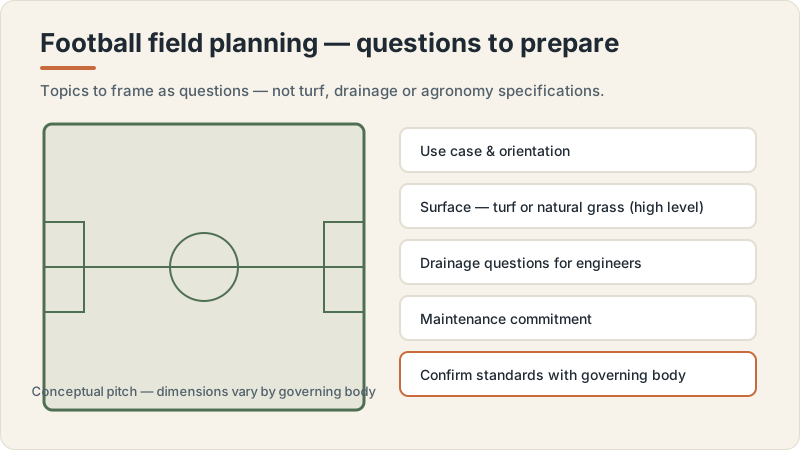
Football field planning concept
Conceptual editorial diagram — not a construction drawing, specification, to-scale plan or proof of a real project. It is not engineering, structural, fire/life-safety, crowd-safety or accessibility-compliance guidance. Capacities, dimensions, standards, requirements and costs vary by facility type, audience, site, use case and governing body, and are confirmed with qualified professionals, relevant authorities and governing bodies. Build Design Hub does not design, build, inspect, certify, recommend or match anyone.
What this guide helps you prepare
This guide helps you assemble the inputs you need before a football field project becomes a series of professional engagements. That means writing down what the pitch is actually for, who will use it and how often, what you already know about the site, and the long list of things you do not yet know. A clear, honest record of intent and unknowns is the single most useful document you can bring to a designer, a civil or drainage specialist, a pitch or surface consultant, or a governing-body contact, because it lets them respond to your situation rather than to guesswork.
It also helps you understand which decisions are genuinely yours to make at this stage and which must wait for qualified input. Use case and broad ambition are yours to define. Orientation, surface choice, drainage strategy, dimensions, gradients, classifications and anything tied to competition or affiliation are areas where requirements vary by location, facility type, audience, site, use case and governing body, and should be confirmed with qualified professionals and the relevant body rather than fixed now. Build Design Hub does not design, build, engineer, inspect, certify, recommend, rank, verify, introduce, broker or match suppliers or contractors, and this guide does not stand in for any of those services.
- A short statement of what the field is for and who the primary users will be
- A record of intended activities: matches, training, community hire, multi-sport, or a mix
- A list of everything you already know about the site, and a clearly separate list of unknowns
- An early view of who owns each decision and who must sign off
- A note of any affiliation, competition or governing body whose rules may apply, to confirm later
- A set of open questions to take into professional and governing-body conversations
Framing use case, orientation and surface choice at a high level
Start with use case because it shapes almost every later conversation. A field used mainly for youth training a few evenings a week raises different planning questions than one intended for affiliated competition, frequent community hire, or shared use across several sports. Record how heavily you expect the pitch to be used, the seasons and times of day, the standard of play you are aiming for, and whether multi-sport or event use is a goal. None of this commits you to a specification; it gives professionals and the governing body the context they need to advise. Whether competitive standards apply at all is itself a question to confirm, not something to assume from another project you have seen.
Orientation and surface choice are introduced here only as topics to raise, not as settings to decide. Field orientation, sun and prevailing-wind considerations, and how a pitch sits within a site are matters that vary by location, layout and use case and should be discussed with qualified professionals rather than copied from a rule of thumb. Surface choice — broadly, whether to consider a natural, artificial or hybrid approach — has implications for use intensity, maintenance, climate suitability, and any governing-body acceptance, all of which differ by situation. Capture your preferences and constraints as questions to explore, and avoid recording any dimension, gradient, classification or surface standard as a fact; those belong to qualified professionals and the relevant body.
- How intensively, and in which seasons and times, do you expect the pitch to be used?
- Is competitive, affiliated or graded play a goal, or is the field mainly for training and recreation?
- Should multi-sport, community-hire or event use be considered in the brief?
- What site factors (sun direction, prevailing wind, surrounding features) should orientation discussions account for, per professional input?
- What are your initial preferences and worries about a natural, artificial or hybrid surface, framed as questions?
- Which surface and use considerations might a governing body need to weigh in on for your intended standard?
Raising drainage and governing-body confirmation early
Drainage is one of the most consequential topics for any football field, and it is far better raised as a set of questions at planning stage than discovered later. Without giving or implying any specifications, note what you can observe and what you need explained: how water currently behaves on the site, whether ponding or wet patches are evident, where surface water might go, and how weather and usage patterns could affect playability. The goal is to give a drainage or civil specialist a clear picture and a list of concerns, not to predetermine an approach. How drainage should be handled depends on the site, the surface being considered, the climate and the intended use, and must be confirmed with qualified professionals.
Governing-body confirmation runs alongside all of this. If your project might be affiliated, used for competition, or graded to any standard, the body that matters to you is the authority on what applies — not this guide, another club's experience, or a supplier's claim. Identify early which body or bodies are relevant, what they may need to confirm about dimensions, surface acceptance, orientation, safety run-off, markings or facilities, and at what point in your process you should approach them. Requirements vary by location, facility type, audience, site, use case and governing body; confirm with qualified professionals and the relevant body, and keep a written record of what you confirmed and with whom.
- What can you observe about how water currently behaves on and around the site?
- Are there signs of ponding, wet areas or run-off issues to flag to a specialist?
- What weather, season and usage patterns should drainage discussions take into account?
- Which governing body or bodies are relevant to your intended use, affiliation or standard?
- What might that body need to confirm, and at what stage should you contact them?
- How will you record confirmations from professionals and the governing body for your project file?
Planning questions before speaking with professionals
Before you bring in qualified professionals, work through the questions you can answer yourself so the conversation starts from a solid base. These are organizational and scoping questions, not technical ones: what the field is for, who decides, what budget envelope and timeframe you are working within at a high level, and what you would consider success or failure. Writing these down exposes gaps and disagreements among stakeholders early, when they are cheap to resolve, and prevents a professional engagement from stalling while basic intent is still being debated.
Equally important is separating what you know from what only a professional or governing body can tell you. Resist the urge to pre-decide orientation, surface, drainage approach, dimensions or standards; instead, phrase each as a question and note any assumption you are making so it can be tested. This protects you from anchoring on numbers or layouts that may not suit your site or your governing body. Keep this list with your brief so every professional and authority you speak to is answering the same well-formed questions.
- Can every stakeholder state, in one sentence, what this field is for?
- Who owns each major decision, and who must approve the project to proceed?
- What constraints (site, access, neighbours, programme, funding envelope) are already known?
- Which assumptions about orientation, surface or drainage are you making that need testing?
- What outcomes would make this project a success, and what would make it a failure?
- Have you listed the unknowns that only qualified professionals or a governing body can resolve?
Questions for qualified professionals
When you engage designers, civil and drainage specialists, pitch or surface consultants and governing-body contacts, bring questions rather than instructions. Ask them to explain how your use case affects their advice, what they would need to investigate about your specific site, and where your assumptions might not hold. Because requirements vary by location, facility type, audience, site, use case and governing body, ask each professional to tell you what depends on factors unique to your project and what they would confirm with the relevant authority. This keeps responsibility for technical and compliance judgements where it belongs.
Use the answers to refine your brief and to structure any quote or proposal comparison on a like-for-like basis, comparing scope, assumptions and exclusions rather than headline figures. Ask how each professional handles orientation, surface and drainage decisions, what governing-body coordination they expect to be involved in, and where the boundaries of their responsibility lie. Build Design Hub does not recommend, rank, verify or match these professionals; choosing and appointing them, and confirming their qualifications and insurance, is your responsibility, ideally with appropriate independent advice.
- How does our intended use and standard of play change what you would advise or investigate?
- What site investigations would you carry out before commenting on orientation, surface or drainage?
- Which decisions must be confirmed with the governing body, and who manages that coordination?
- What assumptions are built into your input, and which of ours do you think need testing?
- How should we structure proposals so scope, assumptions and exclusions can be compared fairly?
- Where does your responsibility end, and what should we confirm independently or with the authority?
What this does not replace
This is an educational project-preparation resource only. It is not a construction manual and not engineering, architectural, structural, civil, fire or life-safety, crowd-safety, accessibility-compliance, permit, zoning, legal, tax or procurement advice. It does not design, specify, certify, inspect or approve anything, and it is not an estimate, quote, price or capacity recommendation. Requirements, standards, capacities and costs vary by location, facility type, audience, site, use case, design team, supplier, contractor and governing body, and are confirmed with qualified professionals, relevant authorities and governing bodies.
Build Design Hub does not design, build, engineer, inspect, certify, recommend, rank, verify, introduce, broker or match suppliers or contractors, and HELPERG LLC is publisher/operator only. Use this resource to prepare your own thinking, then have qualified professionals you engage directly review your project. Decisions about engineering, safety, compliance, procurement and suitability must rest on those professionals, the relevant authorities and the governing bodies for your sport and location.
- Not a construction manual and not engineering, structural or civil design
- Not fire/life-safety, crowd-safety, evacuation or accessibility-compliance advice
- Not permit, zoning, legal, tax or procurement advice
- Not a supplier or contractor recommendation, ranking, directory or matching service
- Not an estimate, quote, price or capacity recommendation — requirements and costs vary
- Qualified professional review is required before any project decision
Football field planning preparation worksheet
- 1Record a one-line statement of what the field is for and who its primary users are
- 2List the activities the pitch must support: matches, training, hire, multi-sport, events
- 3Estimate intended usage intensity by season and time of day, as a planning note
- 4Note the standard of play you are aiming for, and mark whether it is confirmed or assumed
- 5Capture everything known about the site, and keep a separate, explicit list of unknowns
- 6Write down your initial preferences and concerns about orientation, as questions to confirm
- 7Record your high-level thoughts on natural, artificial or hybrid surface as open questions
- 8Note what you can observe about water behaviour, wet areas or run-off on the site
- 9Identify which governing body or bodies may be relevant to your intended use
- 10List what that body may need to confirm and when you plan to contact them
- 11Map decision-owners and required sign-offs for the project
- 12Gather any existing site plans, surveys or constraints documents you already hold
- 13Draft the open questions you will take to professionals and the governing body
- 14Set up a file to record confirmations, with the date and source for each
Common mistakes to avoid
- Treating dimensions, orientation, surface or drainage choices from another project as facts for your own site
- Assuming competitive or affiliation standards apply without confirming with the relevant governing body
- Deciding on a natural or artificial surface before the use case and site context are understood
- Leaving drainage as an afterthought instead of raising it as an early question with a specialist
- Approaching the governing body too late, after key choices have already been made
- Writing a brief full of specifications instead of intent, unknowns and questions
- Comparing professional proposals on headline figures rather than scope, assumptions and exclusions
- Assuming this guide or any website can confirm requirements, costs or approve the project to proceed
When to involve a professional
- When you need orientation, surface or drainage decisions assessed against your specific site rather than general principles
- When the project may be affiliated, used for competition, or graded and a governing body must confirm what applies
- When site conditions such as drainage, levels, access or ground are uncertain and require qualified investigation
- When you must turn a high-level brief into scope, and need help framing it without pre-specifying outcomes
- When comparing proposals and you need professional input on scope, assumptions, exclusions and responsibility boundaries
- When any question touches safety, compliance, accessibility or certification, which must be handled by suitably qualified professionals and authorities
Frequently asked questions
Questions readers ask about this topic
Does this guide tell me the correct dimensions, orientation or surface for a football field?
No. It deliberately avoids stating dimensions, orientation rules, surface standards or any other requirement as fact. These vary by location, facility type, audience, site, use case and governing body, and must be confirmed with qualified professionals and the relevant body. The guide helps you prepare the questions to ask, not the answers.
Can Build Design Hub recommend or connect me with a surface supplier, drainage specialist or contractor?
No. Build Design Hub does not recommend, rank, verify, introduce, broker or match suppliers or contractors, and it does not provide costs, prices or requirements. This is an educational planning resource only. Researching, choosing, appointing and verifying professionals is your responsibility, ideally with appropriate independent advice.
When should I involve the governing body in my planning?
Identify the relevant body early and confirm with them directly what applies to your intended use, affiliation or standard. The right timing depends on your project, so ask qualified professionals and the body itself when they need to be engaged. Do not rely on this guide, another club's experience or a supplier's claim for what a governing body requires.
Is a high-level surface and drainage discussion enough to start building?
No. The high-level framing here is only to prepare conversations. Surface choice, drainage approach and everything technical must be assessed by qualified professionals for your specific site, and any compliance or governing-body matters confirmed with the relevant authority, before decisions are finalized or work proceeds.
Keep reading