
Who this guide is for
- Municipal and parks-department teams scoping a community sports complex on public land
- Sports club or association boards planning to expand from one activity to a multi-activity site
- Schools, colleges and universities preparing a shared athletics and recreation facility brief
- Property developers evaluating a sports or leisure complex as part of a wider scheme
- Facility managers and operators preparing to brief professionals about a new or expanded site
- Community trusts, foundations or owner groups organising stakeholder input before design
Planning diagram
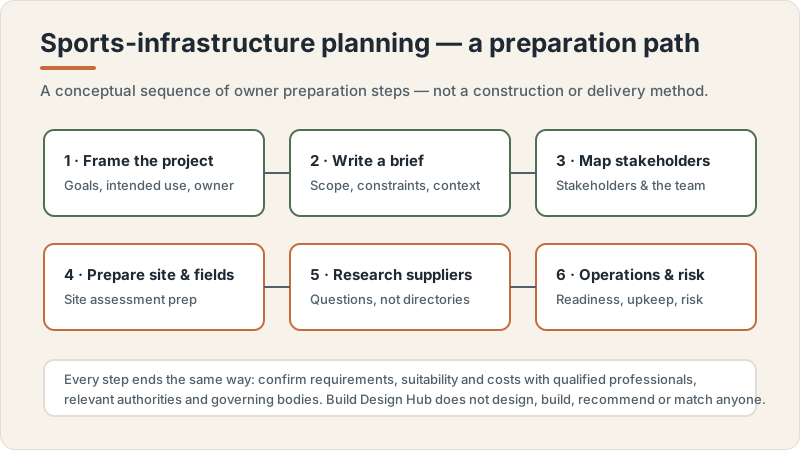
Sports-infrastructure planning path concept
Conceptual editorial diagram — not a construction drawing, specification, to-scale plan or proof of a real project. It is not engineering, structural, fire/life-safety, crowd-safety or accessibility-compliance guidance. Capacities, dimensions, standards, requirements and costs vary by facility type, audience, site, use case and governing body, and are confirmed with qualified professionals, relevant authorities and governing bodies. Build Design Hub does not design, build, inspect, certify, recommend or match anyone.
What this guide helps you prepare
This guide helps you assemble the preparation materials that make later professional advice more productive: a written purpose and vision for the complex, a description of the activities and user groups you hope to serve, an inventory of what the site and existing facilities offer, and a list of the questions and unknowns you want qualified professionals to address. It is about getting your own house in order, not about reaching technical conclusions. A clearer brief tends to lead to clearer conversations, more comparable proposals and fewer surprises once specialists are engaged.
It also helps you think about the project as a system rather than a collection of separate facilities. A complex shares circulation, parking, utilities, staffing and management across multiple activity zones, and decisions in one area ripple into others. Preparing notes on how the parts might relate, where you are uncertain, and who needs to be consulted gives the professional team a stronger starting point. Throughout, remember that any figure, requirement or standard you encounter must be confirmed with qualified professionals, the relevant authorities and the governing bodies for each sport.
- Write a short purpose statement: who the complex serves, which activities, and what success would look like
- List the activities and user groups you want to accommodate, and note which are confirmed versus aspirational
- Gather what you already know about the site, ownership, existing buildings and any prior studies or surveys
- Capture your open questions and assumptions in one place so professionals can address them directly
- Note constraints you are aware of (budget envelope, community expectations, timing pressures) without treating them as fixed answers
- Record which authorities and governing bodies you believe are relevant, to confirm with professionals
Zoning activities and planning shared infrastructure
A multi-activity complex benefits from early thinking about how different uses sit together on the site. Some activities are noisy, some need quiet, some draw spectators while others are for participants only, and some operate at different times of day or seasons. Preparing a simple activity-relationship picture, noting which uses might conflict and which might naturally cluster, gives your design team useful raw material. This is preparation for discussion, not a layout: the actual zoning, separation and adjacency decisions are professional judgments that depend on the site, the audience and the governing-body considerations for each sport.
Shared infrastructure is often where the value and the complexity of a complex concentrate. Parking, access roads, drop-off, entrances, changing and welfare spaces, utilities, storage, maintenance areas and management offices may serve several activities at once. It helps to record which functions you expect to share, which you expect to keep separate, and where you are unsure, so professionals can advise on feasibility and trade-offs. Avoid assuming any capacity, dimension or servicing arrangement; those depend on factors only a qualified team can assess against the relevant requirements and authorities.
- List each planned activity and note its likely needs: spectators or not, noise level, hours of use, seasonality
- Map which activities might conflict (noise, light, crowds, timing) and which could share space or schedules
- Identify infrastructure you hope to share across zones: parking, entrances, changing and welfare areas, utilities, storage
- Note functions you believe must stay separate, and flag the ones you are unsure about
- Record questions about access, circulation and how visitors, players and deliveries would move through the site
- List the authorities and governing bodies whose input on layout and shared facilities you will need professionals to confirm
Phasing, sequencing and the professional team to involve
Few complexes are built all at once. Owners often deliver a first phase, prove demand or funding, then add later phases. Preparing your thinking about sequencing helps the professional team design something that can grow without rework: what must exist from day one, what could follow, and how shared infrastructure might be sized or routed so it does not have to be torn up later. Frame these as questions and preferences rather than commitments, because what is feasible to phase, and in what order, is a professional and authority-dependent judgment, not something to fix in advance.
Assembling the right professional team early is one of the most useful preparation steps. A complex typically involves several disciplines, and the mix depends entirely on the project. Your job at this stage is to understand which roles might be needed, prepare a clear brief for them, and note the questions you want each to answer. Build Design Hub does not recommend, rank, verify, introduce or match any professional, supplier or contractor; identifying and engaging qualified, suitably credentialed people for your jurisdiction is yours to do, with the relevant authorities and governing bodies confirming what each discipline must cover.
- Note what the complex must offer from opening day versus what could be added in later phases
- Record questions about how shared infrastructure should be planned so later phases avoid rework
- List the professional roles you think the project may need, and what you would want each to clarify
- Prepare a single written brief you can share with professionals so proposals are comparable
- Capture funding, governance and decision-making milestones that may influence sequencing, to discuss with advisors
- Confirm with qualified professionals and authorities which disciplines, approvals and governing-body sign-offs a phased complex involves
Planning questions before speaking with professionals
Before you book time with designers, engineers or other specialists, it is worth working through questions you can answer yourself or with your stakeholders. These cover purpose, audience, ownership, budget envelope, community context and your tolerance for risk and complexity. The more of this you settle internally, the more focused and economical the professional conversations become. None of these questions requires you to make a technical decision; they help you describe what you want clearly and honestly, including what you do not yet know.
Use these prompts in stakeholder meetings, board discussions or community consultations to surface disagreements early. It is common for different groups to assume different priorities, audiences or timelines, and resolving those internally is far cheaper before design begins. Where a question touches on a requirement, capacity, cost or standard, leave it open and mark it for a qualified professional rather than guessing, since those answers vary by location, facility type, audience, site, use case and governing body.
- What is the primary purpose of this complex, and which activities and audiences are truly core versus optional?
- Who owns and will operate the site, and how will decisions, funding and governance work over the project's life?
- What budget envelope and funding sources are realistic, and how confident are we in them?
- What community, environmental or planning context do we already know about, and who else must be consulted?
- What level of risk, complexity and ongoing maintenance is our organisation prepared to take on?
- Which decisions are we trying to make ourselves versus which must we hand to qualified professionals?
Questions for qualified professionals
When you engage designers, engineers, planners and other specialists, bring questions rather than assumptions. The list below is a starting point for those conversations; your professional team will expand it for your specific site, jurisdiction and activities. Asking these helps you understand scope, sequencing, approvals and the trade-offs involved, and lets you compare proposals on a like-for-like basis. It also keeps responsibility where it belongs: with the qualified, credentialed people advising you and the authorities and governing bodies that set the requirements.
Treat every answer as specific to your project and to the moment it was given. Requirements, approvals, capacities and standards vary by location, facility type, audience, site, use case and governing body, and they change over time. Ask professionals to put key advice in writing, to identify which authorities and governing bodies must be involved, and to be explicit about what their scope does and does not cover so nothing falls through the gaps between disciplines.
- What disciplines and approvals does a complex of this type and scale typically involve in our jurisdiction?
- How do you suggest we zone activities and plan shared infrastructure given our site and intended uses?
- What considerations affect whether and how this project can be phased without costly rework?
- Which authorities and governing bodies must be engaged, and at what stages, for each activity we plan?
- What does your scope include and exclude, and where do the boundaries with other disciplines sit?
- How should we structure briefs and information so that competing proposals can be compared fairly?
What this does not replace
This is an educational project-preparation resource only. It is not a construction manual and not engineering, architectural, structural, civil, fire or life-safety, crowd-safety, accessibility-compliance, permit, zoning, legal, tax or procurement advice. It does not design, specify, certify, inspect or approve anything, and it is not an estimate, quote, price or capacity recommendation. Requirements, standards, capacities and costs vary by location, facility type, audience, site, use case, design team, supplier, contractor and governing body, and are confirmed with qualified professionals, relevant authorities and governing bodies.
Build Design Hub does not design, build, engineer, inspect, certify, recommend, rank, verify, introduce, broker or match suppliers or contractors, and HELPERG LLC is publisher/operator only. Use this resource to prepare your own thinking, then have qualified professionals you engage directly review your project. Decisions about engineering, safety, compliance, procurement and suitability must rest on those professionals, the relevant authorities and the governing bodies for your sport and location.
- Not a construction manual and not engineering, structural or civil design
- Not fire/life-safety, crowd-safety, evacuation or accessibility-compliance advice
- Not permit, zoning, legal, tax or procurement advice
- Not a supplier or contractor recommendation, ranking, directory or matching service
- Not an estimate, quote, price or capacity recommendation — requirements and costs vary
- Qualified professional review is required before any project decision
Sports complex preparation worksheet
- 1Record a one-paragraph purpose statement for the complex and the success it should deliver
- 2List every activity you hope to host, marking each as confirmed, likely or aspirational
- 3Describe the user groups and audiences for each activity (participants, spectators, community, hire)
- 4Gather existing site information: ownership, boundaries, prior surveys, studies and any existing buildings
- 5Note infrastructure you expect to share across zones and infrastructure you expect to keep separate
- 6Map activity relationships: which uses might conflict on noise, light, crowds, timing or season
- 7Draft a phasing wish list: what must open first and what could follow in later stages
- 8List the professional disciplines you think the project may involve, with questions for each
- 9Write a single shareable project brief that professionals can respond to consistently
- 10Identify the authorities and governing bodies you believe are relevant, to confirm with professionals
- 11Capture budget envelope, funding sources and confidence level without treating any figure as fixed
- 12Record open questions, assumptions and unknowns in one place for professionals to address
- 13Note operations and maintenance responsibilities you will need to plan for once the complex is running
- 14List the stakeholders to consult and the decisions you want resolved internally before design begins
Common mistakes to avoid
- Treating numbers, capacities, dimensions or standards found online as facts instead of confirming them with qualified professionals and governing bodies
- Designing each facility in isolation and only later discovering conflicts over parking, access, noise or shared infrastructure
- Committing to a single all-at-once build when phasing might better match funding and demand, or vice versa
- Engaging professionals before writing a clear brief, leading to vague scopes and proposals that cannot be compared
- Assuming one governing body or one authority covers the whole complex when multiple activities may each have their own
- Underestimating ongoing operations, staffing and maintenance because planning focused only on construction
- Skipping internal stakeholder alignment, so disagreements about purpose or audience surface expensively during design
- Sizing or routing shared infrastructure for phase one only, forcing costly rework when later phases arrive
When to involve a professional
- When you are ready to move from a brief to any layout, design, engineering or technical assessment of the site
- When you need to understand which approvals, authorities and governing-body requirements apply to your activities and location
- When questions of structural, fire, life-safety, crowd, drainage, electrical, lighting or accessibility matters arise — these are always for qualified specialists
- When you are deciding how to phase the project and need to know what can be sequenced without rework
- When you must confirm any capacity, dimension, requirement, cost, timeline or standard before relying on it
- When scope, responsibility or interface gaps between disciplines or contracts need to be clarified in writing
Frequently asked questions
Questions readers ask about this topic
Does Build Design Hub recommend or match suppliers, contractors or professionals for my complex?
No. Build Design Hub is an educational planning resource only. It does not design, build, engineer, inspect, certify, recommend, rank, verify, introduce, broker or match any supplier, contractor or professional. Finding and engaging qualified, suitably credentialed people for your jurisdiction is yours to do, and the relevant authorities and governing bodies confirm what each role must cover.
Can this guide tell me the dimensions, capacities, costs or standards my complex needs?
No. This guide does not state requirements, capacities, dimensions, costs, timelines or standards as facts. All of these vary by location, facility type, audience, site, use case and governing body, and must be confirmed with qualified professionals and the appropriate authorities. The guide only helps you prepare the questions and information to bring to those experts.
When should a sports complex be phased rather than built all at once?
That is a project-specific judgment for qualified professionals and depends on funding, demand, the site and approvals. This guide can help you prepare a phasing wish list and the questions to ask, but whether and how to phase, and in what order, should be decided with your design and advisory team and the relevant authorities.
What is the most useful thing to do before contacting professionals?
Write a clear, honest brief: your purpose, the activities and audiences, what you know about the site, the infrastructure you hope to share, your phasing preferences and your open questions. A clear brief makes professional conversations more focused and helps you compare proposals on a like-for-like basis, without making any technical decision yourself.
Keep reading