
Who this guide is for
- Owners and developers preparing operations documentation before a new sports facility is handed over
- Clubs and committees that want a structured way to discuss upkeep with providers and volunteers
- Municipalities and parks teams coordinating maintenance across multiple courts, pitches or venues
- Schools and universities planning routines for shared sports and recreation assets
- Facility and operations managers building or refreshing a maintenance and records framework
- Project teams assembling a handover brief and asset register to pass to qualified contractors
Planning diagram
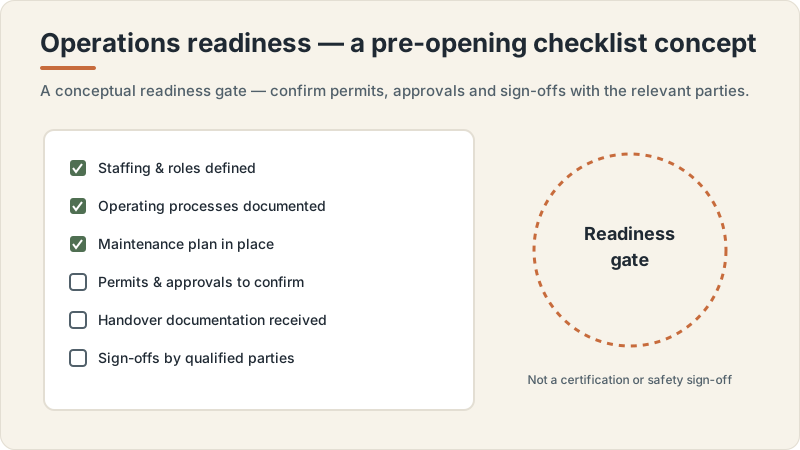
Facility operations readiness concept
Conceptual editorial diagram — not a construction drawing, specification, to-scale plan or proof of a real project. It is not engineering, structural, fire/life-safety, crowd-safety or accessibility-compliance guidance. Capacities, dimensions, standards, requirements and costs vary by facility type, audience, site, use case and governing body, and are confirmed with qualified professionals, relevant authorities and governing bodies. Build Design Hub does not design, build, inspect, certify, recommend or match anyone.
What this guide helps you prepare
This guide helps you turn a vague intention to keep a facility in good condition into an organised, discussable framework. Rather than prescribing a single correct plan, it walks through the building blocks you can assemble yourself: an inventory of the assets you are responsible for, the categories of routine you expect to define with providers, and the record structures that let you see what has been done and what is outstanding. With these pieces drafted, conversations with qualified professionals become more focused, and quotes and proposals become easier to compare because everyone is working from the same picture of the facility.
It is deliberately a preparation tool. The guide does not state how often anything should be serviced, what condition counts as acceptable, or which materials or methods to use, because those depend on the surfaces, equipment, governing-body guidance, manufacturer documentation, and local requirements that apply to your specific facility. Instead, it gives you a way to capture open questions and present them clearly. Think of the output as a brief and a set of registers you hand to the people qualified to fill in the technical detail and to perform the work.
- A working definition of scope: which buildings, surfaces, fixtures and grounds the plan is meant to cover
- A draft asset list you can refine with providers rather than a finished maintenance schedule
- A set of routine categories to discuss, framed as questions about frequency and responsibility
- A record-keeping structure so completed and outstanding tasks stay visible over time
- A list of unknowns to raise with qualified professionals, governing bodies and manufacturers
- A shared reference document that makes provider quotes and proposals easier to compare
Building an asset list as the foundation
Almost every useful maintenance plan starts with an honest inventory of what exists. Before you can discuss routines or compare providers, you need a list of the assets you are responsible for: playing surfaces, line markings, nets and goals, fencing and gates, lighting and its controls, seating, storage, signage, drainage features, irrigation, mechanical and electrical systems, access points, and the surrounding grounds. For each item it helps to note where it is, roughly when it was installed or last refreshed, and any documentation you already hold, such as manufacturer guides or warranty paperwork. You are not assessing condition or fitness here; you are simply cataloguing so nothing is forgotten when professionals are engaged.
An asset list is most valuable when it is structured rather than a loose pile of notes. Grouping assets by area or system, giving each a simple reference, and recording who supplied or installed it makes later conversations far easier. Where you genuinely do not know something — a material, a model, an installation date — record it as a gap to confirm rather than guessing. Manufacturers, the original installers, and governing-body documentation are the right sources for technical detail. The asset list becomes the backbone everything else hangs from: the routines you define and the records you keep should all map back to specific assets on it.
- What playing surfaces, markings, nets, goals and equipment are present, and where each is located
- What documentation exists for each asset (manufacturer guides, warranties, handover packs) and what is missing
- When each asset was installed or last refreshed, recorded as best-known with gaps flagged for confirmation
- Which supplier or installer originally provided each asset, where that is known
- How assets group by area or system so routines and records can map cleanly to them
- Which assets you are unsure about, listed explicitly as questions for providers, installers or manufacturers
Defining routine categories with providers
Once assets are listed, the next building block is the set of routines you expect to agree with qualified providers. The framework approach is to think in categories rather than instructions: routine cleaning and presentation, periodic checks by competent people, seasonal or weather-driven tasks, manufacturer-recommended servicing, and reactive response when something is reported. For each category, the productive question is not how to do the work but who is responsible, how often the routine should occur, what triggers it, and how completion is recorded. The frequencies and methods themselves are for providers, manufacturers and governing-body guidance to define; your job in preparation is to surface the categories and the questions clearly.
Treating maintenance as a recurring loop helps keep the plan alive rather than a document that is filed and forgotten. A simple loop — observe and record, schedule with the responsible party, carry out via qualified people, then log and review — lets you see whether routines are actually happening and whether anything needs to be raised. Be explicit about boundaries: some routines may sit with an in-house team, others with contracted providers, others with manufacturers under warranty terms. Mapping each routine category to a responsible party, and noting where responsibility is unclear, turns a wish list into a structure you can discuss and assign. Avoid writing the technical detail yourself; capture it as questions to confirm.
- Which categories of routine apply — presentation, periodic checks, seasonal tasks, servicing, reactive response
- Who is responsible for each routine: in-house team, contracted provider, or manufacturer under warranty
- How often each routine should occur and what triggers it, framed as a question for qualified providers
- How completion is captured so the routine loop stays visible and reviewable
- Where responsibility is currently unclear or overlapping and needs to be confirmed in writing
- How reactive issues get reported, prioritised and routed to the right responsible party
Planning questions before speaking with professionals
Before you sit down with providers, contractors or governing-body contacts, it is worth working through the questions among your own stakeholders. Clarifying who owns the facility, who pays for maintenance, who has day-to-day authority, and what records already exist will save time later and prevent gaps from being discovered mid-conversation. This internal preparation also helps you distinguish what you can decide yourselves — such as how you want to organise records — from what genuinely needs professional input, such as servicing intervals or condition thresholds. The clearer your own picture, the more focused and comparable the professional conversations become.
Use this stage to assemble the brief you will share. A good brief states the scope, attaches the draft asset list, lists the routine categories you want to discuss, and flags every unknown as a question rather than an assumption. It should make clear that you are seeking guidance to confirm requirements, not asserting them. Keeping the brief factual and free of invented frequencies, standards or costs means professionals can respond on their own terms, and it keeps your planning honest about the boundary between preparation and qualified advice.
- Who owns the facility, who funds maintenance, and who holds day-to-day operational authority?
- What documentation, warranties and handover materials do we already have, and what is missing?
- Which routines do we expect to handle in-house versus contract out, and why?
- What governing bodies or authorities relate to our sports, and what guidance might apply?
- What is our budget intent for ongoing upkeep, expressed as a planning range to discuss, not a fixed figure?
- Which decisions are ours to make, and which must wait for confirmation from qualified professionals?
Questions for qualified professionals
When you engage qualified professionals — providers, manufacturers, surface specialists, electrical and mechanical contractors, or governing-body advisers — the maintenance plan framework gives you a structured set of questions to ask. Rather than requesting that anyone validate numbers you have invented, you present the asset list and routine categories and ask them to define the technical detail: appropriate frequencies, what competent checks involve, what manufacturer documentation requires, and what local or governing-body guidance applies to your facility. This keeps the relationship clear: they hold the expertise and accountability for the work and its requirements, while you hold the organising framework and the records.
These conversations are also where you confirm the boundaries of responsibility and any warranty or compliance obligations that affect how routines must be carried out. Ask professionals to be explicit about what falls inside and outside their scope, what records they will provide, and what they need from you. Requirements vary by location, facility type, audience, site, use case and governing body; treat every answer as specific to your facility rather than a general rule, and document who told you what so your records stay traceable.
- Given our asset list, what routine frequencies and checks do you consider appropriate for this facility?
- What do manufacturer guides, warranties or governing-body documents require us to maintain or evidence?
- Where are the boundaries of your scope, and what falls to us or to other providers?
- What records or certificates will you supply, and what do you need us to keep on our side?
- What local requirements, authorities or governing bodies should we confirm with directly?
- What would you recommend we document now so future providers can pick up the plan cleanly?
What this does not replace
This is an educational project-preparation resource only. It is not a construction manual and not engineering, architectural, structural, civil, fire or life-safety, crowd-safety, accessibility-compliance, permit, zoning, legal, tax or procurement advice. It does not design, specify, certify, inspect or approve anything, and it is not an estimate, quote, price or capacity recommendation. Requirements, standards, capacities and costs vary by location, facility type, audience, site, use case, design team, supplier, contractor and governing body, and are confirmed with qualified professionals, relevant authorities and governing bodies.
Build Design Hub does not design, build, engineer, inspect, certify, recommend, rank, verify, introduce, broker or match suppliers or contractors, and HELPERG LLC is publisher/operator only. Use this resource to prepare your own thinking, then have qualified professionals you engage directly review your project. Decisions about engineering, safety, compliance, procurement and suitability must rest on those professionals, the relevant authorities and the governing bodies for your sport and location.
- Not a construction manual and not engineering, structural or civil design
- Not fire/life-safety, crowd-safety, evacuation or accessibility-compliance advice
- Not permit, zoning, legal, tax or procurement advice
- Not a supplier or contractor recommendation, ranking, directory or matching service
- Not an estimate, quote, price or capacity recommendation — requirements and costs vary
- Qualified professional review is required before any project decision
Maintenance plan preparation worksheet
- 1Define and write down the scope: the buildings, surfaces, fixtures, systems and grounds the plan covers
- 2List every asset you are responsible for, grouped by area or system, with a simple reference for each
- 3Record best-known install or refresh dates for each asset and flag unknowns as gaps to confirm
- 4Gather existing documentation per asset (manufacturer guides, warranties, handover packs) and note what is missing
- 5Note the original supplier or installer for each asset where known
- 6List the routine categories you expect to define with providers (presentation, checks, seasonal, servicing, reactive)
- 7Assign a responsible party to each routine category, or mark it as 'to be confirmed'
- 8Draft the frequency and trigger questions for each routine as questions for professionals, not stated requirements
- 9Design a record structure showing completed, scheduled and outstanding tasks per asset
- 10Decide how reactive issues will be reported, logged, prioritised and routed
- 11Identify the governing bodies, authorities and manufacturers you may need to confirm requirements with
- 12Write a one-page brief that bundles scope, asset list, routine categories and open questions
- 13List which decisions you can make in-house and which must wait for qualified professional input
- 14Record who provided each piece of confirmed guidance and when, so the plan stays traceable
Common mistakes to avoid
- Writing servicing frequencies, condition thresholds or standards into the plan as facts instead of questions to confirm with qualified professionals
- Skipping the asset list and jumping straight to routines, so items get forgotten or duplicated
- Guessing materials, models or installation dates rather than flagging them as gaps to verify with installers and manufacturers
- Leaving responsibility for routines undefined, so tasks fall between an in-house team, contractors and warranty terms
- Treating the plan as a one-off document rather than a recurring loop of record, schedule, do and review
- Designing no record structure, so there is no way to see what has been done or what is outstanding
- Assuming generic guidance applies without confirming requirements that vary by location, facility type, governing body and use case
- Inventing budgets, costs or timelines and presenting them to providers as fixed rather than as planning intent to discuss
When to involve a professional
- When you need appropriate routine frequencies, checks or condition expectations defined for your specific surfaces and equipment
- When manufacturer documentation, warranty terms or governing-body guidance affect how maintenance must be carried out or evidenced
- When electrical, mechanical, structural or surfacing systems are involved and competent inspection or servicing is required
- When responsibility, scope or liability between owner, in-house staff and providers needs to be confirmed in writing
- When local authorities, regulators or governing bodies may impose requirements you must confirm directly
- When the facility is being handed over and you need a qualified party to validate the asset list and records framework
Frequently asked questions
Questions readers ask about this topic
Does Build Design Hub recommend, rank or match maintenance providers or contractors for me?
No. Build Design Hub is an educational resource and does not design, build, inspect, certify, recommend, rank, verify, introduce, broker or match any providers or contractors. This guide gives you a framework to organise your own asset list, routine questions and records so you can hold informed conversations with qualified professionals you find and engage independently.
Will this guide tell me how often to maintain my courts, turf or equipment?
No. It deliberately does not state frequencies, methods, condition thresholds, costs or requirements, because those vary by location, facility type, audience, site, use case and governing body. The guide helps you frame those as questions to confirm with qualified professionals, manufacturers, relevant authorities and the governing bodies for your sports.
Is the asset list something I finalise myself or with help?
You can draft it yourself as a planning exercise, but treat it as a working document. Record what you know, flag what you do not, and have installers, manufacturers and qualified providers confirm or complete the technical detail. The draft makes those conversations more focused and helps you compare quotes and proposals on a consistent basis.
Can I use this plan as proof that maintenance has been done correctly?
No. This guide is for preparation only and is not evidence of compliant maintenance, fitness for use, or safe operation. Records of completed work and any required certificates should come from the qualified people who carry out the work, in line with the requirements that apply to your facility.
Keep reading