
Who this guide is for
- Club committees and owners scoping spectator seating for a new or upgraded facility
- School and university estates teams preparing a seating brief for sports buildings
- Municipal and parks departments planning viewing provision at public venues
- Property developers framing seating at concept stage of a sports facility
- Facility managers preparing to discuss seating upgrades, comfort or accessibility
- Anyone assembling questions before meeting designers, accessibility consultants or seating suppliers
Planning diagram
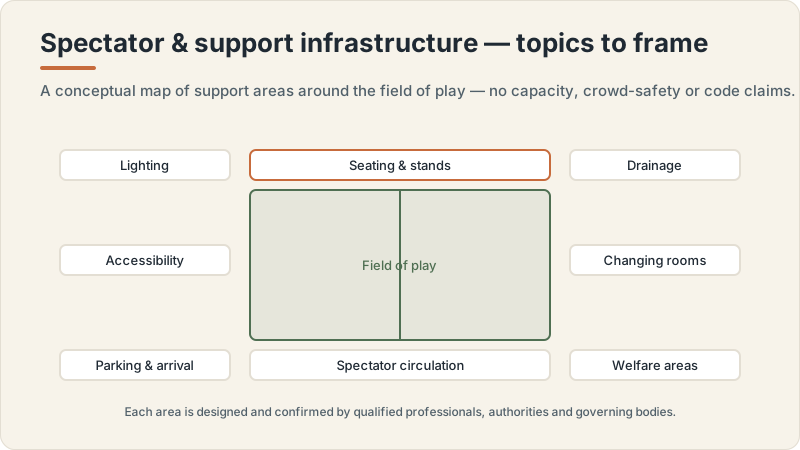
Spectator and support infrastructure concept
Conceptual editorial diagram — not a construction drawing, specification, to-scale plan or proof of a real project. It is not engineering, structural, fire/life-safety, crowd-safety or accessibility-compliance guidance. Capacities, dimensions, standards, requirements and costs vary by facility type, audience, site, use case and governing body, and are confirmed with qualified professionals, relevant authorities and governing bodies. Build Design Hub does not design, build, inspect, certify, recommend or match anyone.
What this guide helps you prepare
This guide helps you prepare for the conversations and documents that precede any seating decision: a written brief that captures who will watch, how long they stay and what the venue is for; a list of questions for designers and consultants; and a structure for comparing what different suppliers and professionals propose. It focuses on planning-level thinking, the kind that belongs in a stakeholder workshop or a brief, rather than on anything that should be engineered, specified or certified. Treat it as a way to clarify your own intentions so that the professionals you engage can do their work against a clear and honest set of requirements.
It does not tell you how many seats to provide, what gradients or dimensions to use, how to design sightlines, how to keep crowds safe, or which seating product to buy. Those questions sit with qualified professionals, relevant authorities and the governing body for your sport, and the correct answers vary by location, facility type, audience, site and use case. What this guide can do is help you describe your situation accurately, surface the trade-offs early, and ask better questions, so the brief you hand over reflects real needs rather than assumptions.
- Clarify the venue's purpose: casual viewing, organised matches, multi-use events or a mix
- Capture who watches and for how long, so comfort and access can be discussed honestly
- Assemble questions for designers, accessibility consultants and seating suppliers
- Build a like-for-like structure to compare what different professionals propose
- Separate planning-level intent from anything that must be engineered or certified
- Record open questions to confirm with qualified professionals and governing bodies
Seating types at a high level
At a planning level it helps to understand the broad families of spectator seating rather than any specific product. Fixed seating is built in and stays in place: this includes simple bench or tiered seating, and individual seats with or without backs and armrests. Demountable or temporary seating, such as modular grandstands brought in for events, offers flexibility for venues whose use changes through the year. Retractable or telescopic systems fold away to free a floor for other activities, which matters in multi-use halls. Standing viewing areas and informal seating, where permitted and appropriate, are another category entirely. Each family carries different implications for comfort, maintenance, the rest of the building and the questions you will need to ask, and whether any given option suits your venue is a matter for professionals to assess.
These are descriptive categories to inform a conversation, not a menu to choose from unaided. The suitability of fixed versus retractable seating, of permanent versus temporary provision, and of seats versus benches depends on the sport, the audience, the site, how often the space changes use, and requirements set by authorities and governing bodies. Build Design Hub does not recommend, rank or verify seating products or the suppliers who provide them. The value of knowing the families is that you can ask a designer or supplier why one approach is proposed over another, and understand the trade-offs they describe, rather than accepting a single option without context.
- Note which seating families seem relevant: fixed, demountable, retractable or informal
- Ask whether the space needs to convert for other uses, which affects retractable options
- Distinguish benches, backless seats and seats with backs or armrests at a comfort level
- Consider how temporary or event seating would be stored, transported and reinstated
- List materials and finishes to discuss for durability, weather exposure and upkeep
- Treat every type as a question for professionals, not a decision to make alone
Sightlines, comfort and accessibility questions to raise
Three themes tend to dominate planning-level seating conversations: whether people can actually see, whether they are comfortable for the time they stay, and whether everyone can take part. Sightlines are about an unobstructed, sensible view of the action, but how that is achieved involves geometry, structure and safety that belong firmly with designers and engineers. Comfort covers seat type, weather protection, the time spectators realistically spend watching, and the difference between a brief drop-in and a full event. Accessibility covers inclusive viewing positions, routes, companion seating and equitable provision. Rather than trying to resolve these yourself, your job in preparation is to raise them clearly and early so they are designed in, not retrofitted.
It is important not to convert these themes into rules of thumb. The right viewing angles, seat spacing, weather provision and accessible arrangements vary by location, facility type, audience, site and governing body, and they must be confirmed with qualified professionals and the relevant authorities. Accessibility in particular is governed by requirements that differ between jurisdictions, so it should be planned with an accessibility consultant and confirmed locally rather than estimated. The practical output of this section is a set of questions, framed around your real audience and use, that you can put to designers and consultants so their proposals address sightlines, comfort and inclusion together.
- Ask how proposed seating keeps views of play clear of fencing, structure or other spectators
- Discuss comfort against realistic dwell time, indoor or outdoor setting and weather exposure
- Raise accessible and companion viewing positions early and ask how they integrate, not bolt on
- Ask how spectators reach seating and how routes relate to the wider facility circulation
- Confirm which accessibility and viewing requirements apply with consultants and local authorities
- Avoid fixing your own angles, spacing or provision figures; record them as questions instead
Planning questions before speaking with professionals
Before you sit down with a designer, accessibility consultant or supplier, it is worth answering a set of questions among your own stakeholders. These shape the brief and prevent professionals from having to guess at your intentions. Who is the audience, and how does their number and behaviour change between a quiet weekday and a busy event? How long do people typically stay, and does that point toward simple benches or more comfortable individual seats? Does the space need to convert for other activities, which would steer the conversation toward retractable or demountable systems? Working these through internally turns a vague wish for seating into a brief professionals can respond to.
It also helps to be honest about constraints and ambitions you have not yet validated. What does the wider site allow, what does the venue need to do over its lifetime, and what operational and maintenance commitment is realistic for whoever runs it? You will not have firm answers to everything, and that is expected; the aim is to record what you know, flag what you do not, and identify which items must be confirmed with qualified professionals and governing bodies. A brief that distinguishes settled decisions from open questions is far more useful than one that quietly assumes.
- Who watches, and how does the audience differ between routine use and event days?
- How long do spectators typically stay, and what does that imply for seat comfort?
- Does the space need to convert for other uses, suggesting retractable or temporary seating?
- What inclusive and accessible viewing needs should be designed in from the start?
- Who will operate and maintain the seating, and what upkeep is realistic for them?
- Which items are settled decisions, and which must be confirmed with professionals?
Questions for qualified professionals
Once your brief is drafted, the next step is to ask qualified professionals the questions only they can answer. Designers, structural engineers, accessibility consultants and safety professionals each bring expertise that no general guide can replace, and the questions below are framed to draw that expertise out rather than to imply any answer. Ask why a particular seating approach is proposed for your venue, how sightlines are being achieved, how accessible and inclusive provision is being designed in, and what requirements from authorities and governing bodies apply to your specific situation. Good professionals will explain their reasoning and tell you what still needs confirming.
Use the same discipline when comparing what different professionals or suppliers propose. Ask each to set out their assumptions, what they have and have not included, and which matters they consider out of their scope and in someone else's. Because Build Design Hub does not design, certify, recommend, rank, verify or match suppliers or contractors, the comparison is yours to make with professional input; this guide only helps you structure it. Keep a record of who is responsible for what, and confirm anything touching safety, capacity, accessibility compliance or standards with the qualified professionals and authorities responsible for it.
- Why is this seating approach proposed for our venue, audience and use case?
- How are sightlines, comfort and accessible viewing being addressed together in the design?
- Which authority, governing-body and accessibility requirements apply to our situation, and who confirms them?
- What is included in your scope, and what falls to other professionals or specialists?
- How should we compare your proposal against others on a like-for-like basis?
- Who holds responsibility for safety, capacity and compliance matters in this project?
What this does not replace
This is an educational project-preparation resource only. It is not a construction manual and not engineering, architectural, structural, civil, fire or life-safety, crowd-safety, accessibility-compliance, permit, zoning, legal, tax or procurement advice. It does not design, specify, certify, inspect or approve anything, and it is not an estimate, quote, price or capacity recommendation. Requirements, standards, capacities and costs vary by location, facility type, audience, site, use case, design team, supplier, contractor and governing body, and are confirmed with qualified professionals, relevant authorities and governing bodies.
Build Design Hub does not design, build, engineer, inspect, certify, recommend, rank, verify, introduce, broker or match suppliers or contractors, and HELPERG LLC is publisher/operator only. Use this resource to prepare your own thinking, then have qualified professionals you engage directly review your project. Decisions about engineering, safety, compliance, procurement and suitability must rest on those professionals, the relevant authorities and the governing bodies for your sport and location.
- Not a construction manual and not engineering, structural or civil design
- Not fire/life-safety, crowd-safety, evacuation or accessibility-compliance advice
- Not permit, zoning, legal, tax or procurement advice
- Not a supplier or contractor recommendation, ranking, directory or matching service
- Not an estimate, quote, price or capacity recommendation — requirements and costs vary
- Qualified professional review is required before any project decision
Spectator seating preparation worksheet
- 1Record the venue's primary purpose and the events or activities seating must serve
- 2Describe the audience and how it changes between routine use and busy event days
- 3Note typical dwell time, indoor or outdoor setting, and weather exposure to discuss
- 4List the seating families that seem relevant: fixed, demountable, retractable, informal
- 5Capture whether the space must convert for other uses, affecting retractable options
- 6Write down comfort priorities to raise: seat type, backs, armrests, shelter or shade
- 7Record inclusive and accessible viewing needs to design in from the start
- 8Note how spectators would reach seating and how routes relate to the facility
- 9Gather the questions you want to ask designers, consultants and suppliers
- 10Identify which authorities and governing bodies may set requirements to confirm
- 11Mark which decisions are settled and which remain open questions for professionals
- 12List the maintenance and operational commitments realistic for whoever runs the venue
- 13Prepare a like-for-like structure to compare professional and supplier proposals
- 14Flag every safety, capacity and compliance item for confirmation with qualified professionals
Common mistakes to avoid
- Treating seating type as a buying decision before the venue's purpose and audience are clear
- Fixing your own viewing angles, seat spacing or capacity figures instead of asking professionals
- Leaving accessible and inclusive viewing as a retrofit rather than designing it in early
- Assuming requirements are universal when they vary by location, facility type and governing body
- Choosing comfort level without being honest about how long spectators actually stay
- Overlooking whether the space needs to convert for other uses before ruling out retractable seating
- Ignoring storage, transport and reinstatement when considering temporary or event seating
- Forgetting to plan who will maintain and operate the seating over the facility's lifetime
When to involve a professional
- When sightlines, viewing angles or any seating geometry need to be designed or assessed
- When anything structural, load-bearing or safety-related about seating is involved
- When accessibility and inclusive viewing provision must be planned and confirmed locally
- When capacity, crowd-safety or evacuation considerations enter the conversation
- When authority or governing-body requirements for your sport or venue need confirming
- When comparing professional or supplier proposals that touch compliance, safety or certification
Frequently asked questions
Questions readers ask about this topic
Does Build Design Hub recommend seating suppliers or tell me how many seats I need?
No. Build Design Hub is an educational planning resource and does not recommend, rank, verify, broker or match suppliers or contractors, and it does not provide capacities, dimensions, prices or requirements. It can help you prepare a brief and questions, but figures and product decisions should come from qualified professionals and suppliers, and requirements should be confirmed with the relevant authorities and governing body.
What are the main types of spectator seating to be aware of?
At a high level, planning conversations often distinguish fixed seating built in place, demountable or temporary seating brought in for events, retractable or telescopic systems that fold away for multi-use spaces, and informal or standing viewing where appropriate. These are descriptive categories to inform a discussion. Which suits your venue is a matter for designers and suppliers to assess against your specific situation.
How should I handle sightlines and accessibility when planning seating?
Raise both early and clearly, but do not try to resolve them yourself. Sightlines involve geometry, structure and safety that belong with designers and engineers, and accessible viewing is governed by requirements that vary by location and should be planned with an accessibility consultant and confirmed locally. Your role in preparation is to ensure these themes are designed in from the start rather than retrofitted.
Can this guide tell me whether fixed or retractable seating is better for my venue?
No. The right choice depends on your sport, audience, site, how often the space changes use, and requirements set by authorities and governing bodies, and it should be assessed by qualified professionals. This guide can help you understand the trade-offs and frame the questions to ask, so you can discuss the options knowledgeably rather than choose one unaided.
Keep reading