
Who this guide is for
- Owners and boards of clubs or venues preparing to receive a completed facility and wanting a structured handover-document brief
- Municipalities and public bodies planning close-out expectations for a publicly funded stadium or community sports facility
- Schools, colleges and universities taking on a new or refurbished sports venue and its operating records
- Developers and project sponsors coordinating handover expectations across multiple delivery parties
- Facility managers and operations leads who will inherit the O&M manuals, as-builts, certificates and warranties
- Project teams and owner's representatives assembling questions before handover meetings with qualified professionals
Planning diagram
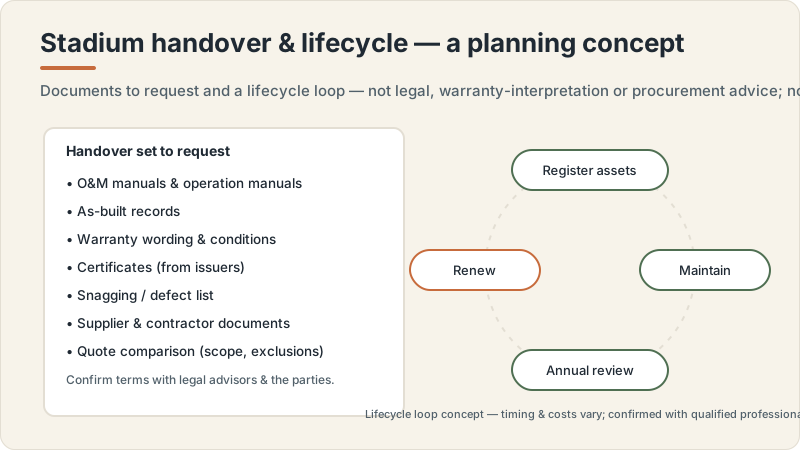
Stadium handover and lifecycle concept
Conceptual editorial diagram — not a construction drawing, specification, to-scale plan or proof of a real project. It is not engineering, structural, fire/life-safety, crowd-safety or accessibility-compliance guidance. Capacities, dimensions, standards, requirements and costs vary by facility type, audience, site, use case and governing body, and are confirmed with qualified professionals, relevant authorities and governing bodies. Build Design Hub does not design, build, inspect, certify, recommend or match anyone.
What this guide helps you prepare
This guide helps you build a preparation framework for discussing the stadium handover documentation set before, during and after those conversations with your qualified project team. It aims to turn a vague expectation that documents will arrive into a specific, written list of what to request, in what form, and what to confirm about each item, so that gaps are surfaced early rather than after occupation. The output you are preparing is a question set and a document register, not a completed handover pack and not a judgement about whether any document is adequate.
It also helps you frame the handover conversation as an ongoing thread through the project rather than a single event at the end. Preparing early lets you ask, at the right milestones, how documents will be collected, formatted, indexed and transferred, and who is responsible for each part. Because requirements and expectations vary by location, facility type, use case, governing body, owner, site, authority, professional team and project scope, treat every item below as a prompt to confirm with qualified professionals and relevant authorities rather than as a standard, list or requirement you can rely on.
- Draft a plain-language description of what your handover documentation brief needs to cover for your facility and intended uses
- Prepare questions about which document categories apply to your project, to raise with your qualified team
- List the stakeholders who will use each document category (operations, maintenance, finance, safety leads) and note who to ask about each
- Prepare questions about the format, indexing and transfer method you should expect the set to arrive in
- Note which topics are outside this guide and must be routed to qualified professionals, authorities or governing bodies
- Record open questions and assumptions to revisit as the project progresses toward handover
Framing the documentation set: O&M manuals, as-builts, certificates and warranties
The handover documentation set is usually discussed as several related but distinct groups, and preparing separate questions for each helps prevent one strong area from masking a weak one. Operation and maintenance (O&M) manuals typically describe how installed systems are meant to be operated and maintained; as-built records typically show what was actually constructed and installed as opposed to what was originally drawn; certificates typically evidence that particular checks, tests or approvals took place; and warranties typically set out supplier or manufacturer commitments on specific products or systems. This guide does not tell you what any of these documents must contain or whether a given document is valid, complete or acceptable; those determinations belong to qualified professionals and the relevant authorities and governing bodies.
For a stadium the set can be large and cross many systems, from pitch and turf systems and floodlighting to seating areas, catering, broadcast, IT, mechanical and electrical services, drainage and access control. Rather than trying to assess any of these yourself, prepare questions about how the set is structured, whether each system is represented, how items map to physical assets, and how you will locate a given manual, drawing, certificate or warranty when you need it. The aim is to understand coverage and organisation at a preparation level, then confirm scope, sufficiency and interpretation with your qualified team.
- What document categories should be represented for our facility, and how will each be labelled and indexed? (confirm with qualified professionals)
- How will as-built records be distinguished from earlier design drawings, and how will changes be reflected?
- How will each certificate, manual and warranty be linked to the specific asset, system or area it relates to?
- Which stadium systems (pitch, lighting, services, access, catering, broadcast, IT) should we expect to see documented, and who confirms that?
- In what formats (searchable digital, native files, physical copies) will each category be provided, and who owns the master set?
- What questions should we ask a qualified professional about whether coverage of the set is complete for our uses?
Requesting and confirming: how to structure the ask around each document group
A useful preparation habit is to separate what you request from what you confirm. Requesting is about naming the items you expect to receive and the form you expect them in; confirming is the follow-up conversation, led by qualified professionals, about whether what arrived matches what was expected and is fit for its intended use. Preparing both halves in advance means you can raise the request early enough to influence how documents are compiled, and you can plan who will carry out the confirmation review rather than assuming it will happen automatically. This guide does not perform, replace or evaluate that confirmation review, and it does not interpret certificates or warranties.
It also helps to think about the lifecycle of the set after handover: who holds it, how it is kept current when systems are altered, how warranty windows and renewal or notification points are tracked, and how future operators will find what they need. Preparing questions about custody, updating and accessibility now can prevent a documentation set from becoming stale or scattered within months of occupation. As always, warranty terms, certificate meaning, renewal obligations and any compliance implications must be confirmed with qualified professionals, relevant authorities and governing bodies, because these vary by location, facility type, use case, governing body, owner, site, authority, professional team and project scope.
- Prepare a written request list naming each document category and the form you expect it in, to discuss with your team
- Note who will lead the confirmation review of each category, and record that this is a professional task not a self-check
- Prepare questions about who holds the master set after handover and how it will be kept current when systems change
- List the warranty-related dates, windows and notification points you want tracked, and ask a professional how to confirm them
- Prepare questions about how operators will locate a specific manual, drawing or certificate when a system needs attention
- Record which confirmations (validity, sufficiency, compliance) you must route to qualified professionals and authorities
Planning questions before speaking with professionals
Before you sit down with your qualified project team, it helps to have organised your own thinking so the conversation is efficient and specific to your facility. That means writing down what you already know about the venue and its intended uses, what you are unsure about, and what decisions depend on the handover documentation set arriving in a usable form. Preparing this internally does not require any technical judgement; it is about clarity on your priorities, your stakeholders and your open questions, so that professionals can advise against a clear brief rather than starting from scratch.
Use this stage to distinguish preparation questions you can answer yourselves (who will use the documents, where they will be stored, who is accountable) from technical or interpretive questions that must go to qualified professionals, authorities or governing bodies (whether a certificate is valid, whether coverage is complete, what a warranty term means). Keeping that line clear prevents the team from either over-relying on self-assessment or under-using their own knowledge of how the facility will actually be operated.
- What are our facility's intended uses and event types, and which stakeholders will rely on the handover set for each?
- Which document categories are we assuming will arrive, and have we written down where that assumption came from?
- Where will the master documentation set live, who will be accountable for it, and how will access be managed?
- What open questions and unknowns do we have that we should bring to qualified professionals rather than resolve ourselves?
- How will we track that requested items have actually been received, without judging whether they are sufficient?
- What internal deadlines or milestones make early handover-document conversations important for our project?
Questions for qualified professionals
When you engage qualified professionals, your prepared question set becomes the agenda. These conversations are where scope, sufficiency, validity and interpretation are actually determined, so frame your questions to draw on their expertise rather than to seek confirmation of your own conclusions. Because so much varies by location, facility type, use case, governing body, owner, site, authority, professional team and project scope, ask them to identify what applies specifically to your project and to flag anything they consider outside their remit that needs a different specialist, an authority or a governing body.
Bring your document register, your request list and your list of assumptions, and ask the team to help you understand where you may have gaps in coverage, custody, updating or accessibility. Remember that Build Design Hub does not carry out any of this work: it does not design, build, engineer, inspect, certify, verify, recommend, rank or match anyone, and it gives no legal, insurance or compliance advice. The professionals you engage are the ones who assess, interpret and advise on the handover documentation set.
- Which document categories are relevant to our specific facility and uses, and which do you consider out of your remit?
- How would you confirm whether the coverage of the handover set is complete for how we intend to operate?
- What should we understand about the meaning, scope and limits of the certificates and warranties in our set?
- Who should assess as-built accuracy, and what process do you recommend for keeping records current after handover?
- Which questions must we take to relevant authorities or governing bodies rather than resolve within the project team?
- What ongoing custody, updating and access practices would you advise for the documentation set after occupation?
What this does not replace
This is an educational planning resource only. It is not a stadium construction manual and not structural, architectural, seating or stand engineering, crowd-safety, crowd-flow, evacuation, fire or life-safety, or accessibility-compliance advice, and it is not permit, zoning, inspection, certification, legal, tax, insurance or procurement advice. It does not design, build, engineer, specify, certify, inspect or approve anything, gives no capacities, dimensions, loads, revenue, ROI or costs, and offers no warranty interpretation or estimate. Requirements, standards, capacities and costs vary by location, facility type, use case, governing body, owner, site, authority, professional team and project scope, and are confirmed with qualified professionals, relevant authorities and governing bodies.
Build Design Hub does not design, build, engineer, inspect, certify, recommend, rank, verify, introduce, broker or match suppliers, contractors, consultants or professionals, and HELPERG LLC is publisher/operator only. Use this resource to prepare your own thinking and briefs, then have qualified professionals you engage directly review your project. Decisions about design, engineering, structure, crowd safety, fire and life safety, accessibility, compliance, capacity, procurement and cost must rest on those professionals, the relevant authorities and the governing bodies for your sport and location.
- Not a stadium construction manual and not structural, architectural or seating/stand engineering
- Not crowd-safety, crowd-flow, evacuation, fire/life-safety or accessibility-compliance advice
- Not permit/zoning, inspection, certification, warranty-interpretation, legal, tax, insurance or procurement advice
- Not a supplier, contractor, consultant or professional recommendation, ranking, directory or matching service
- Not an estimate and gives no capacity, dimension, revenue, ROI or cost figures — requirements and costs vary
- Qualified professional review is required before any stadium project decision
Stadium handover documentation preparation register
- 1Record the facility's intended uses and event types, and note which stakeholders rely on the handover set for each
- 2List the document categories you expect (O&M manuals, as-builts, certificates, warranties) and who confirms which apply
- 3Note, for each stadium system, whether you expect it represented in the set, and mark who to ask to confirm coverage
- 4Draft a written request list naming each item and the form (searchable digital, native, physical) you expect it in
- 5Record who will hold the master documentation set after handover and who is accountable for keeping it current
- 6Note who will lead the professional confirmation review of each category, marking it as a professional task
- 7Log the warranty-related dates, windows and notification points you want tracked, to confirm with a professional
- 8Capture how operators will locate a specific manual, drawing or certificate when a system needs attention
- 9List your internal assumptions about the handover set and where each assumption came from
- 10Record open questions and unknowns to route to qualified professionals, authorities or governing bodies
- 11Note internal milestones that make early handover-document conversations important for your timeline
- 12Track which requested items have been received, without judging whether any item is sufficient or valid
- 13Keep a running list of topics you have confirmed are outside this guide and require specialist input
Common mistakes to avoid
- Treating handover documentation as an automatic end-of-project deliverable and only raising expectations after occupation
- Stating that a fixed set of documents, certificates or capacities is required, instead of confirming what applies with qualified professionals
- Assuming as-built records match design drawings without planning who will assess accuracy
- Self-assessing whether a certificate is valid or a warranty term is met, rather than routing interpretation to a professional
- Failing to name who holds the master set after handover, leaving documents scattered or out of date within months
- Overlooking warranty windows and notification points because no one was assigned to track dates
- Requesting documents without specifying the format, indexing or transfer method you can actually use
- Skipping professional and authority review by assuming a strong document set in one area covers gaps in another
When to involve a professional
- When you need to determine whether the handover documentation set is complete for how you intend to operate the facility
- When certificates or warranties need to be interpreted for meaning, scope, validity or renewal or notification obligations
- When as-built accuracy must be assessed against what was actually constructed and installed
- When any compliance, legal, insurance, procurement or tax implication of the documentation set arises
- When a question belongs to a relevant authority or governing body rather than to the project team
- When you are unsure whether a topic is within your team's remit or needs a different specialist
Frequently asked questions
Questions readers ask about this topic
Does Build Design Hub review, certify or approve our stadium handover documents?
No. Build Design Hub is an educational project-preparation resource. It does not design, build, engineer, inspect, certify, verify or approve anything, and it does not recommend, rank, introduce or match suppliers, contractors or professionals. It provides no capacities, costs, requirements, or legal, insurance or compliance advice. Assessment, interpretation and approval of a handover documentation set are tasks for qualified professionals, relevant authorities and governing bodies.
What documents should be in a stadium handover set?
This guide does not state what must be in any handover set, because that varies by location, facility type, use case, governing body, owner, site, authority, professional team and project scope. Handover sets are commonly discussed in terms of O&M manuals, as-built records, certificates and warranties, but which items apply to your facility, and whether coverage is complete, should be confirmed with qualified professionals.
Can I use this guide to confirm that a certificate or warranty is valid?
No. This guide only helps you prepare questions to ask. It does not interpret certificates or warranties and does not tell you whether any document is valid, sufficient or acceptable. The meaning, scope, limits and any obligations attached to certificates and warranties must be confirmed with qualified professionals and the relevant authorities or governing bodies.
When should we start preparing our handover-document questions?
Preparation is most useful early, so requests can influence how documents are compiled rather than being raised after the delivery team has moved on. This guide helps you frame that early conversation, but the timing, milestones and responsibilities that apply to your project should be confirmed with your qualified project team.
Keep reading