
Who this guide is for
- Owners, clubs, and developers who want a structured way to research potential stadium suppliers before shortlisting
- Municipalities, schools, and public bodies preparing internal supplier-research records ahead of a formal procurement process
- Project teams and owner's representatives assembling documentation and question sets for supplier conversations
- Facility managers who will inherit supplier relationships and want handover and lifecycle questions captured early
- Stakeholders drafting a project brief who need to understand which supplier categories a stadium program may involve
- Anyone comparing supplier claims who wants a checklist of what to confirm independently with qualified professionals
Planning diagram
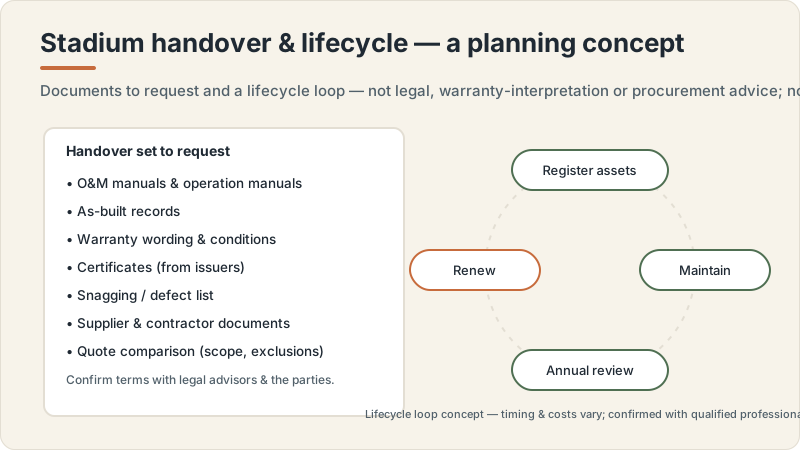
Stadium handover and lifecycle concept
Conceptual editorial diagram — not a construction drawing, specification, to-scale plan or proof of a real project. It is not engineering, structural, fire/life-safety, crowd-safety or accessibility-compliance guidance. Capacities, dimensions, standards, requirements and costs vary by facility type, audience, site, use case and governing body, and are confirmed with qualified professionals, relevant authorities and governing bodies. Build Design Hub does not design, build, inspect, certify, recommend or match anyone.
What this guide helps you prepare
This guide helps you build a supplier-research framework you can fill in yourself. Rather than pointing you to specific suppliers, it helps you decide which categories your stadium program may touch, what evidence you might reasonably ask each candidate to provide, and how to keep your notes organized so that qualified professionals can review them later. The aim is preparation: turning a vague sense of 'we need suppliers' into a structured record of categories, questions, requested documents, and open items to confirm. It does not tell you which suppliers to choose, and it makes no claim about any supplier's suitability, quality, or standing.
It also helps you separate two different activities that are easy to blur: gathering information and making decisions. Research is about collecting comparable, verifiable information and noting where claims need independent confirmation. Decisions about scope, contracting, safety, compliance, and technical fitness belong with your qualified professional team, relevant authorities, and applicable governing bodies. Keeping that boundary clear early tends to make later professional review faster, because your team receives organized questions and documents instead of assumptions presented as conclusions.
- Draft a list of supplier categories your project brief may involve, marked as provisional pending professional scope confirmation
- Record what each supplier claims versus what you have independently confirmed
- Prepare a consistent set of questions so candidate responses can be compared like-for-like
- Note which items are outside research and belong to qualified professionals or authorities
- Keep a single register of requested documents and their status (requested, received, under review)
- Capture open questions and assumptions so nothing is silently treated as a fact
Mapping the supplier categories a stadium program may involve
A stadium program can involve a wide range of supplier categories, and mapping them is a research task, not a procurement decision. Before you contact anyone, it helps to sketch the categories your brief might touch and mark each as provisional until your professional team confirms scope. Categories can span structural and building-envelope elements, seating and spectator systems, playing surfaces, lighting, audiovisual and scoreboards, power and mechanical services, drainage and groundworks, access control, hospitality and catering fit-out, and ongoing operations and maintenance services. Which of these actually apply, and how they are packaged, depends entirely on your specific project; treat the list as a prompt to discuss, not a definition of what your stadium needs.
As you map categories, resist the urge to attach numbers, capacities, or standards to them from memory or from other projects. Requirements vary by location, facility type, use case, governing body, owner, site, authority, professional team, and project scope, and only qualified professionals and relevant authorities can confirm what applies to you. A useful research habit is to write each category as a question ('Which surface systems might this brief involve, and who confirms that?') rather than as a statement. This keeps your framework honest and makes it easier for professionals to correct or narrow the scope when they review it.
- List candidate categories (for example, structure, seating, surfaces, lighting, services, access, operations) as provisional prompts
- For each category, note who on the professional team would confirm whether it applies and how it is scoped
- Flag categories that may overlap or be bundled, and record the questions that overlap raises
- Avoid attaching capacities, dimensions, loads, or standards to any category as if they were fixed
- Identify which categories relate to ongoing operations and handover, not just initial supply
- Mark any category where you are unsure whether it is a supply, install, or service scope
Documentation to request and claims to confirm independently
A supplier-research framework becomes far more useful when it distinguishes what a supplier tells you from what you have confirmed for yourself. For each candidate, you can prepare a consistent list of documentation to request so responses are comparable: company and registration details, references or examples of comparable work, insurance and licensing evidence, relevant quality or process documentation, and any statements about how they handle their own scope, subcontracting, and warranties. Requesting a document is not the same as verifying it, and receiving a claim is not the same as confirming it. Your framework should track both the request status and the confirmation status separately.
Independent confirmation is where qualified professionals and relevant authorities are essential. Claims about certifications, standards, capacities, performance, compliance, or approvals are things to confirm with the issuing body, the relevant authority, or a suitable professional, not things to accept because they appear on a brochure or website. Build Design Hub does not verify suppliers or their claims and cannot tell you whether any statement is accurate. Your role in research is to collect the claim, note the source, and record the appropriate independent check to run, so your professional team can complete verification within their remit.
- Prepare a standard documentation request list so every candidate is asked for the same items
- Track each document by status: requested, received, incomplete, or under professional review
- Log every material claim (certifications, standards, performance) with its source and date
- For each claim, note the independent check and who would perform it (professional or issuing authority)
- Ask how the supplier handles subcontracting, and record which parts of scope may sit with others
- Keep confirmation separate from receipt: a received document is not a confirmed fact
Planning questions before speaking with professionals
Before you involve qualified professionals, it helps to organize your own thinking so their time is spent on judgment rather than on assembling basics. These planning questions are for you and your internal stakeholders. They clarify what you actually know, what you are assuming, and what you need confirmed. Working through them tends to surface gaps early, such as categories you had not considered, claims you were about to accept without a source, or scope that no one has clearly assigned. None of these questions ask you to decide technical, safety, or compliance matters; they simply prepare you to ask better questions of the people who can.
Capturing your answers in writing also creates a record you can hand to your professional team. When your notes show which supplier categories are provisional, which documents you have requested, and which claims are still unconfirmed, professionals can focus on what matters and correct anything you have framed incorrectly. Treat every answer as a starting point to be reviewed, and mark anything you are unsure about clearly rather than resolving it yourself.
- Have we written our supplier categories as provisional prompts rather than fixed requirements?
- For each claim we have collected, have we recorded the source and the confirmation still outstanding?
- Which questions are we tempted to answer ourselves that actually belong to professionals or authorities?
- Is our documentation request list identical across candidates so responses stay comparable?
- Have we separated 'what the supplier says' from 'what we have independently confirmed'?
- What operations, handover, and lifecycle questions should we capture now rather than later?
Questions for qualified professionals
When you bring your research to qualified professionals, relevant authorities, and applicable governing bodies, the goal is to have your framework reviewed and corrected, not to have your conclusions confirmed. These questions help you get the most from that review. They ask professionals to tell you which categories actually apply, which requirements govern your specific project, which claims genuinely need independent verification, and how supplier scope should be defined so that nothing falls between parties. Because requirements vary by location, facility type, use case, governing body, owner, site, authority, professional team, and project scope, only your professionals and the relevant authorities can answer them for your project.
Bring your questions and documents in an organized form and be explicit that you are seeking their professional judgment. Build Design Hub does not provide these answers, does not verify suppliers, and does not act as your professional team. The questions below are prompts to raise with the appropriate qualified professionals and authorities; treat their responses, not this guide, as the basis for any decision.
- Which supplier categories does our specific project actually require, and how should scope be defined for each?
- Which requirements, standards, or approvals apply to us, and which authority or governing body confirms them?
- Which supplier claims should be independently verified, and who is the correct body to verify each?
- How should we structure documentation requests so they support later procurement and handover?
- Where are the interface and responsibility gaps between supplier categories that we should close in scope?
- What operations, maintenance, warranty, and lifecycle questions should we ask suppliers before comparing options?
What this does not replace
This is an educational planning resource only. It is not a stadium construction manual and not structural, architectural, seating or stand engineering, crowd-safety, crowd-flow, evacuation, fire or life-safety, or accessibility-compliance advice, and it is not permit, zoning, inspection, certification, legal, tax, insurance or procurement advice. It does not design, build, engineer, specify, certify, inspect or approve anything, gives no capacities, dimensions, loads, revenue, ROI or costs, and offers no warranty interpretation or estimate. Requirements, standards, capacities and costs vary by location, facility type, use case, governing body, owner, site, authority, professional team and project scope, and are confirmed with qualified professionals, relevant authorities and governing bodies.
Build Design Hub does not design, build, engineer, inspect, certify, recommend, rank, verify, introduce, broker or match suppliers, contractors, consultants or professionals, and HELPERG LLC is publisher/operator only. Use this resource to prepare your own thinking and briefs, then have qualified professionals you engage directly review your project. Decisions about design, engineering, structure, crowd safety, fire and life safety, accessibility, compliance, capacity, procurement and cost must rest on those professionals, the relevant authorities and the governing bodies for your sport and location.
- Not a stadium construction manual and not structural, architectural or seating/stand engineering
- Not crowd-safety, crowd-flow, evacuation, fire/life-safety or accessibility-compliance advice
- Not permit/zoning, inspection, certification, warranty-interpretation, legal, tax, insurance or procurement advice
- Not a supplier, contractor, consultant or professional recommendation, ranking, directory or matching service
- Not an estimate and gives no capacity, dimension, revenue, ROI or cost figures — requirements and costs vary
- Qualified professional review is required before any stadium project decision
Stadium supplier-research preparation worksheet
- 1Record each candidate supplier category as a provisional prompt, marked pending professional scope confirmation
- 2Note, for every category, which professional or authority would confirm whether and how it applies
- 3Assemble one standard documentation request list to use identically across all candidates
- 4Log every requested document with its status: requested, received, incomplete, or under review
- 5Record each material supplier claim alongside its source and the date you captured it
- 6For each claim, write down the independent check needed and who would perform it
- 7Keep 'what the supplier states' visibly separate from 'what has been independently confirmed'
- 8Capture how each candidate describes its own subcontracting, warranties, and scope boundaries
- 9List interface points between categories where responsibility could fall between parties
- 10Gather operations, maintenance, handover, and lifecycle questions to raise before comparing options
- 11Mark every requirement, capacity, dimension, standard, timeline, or cost as 'to confirm', never as fact
- 12Note which items in this worksheet you must not resolve yourself and will route to professionals
- 13Prepare a single page summarizing open questions and assumptions to hand to your professional team
- 14Record which relevant authorities or governing bodies you will need to consult and for what
Common mistakes to avoid
- Treating a supplier's stated capacity, dimension, or standard as a fixed fact instead of an item to confirm with a qualified professional or authority
- Assuming requirements from another project or venue apply to yours, when they vary by location, facility type, use case, governing body, owner, site, authority, professional team, and scope
- Confusing receiving a document with confirming a claim, and recording brochure statements as verified
- Skipping professional review and using self-gathered research as the basis for scope, safety, or compliance decisions
- Asking candidates different questions, so responses cannot be compared like-for-like
- Leaving interface and responsibility gaps between supplier categories unrecorded, so scope falls between parties
- Deferring operations, maintenance, handover, and lifecycle questions until after suppliers are chosen
- Expecting Build Design Hub or any publisher to verify, rank, or match suppliers rather than doing independent confirmation with professionals and authorities
When to involve a professional
- When you need to confirm which supplier categories your specific stadium project actually requires and how their scope should be defined
- When any requirement, standard, certification, capacity, load, dimension, or approval must be established for your project
- When supplier claims relate to compliance, safety, structural, accessibility, or life-safety matters that require qualified judgment
- When you are ready to move from informal research into a formal procurement, contracting, or tender process
- When interface, responsibility, or warranty gaps between supplier categories need to be closed within a defined scope
- When operations, maintenance, handover, or lifecycle obligations must be assessed for your particular facility and site
Frequently asked questions
Questions readers ask about this topic
Does Build Design Hub recommend, rank, verify, or match stadium suppliers?
No. Build Design Hub is an educational publisher operated by HELPERG LLC. It does not design, build, engineer, inspect, certify, recommend, rank, verify, introduce, broker, or match suppliers, contractors, consultants, or professionals, and it does not maintain a directory. It also does not provide capacities, dimensions, costs, or requirements. This guide only helps you prepare your own research framework so qualified professionals and relevant authorities can review it.
Can this guide tell me what my stadium needs from each supplier category?
No. Which categories apply, and what each must provide, depends on your project. Requirements vary by location, facility type, use case, governing body, owner, site, authority, professional team, and project scope. This guide gives you questions to raise; qualified professionals and relevant authorities confirm what actually applies to you.
How should I handle a supplier claim I cannot confirm myself?
Record the claim, note its source and date, and write down the independent check that would confirm it and who would perform that check. Claims about certifications, standards, performance, or approvals should be confirmed with the issuing body, relevant authority, or a suitable qualified professional, not accepted at face value. Confirmation is part of professional review, not something this guide can do for you.
Is my self-gathered research enough to choose suppliers or set scope?
No. Research is for collecting comparable, verifiable information and flagging what needs confirmation. Decisions about scope, contracting, safety, compliance, and technical fitness belong with your qualified professional team, relevant authorities, and applicable governing bodies. Use your notes to prepare those conversations, not to replace them.
Keep reading