
Who this guide is for
- Stadium owners and holding companies preparing to procure or renew service and maintenance agreements
- Sports clubs and their operations staff responsible for running a home venue day to day
- Municipalities, councils and public bodies commissioning or overseeing a community stadium
- Schools, colleges and universities planning maintenance arrangements for a sports venue
- Developers and project teams assembling procurement and handover documentation
- Facility managers and technical directors who will live with the contract after handover
Planning diagram
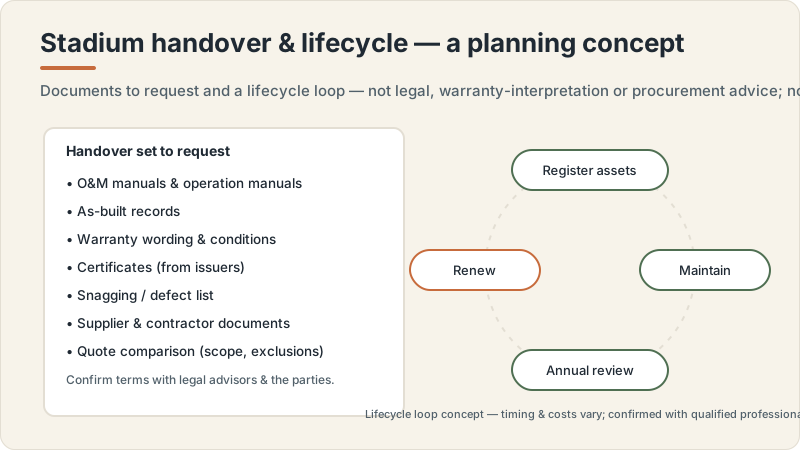
Stadium handover and lifecycle concept
Conceptual editorial diagram — not a construction drawing, specification, to-scale plan or proof of a real project. It is not engineering, structural, fire/life-safety, crowd-safety or accessibility-compliance guidance. Capacities, dimensions, standards, requirements and costs vary by facility type, audience, site, use case and governing body, and are confirmed with qualified professionals, relevant authorities and governing bodies. Build Design Hub does not design, build, inspect, certify, recommend or match anyone.
What this guide helps you prepare
This guide helps you build a clear picture of what a stadium service and maintenance contract may need to cover before you start structured discussions with legal advisors, procurement specialists and prospective service providers. It is aimed at the preparation stage: assembling your questions, mapping the systems and assets you expect the contract to touch, identifying where responsibility boundaries are likely to be ambiguous, and organising your own priorities so you can compare offers on a consistent basis. It does not tell you what the contract should say or what any term means in law; that is for your qualified professionals to advise on.
Think of the output as a well-organised brief and question list rather than a decision. By the time you finish preparing, you should be able to describe the venue you are running, the outcomes you want from a service arrangement, the areas you are unsure about, and the specific points you intend to raise with professionals. Because requirements vary by location, facility type, use case, governing body, owner, site, authority, professional team and project scope, this guide deliberately frames everything as questions to confirm rather than answers to adopt.
- A written summary of the venue, its main systems and the assets you expect a service contract to cover
- A list of the outcomes you want from a maintenance arrangement, in your own words, to test against any proposal
- An inventory of the areas where responsibility feels unclear, ready to raise with legal and procurement advisors
- A set of questions to ask prospective providers so offers can be compared on a like-for-like basis
- Notes on which topics you already know need specialist or legal input rather than an in-house view
- A record of assumptions you are making, each flagged for confirmation with a qualified professional
Clarifying scope: what the contract is asked to cover
Scope is the foundation of any service and maintenance contract, and it is where misunderstandings most often begin. A stadium contains a wide range of systems and assets, from mechanical and electrical services and building fabric to grounds, pitch or surface areas, spectator zones, hospitality spaces, cleaning, waste, grounds keeping and specialist installations. Different providers may assume different boundaries for what is included, so it helps to prepare a clear description of the assets and areas you have in mind and then ask each party to confirm, in writing, what their proposed scope does and does not include. This guide does not tell you which systems must be covered; it helps you assemble the questions so nothing is left ambiguous by default.
It is also useful to distinguish between the different types of activity a contract might address, such as planned or scheduled maintenance, reactive or corrective repairs, condition monitoring, statutory or compliance-related activity, and one-off or project-style work. Preparing questions around each of these lets you understand how a provider intends to handle routine upkeep versus unexpected events, and where the line falls between what is bundled into a fee and what is charged separately. Confirm the treatment of every activity type with your professional and legal advisors, because how these are defined and priced varies widely by provider, venue and arrangement.
- Which systems, assets and areas of the venue does the proposed scope cover, and which are explicitly outside it?
- How does the contract distinguish planned maintenance from reactive repairs and from separately quoted works?
- Who is responsible for compliance-related and statutory activity, and how is that reflected in scope wording?
- How are grounds, pitch or playing surfaces and external areas treated relative to the building itself?
- Where scope overlaps with other providers or in-house teams, how are boundaries described and confirmed?
- How would additions or removals to scope be handled during the term, and what documentation supports that?
Exclusions, terms and service levels to raise
Exclusions are often as important as inclusions, because they define what you will still be responsible for arranging and funding separately. Preparing questions about exclusions helps you avoid the assumption that a single contract covers everything a venue needs. Ask how the agreement treats items such as major replacements, damage caused by events or third parties, work beyond a stated threshold, specialist systems that may need their own arrangements, and anything dependent on external suppliers or authorities. Because the wording and effect of exclusions is a legal matter, note each one as a point to review with your legal advisors rather than something to interpret yourself.
Terms and service levels describe how the relationship will operate over time: the length of the agreement, renewal and termination arrangements, how performance will be described and monitored, response and attendance expectations, reporting, escalation, and how changes and disputes are handled. Preparing clear questions here allows you to compare how different providers structure the ongoing relationship and where your own obligations sit. This guide does not state what any term should be or what constitutes an acceptable service level; those depend on your venue, use case and professional advice, and all such terms should be confirmed with qualified professionals before you commit.
- What is explicitly excluded from the contract, and how would each excluded item be handled instead?
- How are the term length, renewal, extension and termination arrangements described, and what triggers each?
- How are service levels, response and attendance expectations defined, measured and reported?
- How are price reviews, change requests and additional works structured over the life of the agreement?
- What reporting, records and access to information will you receive, and at what frequency?
- How are escalation, remedies and dispute handling described, and which points should legal advisors review?
Planning questions before speaking with professionals
Before you sit down with legal advisors, procurement specialists or prospective providers, it is worth working through a set of internal questions so your own position is clear. These are questions for you and your project team rather than for external parties: they help you articulate what the venue is, how it is used, what matters most to you in a service arrangement, and where you already sense uncertainty. Doing this preparation first tends to make professional conversations more productive, because you arrive with a defined brief rather than an open-ended request.
Frame these internal questions as prompts to record answers and assumptions, not as decisions to lock in. Where you find you are guessing, note it explicitly so it can be raised with the right professional. Because the appropriate approach varies by location, facility type, use case, governing body, owner, site, authority, professional team and project scope, treat every internal conclusion as provisional until confirmed with qualified professionals.
- How would we describe the venue, its main systems and its pattern of use across a typical year?
- What outcomes matter most to us from a service and maintenance arrangement, in priority order?
- Which responsibilities do we expect to keep in-house, and which do we expect to place with a provider?
- Where do we already feel uncertain, and which of those points clearly need legal or procurement input?
- What documentation from the project and handover do we already hold that a provider would need to see?
- What assumptions are we making about scope, exclusions or terms that must be confirmed before we commit?
Questions for qualified professionals
Once your internal preparation is in order, the next step is to take your questions to qualified professionals who can advise on your specific situation. Legal advisors can address contract terms, exclusions, obligations and risk allocation; procurement specialists can help structure a fair comparison of offers; and technical or facilities professionals can advise on the practical scope of maintenance for your venue. This guide cannot substitute for any of that advice, and it does not recommend, rank, verify or introduce any provider or professional. Its role is to help you arrive at those conversations well organised.
When you engage professionals, be explicit about what you already know, what you are assuming, and where you need their judgement. Ask them to confirm anything this guide has framed as a question, and to flag anything you have not thought of. Because requirements vary by location, facility type, use case, governing body, owner, site, authority, professional team and project scope, rely on qualified professionals and relevant authorities for anything that will become a binding commitment.
- Can you review the proposed scope, exclusions and terms and identify where responsibilities are unclear or missing?
- Which parts of a service and maintenance contract carry obligations or risks we should understand before signing?
- How should we structure a fair, like-for-like comparison of competing service proposals for a venue like ours?
- Which specialist systems or activities may need their own separate arrangements rather than one combined contract?
- What handover and asset documentation should we gather and provide so a provider can scope accurately?
- Are there considerations specific to our location, facility type or governing body that we have not accounted for?
What this does not replace
This is an educational planning resource only. It is not a stadium construction manual and not structural, architectural, seating or stand engineering, crowd-safety, crowd-flow, evacuation, fire or life-safety, or accessibility-compliance advice, and it is not permit, zoning, inspection, certification, legal, tax, insurance or procurement advice. It does not design, build, engineer, specify, certify, inspect or approve anything, gives no capacities, dimensions, loads, revenue, ROI or costs, and offers no warranty interpretation or estimate. Requirements, standards, capacities and costs vary by location, facility type, use case, governing body, owner, site, authority, professional team and project scope, and are confirmed with qualified professionals, relevant authorities and governing bodies.
Build Design Hub does not design, build, engineer, inspect, certify, recommend, rank, verify, introduce, broker or match suppliers, contractors, consultants or professionals, and HELPERG LLC is publisher/operator only. Use this resource to prepare your own thinking and briefs, then have qualified professionals you engage directly review your project. Decisions about design, engineering, structure, crowd safety, fire and life safety, accessibility, compliance, capacity, procurement and cost must rest on those professionals, the relevant authorities and the governing bodies for your sport and location.
- Not a stadium construction manual and not structural, architectural or seating/stand engineering
- Not crowd-safety, crowd-flow, evacuation, fire/life-safety or accessibility-compliance advice
- Not permit/zoning, inspection, certification, warranty-interpretation, legal, tax, insurance or procurement advice
- Not a supplier, contractor, consultant or professional recommendation, ranking, directory or matching service
- Not an estimate and gives no capacity, dimension, revenue, ROI or cost figures — requirements and costs vary
- Qualified professional review is required before any stadium project decision
Stadium service contract preparation worksheet
- 1Record a written description of the venue, its main systems and its pattern of use across the year
- 2List the assets and areas you expect a service and maintenance contract to cover
- 3Note the maintenance outcomes that matter most to you, in priority order, in your own words
- 4Gather the handover, warranty and asset documentation a provider would need to scope accurately
- 5Write down each responsibility you expect to keep in-house versus place with a provider
- 6Prepare questions asking each provider to confirm, in writing, what their scope includes and excludes
- 7Prepare questions on how planned maintenance, reactive repairs and separate works are distinguished
- 8Record the exclusions you want to understand and flag each for review with legal advisors
- 9Draft questions on term length, renewal, termination, service levels, reporting and escalation
- 10Note how price reviews, change requests and additional works would be handled over the term
- 11Assemble a consistent question set so competing proposals can be compared on a like-for-like basis
- 12List every assumption you are making about scope, exclusions or terms, each flagged for confirmation
- 13Identify which topics clearly need legal, procurement or technical professional input rather than an in-house view
- 14Prepare a summary brief to bring to qualified professionals so conversations start from a clear position
Common mistakes to avoid
- Assuming a single service and maintenance contract automatically covers every system, asset and area of the venue
- Treating scope, exclusions or service levels stated in a draft as settled without confirming them with legal advisors
- Comparing provider offers that use different scope boundaries as if they were like-for-like
- Overlooking exclusions and thresholds, then being surprised by work that falls outside the agreement
- Stating a term length, response time or service level as a fixed requirement rather than a question to confirm
- Skipping internal preparation and arriving at professional conversations without a clear brief or documentation
- Assuming requirements are the same across locations, facility types, governing bodies or use cases
- Interpreting exclusions, obligations or dispute clauses yourself instead of routing them to qualified professionals
When to involve a professional
- When any contract term, exclusion, obligation or risk allocation needs to be understood before you commit, involve a legal advisor
- When you need to compare competing service proposals fairly, involve a procurement specialist to structure the comparison
- When the practical scope of maintenance for your systems and assets is uncertain, involve technical or facilities professionals
- When specialist systems may need their own separate arrangements, involve the relevant qualified professionals early
- When considerations specific to your location, facility type or governing body may apply, confirm with relevant authorities and advisors
- When insurance, tax or liability questions arise from a proposed arrangement, involve the appropriate qualified professionals
Frequently asked questions
Questions readers ask about this topic
Does Build Design Hub design, build, inspect or recommend a service contract or a provider for my stadium?
No. Build Design Hub is an educational publisher operated by HELPERG LLC. It does not design, build, engineer, inspect, certify, recommend, rank, verify, introduce, broker or match suppliers, contractors, consultants or professionals, and it does not draft or interpret contracts. It also does not state costs, capacities, requirements, standards or timelines as facts. This guide only helps you prepare questions to take to qualified professionals, who should confirm anything that will become a binding commitment.
Can this guide tell me what should be included in or excluded from my contract?
No. What a contract should include, exclude or specify depends on your location, facility type, use case, governing body, owner, site, authority, professional team and project scope. This guide helps you organise the questions to raise, but the actual scope, exclusions and terms must be confirmed with your legal advisors and other relevant qualified professionals.
Is this legal or procurement advice?
No. This is educational planning content only. It does not provide legal, procurement, insurance or tax advice, and it does not draft, review or interpret agreements. Use it to prepare, then confirm every term and obligation with qualified professionals before committing.
How should I use this guide before talking to providers?
Use it to assemble an internal brief: describe your venue, note your priorities, gather your handover and asset documentation, and write down your questions and assumptions. Then take that preparation to legal advisors, procurement specialists and technical professionals, who can advise on your specific situation.
Keep reading