
Who this guide is for
- Prospective court owners or operators researching acrylic surfacing options before approaching suppliers
- Facility managers preparing a like-for-like comparison of multiple surface offers
- Project leads assembling questions and documentation requests for an upcoming court build or resurfacing
- Anyone wanting to understand acrylic system terminology well enough to hold an informed supplier conversation
- Readers preparing for a later review with qualified surfacing, engineering or design professionals
Planning diagram
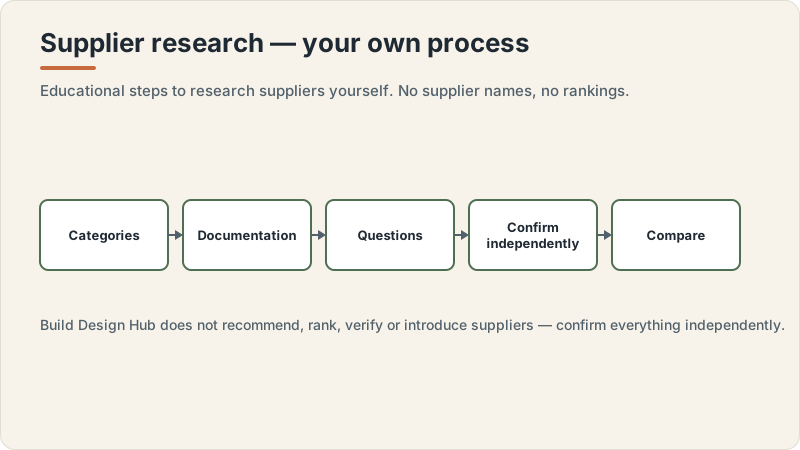
Supplier research process concept
Conceptual editorial diagram — not a construction drawing, specification or to-scale plan. Official court dimensions, standards, drainage, structure and lighting requirements vary by sport, site and location and are confirmed with the relevant federation, supplier and qualified professionals.
What this research helps you prepare
This research helps you arrive at supplier conversations organised rather than guessing. The goal is to understand the categories of acrylic surfacing on offer, the documentation you should request, and the points you will need to confirm independently before any decision. It does not tell you which system suits your court, your sport or your site; that depends on factors only qualified professionals and the relevant federation can assess for your specific project.
By working through the questions below you can build your own comparison structure, a worksheet you fill in with each supplier's answers in their own words and yours. That makes it easier to spot where offers differ, where information is missing, and where a claim needs to be verified rather than assumed. The output is preparation material, not a specification, an estimate or an endorsement.
- Understand acrylic system categories well enough to ask consistent questions
- Know what documentation to request from each supplier
- Identify which claims you must confirm independently rather than take at face value
- Build a neutral comparison structure you can review with a professional
Acrylic system categories to research
Acrylic court surfacing is not a single product. Suppliers may describe cushioned and non-cushioned build-ups, different coat sequences, varying base-preparation assumptions and a range of finishes. Rather than assuming any of these is standard or required, treat the category as something to map: ask each supplier to describe, in plain terms, what their system includes and excludes, and where one supplier's scope stops another's may begin.
When you research categories, focus on understanding terminology and scope boundaries, not on judging quality. Different sports, levels of play and site conditions may call for different approaches, and what is appropriate for your project is a matter for qualified professionals and the relevant federation to determine, not for you to infer from a brochure.
- Cushioned versus non-cushioned build-ups, described in the supplier's own words
- Which layers and coats the supplier counts as part of their system
- What the supplier assumes about the base or existing surface beneath their product
- Colour, texture, line-marking and finish options and any constraints around them
- Aftercare, recoating and maintenance expectations the supplier references
Documentation to request from suppliers
A consistent set of documents makes comparison far easier and gives a qualified professional something concrete to review. Ask every supplier for the same paperwork so you are comparing like with like. Do not treat any document as proof of suitability for your project; treat it as input for independent review.
Where a supplier references compliance with a sport, federation or technical standard, ask them to put that reference in writing and confirm it directly with the relevant body rather than relying on a verbal statement. Requirements vary by sport, level and location, and only the issuing authority or federation can confirm what currently applies.
- Written system descriptions and any product or technical data sheets
- Documented base-preparation and site-condition assumptions
- Any stated standards, federation references or warranty terms, in writing
- Scope inclusions and exclusions clearly separated
- Aftercare and maintenance guidance associated with the system
What to ask before comparing options
Before you place offers side by side, make sure each one answers the same questions, otherwise the comparison is misleading. Ask each supplier to define their scope boundaries, their assumptions about your site, and what they are not responsible for. A clear picture of exclusions is often more revealing than the inclusions.
Resist comparing on a single headline figure or claim. Costs and timelines vary by site, scope, access, drainage, lighting, surface condition, shipping, local conditions and professional requirements, so any number a supplier gives is theirs to confirm in writing and yours to review with a professional, never something to assume or generalise.
- What does this offer explicitly include, and what does it explicitly exclude?
- What does the supplier assume about the base, drainage and site access?
- What documentation supports any standard, federation or warranty claim?
- How are aftercare, recoating and maintenance handled, and by whom?
- What remains unconfirmed and would need independent verification?
What to confirm independently
Several things should never be taken on a supplier's word alone. Any reference to official requirements, sport or federation rules, technical standards, dimensions, permits or tax and customs treatment should be confirmed with the relevant authority, federation or qualified professional for your specific location and project. Requirements vary, and a supplier's summary is not a substitute for the source.
Likewise, the suitability of a given system for your site, your sport and your intended use is a matter for qualified professional assessment. Record what each supplier claims, then route those claims through independent review rather than building decisions on them directly.
- Official requirements, permits and any zoning or building considerations, with the relevant authority
- Sport, level and federation requirements, with the federation or governing body
- Suitability for your specific site and base, with qualified professionals
- Tax, customs or VAT treatment of any imported elements, with a qualified adviser
Questions for qualified professionals
Once you have gathered supplier answers and documentation, a qualified professional can help you interpret them for your specific project. Bring your filled-in comparison worksheet, the documents you collected, and a clear description of your site so the conversation is grounded in real information rather than assumptions.
Use professionals to test the claims you cannot verify yourself, to identify gaps between supplier scopes, and to advise on what your project actually needs. The questions below are starting points for that conversation, not a checklist a professional must follow.
- Which supplier claims need independent verification before they can be relied on?
- Are there gaps or overlaps between the scopes the suppliers have described?
- What base, drainage or site conditions should be assessed before selecting a system?
- What standards or federation requirements apply to my sport and location, and who confirms them?
- What aftercare and maintenance commitments are realistic for my situation?
What this does not replace
This page is educational project-preparation material only. It is not a supplier or contractor recommendation, not contractor or supplier matching, not an estimate, and not procurement, legal, tax or customs advice. It is not engineering, design or construction advice, and it does not specify, verify or endorse any product or company.
Requirements and costs vary by location, site, scope, supplier and project, and must be confirmed directly with the relevant authorities, federations, suppliers and qualified professionals. Build Design Hub does not recommend, rank, verify or introduce suppliers or contractors. HELPERG LLC is the publisher and operator only. Always consult qualified professionals before making project, legal, tax, customs, engineering, construction or procurement decisions.
Acrylic surface supplier research worksheet
- 1Record how each supplier describes their acrylic system in plain language
- 2Note which layers, coats and finishes each supplier counts as included
- 3Capture each supplier's assumptions about the base and existing surface
- 4Request the same documentation set from every supplier for fair comparison
- 5Log any standards, federation or warranty claims and mark them as to-be-verified
- 6List the explicit exclusions and scope boundaries for each offer
- 7Write down aftercare, recoating and maintenance expectations per supplier
- 8Mark every cost, timeline or availability statement as supplier-to-confirm-in-writing
- 9Flag each claim that requires independent confirmation with an authority or professional
- 10Identify gaps or overlaps to raise with a qualified professional
Common mistakes to avoid
- Assuming acrylic systems are interchangeable rather than asking each supplier to define their own scope
- Comparing offers on a single headline figure instead of a consistent question set
- Treating a supplier's standard or federation reference as confirmed rather than verifying it with the source
- Overlooking base-preparation and site assumptions that sit outside the surfacing offer
- Taking quoted costs, timelines or availability as fixed instead of confirming them in writing
- Ignoring exclusions, which often reveal more than the inclusions
- Skipping qualified professional review of suitability for your specific site and sport
- Building decisions on brochure language rather than documented, written answers
When to involve a professional
- Involve qualified professionals to assess whether a given system suits your specific site, base and sport
- Use a professional to test supplier claims you cannot independently verify
- Bring in qualified advisers to interpret standards, federation references and warranty terms for your project
- Consult the relevant authority or federation to confirm official and sport requirements, which vary by location
- Engage qualified professionals before any project, engineering, construction or procurement decision
- Seek qualified tax or customs advice where imported elements may be involved
Frequently asked questions
Questions readers ask about this topic
Does this page recommend an acrylic surface supplier?
No. This is an educational research resource. It does not name, recommend, rank, verify or introduce any supplier. It helps you prepare your own questions and comparison structure to discuss with qualified professionals.
Can you tell me which acrylic system is best for my court?
No. Suitability depends on your site, base, sport and intended use, which only qualified professionals and the relevant federation can assess for your specific project. This page helps you gather information to bring to that review.
Why does this page not give costs or timelines?
Costs and timelines vary by site, scope, access, drainage, lighting, surface condition, shipping, local conditions and professional requirements. Any figures should come from suppliers in writing and be reviewed with a qualified professional, not assumed from a guide.
What should I confirm independently rather than take on a supplier's word?
Confirm official requirements, permits, sport and federation rules, technical standards, and any tax or customs treatment with the relevant authority, federation or qualified professional, since these vary by location and project.
Is Build Design Hub involved in choosing or arranging suppliers?
No. Build Design Hub does not recommend, rank, verify, match or introduce suppliers or contractors. HELPERG LLC is the publisher and operator only. The page is preparation material, not a service.
Keep reading