
Who this guide is for
- Prospective tennis court owners beginning their own surface supplier research
- Operators comparing several surface options before approaching anyone
- Anyone wanting to understand surface families before talking to suppliers
- Project owners assembling documentation and questions for surface conversations
- Clubs planning a new or replacement tennis surface who want a consistent research method
- Owners who want to know what to confirm independently before committing
Planning diagram
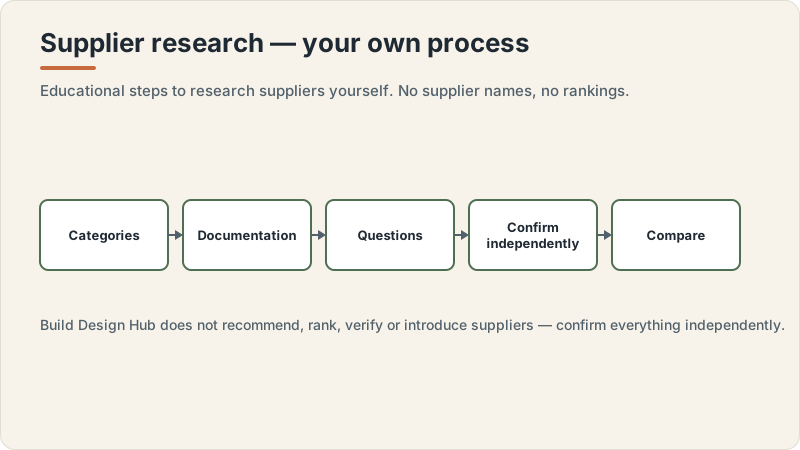
Supplier research process concept
Conceptual editorial diagram — not a construction drawing, specification or to-scale plan. Official court dimensions, standards, drainage, structure and lighting requirements vary by sport, site and location and are confirmed with the relevant federation, supplier and qualified professionals.
What this research helps you prepare
This resource helps you build your own structured research on tennis court surface suppliers, organised around surface families as categories rather than named products or companies. It guides you through which categories of supplier to look into, what documentation to request, what questions to prepare and what you must confirm independently, so you approach later conversations informed and consistent.
Everything here stays at a research and preparation level. It does not tell you which surface or supplier to choose, does not state technical specifications as fact, and does not provide figures. Surface performance, suitability, costs, lead times and availability all vary by site, scope, supplier and location, so the goal is to help you ask better questions and compare answers, not to supply conclusions.
Use it to map the field before you contact anyone, to prepare a like-for-like basis for comparison, and to record where you will need independent verification from qualified professionals.
- A way to map surface families as research categories rather than brands
- A list of documentation to request from any potential surface supplier
- A consistent question set to take into supplier conversations
- A clear sense of what must be confirmed independently, not assumed
Surface families to research as categories
Tennis surfaces fall into broad families, and it helps to research them as categories before looking at any specific supplier. Common families include hard surfaces such as acrylic-coated systems, clay and clay-type surfaces, artificial grass systems, and other engineered options. Each family carries different characteristics around feel, upkeep, climate suitability and renewal, and suppliers tend to specialise.
Research the families themselves first so you can frame questions sensibly, rather than starting from a single product. Note that performance claims, classifications and any sport or federation alignment vary and must be confirmed with the relevant federation, the supplier and a qualified professional. This resource describes families at a planning level and does not state which is best or assert technical facts about any of them.
- Hard surface acrylic-coated systems, as a category to understand
- Clay and clay-type surfaces, and what their upkeep implies
- Artificial grass surface systems and their supporting layers
- Other engineered or specialist surface options you may encounter
- How each family relates to base, drainage and climate as research questions
- Where a surface family would need federation or sport-requirement confirmation
Documentation to request and risk areas to note
A large part of useful research is the paperwork you ask for. From any potential surface supplier you can request documentation that lets you understand and later verify what is being proposed, without taking marketing language at face value. The point is to gather material you can review yourself and share with qualified professionals, not to evaluate it as an expert.
As you collect documentation, note the risk areas where misunderstandings commonly arise. These include unclear boundaries between surface supply and base or drainage works, vague maintenance expectations, ambiguous or unwritten warranty wording, and assumptions about availability, lead times or shipping that are stated loosely. Treat anything about cost, timing or availability as a variable to confirm directly, never as a fixed figure.
- Written scope describing exactly what the surface supply does and does not cover
- Product and material information you can review and verify independently
- Any maintenance or care guidance the surface would require
- Warranty or guarantee wording, in writing, with its conditions
- Documentation of what relates to base, drainage and groundwork interfaces
- Notes on what is assumed about availability, logistics and lead time as items to confirm
What to ask before comparing options
Before you can compare suppliers or surface families fairly, you need a consistent set of questions that everyone answers on the same basis. Asking the same prompts each time surfaces real differences in scope, materials, process and aftercare that a polished proposal can obscure, and gives you a like-for-like foundation for your own comparison matrix.
Keep these as questions, not requests for specifications you would treat as fact. You are listening for clarity, consistency and how a supplier handles uncertainty. Where a question touches cost, timing, availability or sport requirements, expect to confirm the detail independently afterwards, because all of these vary by site, scope, supplier and location.
- What exactly does your surface supply include, and what is excluded?
- How do you describe this surface family, and how do you help me weigh trade-offs?
- How does your work relate to base, drainage and groundwork carried out by others?
- What factors most affect availability, lead time and logistics for a project like mine?
- What maintenance does this surface typically need, in your experience?
- How are scope, inclusions, exclusions and any changes put in writing?
- Where are warranty terms documented, and what conditions apply to them?
Questions for qualified professionals
Some questions sit better with independent qualified professionals than with a supplier, because they call for neutral judgement, verification or specialist knowledge. While you research surface suppliers, it helps to line up the people who can review suitability, base and drainage interfaces, and any local or sport requirements on your behalf.
Use the prompts below to plan who to involve and what to ask them. Requirements vary by location and project and must be confirmed with the relevant authority, the relevant federation and qualified professionals, so this resource cannot state them as fact.
- Designer or engineer: is this surface family suitable for my site, climate and intended use?
- Site, base and drainage specialists: are the groundwork interfaces being planned soundly?
- Relevant federation: what surface, dimension and sport requirements apply to my situation?
- Local authority: what permit, zoning, noise or other local requirements should I confirm?
- Legal or contract advisor: do the warranty and scope terms hold up on review?
- Independent reviewer: does a supplier's documentation stand up to scrutiny against my brief?
What this does not replace
This is an educational project-preparation resource, not a supplier or contractor recommendation, not contractor matching, not an estimate, and not procurement, legal, tax or customs advice. It does not provide engineering, design, architectural, inspection or construction advice, and it does not tell you which surface or supplier to choose.
Requirements and costs vary by location, site, scope, supplier, access, drainage, lighting, surface, shipping and local conditions, and official sport or federation requirements must be confirmed with the relevant bodies. Consult qualified designers, engineers, contractors, base and drainage specialists, local authorities and legal or professional advisors before making project, procurement, legal, tax, customs, engineering or construction decisions.
Build Design Hub does not name, rank, rate, verify, endorse, introduce or match suppliers or contractors. HELPERG LLC is the publisher and operator only. Researching, verifying and selecting any supplier remain entirely your responsibility.
Tennis court surface supplier research checklist
- 1Have you mapped the surface families relevant to your project as research categories?
- 2Have you noted which family raises questions about base, drainage or climate?
- 3Have you requested written scope showing what each surface supply covers and excludes?
- 4Have you requested product and material information you can verify independently?
- 5Have you requested any maintenance or care guidance the surface would need?
- 6Have you requested warranty or guarantee wording in writing, with its conditions?
- 7Have you noted the interface points between surface, base and drainage works?
- 8Have you prepared a consistent question set to use with every option?
- 9Have you treated cost, lead time and availability as items to confirm, not figures?
- 10Have you planned which questions to take to independent qualified professionals?
- 11Have you planned to confirm sport or federation requirements with the relevant body?
- 12Have you recorded where answers differ so you can follow up and verify?
Common mistakes to avoid
- Researching a single product instead of understanding the surface families first
- Naming or fixating on one supplier before mapping the field
- Treating brochure performance claims as confirmed technical fact
- Assuming all surface suppliers include the same base and drainage interfaces
- Accepting vague statements about availability, lead time or shipping as fixed
- Not requesting scope, materials and warranty terms in writing
- Comparing options on different bases instead of asking everyone the same questions
- Skipping independent verification with qualified professionals before committing
When to involve a professional
- A qualified designer or engineer can review whether a surface family suits your site, climate and intended use.
- Site, base and drainage specialists should plan and verify the groundwork interfaces the surface depends on.
- Official surface, dimension and sport requirements vary and should be confirmed with the relevant federation and a qualified professional.
- Permit, zoning, noise and other local requirements vary by location and must be confirmed with the relevant authority and qualified professionals.
- Warranty, scope and contract wording should be reviewed, with legal or professional advice taken where the terms carry weight.
- Build Design Hub does not name, rank, verify or introduce suppliers; research, verification and selection remain your responsibility.
Frequently asked questions
Questions readers ask about this topic
How should I start researching tennis court surface suppliers?
Start with surface families as categories rather than products or companies. Understanding hard, clay-type, artificial grass and other engineered options lets you frame sensible questions and gather comparable documentation before you approach anyone or commit to a direction.
What documentation should I request from a surface supplier?
Ask for written scope, product and material information, any maintenance guidance, and warranty terms with their conditions, plus documentation of how surface supply relates to base and drainage. Gather it to review yourself and share with qualified professionals, not to judge as an expert.
How should I handle questions about cost, lead time and availability?
Treat them as variables to confirm directly with suppliers and qualified professionals, never as fixed figures. All of them vary by site, scope, supplier, access, surface, shipping and local conditions, so focus on what drives them and confirm specifics in writing.
Does this resource recommend or name surface suppliers?
No. It helps you do your own research using surface families as categories. Build Design Hub does not name, rank, rate, verify, endorse or introduce suppliers, and HELPERG LLC is the publisher and operator only. Verification and selection remain your responsibility.
Can I rely on a supplier's claims about a surface meeting sport requirements?
Treat them as a starting point, not as fact. Official surface, dimension and sport requirements vary and should be confirmed with the relevant federation, the supplier and a qualified professional. Listen for whether a supplier references that nuance rather than stating fixed certainties.
Keep reading