
Who this guide is for
- Club or academy directors planning a new or replacement football field who want to run their own contractor research process
- School and university facility leads preparing to procure a training ground or match pitch with their own governance
- Municipal and parks officials assembling a transparent, defensible selection framework for a community football facility
- Property developers including a sports field within a larger scheme who need to coordinate contractor selection with other trades
- Facility managers responsible for an existing ground who are scoping a refurbishment and comparing contractor proposals
- Owners and trustees who want to prepare informed questions before meeting designers, engineers and contractors
Planning diagram
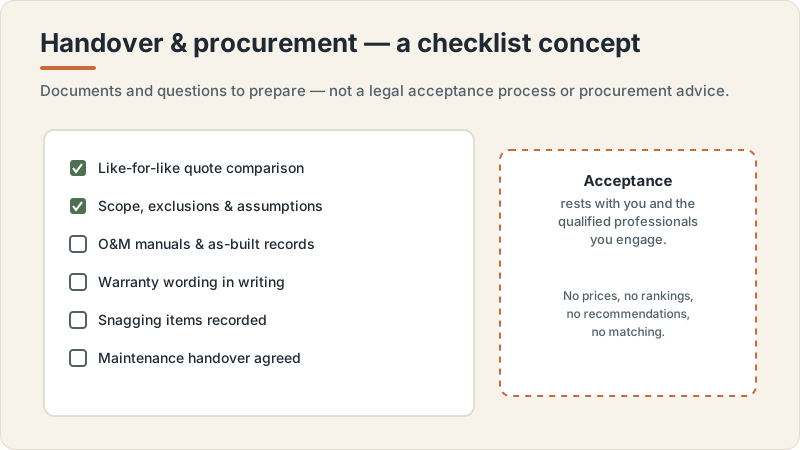
Football field handover checklist concept
Conceptual editorial diagram — not a construction drawing, specification, to-scale plan or proof of a real project. It is not engineering, structural, fire/life-safety, crowd-safety or accessibility-compliance guidance. Capacities, dimensions, standards, requirements and costs vary by facility type, audience, site, use case and governing body, and are confirmed with qualified professionals, relevant authorities and governing bodies. Build Design Hub does not design, build, inspect, certify, recommend or match anyone.
What this guide helps you prepare
This guide helps you build your own structured approach to researching and selecting a contractor for a football-field or training-ground project. It focuses on the preparation that happens before and around procurement: clarifying what your project actually involves, deciding what information you need from each contractor, and organizing that information so you can compare responses fairly. It does not tell you which contractor to choose, name any contractor, or claim that one approach is correct for your situation. Instead it gives you prompts to take into conversations with your own qualified professionals, who will help you interpret what you hear against your specific site, use case and obligations.
The aim is to reduce the chance that an important question goes unasked. Many selection difficulties trace back to vague scope, unverified experience or unclear coordination responsibilities rather than to any single technical detail. By preparing a consistent question set, recording answers in a comparable structure, and noting where a topic must be confirmed with qualified professionals or the relevant authority, you put yourself in a stronger position to evaluate proposals on your own terms. Treat every technical or regulatory point in your notes as something to verify, not something this guide has settled for you.
- Use this to assemble a contractor question set and a consistent way to record and compare answers
- Treat all surface, drainage, certification and regulatory points as items to confirm with qualified professionals and the relevant governing body
- Capture who in your organization needs to review and approve before any commitment is made
- Note that Build Design Hub does not introduce, rank, vet or match contractors and names none
- Separate what you can research yourself from what your professional team must confirm
- Keep a written trail of questions asked and answers received for later comparison and governance
Building a contractor research and due-diligence framework
Before contacting anyone, decide what you are actually trying to learn about a prospective contractor and how you will evaluate it consistently. A useful framework usually covers relevant experience with comparable football-field or sports-surface work, the verifiable references behind that experience, the clarity and completeness of the proposed scope, how the contractor coordinates with other parties, and how they handle change, risk and handover. Writing these dimensions down in advance keeps every conversation comparable and reduces the pull of a confident pitch over substance. Ask the same core questions of each contractor so that differences in their answers, rather than differences in your questions, drive your comparison.
Due diligence is mostly about verification you can perform yourself or with your professionals: confirming that licensing, insurance and registrations are current with the issuing bodies rather than taking a logo at face value, speaking directly to references about projects of similar type and scale, and understanding who would actually perform the work versus who is being presented. Where a claim touches a governing-body requirement, a local authority approval or a surface-system performance topic, record it as a point your qualified professionals and the relevant authority must confirm. This guide cannot tell you whether any specific credential, surface or approach is sufficient for your project, and it offers no list of contractors to start from.
- List the comparison dimensions you care about (relevant experience, references, scope clarity, coordination, change handling) before any outreach
- Ask how the contractor verifies and keeps current its licensing, insurance and registrations, and confirm with the issuing bodies yourself
- Request references for projects of similar type, scale and use case, and prepare questions to ask those references directly
- Clarify who would actually carry out the work, including any specialist subcontractors, and how that is managed
- Decide in advance how you will record answers so contractors are compared on the same basis
- Flag any credential, surface or approval claim as a point to confirm with qualified professionals and the relevant authority
Scope, coordination and handover expectations to clarify
A large share of selection risk lives in scope ambiguity. Prepare to ask each contractor exactly what their proposal includes and, just as importantly, what it excludes, so you can see where responsibilities might fall between parties. For a football field this often spans surface works, sub-base and drainage, surrounding areas, lighting, fencing, line marking and ancillary elements, but what belongs in any one contract varies entirely by project and by how your professional team has structured the work. Your job here is not to specify any of those elements but to confirm in writing where each responsibility sits, who coordinates the interfaces between trades, and how gaps or overlaps will be resolved.
Coordination and handover deserve the same attention as the construction itself. Ask how the contractor expects to work alongside your designers, engineers, other contractors and any authority or governing-body processes your professionals identify, and how design changes, site conditions and approvals would be handled when they arise. Clarify what a complete handover would include in their view, what documentation, records and operating or maintenance information you should expect to receive, and how outstanding items would be tracked and closed. Confirm all certification, inspection, approval and compliance specifics with qualified professionals and the relevant authority rather than treating any contractor statement as definitive.
- Ask for a written, itemized statement of what each proposal includes and explicitly excludes
- Clarify who coordinates interfaces between surface, drainage, lighting, fencing and other trades, and who carries that responsibility
- Confirm how design changes, unforeseen site conditions and approvals would be communicated and managed
- Ask what the contractor considers a complete handover, including documentation and operating or maintenance information you would receive
- Record how outstanding or defect items would be tracked and closed after practical completion
- Note every certification, inspection or compliance point as something to verify with qualified professionals and the relevant authority
Planning questions before speaking with professionals
Spend time clarifying your own project internally before you sit down with designers, engineers or contractors. Be clear on who owns the asset, who will use it and how intensively, what is driving the project, who must approve decisions, and what governance or procurement rules your organization is bound by. Write down what you do and do not yet know, including which technical and regulatory questions you cannot answer yourselves. The clearer your own brief, the more useful every professional conversation becomes, and the easier it is to tell whether a contractor's proposal actually fits your situation rather than a generic one.
Also prepare the practical scaffolding of a selection process: how you will reach out, what information you will ask every contractor to provide, how you will record and compare answers, and who internally needs to review and sign off at each stage. Decide how you will keep a documented trail for transparency and later reference, especially if you operate under public-procurement or institutional rules. Remember that Build Design Hub provides none of this as a service and matches no one; these are questions for you to work through with your own team and professionals.
- Who owns, uses and is accountable for the facility, and who must approve each decision?
- What is driving this project, and what outcomes matter most to your stakeholders?
- What governance, procurement or institutional rules constrain how you select and contract?
- Which questions are technical or regulatory and therefore belong to qualified professionals and authorities, not to your internal team?
- How will you record and compare contractor responses so the process stays consistent and defensible?
- What documentation trail do you need to keep for transparency, audit or future reference?
Questions for qualified professionals
When you engage designers, engineers, surveyors, cost or procurement advisers and legal professionals, use them to interpret what contractors tell you and to confirm anything this guide deliberately leaves open. They can help you understand which requirements, approvals, governing-body considerations and surface-system topics apply to your specific site and use case, and how to structure scope, contracts and risk allocation accordingly. Bring your prepared question set and your recorded contractor answers so professionals can review them in context rather than in the abstract. Ask them explicitly which of your assumptions need testing and which claims from contractors warrant independent verification.
Treat your professional team as the people who turn information into decisions you can stand behind. Ask how they would structure the procurement and contracts for your circumstances, how responsibilities and coordination should be defined, what they would want to see in references and credentials, and how they would handle change, quality and handover. Where any answer touches certification, inspection, compliance, performance or maintenance, ask them and the relevant authority to confirm it. This guide cannot and does not substitute for that advice, and it offers no contractor names, rankings or matches to start from.
- Which requirements, approvals and governing-body considerations apply to our specific site, use case and surface system?
- How would you recommend structuring scope, contracts and risk allocation for a project like ours?
- What would you look for, and independently verify, in a contractor's references, credentials, insurance and capacity?
- How should coordination between contractors, designers, engineers and authorities be defined and managed?
- Which claims in the proposals we have gathered should we treat with caution or confirm separately?
- What would you expect a complete, well-documented handover to include for our type of facility?
What this does not replace
This is an educational project-preparation resource only. It is not a construction manual and not engineering, architectural, turf-installation, drainage-engineering, sports-surface-specification, structural, fire or life-safety, crowd-safety, accessibility-compliance, permit, zoning, legal, tax or procurement advice. It does not design, specify, install, certify, inspect or approve anything, and it is not an estimate, quote, price, capacity recommendation or performance or lifespan guarantee. Requirements, standards, dimensions, surface systems and costs vary by location, use case, governing body, owner, site, climate, maintenance plan, authority and professional team, and are confirmed with qualified professionals, relevant authorities and the sport governing body.
Build Design Hub does not design, build, install, engineer, inspect, certify, recommend, rank, verify, introduce, broker or match suppliers or contractors, and HELPERG LLC is publisher/operator only. Use this resource to prepare your own thinking, then have qualified professionals you engage directly review your project. Decisions about engineering, surface specification, drainage, safety, compliance, procurement and suitability must rest on those professionals, the relevant authorities and the governing body for your sport and location.
- Not a construction manual and not engineering, turf-installation or drainage-engineering instructions
- Not sports-surface specification, structural, fire/life-safety, crowd-safety or accessibility-compliance advice
- Not permit, zoning, legal, tax or procurement advice
- Not a supplier or contractor recommendation, ranking, directory or matching service
- Not an estimate, price, capacity recommendation or performance/lifespan guarantee — requirements and costs vary
- Qualified professional review is required before any project decision
Contractor research and comparison worksheet
- 1Record your project brief: owner, primary users, intensity of use and the outcomes that matter most to stakeholders
- 2List the governance, procurement or institutional rules your selection process must follow
- 3Write down the comparison dimensions you will apply to every contractor (experience, references, scope, coordination, change handling, handover)
- 4Prepare the identical core question set you will ask each contractor so answers stay comparable
- 5Gather and confirm licensing, insurance and registration claims directly with the issuing bodies
- 6Request references for projects of similar type, scale and use case, and note the questions you will ask each reference
- 7Record who would actually perform the work, including any specialist subcontractors, and how it is managed
- 8Capture each proposal's explicit inclusions and exclusions in a single side-by-side format
- 9Note who coordinates interfaces between trades and who carries that responsibility in each proposal
- 10List how change, unforeseen conditions and approvals would be handled by each contractor
- 11Document what each contractor considers a complete handover, including records and operating or maintenance information
- 12Mark every certification, surface, dimension, performance or compliance point as 'confirm with qualified professionals and the relevant authority'
- 13Record which internal reviewers and approvers must sign off at each stage of your process
- 14Keep a dated trail of questions asked and answers received for transparency and future reference
Common mistakes to avoid
- Starting outreach before the project brief, users and approval chain are written down, so conversations drift
- Asking each contractor different questions, which makes proposals impossible to compare fairly
- Accepting credential, insurance or registration claims at face value instead of confirming with the issuing bodies
- Treating a contractor's statement about certification, surface systems or compliance as settled fact rather than a point to verify with professionals and authorities
- Leaving scope inclusions and exclusions vague, so responsibilities fall between parties later
- Overlooking who coordinates the interfaces between trades and who owns that coordination
- Skipping direct reference conversations about projects of similar type, scale and use case
- Ignoring handover and documentation expectations until the end, when they are hardest to renegotiate
When to involve a professional
- When you need to know which requirements, approvals and governing-body considerations apply to your specific site and use case
- When structuring scope, contracts, procurement and risk allocation for the project
- When you want claims in contractor proposals independently reviewed or verified before deciding
- When coordination responsibilities between contractors, designers, engineers and authorities must be defined
- When any certification, inspection, compliance, performance or maintenance question arises
- When your organization operates under public-procurement or institutional rules that shape how selection must be documented and conducted
Frequently asked questions
Questions readers ask about this topic
Does Build Design Hub recommend, rank or match football-field contractors for me?
No. Build Design Hub does not recommend, rank, verify, introduce, broker or match suppliers or contractors, and this guide names none. It gives you a neutral framework to research and compare contractors yourself, alongside your own qualified professionals. Any selection decision is yours to make with your own team.
Will this guide tell me the right turf, drainage, dimensions, costs or timelines for my field?
No. It does not state any requirements, surface specifications, dimensions, prices, timelines or performance figures as facts. Those vary by location, use case, governing body, owner, site, surface system, maintenance plan, climate, authority and professional team. Confirm all such details with qualified professionals, the relevant authority and the applicable sport governing body.
How should I use the question sets in this guide?
Use them to prepare consistent conversations: clarify your own project internally first, then ask every contractor the same core questions and record answers in a comparable format. Bring those answers to your qualified professionals, who can interpret them against your specific circumstances and tell you what to verify further.
Can I rely on a contractor's own statements about credentials and compliance?
Treat them as starting points to verify, not as confirmed facts. Confirm licensing, insurance and registration directly with the issuing bodies, speak to references yourself, and have your qualified professionals and the relevant authority confirm anything touching certification, surface systems, inspection or compliance.
Keep reading