
Who this guide is for
- Football club or academy committees collecting several quotes for a pitch or training-ground project and needing a consistent way to read them
- Municipal or council project leads who must document how field proposals were compared on a like-for-like basis
- School or campus facilities staff coordinating bursar, governor or board review of incoming pitch quotes
- Property developers assembling a procurement pack who want field scope, exclusions and assumptions captured in one grid
- Facility managers translating differently formatted turf, grass and training-ground quotes into a single comparable structure
- Project owners preparing for conversations with qualified professionals who will interpret the technical pitch detail
Planning diagram
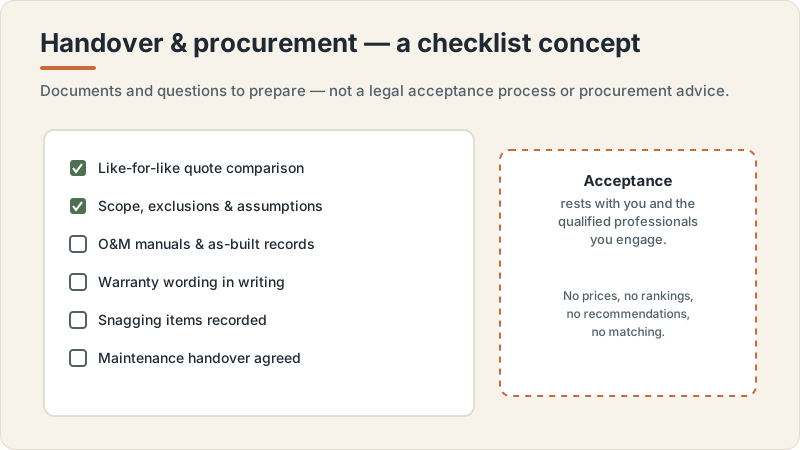
Football field handover checklist concept
Conceptual editorial diagram — not a construction drawing, specification, to-scale plan or proof of a real project. It is not engineering, structural, fire/life-safety, crowd-safety or accessibility-compliance guidance. Capacities, dimensions, standards, requirements and costs vary by facility type, audience, site, use case and governing body, and are confirmed with qualified professionals, relevant authorities and governing bodies. Build Design Hub does not design, build, inspect, certify, recommend or match anyone.
What this guide helps you prepare
This guide helps you build a comparison structure before you sit down with any football-field quotes, so the framework drives the reading rather than the formatting of whichever quote arrived first. You will end with a matrix where the rows are the things you care about comparing for a pitch project, such as scope items, named exclusions, stated assumptions, and the responsibilities each party takes on, and the columns are the quotes themselves, kept anonymous as Quote A, Quote B and so on. Working this way keeps your attention on whether the same item appears across columns rather than on who submitted what.
It also helps you record where a quote is silent. A blank cell in the matrix is information: for a field project it usually means a scope item such as the base, drainage approach, surface system, line marking, goals or fencing was simply not addressed, not that it is included. By capturing what each quote does not mention alongside what it does, you build a view that is honest about uncertainty and ready for discussion with qualified professionals. This guide does not tell you which quote to choose, what any pitch item should contain, or what anything should cost; those judgements belong to you and the professionals and governing bodies you engage.
- A row-and-column structure that keeps pitch scope, exclusions and assumptions visible side by side
- A consistent vocabulary so the same activity is labelled the same way across every column
- A method for marking silences and gaps for field items, not just stated inclusions
- Anonymous column labels so the comparison stays focused on content, not source
- A shared artefact your club, committee, board or stakeholders can read the same way
- A list of follow-up questions generated by the mismatches the matrix exposes
Building the football-field comparison matrix: rows, columns and silences
Start by deciding your rows independently of any single quote. Draft the scope items, exclusion categories and assumption types that matter for your field as you understand it, then keep that row list stable as you read each quote into the columns. For a football pitch, that row set often spans the area you mean to be covered, ground preparation and base, the drainage approach, the surface system, line marking, goals and other equipment, fencing, access for plant, and reinstatement of disturbed ground, but the point is to use your own list rather than copy any quote's headings. If a quote introduces an item your rows do not cover, add a new row and revisit every column for it, so the grid stays complete rather than shaped around one supplier's layout.
Columns are the quotes, labelled neutrally so that no column carries reputation into the reading. For each cell, record what the quote actually says in its own terms, then note whether the item is stated as included, explicitly excluded, assumed, or simply absent. Where a quote uses a different word for what you believe is the same activity, write both your row label and the quote's wording so a professional can confirm whether they are truly the same thing. Resist merging two different items into one row just because a quote bundled them; splitting a bundled surface-and-base or drainage-and-groundwork line into separate rows is often where the most useful comparison points appear. The matrix records what was said and what was left unsaid, not an interpretation of which approach is correct.
- List your rows first, from your own understanding of the field project, before opening any quote
- Split bundled lines such as surface-with-base or drainage-with-groundwork into separate rows
- Use four cell states for every item: included, excluded, assumed, or absent
- Preserve each quote's own wording next to your standard row label
- Add a new row whenever a quote raises a field item your list missed, then fill it for every column
- Treat an empty cell on any pitch item as a question to raise, never as an assumed inclusion
Reading exclusions and assumptions on a pitch project without judging value
Exclusions and assumptions are where like-for-like comparison most often breaks down on a football-field project, because two quotes can look similar on headline scope while differing sharply on what each expects the owner, club or another party to provide. Give exclusions their own block of rows and read every column against each one, so an exclusion present in one quote, such as drainage works, ground reinstatement, spoil removal, line marking, goals or fencing, prompts you to check whether the others are silent, inclusive or assume the same thing implicitly. The goal is not to decide which set of exclusions is acceptable but to make every exclusion explicit and comparable across columns.
Assumptions deserve the same discipline. A field quote may assume site access, ground conditions, existing survey or test information, the state of any prior surface, who handles permits or governing-body confirmation, or who is responsible for utilities and services, and these assumptions shape what the quote actually covers. Record each stated assumption as a row and note how every column treats it, flagging where an assumption in one quote contradicts a statement in another. Keep your notes descriptive: capture what is assumed and where columns diverge, and carry those divergences forward as questions for qualified professionals and the relevant governing bodies rather than resolving them yourself as right or wrong.
- Give exclusions and assumptions their own row blocks, separate from scope
- For each field exclusion, check whether other columns are silent, inclusive or assume the same
- Record who each quote expects to provide or be responsible for an excluded pitch item
- Flag any assumption about access, ground conditions or prior surface that conflicts with another column
- Note assumptions about surveys, tests, permits or governing-body confirmation as comparable rows
- Carry every divergence forward as a question, not a verdict on value or fairness
Planning questions before speaking with professionals
Before you engage qualified professionals, use the matrix to organise your own thinking so the conversation starts from a clear picture rather than a pile of differently formatted field quotes. Walk each row and ask yourself whether you understand what it means, whether the columns genuinely describe the same pitch item, and where you are guessing. The rows where you are unsure, and the cells you marked absent or assumed, become your agenda. Preparing this way lets a professional spend their time interpreting and confirming rather than reconstructing the comparison from scratch.
It also helps to separate questions you can answer yourself by re-reading a quote from questions that genuinely need expert judgement. Some gaps are simply unread detail; others are real ambiguities about responsibility, sequence, surface system or coverage that only a qualified professional, the relevant authority or your sport's governing body can clarify. Sorting your questions this way keeps the eventual conversation focused, and it surfaces where requirements, suitability or interpretation depend on factors specific to your location, use case, surface system, maintenance plan, climate, authority and professional team, which vary and must be confirmed with qualified professionals.
- Which rows do I not fully understand in plain terms for this field project?
- Where do two columns use different words that might describe the same pitch activity?
- Which cells did I mark absent, and is that a silence or a genuine exclusion?
- Which differences between columns can I resolve by re-reading, and which need an expert?
- Which assumptions, if untrue, would change what a quote actually covers for the field?
- What about my site, use case, governing body or climate might affect how these items should be read?
Questions for qualified professionals
When you bring the matrix to qualified professionals, present it as a structured set of questions rather than a request for a recommendation. Ask them to confirm whether items you matched across columns are genuinely equivalent for a football field, to interpret wording you could not, and to identify scope, exclusions or assumptions that your row list may have missed entirely, such as ground conditions, the drainage approach or reinstatement. A professional can also tell you which silences matter and which are routine, and which divergences between columns are consequential given factors that vary by location, use case, surface system, maintenance plan, climate, authority, governing body and professional team.
Keep your questions descriptive and open rather than asking the professional to rank or score the quotes for you. The matrix is most useful when it helps a professional explain what each quote means and what to confirm with relevant authorities and your sport's governing body, not when it pressures them toward a verdict. Record their answers back into the grid or alongside it, so your comparison stays a living, evidence-based document that reflects expert input while leaving the final decision, and its consequences, clearly with you and your stakeholders.
- Are the items I matched across columns genuinely like-for-like for this field, or only similarly worded?
- What scope, exclusions or assumptions should I add as rows that I have not captured?
- Which silent cells represent meaningful gaps versus routine omissions on a pitch project?
- How do factors specific to my site, use case, climate or governing body affect how these rows should be read?
- Which divergences between columns are consequential and which are immaterial for this field?
- What should I confirm directly with the relevant authorities or my sport's governing body before deciding?
What this does not replace
This is an educational project-preparation resource only. It is not a construction manual and not engineering, architectural, turf-installation, drainage-engineering, sports-surface-specification, structural, fire or life-safety, crowd-safety, accessibility-compliance, permit, zoning, legal, tax or procurement advice. It does not design, specify, install, certify, inspect or approve anything, and it is not an estimate, quote, price, capacity recommendation or performance or lifespan guarantee. Requirements, standards, dimensions, surface systems and costs vary by location, use case, governing body, owner, site, climate, maintenance plan, authority and professional team, and are confirmed with qualified professionals, relevant authorities and the sport governing body.
Build Design Hub does not design, build, install, engineer, inspect, certify, recommend, rank, verify, introduce, broker or match suppliers or contractors, and HELPERG LLC is publisher/operator only. Use this resource to prepare your own thinking, then have qualified professionals you engage directly review your project. Decisions about engineering, surface specification, drainage, safety, compliance, procurement and suitability must rest on those professionals, the relevant authorities and the governing body for your sport and location.
- Not a construction manual and not engineering, turf-installation or drainage-engineering instructions
- Not sports-surface specification, structural, fire/life-safety, crowd-safety or accessibility-compliance advice
- Not permit, zoning, legal, tax or procurement advice
- Not a supplier or contractor recommendation, ranking, directory or matching service
- Not an estimate, price, capacity recommendation or performance/lifespan guarantee — requirements and costs vary
- Qualified professional review is required before any project decision
Football field quote comparison matrix preparation worksheet
- 1Draft your row list of pitch scope items from your own understanding before opening any quote
- 2Add separate row blocks for exclusions and for assumptions
- 3Assign neutral, anonymous column labels (Quote A, Quote B, and so on)
- 4Record each cell using one of four states: included, excluded, assumed, or absent
- 5Note each quote's own wording next to your standard row label for every cell
- 6Split any bundled line such as surface-with-base or drainage-with-groundwork into component rows
- 7Mark every empty cell on a field item as a question to raise rather than an assumed inclusion
- 8Capture who each quote expects to provide or be responsible for excluded pitch items
- 9Flag any assumption about access, ground conditions or prior surface that contradicts another column
- 10Record how each column treats surveys, tests, permits and governing-body confirmation
- 11List the rows where you do not fully understand what an item means
- 12Separate questions you can answer by re-reading from those needing a professional
- 13Note which factors specific to your site, use case, climate or governing body may affect interpretation
- 14Reserve a space to record professional and governing-body answers back into or alongside the grid
Common mistakes to avoid
- Letting the first field quote's format dictate the rows, so later quotes are forced into the wrong shape
- Treating a blank or silent cell on a pitch item as if it were included rather than as an open question
- Merging bundled items such as surface and base into one row, which hides differences between columns
- Comparing only headline scope while leaving drainage, line marking, goals, fencing and reinstatement out of the grid
- Assuming two quotes mean the same thing because they use a similar word for a surface or groundwork activity
- Letting supplier identity or reputation colour the reading instead of keeping columns anonymous
- Using the matrix to rank or score quotes yourself rather than to organise questions for professionals
- Recording stated prices, requirements, standards or turf specifications as settled facts instead of items to confirm
When to involve a professional
- When you cannot tell whether pitch items matched across columns are genuinely the same activity
- When exclusions or assumptions about ground conditions, drainage or reinstatement diverge in ways that change what a quote covers
- When a quote's wording on the surface system or base is ambiguous and your re-reading does not resolve it
- When you suspect your row list is missing scope, exclusions or assumptions you have not thought of
- When silences or gaps could carry consequences that depend on your site, use case, climate or governing body
- When stakeholders need an expert interpretation before making or documenting a decision
Frequently asked questions
Questions readers ask about this topic
Does this guide or Build Design Hub recommend which football-field quote to choose?
No. Build Design Hub does not recommend, rank, rate, verify, match or introduce suppliers or contractors, and it gives no prices, costs, requirements or turf specifications. This guide only helps you organise information you gather yourself into a comparable structure. The decision, and its consequences, remain entirely with you and the qualified professionals you choose to engage.
Should I put prices in the comparison matrix?
This guide focuses on scope, exclusions and assumptions for a field project, not prices, and it states no costs. If you choose to track commercial figures, keep that as a separate exercise and confirm any financial interpretation with your own advisers, since this guide does not address pricing, value or fairness in any form.
Why keep the quote columns anonymous?
Anonymous labels such as Quote A and Quote B keep your attention on what each quote actually says about the field rather than on the reputation of who submitted it. This makes the like-for-like reading more consistent and helps stakeholders review the same content the same way. It is an organisational technique, not a judgement about any supplier or contractor.
How do I handle a quote that uses different terminology for the same field work?
Record both your standard row label and the quote's own wording in the cell, then carry it forward as a question. Whether two differently worded items, such as two descriptions of a surface system or a drainage approach, are genuinely the same is something to confirm with a qualified professional, because the answer can depend on your use case, site, climate and governing body, which vary.
Keep reading