
Who this guide is for
- Clubs and academies scoping a new or upgraded football field who need to organise drainage questions before engaging engineers.
- Schools and education providers planning a playing field or training area where seasonal usability and water behaviour matter.
- Municipalities and parks departments framing a drainage brief for a community football pitch or training ground.
- Property developers evaluating a football field as part of a wider site where ground and water conditions are uncertain.
- Facility managers preparing scope, operations and maintenance questions around an existing pitch's drainage performance.
- Owners and trustees assembling site-exposure context and a consistent question set for civil and drainage specialists.
Planning diagram
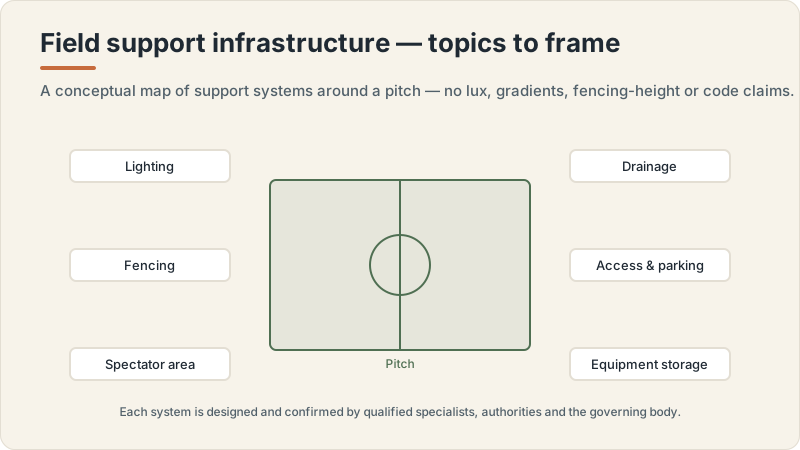
Football field support infrastructure concept
Conceptual editorial diagram — not a construction drawing, specification, to-scale plan or proof of a real project. It is not engineering, structural, fire/life-safety, crowd-safety or accessibility-compliance guidance. Capacities, dimensions, standards, requirements and costs vary by facility type, audience, site, use case and governing body, and are confirmed with qualified professionals, relevant authorities and governing bodies. Build Design Hub does not design, build, inspect, certify, recommend or match anyone.
What this guide helps you prepare
This guide helps you assemble a drainage-focused brief and the site context that makes later engineering conversations productive. That includes a plain-language description of how you intend to use the field, the seasons and weather you expect to play through, the surface system you are considering at a high level, and the observations and documents that describe how water behaves on your site today. The goal is to arrive at conversations with civil and drainage engineers organised, with context recorded, rather than expecting this guide to tell you how water should be managed.
It is deliberately high level and bounded. You will not find gradients, falls, pipe or outfall layouts, capacities, infiltration figures or any calculation here, because those depend entirely on your site, surface system, climate, governing body and the professionals you engage. Instead you will find prompts that help you describe what you observe, clarify what you want the field to do, and identify the questions only a qualified specialist can answer. Use it to build shared understanding among stakeholders before any technical scope or commitment is fixed.
- Draft a plain-language drainage brief: intended use, seasons of play, expected hours and the weather you must play through.
- Record what you already observe about water on the site: where it pools, how fast it dries, where runoff seems to travel.
- Note the surface system you are considering at a high level, as context for professional advice rather than a decision.
- List the drainage questions you cannot answer yourself and intend to take to civil and drainage engineers.
- Identify the governing bodies, authorities and utility or water bodies likely relevant, to confirm their guidance early.
- Capture constraints you already know about, such as neighbouring land, watercourses, existing services or budget envelope to discuss.
Site-exposure and water-behaviour context to observe and compile
Before any engineer visits, you can compile a picture of how the site behaves, framed strictly as observations to discuss rather than conclusions to act on. Watch where rainwater pools and lingers, how quickly different parts of the pitch dry after wet weather, where water appears to flow on and off the site, and whether the field sits low relative to surrounding land, roads or buildings. Note the broad weather pattern you experience across seasons and how that seems to affect usability. These notes help a drainage or civil professional understand your site, but what they mean for the design must come from that professional and the relevant authorities.
Equally useful is the paperwork and history a specialist would normally ask for, gathered in one place. That can include any existing site or topographic information you hold, records of past flooding or waterlogging, knowledge of nearby watercourses, ditches or drains, and an understanding of where existing services and outfalls might run. You are not interpreting any of this; you are assembling it so that surveys and assessments start from an informed position. Treat the underlying ground, soil and water conditions as matters for investigation by qualified professionals, never as something to assume from surface appearance alone.
- Document where water pools after rain, how long it stays, and which areas dry slowest, with rough timings to discuss.
- Record the apparent direction water travels across and off the site, and whether the field sits low relative to surroundings.
- Note any history of flooding, waterlogging or cancelled sessions, and the weather conditions that seemed to cause them.
- Identify nearby watercourses, ditches, ponds or known drains, and any neighbouring land that drains toward or away from the site.
- Gather existing site, topographic, services or prior survey information you already hold, in one organised place.
- Mark all of this as input for professional survey and assessment, never as a conclusion about ground, soil or water conditions.
Surface-system, usage and maintenance context that shapes drainage conversations
Drainage cannot be separated from how the field is built, used and looked after, so it helps to record the surrounding context that engineers will want to weigh, again as questions rather than answers. At a high level, the surface system you are considering, the intensity and pattern of use you expect, and the maintenance capacity you realistically have all influence the drainage conversation. Write down which of these you have decided, which are still open, and which you expect professionals and your governing body to advise on. Avoid assuming any particular drainage approach suits a given surface or use level; that interaction is for qualified professionals to confirm for your specific case.
Operations and maintenance also belong in the early picture because drainage performance is something a facility lives with for years, not just at handover. Note who will maintain the field, what seasons and hours you hope to play through, and how disruption to use would affect your organisation. These are not technical inputs; they are context that helps an engineer understand your priorities and helps you later compare how different professionals describe upkeep, monitoring and responsibilities. Keep every performance expectation, lifespan figure or maintenance interval as something to confirm with qualified professionals rather than a claim to rely on.
- Record the surface system under consideration at a high level, noting it is context for professional advice, not a fixed decision.
- Describe the expected intensity and pattern of use, including peak seasons, training load and match frequency you hope to support.
- Note your realistic maintenance capacity: who maintains the field, with what resources, and how often.
- Capture how much playing disruption from waterlogging your organisation could tolerate, to convey priorities to engineers.
- List the operations and maintenance topics you want professionals to explain, such as monitoring and ongoing responsibilities.
- Treat any performance, usability, lifespan or maintenance-interval expectation as something to confirm with qualified professionals.
Planning questions before speaking with professionals
Before you engage anyone, it helps to resolve the questions your own group can answer and clearly flag those you cannot. Internally, agree on how the field will be used, the seasons and hours you intend to play, the level of waterlogging disruption you can live with, and the rough budget envelope you are prepared to discuss. Just as important is agreeing who decides, who must be consulted, and how stakeholder input is gathered, so that engineering conversations are not derailed by unresolved internal disagreement about priorities or scope.
This internal stage is also where you assemble the context others will work from. Pull together your water-behaviour observations, the site history and documents you hold, the surface-system and usage assumptions you are making, and the constraints you already know about, such as neighbouring land or watercourses. None of this replaces professional assessment; it ensures that when you do engage civil and drainage engineers, surveyors and authority contacts, they begin from an organised picture rather than reconstructing it from scratch.
- How do we intend to use this field, in which seasons and hours, and how much waterlogging disruption can we tolerate?
- What have we actually observed about how water behaves on and around the site, recorded as observations to discuss?
- What site history, documents and prior reports do we already hold that an engineer would want to see?
- Which surface-system and usage assumptions are we making, and which remain open for professional advice?
- Who are our stakeholders, who decides, and who must be consulted before any drainage commitments?
- What budget envelope and maintenance capacity are we prepared to discuss with civil and drainage engineers?
Questions for qualified professionals
When you reach the point of engaging professionals, your role shifts to asking clear questions and comparing how they describe scope and assumptions, not directing technical outcomes. Useful conversations cover what site investigations or surveys the field needs before any drainage approach is considered, how they would interpret your water-behaviour observations, how drainage interacts with your intended surface system and use, and which authorities, governing bodies or water bodies they expect to be involved. Ask each professional to set out clearly what falls inside and outside their scope, and what they would need to investigate before advising.
Use a consistent set of questions across any engineers, consultants or contractors you research so you can compare how they frame scope, assumptions and exclusions rather than comparing on headline figures alone. Remember that Build Design Hub does not recommend, rank, verify or match professionals; sourcing, evaluating and appointing them is your responsibility, ideally with appropriate professional and legal advice. Keep every gradient, fall, capacity, layout, standard, dimension and cost as something for those professionals and the relevant authorities to confirm for your specific site and use.
- What ground, soil and site investigations or surveys do you recommend before any drainage approach is considered?
- How would you interpret the water-behaviour observations and site history we have compiled?
- How does drainage interact with the surface system and intensity of use we are considering, and what trade-offs apply?
- Which authorities, governing bodies, water bodies or utilities do you anticipate needing to consult or seek approval from?
- What ongoing monitoring, maintenance and responsibilities should we plan for, framed as questions for our specific case?
- What is explicitly inside and outside your scope, and what assumptions and exclusions underpin your advice?
What this does not replace
This is an educational project-preparation resource only. It is not a construction manual and not engineering, architectural, turf-installation, drainage-engineering, sports-surface-specification, structural, fire or life-safety, crowd-safety, accessibility-compliance, permit, zoning, legal, tax or procurement advice. It does not design, specify, install, certify, inspect or approve anything, and it is not an estimate, quote, price, capacity recommendation or performance or lifespan guarantee. Requirements, standards, dimensions, surface systems and costs vary by location, use case, governing body, owner, site, climate, maintenance plan, authority and professional team, and are confirmed with qualified professionals, relevant authorities and the sport governing body.
Build Design Hub does not design, build, install, engineer, inspect, certify, recommend, rank, verify, introduce, broker or match suppliers or contractors, and HELPERG LLC is publisher/operator only. Use this resource to prepare your own thinking, then have qualified professionals you engage directly review your project. Decisions about engineering, surface specification, drainage, safety, compliance, procurement and suitability must rest on those professionals, the relevant authorities and the governing body for your sport and location.
- Not a construction manual and not engineering, turf-installation or drainage-engineering instructions
- Not sports-surface specification, structural, fire/life-safety, crowd-safety or accessibility-compliance advice
- Not permit, zoning, legal, tax or procurement advice
- Not a supplier or contractor recommendation, ranking, directory or matching service
- Not an estimate, price, capacity recommendation or performance/lifespan guarantee — requirements and costs vary
- Qualified professional review is required before any project decision
Football field drainage preparation worksheet
- 1Write a plain-language drainage brief stating intended use, seasons and hours of play, and the weather you must play through.
- 2Record where water pools after rain, how long it lingers, and which parts of the pitch dry slowest, with rough timings.
- 3Note the apparent direction water travels across and off the site, and whether the field sits low relative to its surroundings.
- 4Document any history of flooding, waterlogging or cancelled sessions and the conditions that seemed to cause them.
- 5Identify nearby watercourses, ditches, ponds or known drains and any neighbouring land draining toward or away from the site.
- 6Gather existing site, topographic, services and prior survey information you already hold, in one organised place.
- 7Record the surface system under consideration at a high level as context for professional advice, not a fixed decision.
- 8Describe the expected intensity and pattern of use, including peak seasons, training load and match frequency.
- 9Note your realistic maintenance capacity: who maintains the field, with what resources and how often.
- 10Capture how much playing disruption from waterlogging your organisation could tolerate.
- 11Identify the governing bodies, authorities, utilities and water bodies likely relevant, to confirm their guidance.
- 12List your stakeholders and record who decides and who must be consulted before drainage commitments.
- 13Prepare a consistent question set to use across civil and drainage engineers and contractors you research.
- 14Mark every gradient, fall, capacity, layout, dimension or cost item as 'to confirm with qualified professionals'.
Common mistakes to avoid
- Treating surface water-behaviour observations as a diagnosis instead of inputs for professional investigation.
- Assuming a drainage approach suits a chosen surface system or use level without qualified professional advice.
- Skipping ground and site investigation and guessing soil or water conditions from how the surface looks.
- Recording no baseline observations of pooling, drying and runoff, leaving engineers to start from nothing.
- Overlooking nearby watercourses, neighbouring land or existing services until late in the process.
- Comparing engineers or contractors on headline figures rather than on scope, assumptions and exclusions.
- Ignoring how maintenance capacity and intended use intensity shape the drainage conversation.
- Treating any gradient, fall, capacity or performance expectation as fixed instead of confirming it with qualified professionals and authorities.
When to involve a professional
- When the site's water behaviour, slope or history of waterlogging appears uncertain or potentially problematic.
- When ground, soil or subsurface conditions need proper investigation rather than an owner's surface-level guess.
- When drainage interacts with a chosen surface system, intended use intensity or an existing pitch and needs assessment.
- When nearby watercourses, neighbouring land or existing services could be affected and require specialist input.
- When governing-body requirements, authority approvals or water-body consents may apply to drainage on your site.
- When you are ready to define technical scope, surveys or specifications, or to evaluate and appoint engineers or contractors.
Frequently asked questions
Questions readers ask about this topic
Does Build Design Hub design drainage or recommend or match engineers and contractors for my football field?
No. Build Design Hub is an educational resource and does not design, build, engineer, inspect, certify, recommend, rank, verify, broker or match suppliers or contractors. It also gives no costs, requirements or surface or drainage specifications. Sourcing, evaluating and appointing civil and drainage professionals is your responsibility, ideally with appropriate professional and legal advice. This guide only helps you prepare questions and site context.
Can this guide tell me what gradient, falls or drainage system my pitch needs?
No. Those are engineering matters that depend on your site, ground conditions, surface system, climate, governing body and local authorities, and must be determined and confirmed by qualified professionals. This guide helps you observe and record relevant context and frame questions, but it provides no gradients, falls, layouts, capacities, calculations or specifications.
Does this guide include costs, dimensions, timelines or requirements for drainage?
No. It deliberately avoids stating costs, dimensions, capacities, gradients, performance figures, timelines or standards as facts. Requirements vary by location, use case, governing body, owner, site, surface system, maintenance plan, climate, authority and professional team; confirm with qualified professionals and the relevant authorities.
What should I compile before approaching civil and drainage engineers?
Record your observations of how water pools, drains and runs off the site; note any flooding or waterlogging history; identify nearby watercourses and services; gather existing site documents; and describe your intended use and maintenance capacity. Arriving with this organised, framed as context rather than conclusions, makes professional conversations more productive.
Keep reading