
Who this guide is for
- Club and academy owners or committees who want to keep track of a field they will hold for many years
- Schools and educational institutions planning how a pitch fits into long-term facility budgets and stewardship
- Municipalities and parks departments responsible for community fields across multiple sites
- Property developers handing a completed field over to an operator or owner and assembling records
- Facility and grounds managers who will run, monitor and renew the asset day to day
- Sports trusts, charities or community groups stewarding a shared field on behalf of users
Planning diagram
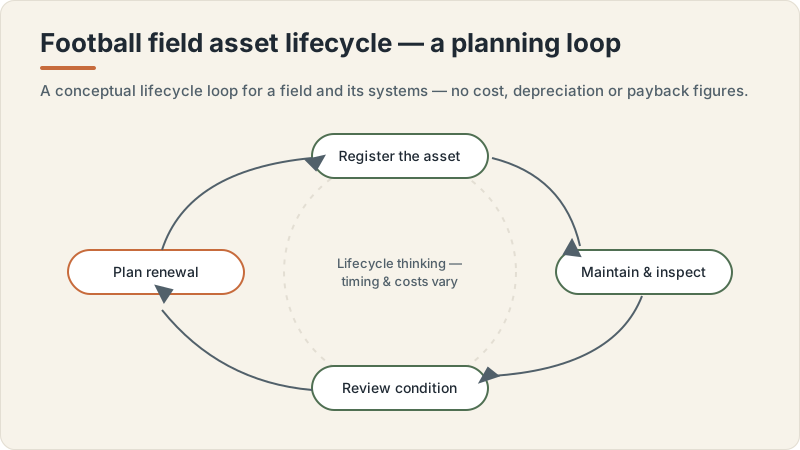
Football field asset lifecycle concept
Conceptual editorial diagram — not a construction drawing, specification, to-scale plan or proof of a real project. It is not engineering, structural, fire/life-safety, crowd-safety or accessibility-compliance guidance. Capacities, dimensions, standards, requirements and costs vary by facility type, audience, site, use case and governing body, and are confirmed with qualified professionals, relevant authorities and governing bodies. Build Design Hub does not design, build, inspect, certify, recommend or match anyone.
What this guide helps you prepare
This guide helps you assemble the planning materials needed to think about a football field as a long-lived asset rather than a one-time build. That includes drafting an asset register, deciding what information you want recorded at handover, and framing the renewal and lifecycle questions you will put to qualified professionals. The aim is preparation: clearer briefs, better-organised records, and a structured set of questions, so that the people who actually design, specify, maintain and renew the field have what they need from you.
It does not tell you how to engineer, design, install, certify, inspect or maintain a field, a surface system, drainage, lighting or fencing, and it does not state any requirement, specification, lifespan or figure as fact. Where this guide raises a topic such as surface condition, drainage performance, equipment, or governing-body expectations, treat it as a prompt to confirm with qualified professionals, relevant authorities and the appropriate sport governing body. Build Design Hub does not design, build, install, inspect, certify, recommend, rank, verify or match suppliers or contractors.
- A starting structure for an asset register you can populate with help from your professional team
- A way to capture what you want handed over and recorded when the field comes into use
- A framework for thinking about repair, refurbishment and renewal as separate decisions over time
- Prompts to organise warranties, manuals, drawings and contact details in one place
- A set of questions to take into stakeholder discussions and professional conversations
- Clarity on which topics must be confirmed with qualified professionals and governing bodies rather than assumed
Building a football field asset register
An asset register is simply an organised record of the things that make up your field and the information you hold about each of them. For a football field or training ground, you might choose to list the playing surface and its system, drainage-related elements, lighting, fencing and perimeter, goals and fixed equipment, irrigation if present, line markings, ancillary structures and any access or pathway elements. The point of preparing the register is to decide, in advance, what you want to know about each item: who supplied it, what documentation exists, what was agreed at handover and where the records live. The specifics of what each element is and how it performs are matters for your professional team and suppliers to describe, not for you to assume.
When you build the register, focus on capturing references rather than making technical judgements. For each entry you might record the supplier or contractor name, relevant warranty or manual references, handover documents, and a note of who to contact with questions. Resist the temptation to write down lifespans, performance numbers, maintenance intervals or specifications as if they were settled facts; instead, note them as open questions to confirm with qualified professionals and the appropriate governing body. A register prepared this way becomes a tool for asking better questions over the years, and for making sure nothing is lost when staff, committees or contractors change.
- List the main elements you want to track and note who supplied or installed each
- Record where warranties, manuals, drawings and handover documents are stored
- Capture contact details for the professionals and suppliers behind each element
- Note, as open questions, anything about condition, performance or intervals to confirm with professionals
- Decide who owns and updates the register, and how often it is reviewed
- Keep a change log so decisions and contractor changes are traceable over time
Lifecycle thinking and renewal questions
Lifecycle thinking means treating the field as something that will need attention at different points: routine care, occasional repair, larger refurbishment, and eventual renewal of major elements. Preparing for this is not about predicting when anything will happen or what it will involve technically; it is about deciding, in advance, what would prompt you to seek professional advice and how you will gather the information needed to make a decision. You might prepare a simple framework that separates day-to-day operations from the bigger, less frequent decisions, so that when a renewal conversation does arise you already know who to involve and what records to bring.
The most useful thing you can prepare here is a set of renewal questions rather than answers. These are the questions you would put to qualified professionals when the time comes: what options exist, what would need assessing, who needs to be involved, and what governing-body or authority expectations might apply. Keeping these questions ready, alongside your asset register, means lifecycle decisions are informed by good records and clear conversations rather than by assumptions. Avoid recording any lifespan, performance or cost expectation as fact; those belong in your list of things to confirm with the appropriate professionals and authorities.
- Distinguish routine operations from larger refurbishment and renewal decisions in your planning notes
- Decide what conditions or observations would prompt you to seek a professional assessment
- Prepare the questions you would ask professionals about renewal options and what they would assess
- Note which governing-body or authority expectations you would need to re-confirm at renewal
- Keep stakeholder roles clear so renewal conversations involve the right people
- Treat all lifespans, intervals and figures as questions to confirm, never as fixed facts
Planning questions before speaking with professionals
Before you sit down with designers, surface specialists, maintenance providers or other qualified professionals, it helps to have worked through your own context. That means being clear about how the field will be used, who the stakeholders are, what records you already hold, and what decisions you are actually trying to make. The clearer you are about your situation and your goals, the more useful the professional conversation will be, and the more relevant the advice you receive. This section is about organising your own thinking, not about reaching technical conclusions.
Use these prompts to prepare a short brief you can share. The aim is to describe your field, its intended use and your stewardship goals in plain terms, and to be honest about what you do not yet know. Anything that touches requirements, specifications, performance or governing-body expectations should appear as a question for the professional, not as a position you have already taken. Requirements vary by location, use case, governing body, owner, site, surface system, maintenance plan, climate, authority and professional team; confirm with qualified professionals.
- How is the field used today and how might that change, in your own words?
- Who are the stakeholders and decision-makers, and how are they involved?
- What records, warranties, manuals and handover documents do you already hold?
- What decisions are you trying to make, and on what rough horizon?
- Which questions feel uncertain enough that you need professional input first?
- What governing-body or authority relationships do you already have, and which are unclear?
Questions for qualified professionals
When you do engage qualified professionals, the value of your preparation shows in the questions you can ask. This section offers prompts you can adapt to your own situation and field. They are deliberately framed as questions, because the answers depend on your specific site, surface system, use case, climate, maintenance plan, governing body and the professionals you work with. Build Design Hub does not provide these answers, does not recommend or rank anyone, and does not match owners with suppliers or contractors; its role is to help you arrive at the conversation prepared.
Bring your asset register and any records to these conversations, and ask the professional to help you understand what should be assessed, what options exist, and what authorities or governing bodies need to be consulted. Capture their answers in your register as confirmed information, replacing the open questions you started with. Keep a clear separation between what a professional has told you about your specific field and any general assumption, so your records stay accurate as people and circumstances change.
- What should be assessed about my field's current elements, and who is qualified to do it?
- What options might exist for repair, refurbishment or renewal of major elements?
- Which governing-body, authority or insurer expectations apply to my situation?
- What documentation should I be keeping, and in what form, for long-term records?
- What would you need from me or my records to give useful advice?
- How should I structure quote comparisons so I am comparing scopes fairly?
What this does not replace
This is an educational project-preparation resource only. It is not a construction manual and not engineering, architectural, turf-installation, drainage-engineering, sports-surface-specification, structural, fire or life-safety, crowd-safety, accessibility-compliance, permit, zoning, legal, tax or procurement advice. It does not design, specify, install, certify, inspect or approve anything, and it is not an estimate, quote, price, capacity recommendation or performance or lifespan guarantee. Requirements, standards, dimensions, surface systems and costs vary by location, use case, governing body, owner, site, climate, maintenance plan, authority and professional team, and are confirmed with qualified professionals, relevant authorities and the sport governing body.
Build Design Hub does not design, build, install, engineer, inspect, certify, recommend, rank, verify, introduce, broker or match suppliers or contractors, and HELPERG LLC is publisher/operator only. Use this resource to prepare your own thinking, then have qualified professionals you engage directly review your project. Decisions about engineering, surface specification, drainage, safety, compliance, procurement and suitability must rest on those professionals, the relevant authorities and the governing body for your sport and location.
- Not a construction manual and not engineering, turf-installation or drainage-engineering instructions
- Not sports-surface specification, structural, fire/life-safety, crowd-safety or accessibility-compliance advice
- Not permit, zoning, legal, tax or procurement advice
- Not a supplier or contractor recommendation, ranking, directory or matching service
- Not an estimate, price, capacity recommendation or performance/lifespan guarantee — requirements and costs vary
- Qualified professional review is required before any project decision
Football field asset and lifecycle preparation worksheet
- 1Record how the field is used now and any expected changes, in plain language
- 2List the main elements you want to track in your asset register
- 3Note the supplier or contractor associated with each element where known
- 4Gather and store warranties, manuals, drawings and handover documents in one place
- 5Record contact details for the professionals and suppliers behind each element
- 6Write down condition, performance and interval topics as open questions to confirm with professionals
- 7Identify which governing body and authorities are relevant and note open questions for each
- 8Define who owns, updates and reviews the asset register, and how often
- 9Draft the renewal questions you would put to professionals when decisions arise
- 10Separate routine operations from larger refurbishment and renewal decisions in your notes
- 11Prepare a short context brief to share with qualified professionals
- 12Set up a change log to keep decisions and contractor changes traceable
- 13List the stakeholders and decision-makers and how each is involved
- 14Note a structure for comparing quotes so scopes are compared fairly
Common mistakes to avoid
- Treating the field as a finished build rather than an asset that needs long-term records and review
- Writing down lifespans, intervals, performance figures or costs as settled facts instead of questions to confirm
- Letting warranties, manuals and handover documents scatter so they are lost when people change
- Assuming governing-body or authority expectations stay the same over time without re-confirming them
- Skipping the asset register because the field seems simple, then having no records when renewal decisions arise
- Mixing general assumptions with what a professional actually said about your specific field
- Leaving ownership of the register unclear so it is never updated after handover
- Going into professional conversations without a clear brief, records or prepared questions
When to involve a professional
- When you are deciding whether an element should be repaired, refurbished or renewed and need an assessment
- When governing-body, authority or insurer expectations are unclear or may have changed
- When you are interpreting warranties, manuals or handover documents and are unsure what they require
- When you need to understand options for a major element and what assessing them would involve
- When stakeholders disagree on a lifecycle decision and need qualified, independent input
- When you are structuring scopes for quote comparison and want to be sure you are comparing fairly
Frequently asked questions
Questions readers ask about this topic
Does Build Design Hub recommend suppliers or contractors, or give costs and turf specifications?
No. Build Design Hub is an educational planning resource only. It does not design, build, install, inspect, certify, recommend, rank, verify, broker or match suppliers or contractors, and it does not provide costs, requirements, lifespans or turf, drainage or other specifications. Those depend on your specific situation and must be confirmed with qualified professionals, relevant authorities and the appropriate sport governing body.
What is an asset register and why would I prepare one for a football field?
An asset register is an organised record of the elements that make up your field and the information you hold about each, such as suppliers, documentation and open questions. Preparing one helps you keep records in one place, ask better questions over time, and avoid losing information when staff, committees or contractors change. This guide helps you structure it; your professional team and suppliers describe the technical detail.
Can this guide tell me how long a surface lasts or when to renew it?
No. This guide does not state any lifespan, interval, performance figure or timeline as fact, because these vary by location, use case, governing body, owner, site, surface system, maintenance plan, climate, authority and professional team. Instead it helps you prepare the questions to put to qualified professionals so they can advise on your specific field.
How does lifecycle thinking differ from day-to-day maintenance?
Lifecycle thinking treats routine care, occasional repair, larger refurbishment and eventual renewal as separate decisions over time, while day-to-day maintenance is the routine part. This guide helps you prepare a framework and renewal questions so the bigger decisions are informed by good records and professional advice rather than assumptions. It does not tell you how to maintain or operate anything.
Keep reading