
Who this guide is for
- Club or facility managers weighing whether to refresh, partly renovate, or fully replace a playing surface
- School, college, or university estates staff scoping a sports-field project for the first time
- Municipal and parks teams preparing a brief before approaching qualified professionals
- Developers or trustees evaluating a pitch within a wider site or community scheme
- Groundskeeping and operations leads who need to translate surface concerns into planning questions
- Volunteer committee members at amateur clubs preparing for stakeholder and funding discussions
Planning diagram
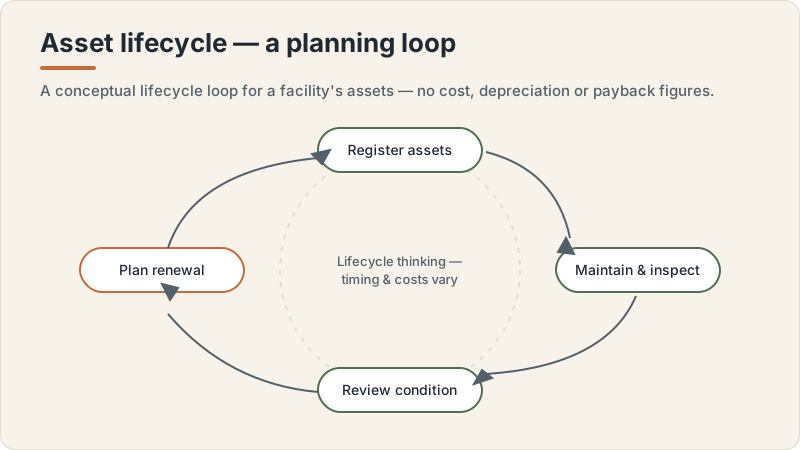
Sports-facility asset lifecycle concept
Conceptual editorial diagram — not a construction drawing, specification, to-scale plan or proof of a real project. It is not engineering, structural, fire/life-safety, crowd-safety or accessibility-compliance guidance. Capacities, dimensions, standards, requirements and costs vary by facility type, audience, site, use case and governing body, and are confirmed with qualified professionals, relevant authorities and governing bodies. Build Design Hub does not design, build, inspect, certify, recommend or match anyone.
What this guide helps you prepare
This guide helps you organise the thinking that comes before a football pitch renovation or replacement is scoped, designed, or priced. It focuses on framing the problem, identifying stakeholders, gathering the information a qualified professional would want to see, and writing down the questions you need answered. It treats renovation versus replacement not as a decision you should make alone from a webpage, but as a set of questions to put to people qualified to assess the surface, the subsurface conditions, the usage demands, and the governing-body and regulatory context that applies to your specific site.
Nothing here tells you what condition your pitch is in, what intervention it needs, what it should cost, how long it should take, or which standards apply. Those are determined by qualified professionals, the relevant authorities, and the applicable governing bodies, and they vary by location, facility type, audience, site, and use case. What this guide can do is help you turn vague dissatisfaction ("the pitch is not good enough") into a structured brief: a clear statement of symptoms, goals, constraints, stakeholders, and open questions that makes your eventual professional conversations far more productive.
- Clarify the difference between a symptom you have noticed and a diagnosis only a professional can make
- Capture goals, constraints, and stakeholders in one place before any technical conversation begins
- Separate questions you can answer internally from those that require qualified professional input
- Prepare a brief that a professional, authority, or governing body can respond to clearly
- Understand that renovation-versus-replacement is framed here as questions, never as a recommendation
- Recognise where this guide stops and where qualified professional advice must begin
Framing renovation versus replacement as questions
The temptation with an underperforming pitch is to jump straight to a solution: "we need a new surface" or "we just need to renovate." A more useful starting point is to treat the renovate-or-replace choice as a series of open questions for qualified professionals rather than a conclusion you reach in advance. What is actually causing the problems being observed? Are the issues at the surface, below it, in drainage, in usage intensity, in maintenance regime, or some combination? Which of these can only be established by a qualified assessment? Documenting the observed symptoms and the questions they raise keeps you from committing to an answer before anyone qualified has looked at the evidence.
It also helps to record the considerations that might pull in either direction, while being clear that the weighing of them is a professional and stakeholder matter, not something this guide decides. Usage patterns, how the facility is intended to be used in future, the expectations of any relevant governing body, available budget envelopes set by your own organisation, and the operational disruption of any works are all factors that qualified professionals and decision-makers will need to consider together. Your job at this stage is to surface these factors as questions and constraints, not to resolve them. Requirements and what is appropriate vary by location, facility type, audience, site, use case, and governing body; confirm everything with qualified professionals.
- What specific problems are being observed, and over what period and conditions have they appeared?
- Which observed issues can only be diagnosed by a qualified professional assessment rather than assumed?
- What is the intended future use, audience, and intensity that any solution would need to serve?
- Which governing bodies or authorities may have an interest, and what should be confirmed with them?
- What internal constraints (budget envelope, seasonal availability, disruption tolerance) frame the options?
- What information would a professional need before they could meaningfully advise on renovate versus replace?
Preparing for a professional condition assessment
A professional condition assessment is something qualified specialists carry out; this guide does not explain how to perform one and you should not attempt to self-diagnose the surface or subsurface. What you can do is prepare so that any assessment you commission is efficient and well-informed. That means gathering the history and context a professional is likely to ask for: how the pitch has been used, what maintenance has been done, what records exist, when problems started, and what has changed. Assembling this material in advance is an organisational task, not a technical one, and it helps qualified people focus their expertise on the questions that matter.
It also helps to be clear about what you want an assessment to inform. Are you trying to understand the current state, explore options, support a funding or governance decision, or all of these? Writing down the decision the assessment is meant to support helps qualified professionals scope their work appropriately and helps you compare different professionals' proposed approaches. Be cautious about treating any single observation, photograph, or anecdote as a conclusion; the purpose of preparation is to hand qualified people good raw material, not to pre-empt their findings. Requirements and appropriate methods vary by site and governing body; confirm with qualified professionals.
- Compile the usage history: who uses the pitch, how often, in what seasons, and for what activities
- Gather existing records, plans, maintenance logs, warranties, and any prior reports you can locate
- Note when problems were first observed and any events or changes that coincided with them
- Write down the decision the assessment is meant to support so professionals can scope appropriately
- List access, scheduling, and operational constraints a visiting professional would need to know
- Prepare questions about what the assessment will and will not cover, and how findings will be reported
Planning questions before speaking with professionals
Before you approach any qualified professional, authority, or governing body, it helps to answer the questions that are genuinely internal to your organisation. These are not technical questions about the pitch; they are about your goals, your stakeholders, your constraints, and your decision-making process. Being clear on these first means your professional conversations stay focused on what only professionals can provide, and it reduces the risk of redesigning your own objectives midway through a project. Treat this as preparing your side of the conversation, not as a substitute for it.
Work through who must be consulted or kept informed, how decisions will be made and signed off, what funding routes or approvals may be involved, and what success would look like in plain terms. Capture your open questions honestly, including the ones you suspect you do not yet know how to ask, so a professional can help you fill the gaps. None of this commits you to a particular solution; it simply ensures that when qualified people do get involved, they are responding to a clear and considered brief rather than a moving target.
- Who are the stakeholders and decision-makers, and who has approval authority for a project like this?
- What does a successful outcome look like in plain language, separate from any specific solution?
- What constraints (seasonal use, budget envelope set internally, disruption limits) must any option respect?
- What approvals, funding routes, or governance steps might apply, and who confirms them?
- What records, plans, and history have you gathered, and what gaps remain to be filled?
- What questions do you most need a qualified professional to help you understand or answer?
Questions for qualified professionals
When you do engage qualified professionals, the value of your preparation shows in the quality of the questions you can ask. Rather than asking for a solution up front, ask them to help you understand the situation, the realistic options, and the trade-offs, and to identify what they would need to investigate before advising. Ask how they would approach a condition assessment, what governing-body or regulatory considerations may apply to your specific facility, and how they would frame the renovate-versus-replace question for a site like yours. Build Design Hub does not recommend, rank, verify, or match professionals; selecting and engaging them is entirely your decision, and the questions below are prompts to support those conversations.
Use professional conversations to confirm anything this guide has deliberately left open, including requirements, standards, methods, sequencing, and what any relevant authority or governing body expects. Ask each professional to be explicit about the limits of their advice, what falls outside their remit, and where additional specialists may be needed. When comparing different professionals' responses, focus on how clearly they scope the problem, how they handle uncertainty, and how transparently they describe what they would and would not cover, rather than on any single figure or claim. Requirements vary by location, facility type, audience, site, use case, and governing body; confirm everything with qualified professionals.
- How would you approach assessing this pitch, and what would you need to investigate before advising?
- What governing-body, regulatory, or authority considerations should we confirm for a facility like ours?
- How would you frame the renovation-versus-replacement question for our specific site and usage?
- What does your advice cover, what falls outside your remit, and where might other specialists be needed?
- What information or access do you need from us, and how and when will you report findings?
- How should we structure quotes or proposals so we can compare different professionals' approaches fairly?
What this does not replace
This is an educational project-preparation resource only. It is not a construction manual and not engineering, architectural, structural, civil, fire or life-safety, crowd-safety, accessibility-compliance, permit, zoning, legal, tax or procurement advice. It does not design, specify, certify, inspect or approve anything, and it is not an estimate, quote, price or capacity recommendation. Requirements, standards, capacities and costs vary by location, facility type, audience, site, use case, design team, supplier, contractor and governing body, and are confirmed with qualified professionals, relevant authorities and governing bodies.
Build Design Hub does not design, build, engineer, inspect, certify, recommend, rank, verify, introduce, broker or match suppliers or contractors, and HELPERG LLC is publisher/operator only. Use this resource to prepare your own thinking, then have qualified professionals you engage directly review your project. Decisions about engineering, safety, compliance, procurement and suitability must rest on those professionals, the relevant authorities and the governing bodies for your sport and location.
- Not a construction manual and not engineering, structural or civil design
- Not fire/life-safety, crowd-safety, evacuation or accessibility-compliance advice
- Not permit, zoning, legal, tax or procurement advice
- Not a supplier or contractor recommendation, ranking, directory or matching service
- Not an estimate, quote, price or capacity recommendation — requirements and costs vary
- Qualified professional review is required before any project decision
Football field renovation planning worksheet
- 1Record the specific problems observed on the pitch, with dates, conditions, and who reported them
- 2Write a plain-language statement of what you want the project to achieve
- 3Note the intended future use: activities, audience, frequency, and seasons
- 4List all stakeholders and who holds approval authority for the project
- 5Gather existing plans, maintenance logs, warranties, and any prior professional reports
- 6Document the usage history of the pitch over recent seasons
- 7Capture internal constraints: budget envelope, scheduling windows, and disruption limits
- 8Identify which authorities or governing bodies may have an interest, to confirm with them
- 9Separate questions you can answer internally from those needing qualified professional input
- 10Write down the decision any condition assessment is meant to support
- 11List access and operational constraints a visiting professional would need to know
- 12Prepare your open questions for qualified professionals, including what you are unsure how to ask
- 13Record how decisions will be made, signed off, and funded within your organisation
- 14Note how you will structure and compare different professionals' proposals fairly
Common mistakes to avoid
- Deciding renovate-or-replace before any qualified professional has assessed the surface or subsurface
- Treating a single observation, photo, or anecdote as a diagnosis rather than a symptom to investigate
- Approaching professionals without a clear brief, goals, or organisational constraints written down
- Assuming requirements, standards, or methods from another facility apply to your own site
- Skipping early stakeholder and approval mapping, then discovering decision-makers were not consulted
- Failing to gather usage history and existing records before commissioning an assessment
- Confusing what your organisation must decide internally with what only professionals can determine
- Comparing professionals on a single figure or claim instead of how clearly they scope and handle uncertainty
When to involve a professional
- When you need the actual condition of the pitch, surface, or subsurface assessed or diagnosed
- When renovation-versus-replacement must be decided based on technical evidence rather than impressions
- When governing-body, regulatory, permitting, or authority requirements may apply to your facility
- When any drainage, regrading, resurfacing, or structural matter is being considered
- When safety, accessibility, certification, or compliance questions arise for the surface or site
- When you need to scope, sequence, or cost actual works rather than prepare for a conversation
Frequently asked questions
Questions readers ask about this topic
Does this guide tell me whether to renovate or replace my pitch?
No. This guide frames renovation versus replacement as a set of questions to put to qualified professionals, not a decision it makes for you. The right answer depends on your specific site, usage, and the assessment of qualified people. It varies by location, facility type, audience, site, use case, and governing body, and must be confirmed with appropriately qualified professionals.
Can Build Design Hub recommend a contractor, supplier, or tell me what this will cost?
No. Build Design Hub does not recommend, rank, verify, introduce, broker, or match suppliers or contractors, and it does not provide costs, prices, timelines, requirements, or standards. This is an educational planning resource only. Selecting professionals and confirming any costs or requirements is your decision, to be made with qualified professionals and the relevant authorities.
Will following this guide tell me what condition my pitch is in?
No. Assessing the condition of a pitch is work that qualified professionals carry out, and this guide does not explain how to do it or let you self-diagnose. The guide only helps you prepare the history, context, and questions a professional may want, so any assessment you commission is more efficient and well-informed.
What should I have ready before I contact a qualified professional?
It helps to have a plain-language statement of your goals, the problems you have observed with dates and conditions, your usage history, existing records and plans, your internal constraints, your stakeholders, and your open questions. The worksheet in this guide outlines these items. Treat them as preparation for a professional conversation, not a replacement for one.
Keep reading