
Who this guide is for
- Owners deciding how their facility will be booked and accessed day to day
- Schools and education estates teams coordinating curriculum, club and community use
- Clubs and committees planning member, guest and casual access
- Municipalities and public-sector teams overseeing community access and equity of use
- Developers and project sponsors preparing a facility brief before handover to an operator
- Facility managers and operators structuring booking, access and supervision responsibilities
Planning diagram
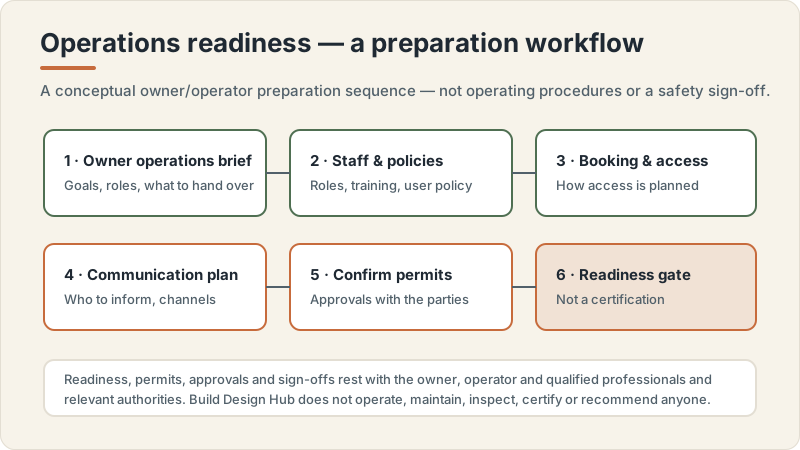
Operations readiness workflow concept
Conceptual editorial diagram — not a construction drawing, specification, to-scale plan or proof of a real project. It is not engineering, structural, fire/life-safety, crowd-safety or accessibility-compliance guidance. Capacities, dimensions, standards, requirements and costs vary by facility type, audience, site, use case and governing body, and are confirmed with qualified professionals, relevant authorities and governing bodies. Build Design Hub does not design, build, inspect, certify, recommend or match anyone.
What this guide helps you prepare
This guide helps you prepare the thinking and the documentation behind a booking and access approach so that conversations with your operator and with qualified professionals are productive. It covers how to map who needs to use the facility, how access might be granted and controlled at a conceptual level, how a booking calendar can balance competing demands, and what owner-side decisions, responsibilities and records should be settled before opening. The output is a set of questions, a draft register of user groups and priorities, and a list of open items to confirm, not a finished policy or an instruction set.
It is written for the planning and project-preparation stage, when you are shaping a brief, agreeing scope with an operator, or reviewing how an existing facility is run. It does not tell you which booking model to adopt, which software to use, or how to design entry, supervision, security or safety arrangements. Those decisions depend on facility type, use intensity, ownership, governing body, local requirements, insurance terms and the operator's own policies, all of which vary; confirm them with qualified professionals, the operator and the relevant authorities.
- Clarify the difference between owner-side decisions and operator-side execution
- Draft a register of user groups, priorities and the access each implies
- Assemble the questions to raise with the operator before opening
- Identify open items to confirm with qualified professionals and authorities
- Prepare governance and record-keeping expectations rather than operational procedures
- Avoid committing to any specific booking model, system or access method prematurely
Mapping who needs access and how booking might work
A useful starting point is to list every group that will need to use the facility and what kind of access each one implies. A school may need curriculum slots, after-school clubs, community evening use and occasional events; a club may need member sessions, coached programmes, casual play and guest access; a municipality may need to balance public bookings with reserved community time. Writing these groups down, alongside the times and conditions each typically needs, turns a vague intention into a register you can discuss with the operator. The aim at this stage is to understand demand and priority, not to allocate the calendar.
From that register you can frame, at a high level, how booking might work: who is allowed to reserve, how far ahead, how priority is resolved when groups compete for the same time, and how casual or walk-up use fits alongside booked use. These are policy questions for you and your operator to decide together, shaped by your purpose and by any obligations attached to public funding, school use or governing-body affiliation. This guide does not propose a particular model or system; how booking is actually operated, and how any access method is configured, are matters to settle with the operator and with qualified professionals.
- Which user groups need access, and what does each typically need (times, frequency, conditions)?
- How should competing demands be prioritised, and who decides when they clash?
- How far in advance might different groups be able to reserve time?
- How would casual, walk-up or guest use sit alongside booked use?
- Are there obligations from funding, school use or a governing body that shape access?
- Which of these are owner decisions and which belong with the operator to run?
Deciding access responsibilities and records with the operator
Beyond the booking calendar, access raises a set of practical decisions about responsibility and accountability that are best agreed with the operator before opening rather than improvised afterwards. These include who is responsible for granting and revoking access, how access is supervised during different periods of use, how unsupervised or out-of-hours use would be handled if it is permitted at all, and how exceptions, events and shared use with other parties are approved. This guide does not describe how to control entry or supervise people, which are operational and potentially safety-sensitive matters; it helps you identify the decisions and ask the operator how they intend to handle them.
Equally important is agreeing what should be recorded and reviewed. Owner-side governance benefits from clarity on what booking and access information is kept, who can see it, how disputes or incidents are logged and escalated, and how the arrangement is reviewed over time as use patterns change. Establishing these expectations early gives you a basis for oversight without stepping into day-to-day operations. Specific record-keeping, data-handling, supervision and any security or safety arrangements should be confirmed with the operator and with qualified professionals, and may be subject to local requirements that vary by location.
- Who grants, changes and removes access, and how are those decisions authorised?
- How is access supervised across different periods, and is any unsupervised use contemplated?
- How are exceptions, events and shared use with third parties approved?
- What booking and access records are kept, and who is responsible for them?
- How are disputes, no-shows or incidents logged and escalated?
- How and how often will the booking and access arrangement be reviewed?
Planning questions before speaking with professionals
Before you involve the operator or any qualified professional, it is worth assembling your own answers and open questions so the conversation starts from a clear brief. Work through your purpose for the facility, the user groups you expect, the priorities between them, and the obligations that constrain how access can be offered. Note where you genuinely do not yet know the answer, because those gaps are exactly what you want professional and operator input on. Capturing this in writing keeps the discussion focused on decisions rather than on re-explaining context.
Frame these as questions rather than conclusions. You are not deciding hours, capacities, supervision ratios or access methods yourself at this stage, and this guide does not provide any such figures or rules. Booking and access arrangements vary by facility type, use intensity, surface, governing body, insurance terms, local requirements and the operator's policies; confirm them with qualified professionals. The goal of this preparation is simply to know what you want, what you must respect, and what you still need to ask.
- What is the facility's primary purpose, and which uses are most important to protect?
- Which user groups have been identified, and how confident are you in that list?
- What obligations (funding, school, governing body, community access) constrain how access is offered?
- Where do you not yet know how access or booking should work?
- What does success look like in terms of fair, manageable use of the calendar?
- What information do you want kept so you can oversee the arrangement responsibly?
Questions for qualified professionals
When you move into discussions with your operator and with qualified professionals, use your prepared brief to ask how booking and access should be approached for your specific facility. Helpful questions explore how the operator intends to run booking, how access and supervision will be handled across different periods, what local requirements, insurance terms or governing-body conditions apply, and how the arrangement will be documented and reviewed. The point is to surface the operator's and professionals' approach, not to have this guide prescribe one.
Treat any figures, hours, ratios, capacities, intervals or standards that come up as matters to confirm with the appropriate professionals and authorities, because they vary by facility type, use, location and policy. Build Design Hub does not operate, supervise, configure access for, or recommend operators, systems, suppliers or contractors, and it does not provide booking models, costs, hours or requirements. Use these questions to gather the specific, accountable guidance that applies to your facility from the people responsible for it.
- How do you intend to run booking, and how will competing demands be prioritised?
- How will access and supervision be handled across staffed, unstaffed and out-of-hours periods?
- What local requirements, insurance terms or governing-body conditions affect access here?
- What booking and access records will be kept, and how is data handled and protected?
- How will exceptions, events and shared use be approved and managed?
- How and how often will the booking and access arrangement be reviewed with us?
What this does not replace
This is an educational planning resource only. It is not a maintenance manual and not inspection, certification, engineering, architectural, structural, HVAC, electrical, safety-compliance, fire or life-safety, or accessibility-compliance advice, and it is not legal, tax, insurance or procurement advice. It does not maintain, operate, inspect, certify, audit or specify anything, gives no maintenance intervals or procedures as universal rules, and offers no warranty interpretation, estimate, price, ROI or capacity figure. Maintenance requirements and costs vary by facility type, use intensity, surface, system, climate, season, governing body, warranty terms, supplier documentation, contractor scope and local professional requirements, and are confirmed with qualified professionals, suppliers, contractors, relevant authorities and governing bodies.
Build Design Hub does not operate, maintain, inspect, certify, audit, design, build, recommend, rank, verify, introduce, broker or match suppliers, contractors, maintenance providers or facility managers, and HELPERG LLC is publisher/operator only. Use this resource to prepare your own thinking and records, then have qualified professionals you engage directly review your facility. Decisions about maintenance, inspection, safety, compliance, warranties, procurement and suitability must rest on those professionals, suppliers, the relevant authorities and the governing bodies for your sport and location.
- Not a maintenance manual and not maintenance instructions, intervals or procedures as universal rules
- Not inspection, certification, safety-compliance, fire/life-safety or accessibility-compliance advice
- Not engineering, architectural, warranty-interpretation, legal, tax, insurance or procurement advice
- Not a supplier, contractor, maintenance-provider or facility-manager recommendation, ranking, directory or matching service
- Not an estimate, price or cost figure — maintenance requirements and costs vary
- Qualified professional review is required before any operations or maintenance decision
Booking and access planning worksheet
- 1Record the facility's primary purpose and the uses you most want to protect
- 2List every user group expected to need access (curriculum, club, member, community, casual, guest, events)
- 3Note the typical times, frequency and conditions each group needs
- 4Capture the priority order between groups and who is to resolve conflicts
- 5Record obligations from funding, school use, a governing body or community-access commitments
- 6Draft the high-level booking questions to raise with the operator (who reserves, how far ahead, how priority is resolved)
- 7List the access responsibility questions to settle with the operator (granting, changing, revoking, supervision)
- 8Note how exceptions, events and shared third-party use should be approved
- 9Record what booking and access information you expect to be kept and who can see it
- 10Capture how disputes, no-shows and incidents should be logged and escalated
- 11List the open items to confirm with qualified professionals and relevant authorities
- 12Note how and how often the arrangement should be reviewed as use patterns change
- 13Mark every figure, hour, ratio or requirement as 'to confirm' rather than decided
- 14Keep this worksheet as a brief to bring to operator and professional conversations
Common mistakes to avoid
- Treating a booking model or access method seen elsewhere as a universal rule rather than a choice to confirm for your facility
- Deciding hours, capacities or supervision arrangements on the owner side instead of with the operator and qualified professionals
- Skipping the user-group register and discovering competing demands only after opening
- Assuming insurance, funding or governing-body terms permit a given access approach without confirming them
- Leaving access responsibility (who grants and revokes it) undefined between owner and operator
- Confusing owner-side governance and record expectations with day-to-day operational procedures
- Treating booking and access as a post-construction afterthought rather than part of operations readiness
- Assuming this guide or any single source can prescribe the right model instead of asking the operator and professionals
When to involve a professional
- When agreeing how booking and access will actually be run, supervised and documented with the operator
- When any access, entry, supervision, security or safety arrangement needs to be designed or specified
- When insurance terms, funding conditions or governing-body rules may constrain how access can be offered
- When local requirements affecting hours, public access, data handling or community use need to be confirmed with the relevant authorities
- When booking and access records involve personal data and need appropriate handling and protection
- When competing or shared use between schools, clubs, community groups or commercial users needs a formal, accountable arrangement
Frequently asked questions
Questions readers ask about this topic
Does this guide tell me which booking system or access method to use?
No. It deliberately stays high-level, helping you prepare questions and decisions about how access might work and what to settle with your operator. It does not name software, recommend a booking model, or describe how to set up entry, supervision or security. Those are operational and sometimes safety-sensitive matters to confirm with the operator and qualified professionals.
Does Build Design Hub operate facilities, supervise access, or recommend operators and suppliers?
No. Build Design Hub is an educational resource. It does not operate, supervise, configure access for, inspect or certify any facility, and it does not recommend, rank, verify or match operators, systems, suppliers, contractors or facility managers. It provides no booking models, costs, hours, ratios, intervals or requirements. Decisions and their execution rest with you, your operator and qualified professionals.
How many hours or how much capacity should we plan for each user group?
This guide does not provide hours, capacities, supervision ratios or any such figures. They vary by facility type, use intensity, governing body, insurance terms, local requirements and operator policy. Confirm what is appropriate for your facility with the operator and qualified professionals.
Can booking and access be sorted out after the facility is built?
It is usually far easier to prepare these questions before opening, because the user groups, priorities and access responsibilities you identify shape how the facility runs. The detailed booking and access arrangements are then settled with your operator; this guide only helps you arrive at that stage prepared.
Keep reading