
Who this guide is for
- Owners and clubs scoping a new or upgraded sports facility who want to understand which professional roles a project may involve
- Municipalities and schools preparing to brief and engage a design and advisory team for a facility
- Developers and project sponsors mapping the disciplines and advisors around a facility scheme
- Facility managers helping shape a project brief and the conversations that will follow
- Boards and committees that need an organised picture of roles before approving an approach
- Anyone preparing stakeholder discussions and questions ahead of speaking with qualified professionals
Planning diagram
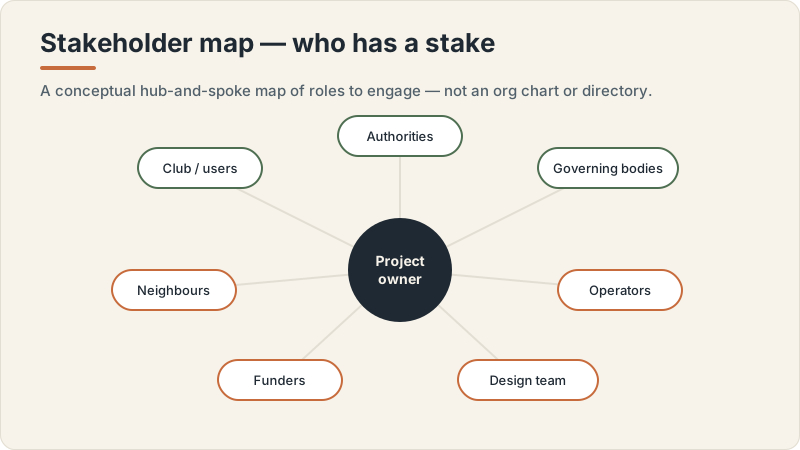
Sports-facility stakeholder map concept
Conceptual editorial diagram — not a construction drawing, specification, to-scale plan or proof of a real project. It is not engineering, structural, fire/life-safety, crowd-safety or accessibility-compliance guidance. Capacities, dimensions, standards, requirements and costs vary by facility type, audience, site, use case and governing body, and are confirmed with qualified professionals, relevant authorities and governing bodies. Build Design Hub does not design, build, inspect, certify, recommend or match anyone.
What this guide helps you prepare
This guide helps you build an organised picture of the professional roles a sports facility project may involve, and how to prepare to engage them. It walks through the kinds of professionals a project of your type might draw on, from an architect and engineering disciplines to specialist consultants and advisors, and through hub-and-spoke thinking that maps how those roles relate. The goal is to help you prepare briefs, stakeholder discussions, scope notes and questions, so that when you do speak with qualified professionals your conversations are focused and your expectations are realistic.
It is deliberately a preparation tool rather than a directory or a recommendation. It does not tell you who to hire, how many people you need, what any role should cost, or what any discipline must do, because those depend on the facility type, audience, site, use case, location and governing body, and must be confirmed with qualified professionals and the relevant authorities. What it offers is a structure for capturing what you want each role to address, what you would ask, and where responsibilities might hand over from one professional to the next.
- A map of the professional roles a project of your type might involve
- Hub-and-spoke thinking for how those roles tend to relate
- A brief you can refine before approaching any professional
- A consistent set of questions to take into early conversations
- A record of which responsibilities sit with which role, and where handovers fall
- A list of open questions and gaps to confirm with qualified professionals and authorities
Roles a sports facility project may involve
Sports facility projects often draw on several distinct kinds of professional, and it helps to think of them as separate roles rather than assuming one party covers everything. Depending on the facility and your scope, a project might involve an architect or lead designer; engineering disciplines such as structural, civil, mechanical, electrical and others; specialist consultants whose focus is narrower, such as sports surfaces, lighting, acoustics, drainage, fire and life safety, accessibility, or playing-field standards; and advisors who sit alongside design, such as cost, planning, legal, environmental, project-management and governing-body liaison roles. Which of these a project actually needs, and how their work is scoped, varies widely and is something to confirm with qualified professionals.
It is worth separating the question of what a role addresses from the question of who provides it, because the same individual or firm may cover several roles on one project and only one on another. As you map the possible roles, note what each is concerned with and where its work might hand over to the next, rather than assuming the boundaries. Treat any view of who is responsible for what as something to confirm in writing with the professionals you engage, since arrangements differ by project, location and governing body.
- An architect or lead designer to shape the overall scheme and brief
- Engineering disciplines such as structural, civil, mechanical and electrical, where relevant
- Specialist consultants for narrower areas such as surfaces, lighting, acoustics or drainage
- Advisors on cost, planning, legal, environmental and project-management matters
- Governing-body or sport-federation liaison where the facility relates to a specific sport
- A note, for each role, of what it addresses and where its work may hand over to another
Hub-and-spoke thinking and how roles connect
Hub-and-spoke thinking is a way of picturing the project so the relationships between roles stay clear. The hub is usually a lead or coordinating role that holds the brief and keeps the parts aligned; the spokes are the disciplines and specialists who each own a defined area and feed back into the hub. The point of the model is not to dictate a structure, since how a team is actually led and coordinated varies by project, contract and governing body, but to help you see who might talk to whom, where decisions are gathered, and where a question for one spoke depends on the answer from another. Mapping it this way before you engage anyone makes it easier to spot gaps and overlaps in your own thinking.
Drawing your own hub-and-spoke sketch can also help you prepare cleaner briefs and questions. For each spoke, you can note what you would want that role to address, what information it would likely need from you, and what it might hand back to the hub. Doing this surfaces the dependencies, places where one discipline's input shapes another's, that are easy to miss until late. Keep the sketch as a thinking aid rather than a plan of record, and confirm the actual coordination, scopes and responsibilities with the qualified professionals you engage.
- Identify a likely hub or coordinating role and what it would hold
- List the spokes, the disciplines and specialists, your project might involve
- For each spoke, note what it addresses and what it would need from you
- Map the dependencies where one role's input shapes another's
- Mark gaps and overlaps in your own picture to raise with professionals
- Treat the map as a preparation aid, not a fixed organisational plan
Planning questions before speaking with professionals
Before you approach any professional, it helps to get your own project clear enough to brief well. That means writing down what the facility is for, who will use it, the constraints you already know about the site and the timeline, and the decisions that are still open. The clearer this is, the easier it is for a professional to tell you which roles a project of your kind tends to involve and how their work would fit, and the easier it is for you to compare what different professionals say. None of this requires you to resolve technical questions; it requires you to frame them.
It also helps to think about your own side of the engagement: who in your organisation makes decisions, who needs to be consulted, what stakeholders and governing bodies have an interest, and how you will record and compare what professionals tell you. Capturing these things in advance means your conversations are about substance rather than logistics, and it gives you a consistent basis for the questions in the next section. Keep these as your own working notes, and confirm anything that affects scope or roles with qualified professionals.
- What is the facility for, who will use it, and what outcomes matter to stakeholders?
- What do we already know about the site, constraints and timeline, and what is still open?
- Which decisions sit with us, and which stakeholders or governing bodies must be consulted?
- What roles do we think a project like ours might involve, and where are we unsure?
- How will we capture and compare what different professionals tell us?
- What is our brief missing that a professional would need before they could advise?
Questions for qualified professionals
When you do speak with qualified professionals, the most useful questions are the ones that clarify roles, scope and boundaries rather than ones that ask for a number or a verdict on the spot. Asking which disciplines a project of your type typically involves, how their own scope would relate to others, and where responsibilities hand over helps you build an accurate picture and avoid gaps. It is also reasonable to ask about qualifications, registrations and the standards and authorities that apply, so you understand who is accountable for what and where independent confirmation belongs.
Record the answers in writing and mark anything that is uncertain or conditional as a question to revisit, rather than treating early indications as settled. Requirements, scopes, qualifications and the involvement of governing bodies vary by location, facility type, audience, site, use case and governing body, and the professionals you engage are the people who can confirm them for your project. Use these prompts to make the boundaries clear and to know which professional owns which question.
- Which professional roles does a project of our type typically involve, and which might we not need?
- How would your scope relate to other disciplines, and where would responsibilities hand over?
- What qualifications, registrations or memberships are relevant to this kind of work?
- Which authorities, governing bodies or standards apply, and who confirms what they require?
- What information would you need from us before you could advise on scope or roles?
- Which of the questions we have are for you, and which belong to another professional?
What this does not replace
This is an educational project-preparation resource only. It is not a construction manual and not engineering, architectural, structural, civil, fire or life-safety, crowd-safety, accessibility-compliance, permit, zoning, legal, tax or procurement advice. It does not design, specify, certify, inspect or approve anything, and it is not an estimate, quote, price or capacity recommendation. Requirements, standards, capacities and costs vary by location, facility type, audience, site, use case, design team, supplier, contractor and governing body, and are confirmed with qualified professionals, relevant authorities and governing bodies.
Build Design Hub does not design, build, engineer, inspect, certify, recommend, rank, verify, introduce, broker or match suppliers or contractors, and HELPERG LLC is publisher/operator only. Use this resource to prepare your own thinking, then have qualified professionals you engage directly review your project. Decisions about engineering, safety, compliance, procurement and suitability must rest on those professionals, the relevant authorities and the governing bodies for your sport and location.
- Not a construction manual and not engineering, structural or civil design
- Not fire/life-safety, crowd-safety, evacuation or accessibility-compliance advice
- Not permit, zoning, legal, tax or procurement advice
- Not a supplier or contractor recommendation, ranking, directory or matching service
- Not an estimate, quote, price or capacity recommendation — requirements and costs vary
- Qualified professional review is required before any project decision
Professional-team planning worksheet
- 1Write a short statement of what the facility is for and who will use it
- 2List the stakeholders and governing bodies with an interest in the project
- 3Sketch a hub-and-spoke map of the roles your project might involve
- 4Note, for each role, what it would address and what it would need from you
- 5Mark the dependencies where one role's input shapes another's
- 6Record which decisions sit with you and who must be consulted
- 7Draft a brief covering purpose, users, known constraints and open questions
- 8List the qualifications and registrations you want to ask each role about
- 9Note the authorities, governing bodies and standards you need to confirm apply
- 10Prepare a consistent set of questions to take into every early conversation
- 11Set up a simple way to capture and compare what professionals tell you
- 12Mark each answer as confirmed in writing or still to be verified
- 13Keep a running list of gaps and overlaps in your own role map
- 14Record open questions to raise with qualified professionals and authorities
Common mistakes to avoid
- Assuming one professional or firm covers every role a project might involve
- Approaching professionals before the project brief is clear enough to advise on
- Treating early, conditional indications about roles or scope as settled facts
- Skipping the hub-and-spoke map and missing gaps or overlaps between disciplines
- Confusing which question belongs to which role, so issues fall between the cracks
- Not recording answers in writing, leaving handovers and responsibilities ambiguous
- Overlooking advisory and governing-body liaison roles by focusing only on design
- Assuming requirements, qualifications or roles are the same across locations and facility types
When to involve a professional
- When you need to know which disciplines and roles a project of your type actually requires
- When scope or responsibilities between roles are unclear or seem to overlap
- When qualifications, registrations or accountability for a role need to be confirmed
- When a governing body, federation or authority may have an interest in the facility
- When your brief raises technical or compliance questions you cannot resolve yourself
- Before committing to any engagement structure, scope or coordination arrangement
Frequently asked questions
Questions readers ask about this topic
Does Build Design Hub recommend or match architects, engineers or other professionals?
No. Build Design Hub publishes educational planning material only. It does not recommend, rank, verify, introduce, broker or match any firm or individual, and it gives no costs, fees or requirements. This guide helps you prepare your own thinking and questions; deciding who to engage, and confirming their qualifications and scope, is for you and the qualified professionals and authorities involved.
How do I know which professional roles my project actually needs?
That depends on the facility type, audience, site, use case, location and governing body, and it is something to confirm with qualified professionals. This guide can help you map the roles a project of your kind might involve and prepare questions, but it does not tell you which roles are required or how many people you need. Treat the map as preparation, not a decision.
Can this guide tell me what a design team or consultant should cost?
No. It does not provide costs, fees, timelines or requirements, because these vary by location, facility type, scope, site, use case and governing body. Those are questions to confirm directly with the professionals you approach and the relevant authorities. The guide focuses on helping you prepare briefs and questions, not on estimating anything.
What is hub-and-spoke thinking and why use it here?
It is a way of picturing a project where a coordinating hub holds the brief and the spokes are the disciplines and specialists who each own a defined area. Using it before you engage anyone helps you see how roles might connect, spot gaps and dependencies, and prepare cleaner briefs. It is a thinking aid, not a fixed organisational structure; the actual coordination is for the professionals you engage to confirm.
Keep reading