
Who this guide is for
- Owners deciding how their facility will be used and governed
- Operators preparing day-to-day rules for booking, access and conduct
- Facility managers documenting expectations for staff and users
- Schools and education providers planning shared-use and community-access policies
- Clubs and committees defining member conduct and booking approaches
- Municipalities and developers preparing owner-side governance documentation
Planning diagram
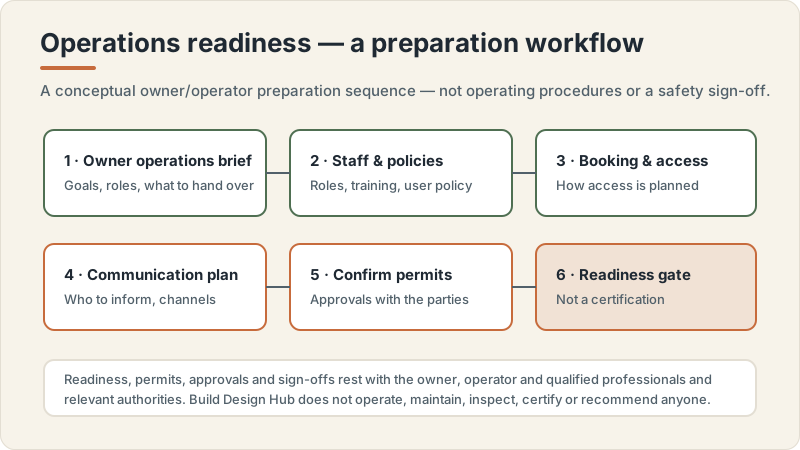
Operations readiness workflow concept
Conceptual editorial diagram — not a construction drawing, specification, to-scale plan or proof of a real project. It is not engineering, structural, fire/life-safety, crowd-safety or accessibility-compliance guidance. Capacities, dimensions, standards, requirements and costs vary by facility type, audience, site, use case and governing body, and are confirmed with qualified professionals, relevant authorities and governing bodies. Build Design Hub does not design, build, inspect, certify, recommend or match anyone.
What this guide helps you prepare
This guide helps you prepare the groundwork for a set of user policies before you sit down with qualified advisers. That groundwork is mostly organisational: deciding which behaviours and situations a policy should address, gathering the facts about your site and users that any adviser will ask for, and drafting plain-language descriptions of what you intend rather than finished clauses. Working this through in advance turns a vague instinct that you need rules into a structured brief that a legal, governance or insurance professional can respond to efficiently.
It also helps you separate the questions you can answer yourself from the ones you cannot. An owner can usually describe how they want a court to be booked, who should have access at which hours, and what conduct they consider unacceptable. What an owner generally cannot determine alone is whether a given approach meets legal, accessibility, safety or insurance expectations, because those vary widely and require professional confirmation. Keeping that line visible is the single most useful thing this preparation does.
- Decide which topics your user policies need to cover before drafting any wording
- Gather site, user and operating facts that advisers will request
- Capture your intentions in plain language for professionals to refine
- Separate owner decisions from questions that need qualified confirmation
- Assemble a brief that makes adviser conversations shorter and clearer
- Record open questions so nothing is assumed or quietly dropped
Mapping the policy areas a facility may need to address
User policies usually cluster into a few recognisable areas: how people book and pay, how they gain physical access, how they are expected to behave, and how the facility responds when something goes wrong. Mapping these areas on paper, before worrying about exact wording, helps you see the whole picture and spot the gaps. A booking rule that ignores cancellations, an access approach that says nothing about out-of-hours entry, or a conduct expectation with no stated consequence are common blind spots that surface only when you lay the areas out side by side.
As you map, note that the right scope for each area depends heavily on your context. A members-only club, a school with community evening use, and a commercial pay-and-play centre face very different situations, and a policy that suits one may be inappropriate for another. The point of mapping is not to settle the content but to define the territory, so that when you brief advisers you can say which areas matter most and why. Treat every example below as a discussion prompt, not a template to adopt.
- Booking and scheduling: reservations, changeovers, cancellations and no-shows
- Access and entry: who, when, supervised versus unsupervised, guests and visitors
- Conduct and behaviour: expectations, prohibited activities and how concerns are raised
- Equipment and facility use: what users may bring, use or are responsible for
- Resolution: how complaints, disputes and breaches are handled and recorded
- Different user groups: members, casual users, juniors, coaches and hirers
Turning intentions into discussion drafts for advisers
Once you know which areas to cover, the useful preparation is to write down what you intend in your own words, clearly labelled as a draft for discussion rather than a finished policy. Describing the outcome you want, for example that bookings made online are held for a stated grace period or that unsupervised access is limited to specific user groups, gives advisers something concrete to react to. It is far easier for a professional to refine a clear statement of intent than to extract one from scratch, and it keeps the substance of the decision with you, the owner, where it belongs.
These discussion drafts should stay deliberately provisional. Resist the urge to lock in wording, consequences or thresholds, because those often have legal, accessibility, safety or insurance dimensions that only qualified advisers can weigh against your situation. Note where you are unsure, where you suspect a rule may have implications you cannot judge, and where you would defer entirely to a professional. A draft annotated with honest uncertainty is more valuable to an adviser than a confident draft that hides its assumptions.
- Write each intended rule as a plain statement of the outcome you want
- Label everything clearly as a draft for discussion, not a final policy
- Flag wording, consequences or thresholds you are unsure about
- Note where a rule may have implications you cannot judge alone
- Keep the substance of decisions with the owner, not with this guide
- Record alternatives you considered so advisers can see your reasoning
Planning questions before speaking with professionals
Before booking time with advisers, it helps to interrogate your own draft so the conversation starts from a considered position. Ask yourself who each policy is really for, what behaviour or situation prompted the need for it, and what you would want to happen if it were ignored. Working through these questions internally often reveals that two intended rules conflict, that a policy assumes a level of supervision the facility will not have, or that an access approach has not accounted for a particular user group. Catching these tensions yourself makes the professional review more focused.
It also helps to think about how policies will live in practice once written. Who communicates them to users, where they are displayed, how they are kept current, and who has authority to apply or vary them are all governance questions an owner can begin to answer. Preparing these operational points alongside the content means advisers can comment on a realistic picture rather than an abstract document. The questions below are prompts to work through before any professional meeting, not conclusions to reach alone.
- Who is each policy for, and what situation does it respond to?
- Do any of our intended rules contradict or undermine each other?
- Does any rule assume supervision, staffing or systems we will not have?
- Have we considered every user group, including juniors, guests and hirers?
- Who will communicate, display and keep these policies current?
- Who has authority to apply, vary or enforce a policy, and how is that recorded?
Questions for qualified professionals
When you move from internal preparation to professional input, your annotated drafts and open questions become the agenda. The right professionals depend on the issue: a lawyer or legal adviser for drafting and liability questions, an insurance adviser for cover implications, an accessibility or safety specialist for those dimensions, and your relevant governing body or local authority for requirements specific to your sport, facility type and location. Build Design Hub does not provide any of these services, does not draft or review policies, and does not recommend, rank or match providers; sourcing and verifying the right professionals is your responsibility.
Frame your questions so professionals can confirm or correct your intentions rather than start from nothing. Ask whether your draft approach raises issues you have not seen, what it must address that you may have missed, and where local or sport-specific requirements apply. Requirements, obligations and protections vary by facility type, use, user group, jurisdiction, governing body, insurer and local professional requirements, so confirm them with qualified professionals rather than treating any example here as settled. Keep a record of what each adviser confirms, so your final policies rest on professional input, not assumption.
- Does our intended approach raise legal or liability issues we have not identified?
- What must our user policies address that we may have overlooked?
- How do conduct, access or booking rules interact with insurance cover?
- Where do accessibility, safety or local requirements apply to our policies?
- Which sport-specific or governing-body expectations affect our user rules?
- What should we document, retain or review, and how often, on professional advice?
What this does not replace
This is an educational planning resource only. It is not a maintenance manual and not inspection, certification, engineering, architectural, structural, HVAC, electrical, safety-compliance, fire or life-safety, or accessibility-compliance advice, and it is not legal, tax, insurance or procurement advice. It does not maintain, operate, inspect, certify, audit or specify anything, gives no maintenance intervals or procedures as universal rules, and offers no warranty interpretation, estimate, price, ROI or capacity figure. Maintenance requirements and costs vary by facility type, use intensity, surface, system, climate, season, governing body, warranty terms, supplier documentation, contractor scope and local professional requirements, and are confirmed with qualified professionals, suppliers, contractors, relevant authorities and governing bodies.
Build Design Hub does not operate, maintain, inspect, certify, audit, design, build, recommend, rank, verify, introduce, broker or match suppliers, contractors, maintenance providers or facility managers, and HELPERG LLC is publisher/operator only. Use this resource to prepare your own thinking and records, then have qualified professionals you engage directly review your facility. Decisions about maintenance, inspection, safety, compliance, warranties, procurement and suitability must rest on those professionals, suppliers, the relevant authorities and the governing bodies for your sport and location.
- Not a maintenance manual and not maintenance instructions, intervals or procedures as universal rules
- Not inspection, certification, safety-compliance, fire/life-safety or accessibility-compliance advice
- Not engineering, architectural, warranty-interpretation, legal, tax, insurance or procurement advice
- Not a supplier, contractor, maintenance-provider or facility-manager recommendation, ranking, directory or matching service
- Not an estimate, price or cost figure — maintenance requirements and costs vary
- Qualified professional review is required before any operations or maintenance decision
User policy preparation worksheet
- 1Record the facility type, user groups and operating model your policies must serve
- 2List every policy area you intend to cover (booking, access, conduct, resolution)
- 3Gather site, staffing and supervision facts that advisers will ask about
- 4Write each intended rule as a plain statement of the outcome you want
- 5Label every draft clearly as a discussion document, not a final policy
- 6Note where intended rules may conflict with one another
- 7Flag any rule whose wording or consequences you are unsure about
- 8Record which user groups each policy applies to, including guests and juniors
- 9List the questions you can answer yourself versus those needing professionals
- 10Identify which advisers (legal, insurance, accessibility, governing body) you will consult
- 11Capture how policies will be communicated, displayed and kept current
- 12Note who will have authority to apply, vary or enforce each policy
- 13Keep a log of what each professional confirms, corrects or adds
- 14Schedule a periodic review point to revisit policies with appropriate advisers
Common mistakes to avoid
- Copying another facility's policies as if they fit your situation and users
- Treating a draft rule as final before any qualified professional has reviewed it
- Assuming a conduct or access rule satisfies legal, safety or accessibility expectations
- Writing rules with no plan for how they will be communicated or applied
- Overlooking specific user groups such as juniors, guests, coaches or hirers
- Setting consequences or thresholds without confirming their implications with advisers
- Skipping professional and governing-body review to save time before opening
- Assuming an insurer or warranty covers situations a policy quietly creates
When to involve a professional
- When drafting wording, consequences or liability terms, involve a legal adviser, as these vary by jurisdiction.
- When a policy may affect insurance cover, confirm implications with a qualified insurance adviser.
- When access, conduct or booking rules touch accessibility or safety, consult appropriate specialists.
- When sport-specific or governing-body expectations apply, confirm them with the relevant body.
- When local requirements may affect your policies, confirm them with appropriate local advisers or authorities.
- When you are unsure whether a rule is appropriate or sufficient, seek professional confirmation before relying on it.
Frequently asked questions
Questions readers ask about this topic
Does Build Design Hub write or review user policies for my facility?
No. Build Design Hub publishes educational planning content only. It does not draft, review, approve, operate, maintain, inspect or certify anything, and it does not recommend, rank or match legal, insurance or other providers. It also gives no costs, intervals or requirements. Drafting and reviewing policies is work for qualified professionals you source and verify yourself.
Can I use the examples in this guide as my actual policies?
No. Every example here is a discussion prompt to help you prepare, not a template to adopt. What is appropriate depends on your facility type, users, jurisdiction, governing body and circumstances. Treat your drafts as provisional and have them confirmed by qualified advisers before relying on them.
What is the difference between policy planning and legal drafting?
Planning is organising your intentions, gathering facts and preparing questions, which an owner can do. Legal drafting turns intentions into enforceable wording and is a professional service. This guide stays firmly on the planning side and routes the drafting itself to qualified advisers.
Which professionals should I involve in user policies?
It depends on the issue, and confirming the right mix is part of your preparation. Legal, insurance, accessibility and safety advisers, plus your relevant governing body or local authority, are common starting points. Requirements vary by facility and location, so confirm with qualified professionals rather than assuming.
Keep reading