HELPERG Ecosystem
Build Design HubBuild Design Hub

Interior Design · Comparison

Stretch Ceiling vs Plasterboard vs Repaired Ceiling

Published

A cracked or uneven ceiling in a room that is already low leaves three realistic choices: tension a stretch membrane just below it, build a new plasterboard ceiling under it, or repair and skim the ceiling you have. They look more alike in a finished room than their marketing suggests, and they differ most in the places you do not see at first: how much height they take, what happens with light fittings, what a leak does, and who can repair them later.

This comparison renders all three in the same room, from the same position, in the same daylight, and then sets out what the evidence does and does not show. It does not crown a winner. Stretch ceilings in particular attract strong claims in both directions; where a claim is measurable, the page says who measured it and for which product, and where nobody has measured it, the page says that instead.

Nothing here replaces a survey of your ceiling, the documents for a specific product, or building control where fire separation is involved.

Compare in the same room

A low ceiling: stretch membrane, new plasterboard or repair

The question

My ceiling is cracked and the room is already low. Do I cover it, rebuild it or repair it?

One low living room, three ceiling decisions, rendered from the same position in the same daylight. A fourth image shows the stretch option in a gloss finish.

The same in every image

  • Same room, walls, window and door
  • Same camera position and lens
  • Same daylight, all lights off
  • Same furniture

What changes

The ceiling system and how it meets the wall

Compare the options for A low ceiling: stretch membrane, new plasterboard or repair
A low living room with a smooth matt white ceiling held in a slim perimeter track just below the original ceiling, daylight from a side window, a grey sofa and an armchair.
The same low living room with a new flat plasterboard ceiling set slightly lower than the original, separated from the walls by a thin dark shadow gap.
The same low living room with the original ceiling kept at full height, its cracks repaired and skimmed, and a curved plaster cornice running along the top of the walls.
The same low living room with a high-gloss white stretch ceiling that reflects the window and the walls like a mirror, with a faint welded seam across it.
3D illustration · not a photograph

Matt membrane: the ceiling reads as plain and flat, with a slim track line at the walls.

Plasterboard on a frame: a conventional painted ceiling, set a little lower, here with a shadow-gap edge.

Repair in place: full height kept, and the original cornice survives.

Gloss membrane: the ceiling reflects the window and the room, and a welded seam can show.

Option A: Stretch membrane, matt finish

A PVC-film or coated-fabric sheet is tensioned in a perimeter track a short way below the old ceiling, which stays in place above it.

Works well when

  • The old ceiling is structurally sound but cracked or uneven, and you want to lose as little height as possible.
  • You want a dry installation without plastering (PVC film is warmed during fitting; fabric is fitted cold).
  • A specific product's fire class, emission label and light-fitting rules suit the room.

Poor fit when

  • The ceiling has to form part of a fire-resisting floor, for example between flats.
  • You plan hot light fittings close to the sheet or need to hang heavy fittings from it.
  • You want to be able to patch or repaint it yourself later.

Main trade-off

Very little height loss and a dry fit, against a specialist finish that is not documented as fire-resisting and that only a trained installer can take down, refit or repair.

Verify before choosing

  • The exact product's reaction-to-fire class and emission label, by product name.
  • The depth each planned light fitting needs and its heat limit.
  • Who can remove and refit it later, and on what terms.
  • An asbestos check before a track is fixed into an older textured ceiling.

Option B: New plasterboard ceiling

Boards are fixed to a metal or timber frame under the old ceiling, jointed, skimmed or taped, and painted.

Works well when

  • The old ceiling has failed — sagging, delaminating or water-damaged.
  • You need room above for cables, insulation or recessed fittings.
  • The ceiling must contribute to fire resistance as part of a tested build-up.

Poor fit when

  • Every centimetre of height matters and the frame would need to be suspended rather than fixed directly.
  • You cannot live with dust, wet trades and drying time.

Main trade-off

A familiar ceiling any decorator can repair, with a void for services — paid for in height, mess and time.

Verify before choosing

  • The frame depth your light fittings and insulation actually need.
  • Whether a fire-resisting build-up is required, and which tested system provides it.
  • An asbestos check before removing or drilling an older textured ceiling.

Option C: Existing ceiling, repaired and skimmed

Cracks are cut out and filled, loose areas re-secured, and the surface skimmed and painted. Nothing is added below.

Works well when

  • The ceiling is sound, dry and well fixed, with cosmetic cracks only.
  • Keeping full height or an original cornice matters to you.

Poor fit when

  • The ceiling sags, sounds hollow or has been soaked.
  • The leak or movement that caused the cracks has not been fixed.
  • An old textured coating has not been tested for asbestos.

Main trade-off

No height lost and nothing new added, but it depends on a sound ceiling and skilled hands — hidden defects can reappear.

Verify before choosing

  • A condition check by someone who will tell you if repair is not enough.
  • That the cause of the cracking is understood and fixed.

Option D: Stretch membrane, gloss finish

The same membrane system in a lacquer-gloss finish instead of matt.

Works well when

  • You want the reflection — it can make a low room read as taller and brighter.
  • The room is wide enough to need few seams, or the seam position is planned.

Poor fit when

  • You dislike seeing the room, lamps and clutter mirrored overhead.
  • The room is wider than one panel and a seam across the middle would bother you.

Main trade-off

A distinctive bright surface, against reflections, visible seams and glare that a matt ceiling does not have.

Verify before choosing

  • See a large sample installed, not a small swatch, under your own light.
  • Ask where the seams will fall for your room's width.

Depths are modelled, not measured: 30 mm for a membrane with no light fittings, 60 mm for plasterboard on a direct-fixed furring frame, none for a repair. Real depths depend on the product and on every light fitting — see the evidence section below.

Where each ceiling meets the wall

The same corner of the same room, looking up. This edge is where the options look most different: a slim track line for a membrane, a shadow gap or taped corner for plasterboard, and the original cornice for a repair.

3D illustration · not a photograph
  • Close-up of a ceiling corner: the matt membrane meets each wall at a slim perimeter track, which shows as a fine line just below the ceiling.
    A · Stretch membrane, matt finish
  • Close-up of a ceiling corner: the new plasterboard ceiling stops short of the walls, leaving a thin dark shadow gap all round.
    B · New plasterboard ceiling
  • Close-up of a ceiling corner: the original ceiling keeps a curved plaster cornice running along the top of both walls.
    C · Existing ceiling, repaired and skimmed
  • Close-up of a ceiling corner: the gloss membrane meets the walls at a slim track and reflects the walls below it.
    D · Stretch membrane, gloss finish

What does not work, and why

Measurable problems, not matters of taste — each with the reason it fails and a way round it.

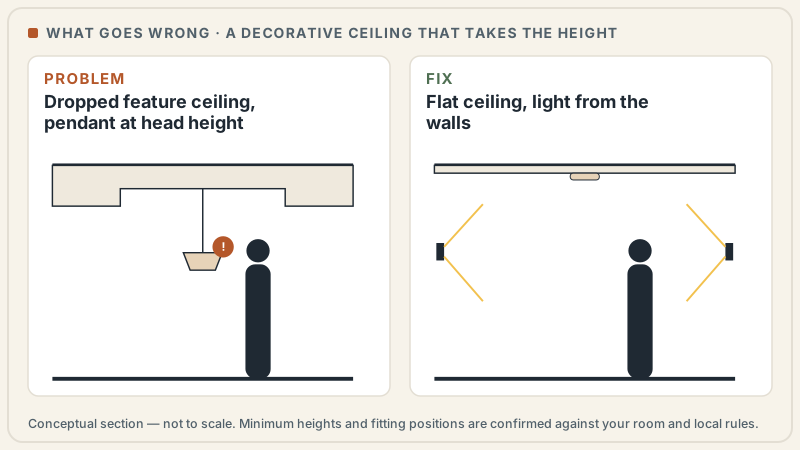
Two section diagrams of a low room. On the left, a dropped decorative ceiling with a deep perimeter step and a low pendant brings the ceiling and the light close to head height. On the right, the ceiling stays flat and light comes from wall lights and a close-fitting ceiling light.
Section: a layered ceiling and a low pendant in a low room, and a flatter alternative. Conceptual editorial diagram — not to scale, not a construction drawing and not a real home. Clearances, fittings and finishes depend on the room, the products and local rules, and are confirmed with qualified professionals.

A decorative ceiling that takes the height

What happens
In an already low room, a dropped feature ceiling, a bulkhead or a long pendant brings the ceiling and light down towards head height.
Why it matters
The room feels lower than before, and a low pendant over a walking route becomes something to duck.
The fix
Keep the ceiling plane as high as it can be. Light from the walls and close-fitting fittings; hang pendants over a table, not a route.
Not a mistake when
The step down is deliberate — to zone a kitchen from a living area, for example — and the remaining height has been checked in use.

These images are 3D illustrations made by Build Design Hub: the rooms are modelled and lit in software, then rendered. They are not photographs, not AI-generated, and not records of any real home or project. How the images are made.

Who this guide is for

  • Owners of a flat or house with a cracked, uneven or patched ceiling in a low room.
  • Anyone who has been quoted for a stretch ceiling and wants to know what to ask before agreeing.
  • People weighing a dry, specialist installation against a conventional ceiling any decorator can repair.
  • Readers who want the health and fire questions answered with sources rather than slogans.

Three answers to one tired ceiling

A stretch ceiling is a thin sheet tensioned into a track fixed around the top of the walls. The sheet is either a plasticised PVC film, which is warmed during fitting so it can be stretched, or a coated knitted polyester fabric, which is fitted cold. The old ceiling stays in place above it.

A new plasterboard ceiling is boards screwed to a metal or timber frame below the old ceiling, then jointed and finished. A repair keeps the existing ceiling: cracks are cut out and filled, loose areas re-secured, and the surface skimmed and painted.

  • Stretch membrane: a new surface, held at the edges, with the old ceiling hidden above it.
  • Plasterboard: a new conventional ceiling on a frame, with a void above it.
  • Repair: the same ceiling, made sound and smooth again, at its original height.

What you see: finish, seams and reflections

In a matt finish, a membrane, a plasterboard ceiling and a well-skimmed repair look very similar from the middle of a room. The differences sit at the edges: a membrane shows a slim track line where it meets the wall, a plasterboard ceiling can have a crisp shadow gap or a plain taped corner, and a repair can keep an original cornice that the other two would usually hide or remove.

Gloss membranes are different. They reflect the window, lamps and the room like a mirror, which some people want in a low room and others find restless. PVC film is made in panels of limited width, so a wide room may have a welded seam; one UK maker documents panels of 1.5 to 2.5 metres before a seam, and widths vary by maker. One coated fabric is listed in widths up to 5.1 metres, so many rooms need no seam at all.

Height: how much each option takes

Height is often the deciding factor in a low room, and it depends on the light fittings more than on the ceiling itself.

  • Stretch membrane: Barrisol gives a minimum of 12.5 mm below the existing ceiling with no fittings, and asks for an 80 mm void for its own spotlights.
  • Plasterboard: in Siniat's guidance a suspended metal grid needs roughly 100 mm before the board; a frame fixed directly to the joists or slab is shallower, and acoustic hangers or insulation add depth.
  • Repair: the ceiling stays where it is. Skim thickness is small, but we found no source that quantifies it, so treat any figure you are given as a contractor's estimate.

Light fittings

With a PVC membrane, fittings must respect a heat limit at the sheet — Barrisol states that fittings must not give off heat above 50 °C — and are supported from the structure above rather than by the sheet; one fabric maker states that additional loads such as lighting should hang directly from the soffit. That is manageable with low-heat LED fittings, but it has to be designed in before the sheet goes up.

A plasterboard ceiling has a void for cables and recessed fittings, subject to its depth and to any fire or acoustic requirement for cutting holes in it. A repaired ceiling usually keeps surface-mounted or pendant fittings unless there is already a void above it.

Leaks: what each ceiling does when water arrives

The best-known stretch ceiling claim is that it catches water from a leak above. Barrisol does state that its ceilings can support several litres of water, but only if the sheet is not perforated and the profiles are fixed to a stated strength, and recovery involves an installer draining and re-tensioning the sheet. Light cut-outs are perforations. We found no maker's document describing how coated-fabric membranes behave in a leak.

Two plasterboard makers' guidance — GIB in New Zealand and Siniat in Australia — says a soaked ceiling lining is likely to sag and will most likely need replacing, while briefly wetted board can sometimes dry out. A repaired plaster ceiling that gets soaked needs the same assessment.

Whichever ceiling you choose, the leak above still has to be found and fixed, and anything wet in the void dried. A membrane can limit damage to the room below; it does not dry the void, and it can hide a slow leak until it shows.

Fire: reaction to fire is not fire resistance

Two different properties get confused here. Reaction to fire — the Euroclass, such as B-s1,d0 — describes how much a material contributes to a fire. Fire resistance describes how long a tested assembly keeps fire from passing through it.

Barrisol states plainly that its ceiling is not fire-resistant, and gives reaction-to-fire classes from B-s1,d0 to B-s3,d0 depending on the finish, with A2-s1,d0 for one finish. Standard plasterboard can be classed A2-s1,d0 under conditions set by the European Commission, but a plasterboard ceiling only adds fire resistance as part of a tested build-up; one maker's listing for a suspended ceiling gives its fire resistance as not applicable.

This matters most where a ceiling forms part of the separation between flats or between a garage and a home. In England, Approved Document B sets reaction-to-fire classes for wall and ceiling linings by location, and where a thermoplastic membrane does not meet them, limits stretched-skin ceilings of flexible panels to 5 m² each, supported on all sides. Building control decides what is acceptable for your situation.

Emissions and PVC: what is documented, and what is not

The US EPA lists building materials and furnishings among indoor sources of volatile organic compounds and advises more ventilation when using products that emit them. That applies to every option here, including paints, fillers and jointing compounds.

For stretch ceilings specifically, we found no peer-reviewed study and no government test of membrane emissions, in English or Russian. The evidence that exists is manufacturer-reported emission labels for named products. A French A+ label is a chamber-measured emission class for a list of substances, not a toxicity verdict, and a certificate covers the tested product only — one maker says so in its own documents.

On PVC film, EU law has banned four phthalate plasticisers at 0.1% or more in articles placed on the market since July 2020. Some makers state their film is phthalate-free; the ones we reviewed do not name the plasticiser they use instead, and none documented emissions while the film is heated during installation. Absence of a study is not evidence of harm, and it is not evidence of safety.

  • Ask for the emission certificate by exact product name, not a range.
  • Ask in writing which plasticiser a PVC film contains, not only that it is phthalate-free.
  • Ventilate during and after installation, whichever ceiling you choose.

Repair, access and lifespan

A plasterboard or plaster ceiling can be patched and repainted by any competent decorator. A stretch membrane can be removed and refitted for access, but by a trained installer who warms and unclips the sheet; we found no documented patch repair for a punctured film and no tested number of refit cycles.

Lifespan figures for stretch ceilings — 30, 40 or 50 years from different makers — come from the manufacturers, with no basis published. Warranties are shorter and cover named defects such as welds and fixings. Treat a warranty as a warranty and a lifespan claim as a claim.

Repairing an old ceiling depends entirely on its condition. In Great Britain, HSE notes that asbestos can be present in buildings built or refurbished before 2000, including textured ceiling coatings, so an older textured ceiling should be checked before it is drilled, sanded or skimmed — whichever option you choose.

Our verdict, in context

The evidence does not support calling stretch ceilings a poor choice in general, and it does not support the blanket praise either. A membrane is a reasonable answer when a sound but cracked ceiling needs a smooth finish with almost no height loss and no plastering, the room does not need a fire-resisting ceiling, and the light fittings are planned for it. It is a weak answer where fire separation matters, where you want to repair and repaint it yourself, or where you want independent proof about emissions or lifespan that does not yet exist.

Plasterboard is the robust, familiar choice when the old ceiling has failed or you need a void for services, at a cost in height and mess. Repair is the right choice when the ceiling is sound — and the wrong one when it is not.

Evidence: what each statement rests on

Each row names its source and the limit of what it shows. A manufacturer's statement applies to that manufacturer's product, never to stretch ceilings in general. Sources were checked on 19 October 2026; where nothing was found, the row says so.

Appearance2 statements
  1. V1Stretch Ceilings Ltd documents PVC panels of 1.5 to 2.5 m width before a seam, joined by factory-welded micro-seams, with a 50 m² maximum panel area.

    Source
    Stretch Ceilings — lighting specification (NBS format) (opens in a new tab) — Stretch Ceilings Ltd Manufacturer
    Applies to
    That maker's PVC system
    Limits
    Other PVC makers' panel widths may differ.
  2. V2Ecophon lists its Clipso So Classic fabric in widths from 1.5 m up to 5.1 m.

    Source
    Clipso So Classic (opens in a new tab) — Ecophon on NBS Source Manufacturer
    Applies to
    Clipso So Classic
    Limits
    One fabric product; a room within that width can be seam-free.
Height4 statements
  1. H1Barrisol gives a minimum distance of 1.25 cm (12.5 mm) between its sheet and the ceiling above, with no fittings.

    Source
    Frequently asked questions (opens in a new tab) — Barrisol UK Manufacturer
    Applies to
    Barrisol track systems
    Limits
    Best case. Barrisol's own spotlight page asks for an 80 mm void for its spots.
  2. H2Siniat gives roughly 100 mm overall for its metal-frame suspended ceiling grid (a 44 mm primary channel and a 25 mm ceiling channel plus hanger space), before board.

    Source
    Minimum depth for a Siniat metal frame suspended ceiling (opens in a new tab) — Siniat Manufacturer
    Applies to
    Siniat MF (UK)
    Limits
    A suspended grid. Directly fixed furring systems are shallower; acoustic hangers and insulation add depth.
  3. H3Barrisol states that "a space of 80 mm is necessary" in the plenum for its spots and their transformers.

    Source
    Barrisol spots (opens in a new tab) — Barrisol UK Manufacturer
    Applies to
    Barrisol spots
    Limits
    Other fittings and other makers have their own depths.
  4. H4We found no source that quantifies the thickness of a skim coat or the height a repair takes.

    Source
    Searches for skim-coat thickness and repair height — Build Design Hub evidence review, October 2026 Our reasoning
    Applies to
    Repair and skim
    Limits
    "Almost no height loss" is reasoning, not a measured figure.
Lighting2 statements
  1. L1Barrisol states any light fitting can be installed as long as it does not give off heat above 50 °C.

    Source
    Frequently asked questions (opens in a new tab) — Barrisol UK Manufacturer
    Applies to
    Barrisol PVC
    Limits
    Barrisol's rule; other makers set their own limits and ring or platform requirements.
  2. L2Ecophon's Clipso data sheet states that additional load such as lighting or ventilation should be hung directly from the soffit.

    Source
    Ecophon Clipso So Classic data sheet (Feb 2024) (opens in a new tab) — Saint-Gobain Ecophon Manufacturer
    Applies to
    Clipso fabric ceilings
    Limits
    One maker's rule for its fabric system.
Leaks5 statements
  1. W1Barrisol states its ceilings can support several litres of water after a leak, provided the sheet is not perforated and the profiles are fixed to 30 kg/m.

    Source
    Frequently asked questions (opens in a new tab) — Barrisol UK Manufacturer
    Applies to
    Barrisol PVC sheets
    Limits
    Conditional: light cut-outs are perforations. No quantity per square metre is given, and recovery involves an installer reheating the sheet.
  2. W2A plasterboard maker's guidance says wet ceiling linings are likely to sag and replacement will most likely be required; briefly wetted board can sometimes dry and recover.

    Source
    Assessing and remediating water damage to plasterboard linings (opens in a new tab) — GIB / Winstone Wallboards Manufacturer
    Applies to
    GIB boards (New Zealand); the principles are general
    Limits
    Manufacturer guidance for its own boards.
  3. W4Siniat (Australia) says almost all ceilings that have been inundated with water will need to be replaced, particularly after contact with saturated insulation.

    Source
    Wet plasterboard: repair or replace (opens in a new tab) — Siniat Australia Manufacturer
    Applies to
    Siniat boards (Australia); the principle is general
    Limits
    Manufacturer guidance; it recommends a plasterer's assessment in every case.
  4. W5None of the coated-fabric membrane documents we opened says how the fabric behaves when water leaks onto it from above.

    Source
    The coated-fabric documents cited on this page — Build Design Hub evidence review, October 2026 Our reasoning
    Applies to
    Fabric membranes
    Limits
    "Fabric lets water through" is therefore not stated as fact on this page.
  5. W3Whatever the ceiling, the leak above still has to be found and fixed, and anything wet in the void dried.

    Source
    Reasoning from rows W1, W2 and W4 — Build Design Hub evidence review, October 2026 Our reasoning
    Applies to
    All three options
    Limits
    A membrane that holds water can limit damage below; it does not dry the void and can hide the leak until it bellies.
Fire5 statements
  1. F1Barrisol states: "The Barrisol ceiling is not fire-resistant."

    Source
    Frequently asked questions (opens in a new tab) — Barrisol UK Manufacturer
    Applies to
    Barrisol
    Limits
    A statement against the maker's own interest. Other makers' documents should be read for their products.
  2. F2Barrisol gives reaction-to-fire classes of B-s1,d0 to B-s3,d0 depending on finish, and A2-s1,d0 for one finish.

    Source
    Frequently asked questions (opens in a new tab) — Barrisol UK Manufacturer
    Applies to
    Barrisol, per finish
    Limits
    Reaction to fire describes how a product contributes to a fire. It is not fire resistance, which belongs to a tested assembly.
  3. F3EN 520 plasterboard can be classed A2-s1,d0 without further testing under conditions in Commission Decision 2006/673/EC (thickness, core density, paper weight, substrate, joints); heavier paper facings fall to B-s1,d0.

    Source
    Commission Decision 2006/673/EC, Annex (opens in a new tab) — legislation.gov.uk (EU text) Government
    Applies to
    EN 520 boards in the EU and GB
    Limits
    Again reaction to fire only. A plasterboard ceiling adds fire resistance only as part of a tested build-up.
  4. F4Knauf's listing for one MF suspended ceiling configuration gives its fire resistance as not applicable, while noting such ceilings can protect the soffit in other build-ups.

    Source
    Knauf MF Ceiling MF-1-12.5-WB-0 (listing on NBS Source) (opens in a new tab) — Knauf Manufacturer
    Applies to
    That configuration
    Limits
    Shows that "plasterboard ceiling" does not automatically mean fire-resisting.
  5. F5In England, Approved Document B (Volume 1, Table 4.1) sets reaction-to-fire classes for wall and ceiling linings by location; paragraph 4.17 limits ceilings of TP(a) flexible thermoplastic panels to 5 m² each, supported on all sides.

    Source
    Approved Document B: Fire safety, Volume 1 — Dwellings (opens in a new tab) — UK Government (Ministry of Housing, Communities and Local Government) Government
    Applies to
    England only
    Limits
    The thermoplastic route applies only where a membrane does not meet Table 4.1. Wales, Scotland, Northern Ireland, Ireland, the US and Australia have their own rules. Building control decides.
Emissions7 statements
  1. E1The US EPA lists building materials and furnishings among indoor sources of volatile organic compounds and advises more ventilation when using products that emit them.

    Source
    Volatile Organic Compounds' Impact on Indoor Air Quality (opens in a new tab) — US Environmental Protection Agency Government
    Applies to
    All indoor products
    Limits
    General guidance. It does not mention stretch ceilings and sets no product limits.
  2. E2No peer-reviewed study or government test measuring emissions from stretch ceiling membranes was found.

    Source
    Searches for chamber tests of stretch ceiling membranes, in English and in Russian (a market where these ceilings are widespread) — Build Design Hub evidence review, October 2026 Our reasoning
    Applies to
    The category
    Limits
    Absence of a study is not evidence of harm or of safety. The only membrane emission evidence found is manufacturer-reported labels for named products.
  3. E3The French A+ to C emission label classes a product by chamber-measured concentrations of ten listed substances plus total VOCs, with the worst result setting the class.

    Source
    Étiquetage des produits de construction et de décoration au regard de l'émission de COV (opens in a new tab) — ANSES Government
    Applies to
    Products sold in France; the label also appears elsewhere
    Limits
    An emission class, not a toxicity verdict. It does not describe emissions while a PVC film is heated during installation.
  4. E4EU REACH entry 51 bans four phthalates (DEHP, DBP, BBP, DIBP) at 0.1% or more of the plasticised material in articles placed on the market after 7 July 2020; PVC is covered.

    Source
    Commission Regulation (EU) 2018/2005, Annex (opens in a new tab) — legislation.gov.uk (EU text) Government
    Applies to
    Articles placed on the EU market
    Limits
    Covers only those four phthalates. It says nothing about other plasticisers, and does not cover ceilings placed on the market before July 2020.
  5. E5Barrisol states its sheets use phthalate-free plasticisers; it does not name the plasticiser on the pages reviewed.

    Source
    Barrisol and the indoor air quality (opens in a new tab) — Barrisol Manufacturer
    Applies to
    Barrisol PVC sheets only
    Limits
    A self-declaration. Phthalate-free is not plasticiser-free.
  6. E6Ecophon states that its VOC certificates for Clipso apply to the tested fabrics and fabric-absorber combinations.

    Source
    Ecophon Clipso brochure (2025) (opens in a new tab) — Saint-Gobain Ecophon Manufacturer
    Applies to
    Named Clipso fabrics and combinations
    Limits
    The maker's own wording confirms a certificate covers the tested product, not the category.
  7. E7None of the PVC film makers whose documents we could open names the plasticiser it uses, and none publishes measurements of emissions while the film is heated during installation.

    Source
    The documents of the PVC film makers cited on this page — Build Design Hub evidence review, October 2026 Our reasoning
    Applies to
    Barrisol, Newmat and Stretch Ceilings Ltd documents reviewed
    Limits
    A gap in published evidence, not a finding of harm. Ask the installer for both in writing.
Access and repair1 statement
  1. R1Barrisol describes removal as heating the ceiling and unclipping the sheet from the track with a special tool, by trained installers.

    Source
    Conditions of installation (opens in a new tab) — Barrisol UK Manufacturer
    Applies to
    Barrisol PVC
    Limits
    No documented number of refit cycles, and no documented patch repair for a punctured film was found.
Lifespan3 statements
  1. D1Barrisol gives a 10-year warranty for sheet welding and harpoons, and separately claims a longevity of more than 40 years.

    Source
    Frequently asked questions (opens in a new tab) — Barrisol UK Manufacturer
    Applies to
    Barrisol
    Limits
    A warranty covers named defects. The longevity figure is a manufacturer claim; no independent service-life data was found for any stretch ceiling.
  2. D2Newmat estimates the life expectancy of a Newmat ceiling at "+/- 30 years".

    Source
    FAQ (opens in a new tab) — Newmat Manufacturer
    Applies to
    Newmat ceilings
    Limits
    An estimate with no basis published.
  3. D3Ecophon's NBS listing for Clipso So Classic gives an expected lifespan of 50 years and a ten-year warranty.

    Source
    Clipso So Classic (opens in a new tab) — Ecophon on NBS Source Manufacturer
    Applies to
    Clipso So Classic
    Limits
    No basis given for the 50-year figure. No independent service-life data was found for any stretch ceiling.
Repairing an old ceiling1 statement
  1. P1HSE (Great Britain) says asbestos can be found in any building built or refurbished before 2000, including textured decorative ceiling coatings.

    Source
    Diagrams showing where asbestos can occur in buildings (opens in a new tab) — Health and Safety Executive Government
    Applies to
    Great Britain; other countries have their own rules
    Limits
    Relevant to all three options whenever an old ceiling is drilled, sanded, skimmed or removed.

Before you choose a ceiling

  1. 1Have the existing ceiling's condition assessed: sound, sagging, hollow or water-damaged?
  2. 2Find and fix the cause of any cracking or leak first.
  3. 3Check older textured ceilings for asbestos before any drilling or sanding.
  4. 4List every light fitting and the depth and heat limits it needs.
  5. 5Ask whether the ceiling forms part of a fire separation, and who decides what is acceptable.
  6. 6For a membrane, get the exact product name, its reaction-to-fire class and its emission certificate.
  7. 7For PVC film, ask in writing which plasticiser it contains.
  8. 8Ask who can remove, refit or repair the ceiling later, and on what terms.
  9. 9See a large sample of the finish under your own light before committing.

Common mistakes to avoid

  • Choosing a membrane to hide a leak or a sagging ceiling instead of fixing the cause.
  • Treating a reaction-to-fire class as fire resistance.
  • Planning downlights after the ceiling is chosen, then finding the void or heat limits do not allow them.
  • Accepting "non-toxic" or "lasts 50 years" without a named product, a test or a basis.
  • Skimming over a ceiling that is loose or hollow because the cracks look cosmetic.

When to involve a professional

  • A plasterer or surveyor to assess whether the existing ceiling can be repaired.
  • Building control where the ceiling is part of a fire separation, such as between flats.
  • An electrician for light fittings, cable routes and heat limits in any of the three options.
  • The stretch ceiling installer for the product documents, fitting rules and after-sales terms.

Frequently asked questions

Questions readers ask about this topic

Are stretch ceilings toxic?

We found no independent study showing that they are or that they are not. The evidence available is manufacturer-reported emission labels for named products. Ask for the certificate by product name, ask which plasticiser a PVC film contains, and ventilate during and after installation.

Are stretch ceilings fire-resistant?

Not on the evidence we found. Barrisol states its ceiling is not fire-resistant, and the other products we reviewed publish reaction-to-fire classes such as B-s1,d0, which describe a material's contribution to a fire, not its ability to stop one.

Can a stretch ceiling hold water from a leak?

Some PVC film systems can hold a limited amount of water for a time, under conditions the maker states: an unperforated sheet and strongly fixed profiles. An installer then drains and re-tensions it. The leak and the wet void still need fixing and drying.

How much height does a stretch ceiling take?

From about 12.5 mm with no fittings in one maker's data, and more with lights — the same maker asks for an 80 mm void for its spotlights. In Siniat's guidance a suspended plasterboard grid needs about 100 mm before the board; a repair takes almost none.

Can I repair a stretch ceiling myself?

Generally not. Removal and refitting is done by trained installers, and we found no documented patch repair for a punctured film.

Is it better to repair the old ceiling?

When it is sound, dry and well fixed, yes: it keeps the full height and any original details. When it sags, sounds hollow or has been soaked, repair is not enough.

Keep reading

Related guides and sections