
Who this guide is for
- Court owners preparing to select a resurfacing contractor for an existing tennis court
- Facility managers building a consistent way to compare several contractors
- Clubs deciding how to research and shortlist before committing
- Project leads gathering questions and references prompts before site visits
- Owners who want to understand experience, coordination and handoff before signing
- Anyone wanting a structured research approach rather than a single headline price
Planning diagram
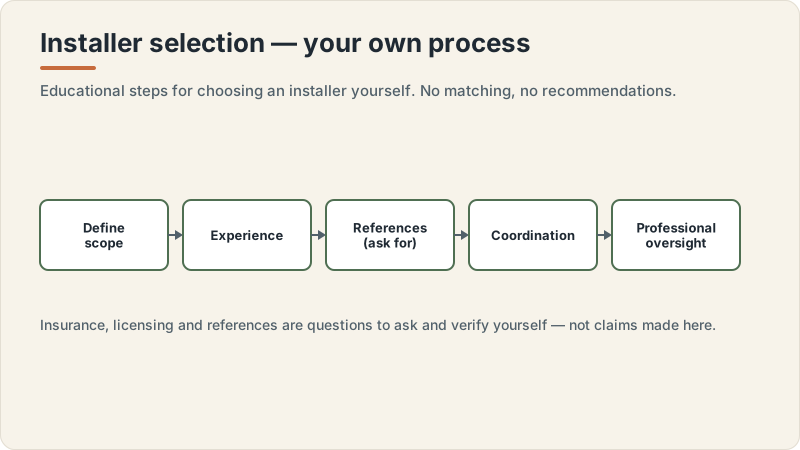
Installer selection process concept
Conceptual editorial diagram — not a construction drawing, specification or to-scale plan. Official court dimensions, standards, drainage, structure and lighting requirements vary by sport, site and location and are confirmed with the relevant federation, supplier and qualified professionals.
What this research helps you prepare
This resource helps you prepare your own approach to selecting a tennis court resurfacing contractor: how to define and confirm scope, what experience and coordination questions to ask, how to request references without anyone inventing them for you, how a site-specific review should inform the work, and what handoff documentation to expect. It is built so the same questions and comparison structure can be applied to each contractor you consider, giving you a like-for-like basis for your own judgement.
It does not tell you which contractor to choose, what your court requires, or what resurfacing should cost or how long it should take. Those depend on the condition of your court, the existing surface and base, drainage, access, climate and the contractor, and they vary from project to project. Use the prompts to draw out each contractor's approach and to surface the differences a polished proposal can hide, then verify independently and with qualified professionals.
- A research framework you can reuse across every contractor
- A consistent comparison structure you complete yourself
- Prompts that separate clear, methodical planners from vague ones
- A record of what each contractor commits to in writing
Experience and scope-clarity questions
Resurfacing can mean very different things, from refreshing a worn coating to deeper work involving sections of the existing surface or base. Ask each contractor to define exactly what they propose and where its boundaries sit, so you are not comparing a light refresh against a heavier intervention as if they were equivalent. Clear, written scope is the foundation of a fair comparison.
It is also reasonable to research a contractor's relevant experience with tennis court resurfacing specifically, rather than general surfacing or construction. You are listening for a reasoned, methodical approach and a clear scope, not a fixed answer or an instruction about what your court needs, which is a matter for qualified assessment.
- How do you define the resurfacing scope for this court, in writing?
- How do you distinguish resurfacing from repair and full renovation?
- What experience do you have with tennis court resurfacing specifically?
- What conditions might change the scope once work has begun?
- How are line markings, colours and any reconfiguration handled within scope?
Site-specific review, coordination and references
A sound proposal usually follows a site-specific look at your court rather than a generic template. Ask how the contractor would assess the existing surface, cracks, low spots, drainage behaviour and the base before committing to an approach, and how they record and share what they find. Assessment of those technical matters is for qualified professionals; here you are researching how the contractor plans for them and who carries out specialist evaluation.
Coordination is a common source of risk, especially where drainage, fencing, lighting or other trades interact with resurfacing. Ask how the contractor manages interfaces, sequencing and access, and who is responsible at each handover. It is also reasonable to ask a contractor whether they can provide references you may contact yourself; this resource never supplies, invents or vouches for any references, contractors or projects, and any you receive should be checked independently.
- How will you assess the existing surface and base before proposing an approach?
- How do you handle coordination with drainage, fencing or lighting work?
- How are access, sequencing and site responsibilities managed and recorded?
- Can you provide references I may contact directly to verify your track record?
- How is the site review documented and shared with me?
- What would lead you to recommend pausing, rescoping or involving a specialist?
Insurance, licensing and handoff documentation
Insurance, licensing, registration and any applicable certifications are things to ASK each contractor about and to verify independently, not claims this resource makes or confirms on anyone's behalf. Requirements vary by location and project, so treat these as questions whose answers you confirm with the relevant authorities and with the contractor's own documentation rather than assuming a standard applies.
Equally important is what you receive at the end. Ask what handoff documentation the contractor provides, such as a record of the work carried out, materials used, aftercare and maintenance guidance, return-to-play timing and any warranty terms in writing. Curing and return-to-play timing depend on materials, weather and site and vary, so expect answers that differ and confirm specifics for your project.
- What insurance and licensing do you hold, and how can I verify them independently?
- What handoff documentation do you provide when the work is complete?
- What aftercare and maintenance guidance is included, and in what form?
- How long before the court can be used again, and what affects that timing?
- What does any warranty cover and exclude, and is it provided in writing?
- Who do I contact, and how, if an issue arises after completion?
What to ask before comparing options
Before you weigh one contractor against another, make sure you are comparing the same thing. Confirm that each has defined scope, inclusions, exclusions and assumptions in writing, so a headline price does not disguise very different amounts of work. Note where preparation, crack treatment, drainage attention, line marking, waste removal and reinstatement sit in each offer.
Pricing structures, allowances and provisional items vary by contractor and project, so this resource suggests no figures. The point of these prompts is to build a consistent comparison you complete yourself, recording each contractor's answers, documentation and references in the same format so differences are visible and your own decision rests on like-for-like information.
- Has each contractor defined scope, inclusions and exclusions in writing?
- Are assumptions and any provisional items stated clearly for each offer?
- Is preparation, crack treatment and drainage attention shown consistently?
- Have you recorded references, insurance and documentation the same way for all?
- Are coordination responsibilities and handovers described for each contractor?
- Is each warranty and aftercare commitment captured in writing for comparison?
Questions for qualified professionals
Beyond the contractors themselves, other qualified professionals help you judge whether resurfacing is the right path and whether a proposed approach is sound. A designer, engineer or surfacing specialist can advise on the condition of the base and drainage, while local authorities and the relevant tennis federation or governing body can confirm any applicable requirements for your court and location.
Use these prompts to decide who else to involve and what to confirm independently of any single proposal. Requirements vary by location and project and should be verified with the relevant authority and qualified professionals rather than assumed from a contractor's description.
- Is resurfacing appropriate for this court, or is wider renovation advisable?
- How sound are the existing base and drainage for resurfacing?
- What local permissions or notifications, if any, might apply?
- Do any surface, dimension or marking standards apply for our intended use?
- How should we verify a contractor's references and track record independently?
- What maintenance plan would protect the resurfaced court over time?
What this does not replace
This resource is educational project-preparation only. It is not a supplier or contractor recommendation, not contractor matching, not an estimate or quote, and not procurement, legal, tax, customs, engineering, architectural, surfacing, inspection or construction advice. It does not tell you which contractor to choose, what your court requires, or what work should cost or how long it should take.
Costs, timelines and requirements vary by location, site condition, existing surface, base, drainage, access and contractor, and must be confirmed with the relevant professionals and authorities. Consult qualified designers, engineers, surfacing and drainage specialists, local authorities and legal or professional advisors where appropriate before making project, procurement or construction decisions. Build Design Hub does not recommend, rank, rate, verify, introduce or match suppliers or contractors, and HELPERG LLC is publisher and operator only; researching, verifying and selecting any contractor remains your responsibility.
Resurfacing contractor selection research checklist
- 1Have you asked each contractor to define the resurfacing scope in writing?
- 2Have you asked how they distinguish resurfacing from repair and renovation?
- 3Have you researched each contractor's specific tennis court resurfacing experience?
- 4Have you asked how the existing surface and base would be assessed first?
- 5Have you asked how coordination with other trades and access is managed?
- 6Have you asked each contractor for references you can contact yourself?
- 7Have you planned to verify references, insurance and licensing independently?
- 8Have you asked what handoff documentation will be provided on completion?
- 9Have you asked what aftercare, return-to-play timing and warranty terms apply?
- 10Have you captured inclusions, exclusions and assumptions consistently for all?
- 11Have you recorded each contractor's answers in the same comparison format?
- 12Have you identified which qualified professionals to involve before deciding?
Common mistakes to avoid
- Treating every contractor's idea of resurfacing as the same scope of work
- Comparing contractors on headline price without checking inclusions and assumptions
- Assuming experience with general surfacing equals tennis court resurfacing experience
- Accepting reassurance about drainage and base condition without a review plan
- Taking insurance, licensing or references on trust instead of verifying them yourself
- Overlooking how coordination with other trades is managed and who is responsible
- Failing to confirm handoff documentation, aftercare and warranty terms in writing
- Skipping independent verification of a contractor's references and track record
When to involve a professional
- Assessment of the existing surface, base, cracks and drainage should be carried out by qualified surfacing, engineering or drainage professionals.
- Whether resurfacing or wider renovation is appropriate is a judgement for qualified professionals familiar with your court.
- Any surface, dimension or line-marking standards vary by use and should be confirmed with the relevant tennis federation, supplier or designer.
- Insurance, licensing and local permissions vary by location and should be verified directly with the contractor and relevant authorities.
- Build Design Hub does not rate, rank, recommend, verify, introduce or match contractors; researching, selecting and verifying any contractor is your responsibility, ideally with professional support.
Frequently asked questions
Questions readers ask about this topic
How should I start selecting a resurfacing contractor?
Begin by researching and preparing a consistent set of questions: ask each contractor to define scope, experience, inclusions and exclusions in writing, and to explain how they would review your court. A like-for-like basis lets you compare fairly and decide yourself, ideally with professional input.
Can I ask a contractor for references?
Yes. It is reasonable to ask whether a contractor can provide references you may contact directly to verify their track record. This resource never supplies, invents or vouches for any references, contractors or projects, and any references you receive should be checked independently by you.
Should I just ask whether a contractor is insured and licensed?
Treat insurance, licensing and registration as questions to ask each contractor and to verify independently with the relevant authorities and the contractor's own documentation. Requirements vary by location and project, so confirm specifics rather than assuming a standard applies.
Does this resource recommend or match resurfacing contractors?
No. It provides a research framework to structure your own selection. Build Design Hub does not rate, rank, recommend, verify, introduce or match contractors, and HELPERG LLC is publisher and operator only; researching, verifying and selecting a contractor remains your responsibility.
Will this tell me what resurfacing costs or how long it takes?
No. Costs and timelines vary by location, court condition, existing surface, base, drainage, access and contractor. This resource points to the factors behind them and to the contractors and professionals who can confirm specifics for your project, rather than giving any figures.
Keep reading