
Who this guide is for
- Court owners reviewing a tennis court resurfacing quote they have received
- Facility managers comparing two or more resurfacing quotes side by side
- Clubs deciding whether a quote covers what they actually need
- Project leads checking a quote's assumptions and exclusions before discussing it
- Owners wanting to understand documentation, logistics and warranty terms in a quote
- Anyone preparing follow-up questions after receiving a resurfacing proposal
Planning diagram
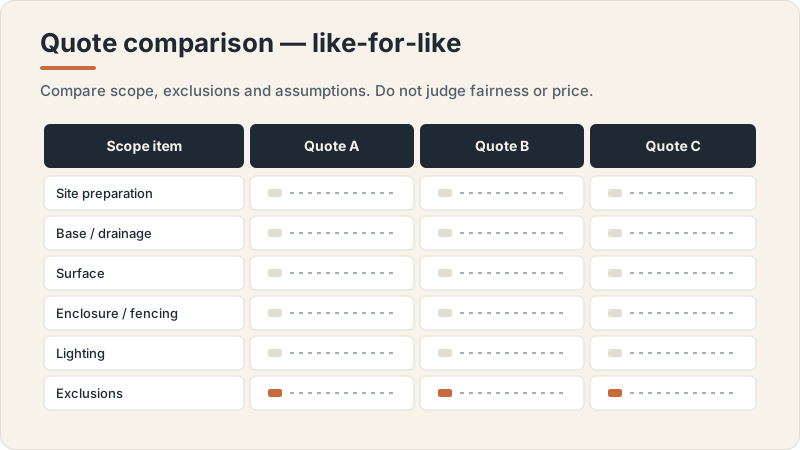
Quote comparison matrix concept
Conceptual editorial diagram — not a construction drawing, specification or to-scale plan. Official court dimensions, standards, drainage, structure and lighting requirements vary by sport, site and location and are confirmed with the relevant federation, supplier and qualified professionals.
What this research helps you prepare
This resource helps you prepare a consistent way to read a tennis court resurfacing quote, so you can see what scope it describes, which assumptions it rests on, what it includes and excludes, and how aftercare, logistics and warranty are addressed. The goal is to give you a structured lens you can apply to each quote in the same way, producing a like-for-like view rather than a comparison of headline numbers alone.
It does not assess whether a quote is fair, complete or correctly priced, and it offers no figures or estimates. What a resurfacing project should cost, how long it should take and what your court needs all depend on the condition of your court, the existing surface and base, drainage, access, climate and the supplier, and they vary from project to project. Use the prompts here to understand each quote and to surface the questions worth asking, not to reach a verdict on price.
- A repeatable way to read each quote on the same terms
- Prompts that expose assumptions, gaps and exclusions
- A structure for comparing scope rather than only price
- A record of what each quote actually commits to in writing
Reading the scope and surface-preparation inclusions
The most important part of a resurfacing quote is the scope: what work is described and where its boundaries sit. Resurfacing can range from refreshing a worn coating to work that involves the existing surface or sections of base, so read each quote to see exactly what is proposed and whether surface preparation, crack attention, drainage consideration, line marking and reinstatement of surroundings are described as part of the work or left out.
Pay attention to how preparation is treated, because it often drives both quality and the difference between two quotes. Whether a quote includes assessing and preparing the existing surface, addressing cracks or low spots, and protecting or reinstating areas around the court is something to confirm in writing. The suitability of any particular approach for your court is a matter for qualified assessment, so you are reading for clarity and completeness of description, not for technical instruction.
- Is the resurfacing scope described clearly, with boundaries stated?
- Is surface preparation included, and what does it cover?
- Are cracks, low spots or drainage mentioned, or left out?
- Are line markings, colours and any reconfiguration within scope?
- Is reinstatement of areas around the court included?
Assumptions, exclusions and documentation to check
Quotes often rest on assumptions about the condition of the court, the soundness of the base, drainage behaviour or site access, and those assumptions shape what the price covers. Read each quote for stated assumptions and for an explicit list of exclusions or optional extras, so you can see where the quoted work stops and where additional cost might arise if conditions differ from what was assumed.
Documentation matters as much as the words in the quote. Look for whether the quote references a site assessment, drawings or photographs, a clear specification, payment and acceptance terms, and how any variation or additional work would be identified, agreed and recorded. Pricing structures, allowances and provisional items vary by supplier and project, so this resource suggests no figures; the point is to understand the boundaries of each offer and how change would be handled.
- What assumptions does the quote make about court, base and drainage?
- Is there an explicit list of exclusions and optional extras?
- How would additional work be identified, agreed and recorded?
- Does the quote reference an assessment, specification or drawings?
- Are payment, acceptance and variation terms stated clearly?
- Is responsibility for access, waste and reinstatement defined?
Logistics, aftercare and warranty terms in the quote
A resurfacing quote also implies a set of logistics: access to the site, sequencing of work, weather dependencies, and how long the court is out of use before and after the work. Read the quote for what it says about scheduling, site access, and curing or settling before return to play, recognising that these depend on materials, weather and site and so vary; confirm specifics with the supplier for your own project rather than assuming a standard.
Aftercare and warranty terms are easy to overlook and important to read closely. Check whether the quote describes maintenance guidance, what any warranty or guarantee covers and excludes, what conditions keep it valid, and how a claim would work. Warranty terms differ between suppliers, so the aim is to understand what each quote offers in writing rather than to assume a typical period or coverage.
- What does the quote say about access, sequencing and scheduling?
- Is curing or return-to-play timing addressed, and what affects it?
- Does the quote describe aftercare and maintenance guidance?
- What does any warranty cover, and what does it exclude?
- What conditions or maintenance keep a warranty valid?
- Are warranty and aftercare terms set out in writing?
What to ask before comparing options
Before lining up two or more resurfacing quotes against each other, it helps to confirm that each describes the same scope, makes its assumptions explicit, and treats inclusions, exclusions, logistics and warranty in a comparable way. Without that, a lower figure may simply reflect a narrower scope or more assumptions, and a like-for-like comparison is not possible until those differences are surfaced.
Use these prompts to standardise what you are comparing and to identify the questions each quote leaves open. The aim is to make differences visible and to know what to clarify with each supplier, not to decide which quote is better; judgements about suitability and value are for you and your qualified professionals to make.
- Does each quote describe the same resurfacing scope and boundaries?
- Are the assumptions in each quote stated and comparable?
- Are inclusions and exclusions itemised the same way across quotes?
- Is preparation handled consistently, or only in some quotes?
- Are logistics, curing and aftercare addressed in each quote?
- Are warranty terms comparable, or expressed very differently?
- What does each quote leave unstated that you still need to ask?
Questions for qualified professionals
Reading a quote tells you what a supplier proposes; qualified professionals can help you judge whether the proposed approach suits your court and whether the assumptions behind a quote are reasonable. A designer, engineer or surfacing specialist can advise on the condition of the existing surface, base and drainage, while local authorities and the relevant tennis federation or governing body can confirm any applicable requirements for your court and location.
Use these prompts to decide who else to involve and what to confirm independently of any single quote. Requirements and conditions vary by location and project and should be verified with the relevant authority and qualified professionals, rather than assumed from the wording of a proposal.
- Are the assumptions in this quote reasonable for our court?
- How sound are the existing surface, base and drainage for resurfacing?
- Is the proposed scope appropriate, or is wider renovation advisable?
- Do any surface, dimension or marking standards apply for our use?
- What local permissions or notifications, if any, might apply?
- How should we verify a supplier's track record independently?
What this does not replace
This resource is educational preparation only. It is not an estimate, not a quote, not an assessment of whether any quote is fair or correctly priced, and not contractor matching. It does not provide legal, tax, customs, engineering, architectural, surfacing, inspection or design advice, and it does not tell you what your court requires or what work should cost or how long it should take.
Costs, timelines, inclusions and requirements vary by location, site condition, existing surface, base, drainage, access and supplier, and must be confirmed with the relevant suppliers, professionals and authorities. Consult qualified designers, engineers, surfacing and drainage specialists, local authorities and legal, tax or professional advisors where appropriate. Build Design Hub does not recommend, rank, verify, introduce or match suppliers or contractors, and HELPERG LLC is publisher and operator only; reviewing, verifying and accepting any quote remains your responsibility.
Resurfacing quote review worksheet
- 1Have you confirmed the quote describes the resurfacing scope and its boundaries in writing?
- 2Have you checked whether surface preparation is included and what it covers?
- 3Have you noted how cracks, low spots and drainage are treated, or whether they are excluded?
- 4Have you listed the assumptions the quote makes about court, base and drainage?
- 5Have you found the explicit exclusions and optional extras in the quote?
- 6Have you checked how additional or variation work would be identified, agreed and recorded?
- 7Have you confirmed what documentation, drawings or specification the quote references?
- 8Have you read what the quote says about access, sequencing and return-to-play timing?
- 9Have you checked the aftercare and maintenance guidance described?
- 10Have you reviewed what any warranty covers, excludes and requires, in writing?
- 11Have you standardised each quote so you are comparing like with like?
- 12Have you identified which questions remain for the supplier and which professionals to involve?
Common mistakes to avoid
- Comparing quotes on the headline figure without reading the scope behind it
- Assuming surface preparation and crack treatment are included when they are not stated
- Overlooking the assumptions a quote rests on about base and drainage condition
- Missing the exclusions or optional extras that change what the price covers
- Treating different descriptions of scope as if they were the same work
- Ignoring logistics and return-to-play timing when planning court availability
- Relying on a verbal warranty rather than the written terms in the quote
- Reaching a verdict on a quote without independent professional input
When to involve a professional
- Whether the assumptions and proposed approach in a quote suit your court is a judgement for qualified surfacing, engineering or drainage professionals.
- Assessment of the existing surface, base, cracks and drainage should be carried out by suitably qualified professionals rather than inferred from a quote.
- Whether resurfacing or more extensive renovation is appropriate is best confirmed with professionals familiar with your court.
- Any surface, dimension or line-marking standards vary by use and should be confirmed with the relevant tennis federation, supplier or designer.
- Local permissions, tax or other requirements vary by location and may need confirmation with the relevant authority or advisor.
- Build Design Hub does not rate, rank, recommend, verify or match suppliers or contractors; reviewing and accepting a quote is your responsibility.
Frequently asked questions
Questions readers ask about this topic
Does this resource tell me if my resurfacing quote is fair or reasonable?
No. It helps you read and understand a quote's scope, assumptions, inclusions and exclusions so you can ask better questions, but it makes no judgement about whether any quote is fair, complete or correctly priced. That assessment is for you and your qualified professionals.
How can I compare two resurfacing quotes properly?
Start by confirming each describes the same scope, states its assumptions, and itemises inclusions, exclusions, logistics and warranty in a comparable way. A lower figure may simply reflect a narrower scope, so the aim is to make differences visible rather than to pick a winner.
What should I look for in a quote's exclusions?
Look for an explicit list of what is not covered or treated as an optional extra, such as preparation, crack treatment, drainage attention, line marking, waste removal or reinstatement, and for how additional work would be agreed. Exclusions vary by supplier, so understand each offer's boundaries rather than assuming a standard.
Will this give me prices or timelines for resurfacing?
No. Costs and timelines vary by location, court condition, existing surface, base, drainage, access and supplier. This resource points to the assumptions, documents and questions that reveal them, and to the suppliers and professionals who can confirm specifics, rather than giving any figures.
Does Build Design Hub review my quote or recommend a contractor?
No. This is an educational worksheet you apply yourself. Build Design Hub does not review quotes, provide estimates, or recommend, rank, verify or match suppliers or contractors, and HELPERG LLC is publisher and operator only; reviewing and accepting any quote remains your responsibility.
Keep reading