
Who this guide is for
- Club, academy and facility owners weighing the lifetime upkeep of a synthetic pitch before committing to a build, surface system or replacement.
- Schools, colleges and university estate teams preparing budgets and briefs for synthetic sports-surface upkeep across multiple seasons.
- Municipal and parks managers planning maintenance programs across one or several community or school artificial pitches.
- Developers and project sponsors who need to understand the maintenance obligations attached to an artificial-turf facility they are delivering.
- Facility and operations managers structuring tenders or service-level discussions with synthetic-turf maintenance contractors.
- Club committees, trustees and volunteers who must scope upkeep responsibilities and prepare questions for qualified professionals.
Planning diagram
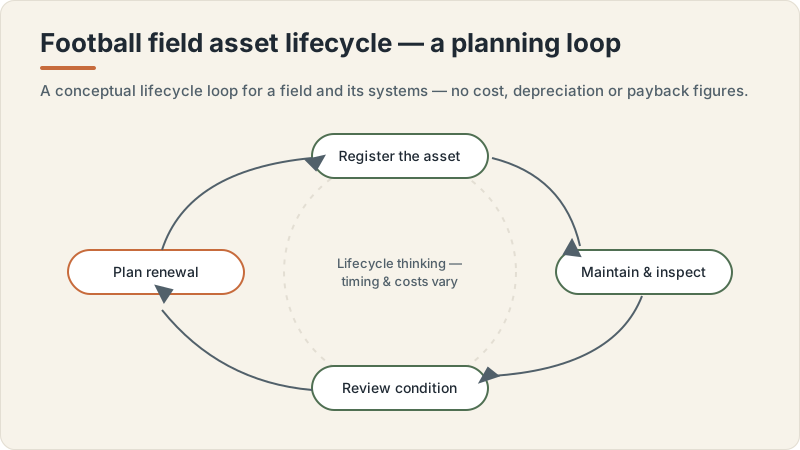
Football field asset lifecycle concept
Conceptual editorial diagram — not a construction drawing, specification, to-scale plan or proof of a real project. It is not engineering, structural, fire/life-safety, crowd-safety or accessibility-compliance guidance. Capacities, dimensions, standards, requirements and costs vary by facility type, audience, site, use case and governing body, and are confirmed with qualified professionals, relevant authorities and governing bodies. Build Design Hub does not design, build, inspect, certify, recommend or match anyone.
What this guide helps you prepare
This guide helps you build the thinking and the paperwork that should precede any serious conversation about maintaining an artificial-turf pitch. That means a plain statement of what the surface is for, who plays on it and how intensively, which outcomes matter to your stakeholders, and which constraints (site, climate, budget cycle, governing-body affiliation, seasonal calendar) shape the regime. With those defined, you can brief turf professionals and contractors accurately and compare their advice on a like-for-like basis, rather than reacting to whichever proposal arrives first.
It also helps you treat maintenance as a lifecycle question rather than a task list. A regime for a synthetic surface is the sum of routine upkeep, periodic deeper renovation, condition monitoring, equipment and labour arrangements, contingency for weather and heavy use, and eventual major renovation or replacement of the carpet and infill. Thinking across that whole lifecycle early lets you ask better questions, anticipate decision points, and avoid treating maintenance as an afterthought bolted on once the surface is already installed. Every figure or method you have in mind should be treated as provisional until a qualified professional confirms it for your situation.
- A plain statement of the surface system, intended sports, and expected hours and intensity of use across a typical year.
- A list of stakeholders and decision-makers who must agree the maintenance approach and who hold the budget.
- Your maintenance goals (playability, surface consistency, longevity, appearance, safety expectations to confirm with professionals) in priority order.
- Known site and environmental constraints to raise with professionals, such as climate, surrounding trees, contamination sources or access.
- A record of any governing-body, league, manufacturer-warranty or insurer affiliations whose expectations you will need to confirm directly.
- A first draft of the questions and unknowns you want qualified professionals to address.
Understanding the artificial-turf maintenance regime as questions, not specifications
A synthetic pitch is a system, and preparing well means recognising the layers and elements you may need to ask about without assuming any particular treatment for them. The carpet fibres, any performance or stabilising infill, the shockpad or base, line markings and the surrounding drainage all behave and wear differently, and how they are groomed, cleaned, decompacted, topped up or monitored is a matter for specialists to advise, not for this guide to prescribe. The aim here is to identify which elements exist in your system and which decisions attach to each, so you can ask focused questions rather than arrive with assumptions copied from a different surface or a different climate.
It also helps to separate the categories of activity people lump together as maintenance, again as questions rather than answers. Routine upkeep, periodic deeper renovation, reactive responses to spills or damage, condition monitoring and reporting, and warranty-related obligations are distinct streams that may sit with different parties and follow different rhythms. Documenting which of these your facility will need, and flagging that frequencies, methods, products and settings are for professionals to determine, keeps your brief honest and prevents online generalisations from hardening into requirements they are not.
- Which elements of your surface system (fibres, infill if any, shockpad, base, markings, perimeter drainage) you will need to ask professionals about.
- How the categories of maintenance activity differ for your facility, framed as questions for specialists rather than fixed tasks.
- What contamination or wear sources are specific to your site (trees, traffic, food and drink, weather) and worth raising.
- Which manufacturer or warranty conditions may attach to your surface, to confirm directly with the supplier and a professional.
- How condition might be monitored and reported over time, asked as a question rather than assumed as a method or threshold.
- What you currently assume about infill, grooming or cleaning that should be explicitly flagged for professional confirmation.
Lifecycle thinking, renovation and replacement planning
A particularly useful preparation lens is to map the surface lifecycle into phases and ask what maintenance thinking belongs in each, without committing to any frequency, method or product. Early life after installation, steady-state operation, intensive-use peaks, recovery periods, periodic deeper renovation, and end-of-life major renovation or replacement of the carpet and infill each raise different questions and may involve different specialists. Rather than deciding answers yourself, the aim is to identify which decisions exist, who should make them, and what information a professional would need to advise responsibly for an artificial surface like yours.
Lifecycle thinking also surfaces the relationship between use and upkeep, and the eventual capital event that synthetic surfaces tend to face. Because turf lifespan, wear rates and renovation triggers vary so widely by system, climate, usage and care, this is exactly the kind of thing to plan to discuss early with professionals rather than to assume from a number you read somewhere. Documenting your expected usage pattern, your tolerance for closures or reduced bookings, and your budget cycle lets specialists speak to how intensity, climate and surface system interact for your specific facility, and lets you plan the major renovation or replacement decision as a deliberate step rather than a surprise.
- What distinct lifecycle phases your surface will pass through, and which maintenance decisions belong to each.
- The relationship between hours of use, recovery and longevity that you want professionals to explain for your specific system.
- Which activities are routine, which are periodic deeper renovation, and which are major capital events to plan and budget separately.
- What condition signals or monitoring approaches professionals would use to judge wear, framed as questions not thresholds.
- When end-of-life renovation or replacement should first enter the conversation, so it is planned rather than discovered.
- Your tolerance for closures, rest periods or reduced bookings, and how that might interact with usage and longevity.
Planning questions before speaking with professionals
Before you contact turf specialists, contractors, manufacturers or governing bodies, work through the questions you can answer yourself, because the clarity of your brief shapes the quality of advice you receive. These are questions about your goals, constraints, budget posture, decision-making process and risk tolerance, not technical questions about fibres, infill or machinery. Getting your own house in order first means professionals spend their time advising rather than extracting basic facts, and it helps you recognise when a proposal does not actually fit your facility.
It also helps to be honest about what you do not yet know and where your assumptions are soft. Distinguishing what you have decided from what is still open lets you ask focused questions and avoid presenting guesses as fixed requirements. Treat every frequency, infill detail, lifespan or standard you have in mind as provisional until a qualified professional confirms it for your location, surface system, audience, use case and governing body.
- What does success look like for this surface over one season, and across its whole lifecycle?
- Who holds the maintenance budget, who approves changes, and what is our decision timeline?
- How intensively will the pitch really be used, and how confident are we in that estimate?
- Which expectations are non-negotiable for us, and which are flexible or aspirational?
- What constraints (climate, surrounding trees, access, contamination, calendar, warranty) must any regime work within?
- What do we currently assume about upkeep or lifespan that we should explicitly flag for professional confirmation?
Questions for qualified professionals
When you reach qualified professionals, manufacturers, governing bodies and relevant authorities, your aim is to convert your prepared brief into specific, confirmable advice for your facility. Ask them to assess your surface system, usage and conditions, and to explain the regime, decision points and trade-offs in terms of your pitch rather than generic rules. Because requirements and recommendations vary by location, surface system, climate, audience, site, use case, maintenance plan and governing body, ask every professional to confirm what applies to you and to flag where their advice is conditional or where another specialist should be consulted.
Use these conversations to test your assumptions, not just to collect quotes. Ask professionals to identify what could go wrong, what they would monitor and report, when major renovation or replacement typically becomes a discussion for a synthetic surface like yours, and what they would need from you to advise responsibly. Where any question touches player safety, warranty conditions, compliance, certification, insurance or governing-body rules, treat the professional's and the authority's confirmation as the authoritative answer, never this guide.
- Given our surface system, climate and usage, what would a responsible maintenance regime need to consider, and what varies for our pitch?
- How would you monitor and report on surface condition over time, and what would prompt escalation?
- What lifecycle decision points should we plan for, and when does major renovation or replacement typically enter the conversation?
- Which expectations come from a governing body, league, manufacturer warranty, insurer or authority, and how do we confirm them directly?
- What are the main risks or failure modes for a synthetic surface and regime like ours, and how are they usually managed?
- What information, access or records would you need from us to give advice we can rely on, and who else should we involve?
What this does not replace
This is an educational project-preparation resource only. It is not a construction manual and not engineering, architectural, turf-installation, drainage-engineering, sports-surface-specification, structural, fire or life-safety, crowd-safety, accessibility-compliance, permit, zoning, legal, tax or procurement advice. It does not design, specify, install, certify, inspect or approve anything, and it is not an estimate, quote, price, capacity recommendation or performance or lifespan guarantee. Requirements, standards, dimensions, surface systems and costs vary by location, use case, governing body, owner, site, climate, maintenance plan, authority and professional team, and are confirmed with qualified professionals, relevant authorities and the sport governing body.
Build Design Hub does not design, build, install, engineer, inspect, certify, recommend, rank, verify, introduce, broker or match suppliers or contractors, and HELPERG LLC is publisher/operator only. Use this resource to prepare your own thinking, then have qualified professionals you engage directly review your project. Decisions about engineering, surface specification, drainage, safety, compliance, procurement and suitability must rest on those professionals, the relevant authorities and the governing body for your sport and location.
- Not a construction manual and not engineering, turf-installation or drainage-engineering instructions
- Not sports-surface specification, structural, fire/life-safety, crowd-safety or accessibility-compliance advice
- Not permit, zoning, legal, tax or procurement advice
- Not a supplier or contractor recommendation, ranking, directory or matching service
- Not an estimate, price, capacity recommendation or performance/lifespan guarantee — requirements and costs vary
- Qualified professional review is required before any project decision
Artificial-turf maintenance planning worksheet
- 1Record the surface system, intended sports and the seasons or calendar the pitch must serve.
- 2Estimate expected hours and intensity of use across a typical year, noting how confident the estimate is.
- 3List every stakeholder and decision-maker, and note who holds and approves the maintenance budget.
- 4Write your maintenance goals (playability, consistency, longevity, appearance, safety expectations to confirm) in priority order.
- 5Document site and environmental constraints to raise with professionals: climate, surrounding trees, contamination sources, access and drainage context.
- 6Note any governing-body, league, manufacturer-warranty or insurer affiliations whose expectations you will need to confirm directly.
- 7List the elements of your surface system you will need professionals to advise on, without assuming any treatment for them.
- 8Map the surface lifecycle into phases and note which maintenance decisions belong to each.
- 9Define which responsibilities will be in-house, contracted out, or shared, and where the boundaries lie.
- 10List the categories of provider you need to research, without ranking or selecting any.
- 11Prepare a quote-comparison structure capturing scope, assumptions, exclusions, responsibilities and reporting for each proposal.
- 12Separate what you have decided from what is still open or assumed, and flag assumptions for professional confirmation.
- 13Write the specific questions you want each qualified professional, manufacturer, governing body or authority to answer.
- 14Note your tolerance for closures or reduced bookings, and what records or access a professional may need to advise.
Common mistakes to avoid
- Treating maintenance as something to figure out after installation, rather than planning the regime alongside the build or replacement decision.
- Assuming a frequency, infill detail, product, cost, lifespan or standard is fixed when it actually varies by surface system, climate, usage, audience and governing body and must be confirmed.
- Applying natural-grass or generic-turf assumptions to a synthetic surface instead of asking specialists about your specific system.
- Comparing provider proposals informally, so differences in scope, assumptions and exclusions stay hidden until problems appear.
- Leaving responsibilities undefined between owner, operator, club and contractor, creating gaps where each assumes another is responsible.
- Underestimating or guessing usage intensity, then briefing professionals on a usage pattern that does not match reality.
- Ignoring lifecycle phases and end-of-life replacement, so major renovation is discovered as a crisis rather than planned and budgeted.
- Overlooking manufacturer-warranty or governing-body conditions and treating online guidance as authoritative instead of confirming directly.
When to involve a professional
- When any decision touches player safety, warranty validity, certification, insurance or governing-body rules, involve qualified professionals and the relevant authority before acting.
- Before committing budget to a maintenance regime, surface system or major renovation, have a turf specialist assess your specific pitch and usage.
- When proposals diverge significantly or you cannot tell why, ask a qualified professional to review scope, assumptions and exclusions with you.
- When usage is set to increase sharply, or the surface shows unexpected wear, compaction or drainage issues, seek professional assessment rather than adjusting the regime yourself.
- When end-of-life renovation or replacement of the carpet or infill enters the conversation, involve specialists to assess condition and options for your facility.
- Whenever you are unsure whether a requirement, frequency, lifespan or standard applies to you, confirm it directly with a qualified professional, manufacturer or governing body.
Frequently asked questions
Questions readers ask about this topic
Does this guide tell me how to maintain my artificial-turf football pitch?
No. It is an educational planning resource that helps you prepare briefs, questions and comparisons. It does not provide maintenance methods, frequencies, infill or product details, machinery settings or schedules. Any actual maintenance regime should be designed with qualified turf professionals who can assess your specific surface system, site and use.
Can Build Design Hub recommend, rank or connect me with a turf maintenance contractor or supplier?
No. Build Design Hub does not recommend, rank, verify, introduce, broker or match suppliers or contractors, and it provides no costs, prices, requirements or turf specifications. This guide only helps you organise your own research and questions so you can approach and compare providers yourself, then take advice from qualified professionals.
Why doesn't this guide give frequencies, infill details, costs or a turf lifespan?
Because those genuinely vary by surface system, location, climate, intensity of use, audience, maintenance plan and governing body. Stating them as facts would be misleading. The guide instead frames them as questions to confirm with qualified professionals, manufacturers, relevant authorities and governing bodies for your specific situation.
How is lifecycle thinking different from a maintenance schedule?
Lifecycle thinking maps the phases a synthetic surface passes through, from early life through steady use to renovation and eventual replacement, and identifies which decisions and unknowns belong in each. It is a preparation lens, not a schedule. The actual schedule, methods and timing are for qualified professionals to advise based on your surface system and conditions.
What should I have ready before contacting a turf professional?
A clear statement of surface system and intended use, realistic usage estimates, your goals in priority order, known site constraints, relevant affiliations and warranty conditions, a list of what is decided versus assumed, and the specific questions you want answered. The worksheet in this guide is structured to help you assemble exactly that.
Keep reading