
Who this guide is for
- Club and academy directors weighing a football surface decision who want a structured way to research suppliers before committing
- School and university facility leads coordinating a pitch or training-area project with shared community use
- Municipal and parks officials preparing procurement that must withstand public scrutiny and documentation requests
- Property developers including a football field or training ground within a larger site and assembling a project brief
- Facility and grounds managers responsible for ongoing maintenance who need to research operational implications early
- Owners and trustees who will fund the project and want to compare supplier claims on a like-for-like basis
Planning diagram
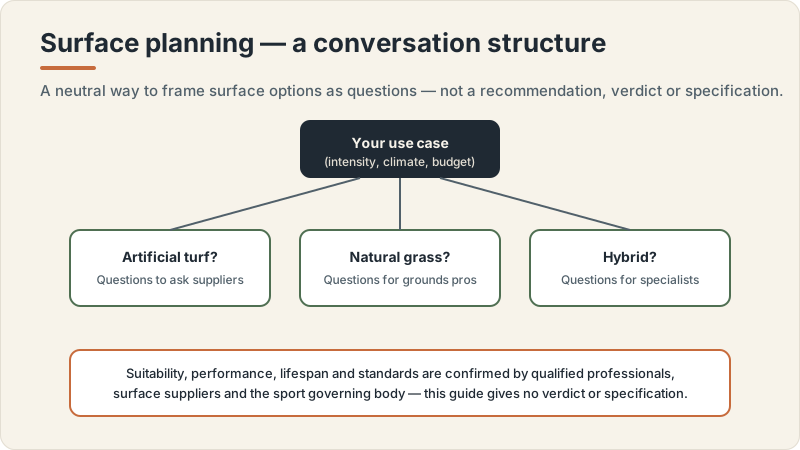
Football surface planning conversation concept
Conceptual editorial diagram — not a construction drawing, specification, to-scale plan or proof of a real project. It is not engineering, structural, fire/life-safety, crowd-safety or accessibility-compliance guidance. Capacities, dimensions, standards, requirements and costs vary by facility type, audience, site, use case and governing body, and are confirmed with qualified professionals, relevant authorities and governing bodies. Build Design Hub does not design, build, inspect, certify, recommend or match anyone.
What this guide helps you prepare
This guide helps you build a research framework before you start serious conversations with surface suppliers, contractors or qualified professionals. It is about preparation: clarifying who will use the field and how often, writing down what you do and do not yet know, and creating a consistent set of questions and document requests so that every party you speak to is answering the same prompts. With that structure in place, the responses you collect become comparable rather than a pile of mismatched sales material, and gaps in your own understanding become visible early.
It does not help you engineer, design, install, certify, permit or operate a football field, turf or drainage system, and it deliberately avoids stating any specification, dimension, performance figure or standard as fact. Instead, it points you toward the categories of information worth researching and the claims worth confirming independently. The goal is for you to arrive at meetings with qualified professionals and governing bodies already organised, so their time is spent on judgement and verification rather than on untangling an unstructured brief.
- Write a plain-language summary of intended users, sports, age groups and rough weekly hours of play you expect, to anchor every later conversation
- List what is already decided versus genuinely open, so suppliers are not pitching to a moving target
- Decide which questions are for suppliers, which are for contractors, and which must go to qualified professionals or governing bodies
- Set up a simple comparison structure so each supplier answers the same prompts in the same format
- Note any claims you intend to verify independently rather than accept at face value
- Record which approvals, governing-body sign-offs or authority confirmations you have not yet researched
Surface categories and supplier types worth researching
Football surfaces span a range of broad families, from natural grass systems to engineered synthetic and hybrid approaches, and the type of party you research differs accordingly. Some organisations focus on supplying a surface product, others on installation, others on ongoing maintenance, and some present themselves as handling several of these. Rather than assuming any single supplier covers everything you need, it is worth mapping which roles each party actually performs and where the boundaries between supply, installation, warranty and maintenance fall. Treat the differences between surface families as topics to discuss with qualified professionals against your specific use case, climate and site, not as a ranking you can settle from a web page.
When you research categories, your aim is to understand scope of responsibility and continuity of accountability, not to crown a winner. Ask each party to describe in writing what they supply, what they explicitly exclude, and who they expect to be responsible for the parts they do not cover. This makes it far easier to spot gaps where no one owns a critical element, and to bring those gaps to your professional team. Whether any particular surface family suits your situation depends on factors that vary by use case, governing body, site, climate and maintenance plan; confirm with qualified professionals.
- Map which surface families you are even considering and which you have ruled out, with a note on why and who advised it
- For each party, record whether they supply, install, maintain, warrant, or some combination, and what they exclude
- Ask how each surface family is said to behave for your stated mix of sports, ages and usage hours, then plan to confirm independently
- Identify which governing bodies or competition organisers may have a view on the surface, and note them as parties to consult
- Note any claims about all-weather use, year-round play or usage intensity as items to verify rather than accept
- Clarify who would be accountable for performance over time, and how that is documented, without treating any stated lifespan as fact
Documentation to request and claims to confirm independently
A disciplined supplier-research process leans heavily on documentation. Rather than relying on conversations and brochures, ask each party to provide written material that you can review at your own pace and share with qualified professionals: scope descriptions, warranty terms, maintenance expectations, references to any test or certification documents they cite, and clear statements of what is and is not included. The point of collecting documents is not to judge them yourself against a standard, but to create a record that a qualified professional can examine and that you can compare consistently across parties.
Equally important is deciding which claims you will confirm independently. Statements about certifications, governing-body approvals, test results, durability, drainage behaviour or compliance are exactly the kind of thing worth verifying through the issuing body, the relevant authority or your own professional team rather than taking on trust. Build Design Hub does not verify suppliers, validate certificates or confirm any claim on your behalf; that confirmation is your responsibility to arrange with the appropriate qualified parties. Frame durability, certification, drainage or compliance figures as questions to confirm, since all of them vary by site, system, authority and professional team.
- Request a written scope of supply that names inclusions, exclusions and assumptions in plain language
- Ask for warranty and maintenance documentation, and note exactly which conditions could void coverage
- When a certification, test result or governing-body approval is mentioned, record the issuing body so you can confirm it directly with that body
- Request references to any standards a party relies on, then take those to qualified professionals rather than interpreting them yourself
- Keep a log of every claim you intend to verify, who can verify it, and whether it has been confirmed
- Ask how the party documents responsibilities at handover, and what records you would receive, without assuming any figure is final
Planning questions before speaking with professionals
Before you book time with qualified professionals, it pays to answer a set of internal questions so your brief is coherent. These are questions for you and your stakeholders, not for suppliers: who the field is really for, how decisions will be made, who controls the budget, what your tolerance for ongoing maintenance effort is, and what would count as success. Working through them first means that when a professional asks why you are leaning one way, you can answer from a considered position rather than improvising, and it reduces the risk of expensive direction changes later.
These questions also surface the constraints and unknowns you should flag early. If you are unsure who the governing authority is, whether community or competition use is expected, or how the field fits a wider site, name those uncertainties now so professionals can address them directly. The aim is a brief that is honest about what is settled and what is open, because everything material here varies by location, use case, governing body, owner, site, surface system, maintenance plan, climate and authority, and a qualified team can only advise well if your assumptions are written down.
- Who are the primary and secondary users, and how might that change over the next several years?
- Who makes the final surface decision, who funds it, and who must approve it before it proceeds?
- What level of ongoing maintenance effort and responsibility is the organisation realistically prepared to carry?
- Is competition, community, or governing-body sanctioned use expected, and have you identified which bodies that brings into scope?
- How does this field relate to the rest of the site, and what other approvals might that connection trigger?
- What would make this project a success or a failure in the eyes of each key stakeholder?
Questions for qualified professionals
Once your brief and research are organised, the next step is taking the right questions to the right professionals. The most useful questions are open ones that ask a professional to assess your situation rather than confirm a conclusion you have already reached. Ask what they would want to investigate about your site, which surface families fit your stated use and why, what governing-body or authority requirements they think apply, and which supplier claims they would insist on verifying. Their answers will often reshape your brief, which is exactly what early professional involvement is for.
Use these conversations to test the supplier information you have gathered. Bring the documentation and the claims log, and ask professionals to tell you where they see gaps, unsupported assertions, or questions that should be confirmed with an authority or governing body. Because requirements, performance and suitability vary by location, use case, governing body, owner, site, surface system, maintenance plan, climate, authority and professional team, the role of the professional is to apply judgement to your specifics, not to ratify a generic answer; confirm everything material with them and the relevant authorities.
- What would you need to investigate about our site, use case and climate before advising on a surface direction?
- Which surface families do you think fit our stated users and usage, and what trade-offs would you want us to understand?
- Which governing bodies, competition organisers or authorities should we be consulting, and at what stage?
- Looking at our supplier documentation, where do you see claims that should be independently confirmed?
- Who do you think should be accountable for performance, maintenance and warranty, and how should that be documented?
- What questions are we not asking that you would expect a prepared owner in our position to be asking?
What this does not replace
This is an educational project-preparation resource only. It is not a construction manual and not engineering, architectural, turf-installation, drainage-engineering, sports-surface-specification, structural, fire or life-safety, crowd-safety, accessibility-compliance, permit, zoning, legal, tax or procurement advice. It does not design, specify, install, certify, inspect or approve anything, and it is not an estimate, quote, price, capacity recommendation or performance or lifespan guarantee. Requirements, standards, dimensions, surface systems and costs vary by location, use case, governing body, owner, site, climate, maintenance plan, authority and professional team, and are confirmed with qualified professionals, relevant authorities and the sport governing body.
Build Design Hub does not design, build, install, engineer, inspect, certify, recommend, rank, verify, introduce, broker or match suppliers or contractors, and HELPERG LLC is publisher/operator only. Use this resource to prepare your own thinking, then have qualified professionals you engage directly review your project. Decisions about engineering, surface specification, drainage, safety, compliance, procurement and suitability must rest on those professionals, the relevant authorities and the governing body for your sport and location.
- Not a construction manual and not engineering, turf-installation or drainage-engineering instructions
- Not sports-surface specification, structural, fire/life-safety, crowd-safety or accessibility-compliance advice
- Not permit, zoning, legal, tax or procurement advice
- Not a supplier or contractor recommendation, ranking, directory or matching service
- Not an estimate, price, capacity recommendation or performance/lifespan guarantee — requirements and costs vary
- Qualified professional review is required before any project decision
Football field surface supplier-research worksheet
- 1Record the intended users, sports, age groups and rough weekly usage hours in plain language
- 2Note which surface families you are considering and which you have ruled out, with the reason and adviser for each
- 3List the parties you are researching and mark whether each supplies, installs, maintains or warrants the surface
- 4Gather a written scope of supply from each party that states inclusions, exclusions and assumptions
- 5Collect warranty and maintenance documentation from each party and record what could void coverage
- 6Log every certification, approval or test result mentioned, with the issuing body you will confirm it through
- 7Record which governing bodies, competition organisers or authorities may have a view, and whether you have contacted them
- 8Capture the same prompts answered by each supplier so responses can be compared side by side
- 9Maintain a claims-to-verify log noting the claim, who can confirm it, and its current status
- 10Write down who funds, decides and approves the surface choice and how those approvals will be obtained
- 11Note open questions and unknowns to raise with qualified professionals rather than guessing at answers
- 12List the professionals and authorities you still need to consult and what you will ask each
- 13Record how responsibilities would be documented at handover and what records you would receive
- 14Keep a running list of items you are treating as questions to confirm rather than facts
Common mistakes to avoid
- Treating supplier brochures, durability figures or stated lifespans as confirmed facts instead of claims to verify with qualified professionals and issuing bodies
- Comparing suppliers on different questions, so the responses cannot be set side by side
- Assuming one party covers supply, installation, maintenance and warranty without confirming the boundaries in writing
- Skipping early professional involvement and locking in a direction before anyone qualified has reviewed the site
- Failing to identify which governing bodies, competition organisers or authorities have a stake before talking to suppliers
- Accepting a certification or approval claim without confirming it directly with the body that issued it
- Leaving accountability for ongoing maintenance and performance undefined until after a decision is made
- Expecting Build Design Hub or any educational guide to recommend, rank or match a supplier, rather than doing that research and confirmation yourself
When to involve a professional
- When you are ready to translate a brief into actual surface or site decisions and need judgement applied to your specific situation
- When supplier documentation cites certifications, standards or test results that must be interpreted and independently confirmed
- When governing-body, competition or authority requirements may apply and you are unsure which bodies are in scope
- When the football field connects to a wider site and may trigger additional approvals or coordination
- When warranty, maintenance and accountability terms need to be reviewed before any commitment is made
- When stakeholders disagree on users, budget or success criteria and the brief needs an impartial professional perspective
Frequently asked questions
Questions readers ask about this topic
Does Build Design Hub recommend or match football field surface suppliers or contractors?
No. Build Design Hub is an educational publisher and does not recommend, rank, verify, introduce, broker or match suppliers or contractors, and it provides no costs, requirements or turf specifications. This guide only helps you structure your own research and prepare questions to take to qualified professionals, governing bodies and the parties you choose to contact and verify yourself.
Will this guide tell me which surface is best or what one should cost?
No. It deliberately avoids stating any surface choice, specification, performance figure, lifespan or cost as fact, because all of these vary by location, use case, governing body, owner, site, surface system, maintenance plan, climate, authority and professional team. The guide helps you frame those as questions to confirm with qualified professionals and the relevant authorities.
How should I handle certification or test-result claims from a supplier?
Treat them as claims to confirm rather than facts. Record the issuing body for each claim and confirm it directly with that body, and ask your qualified professionals to review what the documentation actually supports. This guide does not validate certificates or confirm any claim on your behalf.
When should I bring in qualified professionals?
As early as your brief allows, ideally before you commit to a direction. Use your research and claims log to give them a clear starting point, and rely on them to apply judgement to your specific site, use case and governing-body context rather than ratifying a generic answer.
Keep reading