
Who this guide is for
- Club and academy owners or board members planning how a home pitch will be maintained over its life
- School and university facilities staff responsible for a grass sports surface used by many groups
- Municipal and parks departments overseeing community football pitches and shared-use grounds
- Property developers including a natural-grass pitch within a wider sports or community scheme
- Facility and operations managers preparing maintenance briefs, budgets and contractor conversations
- Grounds and estates teams gathering questions before engaging agronomists or specialist contractors
Planning diagram
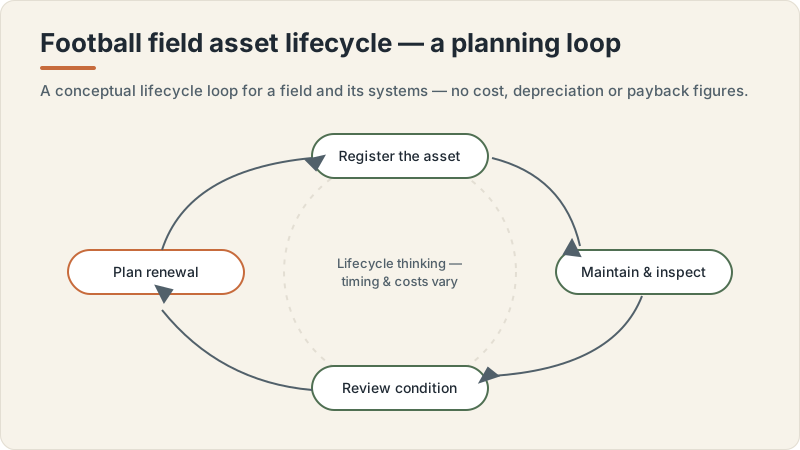
Football field asset lifecycle concept
Conceptual editorial diagram — not a construction drawing, specification, to-scale plan or proof of a real project. It is not engineering, structural, fire/life-safety, crowd-safety or accessibility-compliance guidance. Capacities, dimensions, standards, requirements and costs vary by facility type, audience, site, use case and governing body, and are confirmed with qualified professionals, relevant authorities and governing bodies. Build Design Hub does not design, build, inspect, certify, recommend or match anyone.
What this guide helps you prepare
This guide helps you prepare the thinking, documents and questions that come before any maintenance work is planned or commissioned. It is aimed at the planning stage: when you are deciding what level of presentation and playability you are aiming for, who will be responsible for the pitch, how usage will be managed, and what conversations you need to have with qualified grounds professionals, agronomists, the relevant authorities and your governing body. It is not a manual for maintaining grass, and it does not contain regimes, products or schedules to follow.
The value of preparation is that it lets you reach professional discussions with your goals, constraints and uncertainties already written down. Rather than asking a contractor or agronomist to guess what you want, you can present a clear brief covering use patterns, ambitions, budget framing and known site issues, and let them advise on what is achievable and appropriate. Because every natural-grass pitch behaves differently, this guide steers you toward describing your situation accurately and asking informed questions, not toward adopting any particular maintenance approach.
- Clarify the standard of presentation and playability you are aiming for, and who decides it
- Identify who will be accountable for day-to-day care versus periodic specialist work
- Gather what you already know about the pitch's construction, drainage and history
- Frame how the pitch is used now and how usage might change over coming seasons
- Note the questions you cannot answer yourself and will need professionals to address
- Prepare to compare proposals on a like-for-like basis rather than on headline figures
Thinking about the maintenance lifecycle, not just the next season
A natural-grass pitch is a living surface whose condition is shaped continuously by weather, wear, the underlying construction and the care it receives, so planning benefits from a lifecycle view rather than a season-by-season one. Lifecycle thinking means asking how the surface is expected to perform across wet and dry periods, how heavy use accumulates over a season, what periodic renovation or recovery work tends to be discussed for surfaces like yours, and how all of that connects to budgets that may span several years. The specifics of any cycle, including timing, intensity and what counts as renovation, vary by site, climate, construction and use, and should be confirmed with qualified professionals rather than assumed from general descriptions.
Framing maintenance as a lifecycle also changes the questions you ask suppliers and professionals. Instead of focusing only on routine upkeep, you can ask how a proposed approach anticipates peak-use periods, end-of-season recovery, and the slower changes that affect a surface over years. This helps you understand the difference between ongoing care and larger periodic interventions, and to plan governance and budgeting around both. It is not a basis for setting your own schedule; it is a way to have a more complete conversation with the people qualified to advise on what your pitch actually needs.
- List the distinct phases you want professionals to address: routine care, peak-use periods, recovery and longer-term renewal
- Ask how a proposed approach responds to your local climate and seasons, without assuming any fixed calendar
- Record what is known about the pitch's age, construction and previous interventions
- Consider how multi-year budgeting might separate ongoing care from periodic larger works
- Note who holds historical records and whether they are available to incoming professionals
- Ask how success or condition would be described and reviewed over time, in the professional's terms
Mapping usage, responsibility and operational realities
How a pitch is used is often the single biggest input into any maintenance conversation, so it is worth describing usage carefully before you speak to anyone. That means capturing who plays on the surface, how often, in what conditions, and whether use is likely to grow as a club, academy or community programme develops. It also means being honest about pressures such as training load, multiple teams sharing one surface, events outside normal play, and periods when the pitch cannot rest. Professionals can only advise sensibly when they understand these realities, and the realities themselves vary so much between sites that there is no general answer to carry over from another pitch.
Alongside usage, it helps to map responsibility and operations clearly. Who will carry out everyday tasks, who oversees specialist work, who controls access during recovery periods, and who makes decisions when play and pitch condition conflict? These are organisational questions as much as technical ones, and resolving them early prevents confusion later. Documenting roles, decision rights and constraints gives professionals and suppliers a realistic picture of how their advice would be implemented, and gives you a clearer basis for comparing what different providers are actually offering to do.
- Describe current usage honestly: teams, age groups, frequency and conditions of play
- Anticipate how demand might change if programmes, membership or events expand
- Identify who decides when the pitch is rested, closed or restricted, and on what basis
- Clarify the split between in-house tasks and work expected from specialist contractors
- Note any access, security, water, power or storage constraints affecting maintenance work
- Capture how conflicts between play demand and surface recovery would be resolved
Planning questions before speaking with professionals
Before you contact agronomists, grounds contractors or your governing body, it is worth working through the questions you can answer internally so that your brief is grounded in your own situation. These are not technical turf questions; they are questions about goals, ownership, budget framing, usage and tolerance for disruption. Answering them first means professional time is spent on advice you genuinely need, rather than on establishing basics you could have prepared. It also helps you notice where your own stakeholders disagree, so those tensions can be resolved before they reach a contractor.
Treat this as an internal alignment exercise across whoever has a stake in the pitch, whether that is a board, a parks department, a school leadership team or a facilities function. The goal is a shared, written understanding of what you want, what you can commit to, and what you are unsure about. Where a question touches on anything technical, including condition, suitability or what a surface can withstand, the right response is to record it as an open question for qualified professionals rather than to guess at an answer yourselves.
- What standard of pitch are we aiming for, and who has agreed that ambition?
- What is our realistic capacity for ongoing care, in people, budget and time?
- How much disruption to play can we tolerate for recovery or larger works?
- What do we already know, and not know, about the pitch's construction and history?
- Who owns the decision when surface condition and play demand conflict?
- What constraints, such as shared use or events, must any professional understand from the outset?
Questions for qualified professionals
When you do engage qualified professionals, your questions can focus on understanding their assessment, their proposed approach and how it fits your situation, rather than on confirming details you have read elsewhere. Good questions ask what they would need to inspect, what they would want to know about your usage and goals, how they would describe the condition and behaviour of a surface like yours, and what their proposed scope does and does not include. Because requirements vary by location, use case, governing body, owner, site, surface system, maintenance plan, climate, authority and professional team, the most useful answers are the ones specific to your pitch from someone qualified to give them.
These conversations are also where you confirm relationships with the relevant authorities and your sport's governing body, including any expectations that apply to your competition level. Ask how a professional accounts for those expectations, how they would coordinate with other parties, and how their proposals could be compared with others on a consistent basis. The aim is not to extract a specification from this guide but to leave each conversation understanding what is being proposed, why, and what assumptions it rests on, so your own decisions are well informed.
- What would you need to assess about this pitch before advising, and how?
- How would you describe what a surface like ours can realistically withstand given our usage?
- What does your proposed scope include and exclude, and where might extra work arise?
- How do governing-body or competition expectations shape what you would recommend?
- How should we compare your proposal with others on a like-for-like basis?
- What ongoing reporting or review would you expect, and how are decisions documented?
What this does not replace
This is an educational project-preparation resource only. It is not a construction manual and not engineering, architectural, turf-installation, drainage-engineering, sports-surface-specification, structural, fire or life-safety, crowd-safety, accessibility-compliance, permit, zoning, legal, tax or procurement advice. It does not design, specify, install, certify, inspect or approve anything, and it is not an estimate, quote, price, capacity recommendation or performance or lifespan guarantee. Requirements, standards, dimensions, surface systems and costs vary by location, use case, governing body, owner, site, climate, maintenance plan, authority and professional team, and are confirmed with qualified professionals, relevant authorities and the sport governing body.
Build Design Hub does not design, build, install, engineer, inspect, certify, recommend, rank, verify, introduce, broker or match suppliers or contractors, and HELPERG LLC is publisher/operator only. Use this resource to prepare your own thinking, then have qualified professionals you engage directly review your project. Decisions about engineering, surface specification, drainage, safety, compliance, procurement and suitability must rest on those professionals, the relevant authorities and the governing body for your sport and location.
- Not a construction manual and not engineering, turf-installation or drainage-engineering instructions
- Not sports-surface specification, structural, fire/life-safety, crowd-safety or accessibility-compliance advice
- Not permit, zoning, legal, tax or procurement advice
- Not a supplier or contractor recommendation, ranking, directory or matching service
- Not an estimate, price, capacity recommendation or performance/lifespan guarantee — requirements and costs vary
- Qualified professional review is required before any project decision
Natural grass pitch maintenance preparation worksheet
- 1Record the standard of presentation and playability you are aiming for, and who agreed it
- 2Document current usage: teams, age groups, frequency, conditions and shared use
- 3Note expected changes in demand from growing programmes, membership or events
- 4Gather everything known about the pitch's construction, drainage and maintenance history
- 5List who holds historical records and whether they are available to new professionals
- 6Map responsibilities: in-house tasks, specialist work, oversight and decision rights
- 7Capture site constraints such as access, water, power, storage and security
- 8Record how decisions are made when play demand and surface recovery conflict
- 9Frame budget thinking across ongoing care and periodic larger works, without fixed figures
- 10Write down your tolerance for disruption and closure during recovery or renovation
- 11List the open technical questions only qualified professionals should answer
- 12Note relevant authorities and governing-body expectations to confirm with professionals
- 13Prepare a consistent structure for comparing supplier and contractor proposals
- 14Keep a log of assumptions to verify rather than treating any as confirmed fact
Common mistakes to avoid
- Copying a maintenance approach from another pitch without confirming it suits your own site, climate and usage
- Treating mowing, watering or treatment details found online as facts rather than questions for qualified professionals
- Planning only for the next season instead of taking a multi-year lifecycle view of the surface
- Underestimating how heavily the pitch will be used and how that affects recovery needs
- Leaving responsibility and decision rights undefined so play and pitch condition routinely conflict
- Comparing supplier proposals on headline impressions rather than on a like-for-like scope basis
- Assuming a fixed lifespan, cost or renovation timeline before any professional has assessed the pitch
- Skipping early alignment among stakeholders, so disagreements surface only after contractors are involved
When to involve a professional
- When you need an assessment of the pitch's actual construction, drainage or current condition
- When usage is increasing or changing in ways that may exceed what the surface can handle
- When you are scoping or comparing maintenance proposals and need to understand what each includes
- When governing-body or competition expectations may apply and must be confirmed for your level
- When larger periodic works, renovation or recovery planning are being considered
- When stakeholders disagree on standards, budget or how surface condition should be managed
Frequently asked questions
Questions readers ask about this topic
Does this guide tell me how to maintain my grass pitch?
No. It is an educational preparation guide that helps you organise goals, questions and a brief before speaking with qualified professionals. It does not provide mowing heights, watering volumes, fertiliser or chemical regimes, renovation schedules or any maintenance instructions, because those depend on your specific site and must come from qualified grounds and agronomy professionals.
Can Build Design Hub recommend or connect me with a maintenance contractor or supplier?
No. Build Design Hub does not design, build, maintain, inspect, certify, recommend, rank, verify, broker or match suppliers or contractors, and it provides no costs, requirements or turf specifications. This guide only helps you prepare your own questions and research so that you can approach and compare qualified providers yourself.
Why does this guide avoid giving costs, timelines or turf lifespans?
Because those figures vary by location, use case, governing body, owner, site, surface system, maintenance plan, climate, authority and professional team. Stating them as facts would be misleading. Treat any number you encounter as something to confirm with qualified professionals and the relevant authorities for your specific pitch.
What should I have ready before contacting an agronomist or grounds contractor?
A written description of your goals, current and expected usage, what you know about the pitch's history and construction, your constraints and budget framing, and a list of the technical questions you cannot answer yourself. Arriving organised lets professionals focus on advice specific to your pitch.
Keep reading