
Who this guide is for
- Club, academy or facility owners researching artificial turf suppliers before approaching them
- School and municipality project leads preparing consistent supplier conversations for a pitch project
- Facility managers comparing several turf suppliers on a like-for-like basis
- Developers assembling a brief and a question set before any commitment
- Owners unsure what documentation and samples to request from a turf supplier
- Anyone wanting to understand what must be confirmed independently versus taken on trust
Planning diagram
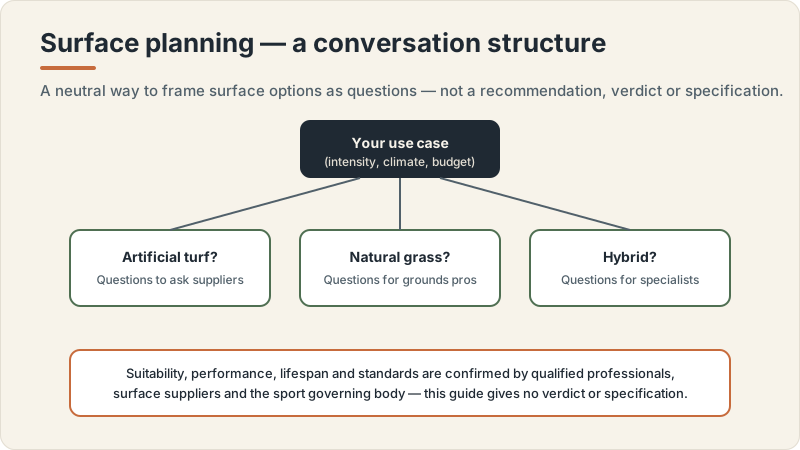
Football surface planning conversation concept
Conceptual editorial diagram — not a construction drawing, specification, to-scale plan or proof of a real project. It is not engineering, structural, fire/life-safety, crowd-safety or accessibility-compliance guidance. Capacities, dimensions, standards, requirements and costs vary by facility type, audience, site, use case and governing body, and are confirmed with qualified professionals, relevant authorities and governing bodies. Build Design Hub does not design, build, inspect, certify, recommend or match anyone.
What this guide helps you prepare
This guide helps you build a structured set of questions and a comparison structure to use when researching artificial turf suppliers for a football field or training ground. It is organised around understanding who you are speaking to, the documentation and samples worth requesting, the claims worth confirming independently, and the questions to plan before you compare any options. It deliberately stays at a preparation and question level so you can cover ground that headline product names and sales descriptions often skip over.
Everything here is framed as something to confirm rather than something stated as fact. This guide does not specify turf, infill, pile height, drainage, dimensions, performance, durability or lifespan, and it does not say what any supplier should answer. Requirements vary by location, use case, governing body, owner, site, surface system, maintenance plan, climate, authority and professional team; confirm with qualified professionals. The useful output is informed research and a fair basis for comparison, not fixed expectations or an endorsement of any product or company.
- A question set spanning supplier role, product detail, documentation and samples
- A comparison structure you populate yourself with each supplier's answers
- Prompts that help you notice vague, inconsistent or missing information
- A clear separation between what to confirm independently and what to take on trust
- Framing that keeps cost, availability and requirements as factors to confirm, not figures
- A list of points to carry into later conversations with qualified professionals
Understanding who you are speaking to
Artificial turf for football reaches buyers through several kinds of supplier, and they package responsibility very differently. Some focus only on supplying the turf product, others bundle supply with installation or with a wider field package, and some act as intermediaries between you and a manufacturer. Mapping which type you are speaking to early helps you understand where their responsibility starts and ends, and stops you assuming every supplier offers the same scope, support and aftercare.
Research the role before the product, because the same surface can come with very different documentation, support and accountability depending on who is selling it. Ask each supplier to describe their own role in their own words and record it, so you can compare like with like rather than reading a uniform offer into very different propositions. This guide does not assess any supplier; it only helps you frame the questions that reveal how each one describes itself.
- Are you a manufacturer, a distributor, an installer, or an intermediary?
- Do you supply turf only, supply and install, or work as part of a wider field package?
- Which parts of a football field project do you handle, and which do you leave to others?
- Where is the turf you supply made, and how do you describe its origin in writing?
- How do you support a buyer who is still researching options rather than ready to commit?
- Who would carry responsibility for what after supply or installation, in your description?
Documentation, samples and claims to confirm independently
Once you understand who you are dealing with, focus your research on what a supplier can put in writing and what you would need to confirm elsewhere. Ask for the product documentation a supplier can provide so you can review it independently, rather than relying on a verbal sales description. Treat any performance, durability, suitability or compliance claim as something to verify with documentation, the relevant football governing body and qualified professionals, not as fact to accept on the page.
Samples are part of research too. Asking how you can see and handle a representative sample, and how to confirm it matches what would actually be supplied, helps you compare materials rather than marketing language. This guide does not state what any turf specification, test result or governing-body requirement should be, and it does not tell you whether a product is suitable for your site or intended use. Those depend on factors only qualified professionals and the appropriate authority or governing body can assess for your specific project.
- What product documentation can you provide for me to review independently?
- Does the written description match what is said verbally, and where does it differ?
- Can you provide a representative sample, and how do I confirm it matches the supply?
- What test or compliance documentation exists, who issued it, and is it current?
- How do you describe the relationship between this product and any governing-body requirements?
- Which claims would you expect me to confirm with a qualified professional or authority?
Planning questions before speaking with professionals
Before you bring qualified professionals into the conversation, it helps to organise your own questions and to be clear about what you are trying to learn. Decide who your stakeholders are, what your intended use and users look like, and what documentation you have gathered from suppliers so far. The more structured your own preparation, the more useful a professional's time becomes, because they can focus on judgement rather than on assembling basic facts you could have organised yourself.
Use this stage to record what is still unknown and what each supplier has left unconfirmed, rather than to reach conclusions. Capture each supplier's answers in a consistent worksheet so differences are visible, and flag every claim that needs independent verification. This guide cannot tell you what your project requires; requirements vary by location, use case, governing body, owner, site, surface system, maintenance plan, climate, authority and professional team, and must be confirmed with qualified professionals.
- Have you written down your intended use, users and the stakeholders involved?
- Have you noted which governing body or authority you will need to confirm requirements with?
- Have you gathered each supplier's documentation into one place for review?
- Have you recorded each supplier's answers in a consistent comparison structure?
- Have you listed every claim that still needs independent verification?
- Have you separated what you know from what a professional still needs to assess?
Questions for qualified professionals
Some questions sit better with independent professionals than with a supplier, because they involve judgement, verification or specialist knowledge that a seller cannot be neutral about. While you research turf suppliers, it helps to line up the people who can give independent input on surface suitability, supporting groundwork, governing-body requirements and any documentation that needs reviewing, so you are not relying on the supplier to mark their own work.
Use the prompts below to plan who to involve and what to ask them, not to reach conclusions yourself. This guide cannot state requirements, assess any product or confirm suitability for your site; requirements vary by location, use case, governing body, owner, site, surface system, maintenance plan, climate, authority and professional team, and must be confirmed with qualified professionals, the relevant authorities and the appropriate football governing body.
- Designer or engineer: is an artificial turf surface appropriate for my site and intended use?
- Site, groundwork and drainage specialists: is the supporting work being planned soundly?
- Relevant football governing body or authority: what surface and field requirements apply here?
- Qualified document reviewer: do the product papers support what the supplier claims?
- Maintenance or operations advisor: what would upkeep involve over the surface's working life?
- Legal or contract advisor: do the supply terms, guarantee and exclusions hold up on review?
What this does not replace
This is an educational project-preparation resource only. It is not a construction manual and not engineering, architectural, turf-installation, drainage-engineering, sports-surface-specification, structural, fire or life-safety, crowd-safety, accessibility-compliance, permit, zoning, legal, tax or procurement advice. It does not design, specify, install, certify, inspect or approve anything, and it is not an estimate, quote, price, capacity recommendation or performance or lifespan guarantee. Requirements, standards, dimensions, surface systems and costs vary by location, use case, governing body, owner, site, climate, maintenance plan, authority and professional team, and are confirmed with qualified professionals, relevant authorities and the sport governing body.
Build Design Hub does not design, build, install, engineer, inspect, certify, recommend, rank, verify, introduce, broker or match suppliers or contractors, and HELPERG LLC is publisher/operator only. Use this resource to prepare your own thinking, then have qualified professionals you engage directly review your project. Decisions about engineering, surface specification, drainage, safety, compliance, procurement and suitability must rest on those professionals, the relevant authorities and the governing body for your sport and location.
- Not a construction manual and not engineering, turf-installation or drainage-engineering instructions
- Not sports-surface specification, structural, fire/life-safety, crowd-safety or accessibility-compliance advice
- Not permit, zoning, legal, tax or procurement advice
- Not a supplier or contractor recommendation, ranking, directory or matching service
- Not an estimate, price, capacity recommendation or performance/lifespan guarantee — requirements and costs vary
- Qualified professional review is required before any project decision
Artificial turf football field supplier research worksheet
- 1Have you identified which role each supplier plays and recorded it in their own words?
- 2Have you asked what is included with the turf and what you would arrange separately?
- 3Have you asked where the product is made and how its origin is described in writing?
- 4Have you requested product documentation you can review independently?
- 5Have you asked for a representative sample and how to confirm it matches the supply?
- 6Have you noted which test or compliance documents exist and who issued them?
- 7Have you recorded how each supplier describes any governing-body or sport requirement?
- 8Have you asked what factors affect availability and delivery and what could change them?
- 9Have you asked where any guarantee, warranty or aftercare terms are documented?
- 10Have you written down your intended use, users and the stakeholders involved?
- 11Have you captured each supplier's answers in a consistent comparison structure?
- 12Have you listed every claim that needs independent verification before relying on it?
- 13Have you planned which points to confirm with qualified professionals and authorities?
- 14Have you noted which governing body you will confirm field and surface requirements with?
Common mistakes to avoid
- Comparing suppliers on product name alone without checking what each one means by it
- Accepting performance, durability or lifespan claims verbally instead of in reviewable documentation
- Assuming a sample represents the exact batch that would actually be supplied
- Reading a uniform scope into suppliers who package responsibility very differently
- Treating governing-body or surface requirements as settled rather than confirming them with the body itself
- Not capturing each supplier's answers in a consistent structure for fair comparison
- Assuming a product is suitable for your site or intended use without independent professional review
- Relying on a brochure or proposal alone without verifying anything independently
When to involve a professional
- A qualified designer or engineer can assess whether an artificial turf surface suits your site and intended use.
- Site, groundwork and drainage specialists should confirm that the supporting work is being planned soundly.
- Surface and field requirements vary and should be confirmed with the relevant football governing body or authority.
- Product, test and compliance documentation should be reviewed by someone qualified to judge whether it supports a supplier's claims.
- Supply contracts, guarantees, exclusions and any aftercare terms should be reviewed by appropriate legal or contract advisors.
- Build Design Hub does not recommend, verify, rank or introduce suppliers; researching and selecting one remains your responsibility.
Frequently asked questions
Questions readers ask about this topic
What should I ask an artificial turf football supplier first?
Start by establishing their role: whether they manufacture, distribute, install or act as an intermediary, and what is included with the turf. Suppliers package responsibility very differently, so understanding where their role starts and ends matters more than any headline product name. Record each answer so you can compare like with like later.
Does this guide recommend, rank or match turf suppliers, or give costs and specifications?
No. It only provides questions and a structure for your own research. Build Design Hub does not name, match, rank, rate, verify or endorse any supplier or contractor, and it gives no costs, requirements or turf specifications. HELPERG LLC is the publisher and operator only. Researching, verifying and selecting any supplier remain your responsibility.
How should I handle a supplier's claims about performance, durability or governing-body requirements?
Treat them as a starting point, not as fact. Ask for them in writing, then confirm them independently with documentation, qualified professionals and the appropriate football governing body. Requirements vary by location, use case, governing body, site, surface system, climate and professional team, so listen for whether a supplier references that nuance rather than stating fixed certainties.
What documentation and samples should I request?
Ask for product documentation you can review independently and for a representative sample, along with how to confirm the sample matches what would be supplied. Treat any specification, test or compliance claim as something to verify with documentation and qualified professionals rather than accept on the page.
Can this guide tell me whether a turf product is suitable for my field?
No. Suitability depends on your site, intended use, climate, maintenance plan and the requirements of the relevant authority or governing body, and only qualified professionals can assess it for your specific project. This guide helps you prepare the questions and gather the documentation that make that professional review more productive.
Keep reading