
Who this guide is for
- Club and academy owners or boards scoping a lighting project for an existing or planned football field before engaging designers
- School, college and university facility teams weighing evening or community use of a pitch and the planning conversations that follow
- Municipal and parks departments preparing a brief for a public or shared sports field and its surrounding neighbours
- Developers and project sponsors integrating a football field into a larger site and coordinating early-stage stakeholder discussions
- Facility managers and grounds teams responsible for ongoing operation, switching and maintenance planning of an existing or future system
- Community sports trusts and multi-use venue operators balancing competing user groups, schedules and neighbour relationships
Planning diagram
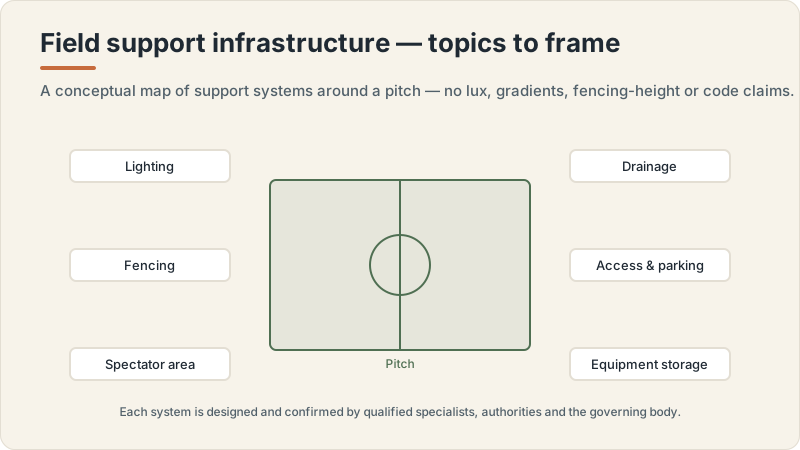
Football field support infrastructure concept
Conceptual editorial diagram — not a construction drawing, specification, to-scale plan or proof of a real project. It is not engineering, structural, fire/life-safety, crowd-safety or accessibility-compliance guidance. Capacities, dimensions, standards, requirements and costs vary by facility type, audience, site, use case and governing body, and are confirmed with qualified professionals, relevant authorities and governing bodies. Build Design Hub does not design, build, inspect, certify, recommend or match anyone.
What this guide helps you prepare
This guide helps you arrive at conversations with qualified professionals, your relevant authorities and your sport governing body already knowing what you want to ask. Field lighting touches several worlds at once: how the space is used, who is affected around it, how it will be paid for and maintained, and who is legally and technically responsible for designing it. Preparing those threads in advance tends to make later professional conversations shorter, clearer and less prone to expensive misunderstandings. Nothing here tells you what light levels to install, where to place anything, or how to wire, mount or certify equipment; those are decisions for licensed and qualified people working to the requirements that apply to your specific situation.
Instead, the guide gives you a structure for a brief: a written statement of intended uses, constraints, stakeholders, open questions and decision points that a designer or consultant can respond to. Because lighting requirements vary by location, use case, governing body, owner, site, surface system, maintenance plan, climate, authority and professional team, the most useful thing you can do early is document what you know and flag what you do not. The sections that follow walk through confirming light levels for your use, understanding light spill and neighbour impacts, and identifying who designs the system, framed entirely as preparation rather than instruction.
- Write a plain-language statement of who will use the field, for what, and at what times of day and year
- List the stakeholders who should be consulted, including neighbours, users, authorities and any governing body
- Capture the open questions you cannot answer yourself so professionals can address them directly
- Separate decisions that are yours as owner from decisions that belong to qualified designers and authorities
- Record any constraints you already know about the site, schedule, neighbours or budget approval process
- Note which approvals or confirmations you suspect will be needed, to be verified rather than assumed
Confirming light levels for the intended use
The amount and quality of light a football field needs is driven by how it is used, and that is precisely the thing to confirm rather than assume. A field used for casual training, an academy development programme, competitive matches, broadcast or community recreation may each sit under different expectations, and those expectations are set by the relevant sport governing body, the competition or league involved, and the authorities for your area. Your job in preparation is not to choose a light level; it is to define your intended uses clearly enough that a qualified lighting designer can map them to the requirements that actually apply, and to identify which governing body or competition rules you will need to confirm against.
Be specific about the range of activities you hope to support, because a system briefed only around the most demanding use may differ from one briefed around everyday training, and a system briefed too narrowly may not suit a future ambition. Document whether your use is fixed or likely to evolve, whether you anticipate hosting graded competition, and whether any league or governing body has a say. Then treat the actual light-level criteria as something the designer confirms with those bodies and authorities. Requirements vary by location, use case, governing body, owner, site, surface system, maintenance plan, climate, authority and professional team; confirm with qualified professionals.
- Describe each intended use distinctly: training, internal matches, graded competition, community hire, events
- Identify which sport governing body, league or competition rules might apply to each use
- Note any aspiration to host higher-grade play later, so the brief can flag future flexibility as a question
- Ask who is responsible for confirming the applicable lighting criteria for each use, and against what
- Record whether broadcast, streaming or spectator viewing is ever envisaged, as a point to raise with professionals
- Flag uncertainty honestly rather than guessing a level, leaving the confirmation to qualified designers and authorities
Light spill, neighbours and the surrounding area
Lighting a field does not stop neatly at its edges, and the way light reaches beyond the pitch, into the sky, onto nearby homes, roads, habitats or other properties, is one of the most common sources of objection and one of the most important early conversations. This is usually called light spill or obtrusive light, and how it is assessed and limited is a matter for qualified professionals working to the rules of your local planning or environmental authority. In preparation, your task is to understand your surroundings and the people in them: who is nearby, what they might be sensitive to, when the lights would be on, and which authorities have a say. You are mapping the context, not designing the mitigation.
Engaging neighbours and authorities early, before a design is fixed, tends to surface concerns while they can still be accommodated. Document the residential, ecological, transport and amenity features around the site, note hours of intended operation, and identify the planning, environmental or licensing bodies whose requirements will shape what is permissible. Whether spill can be controlled, what limits apply, and how operating hours interact with neighbour amenity all vary by location, use case, governing body, owner, site, surface system, maintenance plan, climate, authority and professional team; confirm with qualified professionals. Resist the temptation to reassure neighbours with specifics you are not qualified to promise.
- Map nearby homes, roads, schools, habitats and other properties that could be affected by light or operating hours
- List the planning, environmental, licensing or amenity authorities that may have a role, to confirm rather than assume
- Note your intended switch-on and switch-off times and whether they vary by season or event
- Identify any sensitive features (dark-sky areas, wildlife corridors, residential windows) to raise with professionals
- Plan how and when you will consult neighbours, and capture their concerns in writing for the design brief
- Ask qualified professionals how spill is assessed and controlled for your site rather than stating limits yourself
Planning questions before speaking with professionals
Before you book time with a lighting designer, electrical engineer or consultant, it helps to have your own house in order. Much of what determines a project's shape is information only you and your stakeholders hold: who decides, who pays, who operates it afterwards, what the schedule pressures are, and what is genuinely fixed versus negotiable. Working through these internally first means the professional conversation can focus on their expertise rather than on basic facts you could have supplied. It also helps you notice gaps, such as an unconfirmed governing-body relationship or an unresolved question about future use, while there is still time to address them.
These questions are about ownership of decisions and clarity of intent, not technical answers. Keep a written record so the same brief can go to more than one professional and so quote comparisons are made against the same scope. Where a question depends on requirements, standards or figures, the honest answer in this phase is usually to mark it as something to confirm with qualified professionals and authorities rather than to fill it in. Requirements vary by location, use case, governing body, owner, site, surface system, maintenance plan, climate, authority and professional team; confirm with qualified professionals.
- Who within your organisation has authority to approve the brief, the scope and the eventual decision?
- What are the intended uses, and which of them are confirmed versus aspirational?
- Who will operate, switch, monitor and maintain the system once it exists, and is that capacity in place?
- What constraints already exist around the site, neighbours, schedule and approval timeline?
- Which governing bodies, leagues or authorities do you already know you must engage, and which are unclear?
- How will you compare proposals fairly, ensuring each professional is responding to the same documented scope?
Questions for qualified professionals
When you do speak with qualified professionals, the most valuable questions clarify responsibility, scope, assumptions and the path to confirmation. A good designer or consultant should be able to explain who confirms the applicable light-level criteria, how light spill will be assessed against your authority's expectations, what they need from you, and where the boundaries of their responsibility lie. Asking them to state their assumptions in writing, and to identify which approvals or confirmations sit outside their remit, protects you from surprises later. These are framing questions; the technical design, calculations and certifications remain the professional's work, not yours.
Use these prompts to compare professionals on substance rather than on headline figures. Ask each one the same questions, record the answers, and note where they differ in approach or in what they treat as your responsibility versus theirs. Be wary of anyone who offers firm requirements, levels or guarantees before understanding your uses, site and authorities; the appropriate answer to many questions at this stage is that it depends and must be confirmed. Requirements vary by location, use case, governing body, owner, site, surface system, maintenance plan, climate, authority and professional team; confirm with qualified professionals.
- Who confirms the applicable light-level criteria for each of our intended uses, and with which bodies?
- How will light spill and obtrusive light be assessed against our local authority's expectations?
- Which approvals, permits or governing-body confirmations are needed, and who is responsible for obtaining each?
- What information, surveys or stakeholder inputs do you need from us before you can proceed?
- What falls inside your scope and responsibility, and what remains the owner's or another professional's?
- What assumptions are you making, and how would changes to our intended use affect the project?
What this does not replace
This is an educational project-preparation resource only. It is not a construction manual and not engineering, architectural, turf-installation, drainage-engineering, sports-surface-specification, structural, fire or life-safety, crowd-safety, accessibility-compliance, permit, zoning, legal, tax or procurement advice. It does not design, specify, install, certify, inspect or approve anything, and it is not an estimate, quote, price, capacity recommendation or performance or lifespan guarantee. Requirements, standards, dimensions, surface systems and costs vary by location, use case, governing body, owner, site, climate, maintenance plan, authority and professional team, and are confirmed with qualified professionals, relevant authorities and the sport governing body.
Build Design Hub does not design, build, install, engineer, inspect, certify, recommend, rank, verify, introduce, broker or match suppliers or contractors, and HELPERG LLC is publisher/operator only. Use this resource to prepare your own thinking, then have qualified professionals you engage directly review your project. Decisions about engineering, surface specification, drainage, safety, compliance, procurement and suitability must rest on those professionals, the relevant authorities and the governing body for your sport and location.
- Not a construction manual and not engineering, turf-installation or drainage-engineering instructions
- Not sports-surface specification, structural, fire/life-safety, crowd-safety or accessibility-compliance advice
- Not permit, zoning, legal, tax or procurement advice
- Not a supplier or contractor recommendation, ranking, directory or matching service
- Not an estimate, price, capacity recommendation or performance/lifespan guarantee — requirements and costs vary
- Qualified professional review is required before any project decision
Football field lighting preparation worksheet
- 1Record every intended use of the field, with times of day and seasons for each
- 2Note which uses are confirmed and which are aspirational or under discussion
- 3List the sport governing bodies, leagues or competitions that may have a say, to confirm with each
- 4Identify the planning, environmental and licensing authorities whose requirements may apply
- 5Map neighbours and surrounding features (homes, roads, habitats, dark-sky areas) that light or hours could affect
- 6Capture intended operating hours and any seasonal or event-based variation
- 7Document who within your organisation approves the brief, the scope and the final decision
- 8Record who will operate, switch, monitor and maintain the system after it is built
- 9Gather any existing site information, drawings or surveys you already hold, to share with professionals
- 10List the open questions you cannot answer yourself, marked for qualified professionals and authorities
- 11Note known constraints on schedule, approvals, budget sign-off and neighbour relations
- 12Prepare a consistent scope description so multiple professionals respond to the same brief
- 13Set up a structure to compare proposals on scope and responsibility rather than headline numbers
- 14Keep a written log of neighbour and stakeholder concerns raised during early consultation
Common mistakes to avoid
- Assuming a light level or specification yourself instead of confirming the applicable criteria with the governing body and qualified professionals
- Briefing only the most demanding use, or only the cheapest, without documenting the realistic range of intended uses
- Leaving neighbours and authorities until a design is fixed, so concerns surface too late to accommodate
- Treating light spill as a detail rather than an early planning conversation with your local authority
- Comparing proposals on headline figures or price rather than on matched scope and stated responsibilities
- Failing to identify who will operate and maintain the system, so ongoing capacity is never planned
- Confusing decisions that are yours as owner with technical decisions that belong to qualified designers and authorities
- Promising neighbours specifics about spill or hours that you are not qualified to guarantee
When to involve a professional
- When you need the light-level criteria for your intended uses confirmed against governing-body, league or authority requirements
- When light spill or obtrusive light must be assessed against local planning or environmental expectations
- When any electrical, structural, mounting or photometric design is involved, which is strictly professional and licensed work
- When approvals, permits or governing-body confirmations may be required and responsibility for them must be assigned
- When a single field must serve mixed or evolving uses and the brief needs translating into a workable scope
- When neighbour or environmental objections arise and a qualified consultant should advise on assessment and mitigation
Frequently asked questions
Questions readers ask about this topic
Does Build Design Hub design the lighting, recommend suppliers or tell me what light levels I need?
No. Build Design Hub is an educational publisher and does not design, engineer, install, certify, recommend, rank, verify, broker or match suppliers or contractors, and it gives no costs, requirements or specifications. This guide only helps you prepare questions and a brief. The applicable light levels, spill limits and any specifications must be confirmed with qualified professionals, your relevant authorities and your sport governing body, because they vary by location, use case, governing body, owner, site, surface system, maintenance plan, climate, authority and professional team.
Who decides what light level my football field needs?
That is set through the requirements of your sport governing body, any league or competition involved, and your local authorities, and it is confirmed by a qualified lighting designer who maps your intended uses to those requirements. Your role in preparation is to define your uses clearly and identify which bodies have a say, not to choose a level yourself. Confirm everything with qualified professionals.
How do I handle neighbours worried about light spill?
Engage them early, before a design is fixed, and record their concerns in writing for your brief. How spill is assessed and controlled is a matter for qualified professionals working to your local planning or environmental authority's expectations, so avoid promising specifics you are not qualified to guarantee. Map the surroundings and the affected parties, then let professionals address mitigation.
Why does this guide avoid giving numbers, standards or costs?
Because those vary by location, use case, governing body, owner, site, surface system, maintenance plan, climate, authority and professional team, and stating them as facts could mislead. The guide is intentionally limited to preparation: organising your uses, stakeholders, constraints and open questions so that qualified professionals and authorities can supply the answers that apply to your specific project.
Keep reading