
Who this guide is for
- Private owners and developers planning a new or replacement football field or training ground
- Football clubs and academies preparing a brief before approaching professionals or a board
- Schools and colleges scoping a pitch project for sport, PE and community use
- Municipalities and parks teams capturing requirements for a community football facility
- Facility managers structuring a brief for upgrades, renovation or added training areas
- Project sponsors who need an organised written picture before briefing partners or funders
Planning diagram
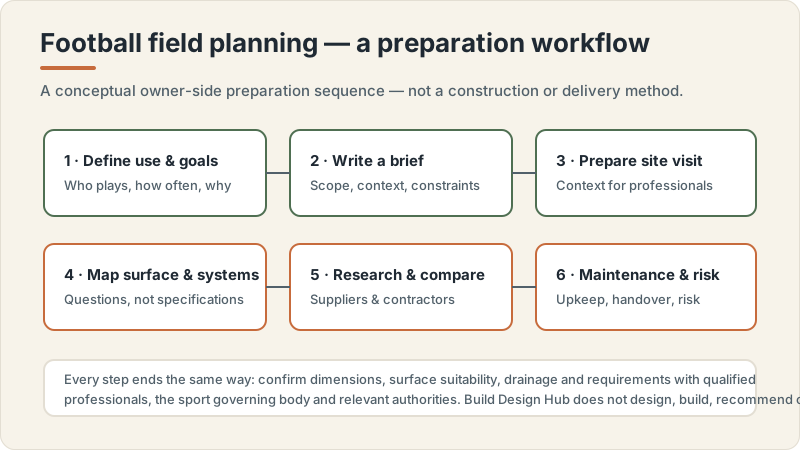
Football field planning workflow concept
Conceptual editorial diagram — not a construction drawing, specification, to-scale plan or proof of a real project. It is not engineering, structural, fire/life-safety, crowd-safety or accessibility-compliance guidance. Capacities, dimensions, standards, requirements and costs vary by facility type, audience, site, use case and governing body, and are confirmed with qualified professionals, relevant authorities and governing bodies. Build Design Hub does not design, build, inspect, certify, recommend or match anyone.
What this guide helps you prepare
This guide helps you write the part of a football field project that only you, the owner or sponsor, can write: the brief. That means capturing your goals, the intended use and users, the site context as you understand it, the boundaries of what the project does and does not cover, the constraints you already know about, and who owns each decision. It is meant to be completed before you request quotes or engage qualified professionals, so that your early conversations all start from the same clear, written reference rather than from scattered assumptions.
A good brief frames questions clearly and records what is known versus what is still open; it does not try to answer technical or commercial questions itself. By separating what you have decided from what you are still asking, you give architects, engineers, surface and lighting specialists, contractors and governing-body contacts something concrete to respond to. Requirements, dimensions, specifications, costs and timelines are deliberately left as questions here, because they vary by location, use case, governing body, site, surface system, maintenance plan, climate, authority and professional team, and must be confirmed with qualified professionals.
- A single written reference that everyone you engage can respond to
- A clear statement of goals, intended use and the people who will use the field
- The site context and constraints you already know, recorded honestly
- Explicit scope boundaries: what the project includes and excludes
- A named decision owner for each major question
- A running list of open questions to take to qualified professionals
Fields to capture in the brief yourself
Before any professional gets involved, there is a set of fields only you can fill in, because they describe your intentions and your situation rather than any technical solution. Start with the purpose: why this project exists, what success would look like to you, and what would make it a disappointment. Then describe the intended use and users in plain terms: training, matches, community hire, school sport, youth or senior play, and how heavily and how often you expect the field to be used across a typical week and season. The clearer you are about use, the easier it is for professionals to ask the right follow-up questions, though the implications of any use pattern are theirs to assess, not yours to assume.
Next, capture the site context as you understand it and the boundaries of the project. Record what you know about the location, existing features, neighbouring uses and any history that might matter, while flagging anything you are unsure of as a question rather than a fact. Set out what is in scope and what is explicitly out of scope, so later conversations do not quietly expand the project. Avoid writing in numbers, sizes, surface types or specifications as if they were settled; describe what you want to achieve and leave the how, and any figures, as questions for qualified professionals to confirm against the relevant requirements.
- Purpose: why the project exists and what success and failure look like to you
- Intended use: training, matches, hire, school or community use, age groups
- Expected usage intensity and pattern across a typical week and season
- Site context you know: location, existing features, neighbours, relevant history
- Scope boundaries: what is included, what is explicitly excluded for now
- Known constraints you are already aware of, each flagged as confirmed or assumed
Constraints, assumptions and decision owners
Every brief carries constraints and assumptions, and writing them down is what stops them causing trouble later. Constraints might include the land or space you have available, access, neighbours, the calendar of existing activity you cannot disrupt, or commitments you have already made. Assumptions are the things you are taking for granted that have not been confirmed, such as what the site can support or what a governing body might expect. The discipline here is simply to separate the two: mark what you know from a reliable source, and mark what is still belief. Professionals can then test the assumptions instead of inheriting them unspoken.
Just as important is recording who decides what. Football field projects often involve several parties, a club committee, a school, a parks department, a board, funders, neighbours, and confusion over who has authority to decide something is a frequent cause of delay. For each significant question, note who owns the decision, who must be consulted, and who simply needs to be informed. This is not about resolving the decisions now; it is about making the brief clear on where each one sits, so that when professionals raise a question, it reaches the right person without a detour.
- Known constraints: available space, access, neighbours, existing activity calendar
- Commitments already made that the project must work around
- Assumptions you are making that have not yet been confirmed by anyone qualified
- Decision owners: who decides, who is consulted, who is informed for each question
- Stakeholders who must sign off or be kept aware as the project develops
- A clear note of which items are settled and which are still open questions
Planning questions before speaking with professionals
Before you reach out to architects, engineers, surface or lighting specialists, contractors or governing-body contacts, it helps to pressure-test your own brief with a set of planning questions. These are not technical questions; they are questions about clarity and completeness. Have you described the purpose and users in a way someone outside your group would understand? Have you separated what you know from what you assume? Is the scope boundary explicit enough that a professional could tell you whether something falls inside or outside it? Working through questions like these before any meeting usually surfaces gaps while they are still cheap to fix.
Use this stage to decide what you most need help with and what you are deliberately leaving open. It is perfectly reasonable for a brief to say that surface type, dimensions, drainage, lighting and similar matters are open questions for qualified professionals, and in fact that is the correct posture, since those depend on requirements that vary by location, use, governing body, site and climate. The aim is to arrive at professional conversations with a brief that is honest about its own boundaries, not one that pretends to have answers it cannot have.
- Would someone outside your group understand the purpose and intended users from the brief alone?
- Have you clearly separated confirmed facts from assumptions you have not checked?
- Is the scope boundary explicit enough to test whether a new idea is in or out?
- Have you listed the questions you most want qualified professionals to address?
- Are the known constraints and existing-activity calendar captured in writing?
- Is it clear who owns each decision and who must be consulted before it is made?
Questions for qualified professionals
Once the brief is written, it becomes the starting point for conversations with qualified professionals, not a substitute for them. Architects, civil and drainage engineers, surface and lighting specialists, contractors, accessibility advisers and your relevant authorities and sport governing bodies can take the brief and tell you what is feasible, what is required, what is missing and what needs to change. The questions below are prompts to take into those conversations, anchored to the brief and the open questions you have already recorded, rather than things to resolve yourself.
Be candid about what is still unconfirmed. The most useful thing you can bring a professional is an organised brief that is honest about its assumptions and gaps, so they can focus their expertise where it counts. Matters such as dimensions, surface systems, drainage, lighting, fencing, capacity, compliance, permitting and cost are theirs to assess against requirements that vary by location, use case, governing body, site, climate and authority, and should rest on qualified professional review rather than on this brief.
- Does the brief give you enough to assess feasibility, and what is missing?
- Which of our assumptions need to be confirmed, and who confirms each one?
- What official requirements, approvals or governing-body rules apply to this use and site?
- Which questions about surface, drainage, lighting, dimensions and capacity should we treat as open for you to assess?
- Where are the risks or gaps in scope that we have not accounted for?
- How should the brief evolve into a properly scoped project once you have reviewed it?
What this does not replace
This is an educational project-preparation resource only. It is not a construction manual and not engineering, architectural, turf-installation, drainage-engineering, sports-surface-specification, structural, fire or life-safety, crowd-safety, accessibility-compliance, permit, zoning, legal, tax or procurement advice. It does not design, specify, install, certify, inspect or approve anything, and it is not an estimate, quote, price, capacity recommendation or performance or lifespan guarantee. Requirements, standards, dimensions, surface systems and costs vary by location, use case, governing body, owner, site, climate, maintenance plan, authority and professional team, and are confirmed with qualified professionals, relevant authorities and the sport governing body.
Build Design Hub does not design, build, install, engineer, inspect, certify, recommend, rank, verify, introduce, broker or match suppliers or contractors, and HELPERG LLC is publisher/operator only. Use this resource to prepare your own thinking, then have qualified professionals you engage directly review your project. Decisions about engineering, surface specification, drainage, safety, compliance, procurement and suitability must rest on those professionals, the relevant authorities and the governing body for your sport and location.
- Not a construction manual and not engineering, turf-installation or drainage-engineering instructions
- Not sports-surface specification, structural, fire/life-safety, crowd-safety or accessibility-compliance advice
- Not permit, zoning, legal, tax or procurement advice
- Not a supplier or contractor recommendation, ranking, directory or matching service
- Not an estimate, price, capacity recommendation or performance/lifespan guarantee — requirements and costs vary
- Qualified professional review is required before any project decision
Football field project brief worksheet: fields to capture before engaging professionals
- 1Record the project purpose: why it exists, and what success and disappointment would look like to you
- 2Describe the intended use: training, matches, hire, school or community play, and the age groups involved
- 3Note expected usage intensity and pattern across a typical week and season
- 4Capture the site context you know: location, existing features, neighbours and relevant history
- 5Write down each known constraint and mark it as confirmed or assumed
- 6List commitments and existing activity the project must work around
- 7State the scope boundary clearly: what is included and what is explicitly excluded for now
- 8List the open questions you most want qualified professionals to address
- 9Note every assumption you are making that has not been independently confirmed
- 10Identify the decision owner, consultees and those to be informed for each major question
- 11List the stakeholders who must sign off or be kept aware as the project develops
- 12Gather any documents you already hold about the site, ownership or prior plans, noting gaps
- 13Mark items where you are leaving surface, dimensions, drainage, lighting and similar as questions for professionals
- 14Keep one running list separating what is settled from what remains an open question
Common mistakes to avoid
- Writing the brief around a solution you have already pictured, instead of the purpose and users, which narrows professional input before it begins
- Recording assumptions as if they were confirmed facts, so no one knows what still needs checking
- Stating dimensions, surface types, capacities or budgets in the brief as fixed, when these vary by location, use and governing body and must be confirmed with professionals
- Leaving the scope boundary vague, which lets the project quietly expand as conversations go on
- Failing to name who owns each decision, causing delay when a professional needs an answer
- Describing intended use loosely, so professionals cannot ask the right follow-up questions
- Treating the brief as the finished project scope rather than a starting point for professional review
- Skipping a record of constraints and existing activity, then discovering them late as problems
When to involve a professional
- When you need to know whether your intended use, users and site are feasible together, involve an architect or relevant engineer to assess the brief
- When questions about dimensions, surface systems, drainage, lighting or fencing arise, leave them for qualified specialists rather than answering them in the brief
- When official requirements, approvals or sport governing-body rules may apply, confirm them with the relevant authorities and bodies before assuming anything
- When constraints such as access, neighbours or existing activity look as if they could shape the project, get professional input early
- When several stakeholders must agree, involve advisers who can help structure decisions and clarify what each party is committing to
- When the brief is ready to become a scoped project, have qualified professionals review it before any design, procurement or construction decisions are made
Frequently asked questions
Questions readers ask about this topic
What exactly should an owner put in a football field project brief?
In broad terms, the things only you can describe: the purpose, the intended use and users, the site context as you understand it, the scope boundaries, the constraints you already know about, your assumptions, and who owns each decision. Keep technical matters such as dimensions, surface, drainage and lighting as open questions for qualified professionals, since those vary by location, use case, governing body, site and climate and must be confirmed with them.
Does this guide tell me the required pitch size, surface or other specifications?
No. It states no dimensions, capacities, surface specifications, drainage gradients, lighting levels, fencing details, costs, timelines or standards as facts. Those vary by location, use case, governing body, owner, site, surface system, maintenance plan, climate, authority and professional team. The brief should record them as questions to confirm with qualified professionals and the relevant authorities and sport governing bodies, not as settled answers.
Does Build Design Hub recommend, rank or match suppliers and contractors for my field?
No. Build Design Hub is an educational resource and does not design, build, install, engineer, inspect, certify, recommend, rank, introduce, broker or match suppliers or contractors, and it gives no costs, requirements or turf specifications. HELPERG LLC is the operator and publisher only. This guide helps you prepare a brief and good questions; selecting and engaging professionals and suppliers is your decision to make with qualified advice.
Can I treat the finished brief as my project scope?
Treat it as a clear starting point, not a final scope. A brief captures your intentions and open questions so qualified professionals can respond to a common reference. The scope itself should emerge from their review of feasibility, requirements and risk, which depend on factors that vary by site, use and authority and need professional assessment rather than a self-fill document.
Keep reading