
Who this guide is for
- Municipal staff and parks or recreation departments scoping a new or upgraded public football field and preparing for community and council discussions
- Local football clubs and community sports organisations preparing a brief for a shared or council-owned pitch
- Youth academies and grassroots programmes that need a public or multi-use field and want to prepare structured questions before meetings
- Schools and education bodies exploring a field that doubles as a community asset outside school hours
- Developers and contribution-funded projects preparing public-realm or amenity sports space as part of a wider scheme
- Facility managers and trustees responsible for an existing public field who are planning engagement, multi-use or access changes
Planning diagram
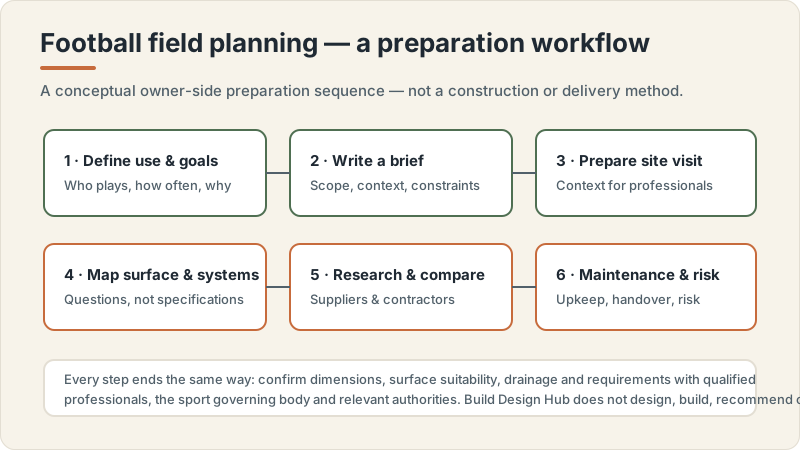
Football field planning workflow concept
Conceptual editorial diagram — not a construction drawing, specification, to-scale plan or proof of a real project. It is not engineering, structural, fire/life-safety, crowd-safety or accessibility-compliance guidance. Capacities, dimensions, standards, requirements and costs vary by facility type, audience, site, use case and governing body, and are confirmed with qualified professionals, relevant authorities and governing bodies. Build Design Hub does not design, build, inspect, certify, recommend or match anyone.
What this guide helps you prepare
This guide helps you assemble the inputs a public football field project needs before any design, procurement or approval conversation begins. That means building a clear written brief of what the community is trying to achieve, identifying every stakeholder and authority who has a say, and turning your assumptions into a list of questions rather than conclusions. It is preparation work: organising who to talk to, what to ask, what to record, and how to compare the responses you receive from qualified professionals and the responsible authorities.
It deliberately stops short of anything technical. You will not find pitch dimensions, surface types, infill, drainage gradients, lighting levels, fencing heights, capacities, costs or timelines presented as facts, because those depend entirely on your site, intended use, governing body, climate, authority and professional team. Instead, this guide frames each of those topics as something to confirm with the people qualified to determine it, and helps you arrive at those conversations with a structured brief and a documented set of open questions.
- Write down the project's purpose in plain language: who the field is for, what uses are intended, and what success would look like for the community
- List the public stakeholders and authorities you believe are involved, and note which ones you have not yet confirmed
- Capture your assumptions about use, season, governing body and access separately from confirmed facts, so professionals can correct them
- Record the questions you intend to raise rather than answers you have guessed
- Note where decisions are still open versus where the community or authority has already taken a position
- Keep a running register of unknowns and who is best placed to resolve each one
Mapping public stakeholders and community engagement
A municipal field touches more groups than a private pitch, and missing one early can stall a project later. Useful preparation starts with mapping who is affected, who decides and who pays, because these are often different people. That can include the responsible council or municipal department, elected representatives, neighbouring residents, existing user groups, schools, clubs, accessibility and inclusion advocates, and any body that governs how a public asset is funded or used. Your job at this stage is not to satisfy each group but to identify them, understand what each cares about, and record how and when you plan to hear from them.
Engagement is most useful when it is planned rather than reactive. Think about what you want to learn from the community, how you will gather it fairly, and how you will feed it back so people see their input reflected. Document concerns, requests and points of disagreement as they surface, and be honest in your notes about trade-offs you cannot yet resolve. None of this determines design or approval outcomes, which rest with qualified professionals and the relevant authorities, but it gives those professionals a far clearer picture of the public context they are working within.
- Who is the responsible authority or department, and who holds the decision and the budget for this field?
- Which existing user groups, clubs, schools or programmes already use the space or expect to?
- Who are the immediate neighbours, and what concerns might they raise about noise, lighting, traffic or hours of use?
- How will you gather community input fairly, and how will you report back what you heard?
- Which inclusion, accessibility and youth interests should be invited into the conversation early rather than late?
- Where do stakeholder interests conflict, and who is qualified to weigh those trade-offs?
Multi-use, access and shared scheduling questions
Public fields are frequently asked to serve more than one purpose: football alongside other sports, organised play alongside casual community use, school hours alongside evening club bookings. Preparing these questions early helps because multi-use ambitions interact with almost every later decision a professional team will examine, from how the surface is intended to perform to how access, parking, lighting hours and booking are managed. At the planning stage you are not deciding what is feasible; you are documenting which uses the community wants, how they might compete, and what you will need to ask qualified professionals and the relevant governing bodies to confirm.
Access is its own preparation topic. Public space raises questions about how people arrive, how the field is opened and supervised, how it accommodates people of differing abilities, and how it stays available and equitable across different groups and seasons. Capture how you imagine access working and where you are unsure, and flag governing-body and authority touchpoints rather than assuming an answer. Keeping multi-use and access as open, well-framed questions, rather than fixed requirements you have invented, is what lets professionals and authorities give you reliable guidance later.
- Which sports and which types of use (organised, casual, school, club) is the field expected to support, and who decides priority when they clash?
- What access, arrival and parking questions should be raised with planners and the responsible authority?
- How might intended hours of use, including evenings, affect what you need to ask about neighbours, lighting and supervision?
- What inclusion and accessibility questions should you put to qualified professionals so the field works for the whole community?
- How would bookings, equitable allocation and seasonal availability be managed, and who owns that responsibility?
- Which multi-use ambitions need confirmation from a relevant sport governing body before they shape the brief?
Planning questions before speaking with professionals
Before you sit down with planners, authorities or a professional team, it helps to have your own house in order so those conversations are productive rather than exploratory. The questions in this section are ones to ask yourself and your own stakeholders first. They clarify what you actually want, what you already know, what you are assuming, and what you are hoping someone else will resolve. Arriving with this written down lets a professional spend their time confirming, correcting and advising rather than reconstructing your intentions.
Treat your answers as a living brief, not a specification. You are recording goals, constraints, community input and open questions, not committing to dimensions, surfaces, systems or numbers. Where you are tempted to write down a requirement, rewrite it as a question to confirm. This keeps the brief honest and makes it obvious to professionals and authorities where they need to apply their judgement to your specific site, use case, climate and governing-body context.
- What is the field for, who uses it, and which outcomes matter most to the community and the responsible authority?
- Which stakeholders and authorities have we confirmed are involved, and which are still assumed?
- What community input have we gathered, and what concerns or conflicts remain unresolved?
- What do we genuinely know versus what are we assuming about use, season, access and governing-body expectations?
- What is our intended multi-use and access picture, and where are we unsure it is realistic?
- What questions, unknowns and decisions are we bringing to professionals, and who is responsible for each on our side?
Questions for qualified professionals
Once your brief and stakeholder map are prepared, the next step is identifying what only qualified professionals and the relevant authorities can determine, and framing those as clear questions. This is where anything about feasibility, surfaces, drainage, lighting, access compliance, governing-body conformance, approvals, scope, sequencing and ongoing maintenance belongs. Nothing in this guide answers those questions, and you should be wary of any source that gives a confident, site-independent answer, because the correct answer depends on your specific location, use case, site, surface system, maintenance plan, climate, authority and professional team.
Use these prompts to structure conversations and to compare what different professionals tell you, noting where their guidance agrees and where it differs so you can ask why. Keep your role as the person who documents and confirms, not the person who specifies. When a professional gives you a parameter, record it as their determination for your project rather than a general fact, and confirm anything that affects public safety, access, approvals or governing-body conformance directly with the responsible authority or body.
- What does feasibility on this specific site involve, and which studies or specialists would you bring in?
- Which authorities, approvals and sport governing bodies apply to a public field of this kind, and how do we confirm their expectations?
- How should our multi-use and access ambitions be assessed, and what would change them?
- What questions should we be asking about the surface system, drainage and lighting that you would determine for our site rather than us assuming?
- How would you structure scope, sequencing and the professional team, and what should we compare between proposals?
- What ongoing maintenance, operations and review responsibilities should we plan for, and who should hold them?
What this does not replace
This is an educational project-preparation resource only. It is not a construction manual and not engineering, architectural, turf-installation, drainage-engineering, sports-surface-specification, structural, fire or life-safety, crowd-safety, accessibility-compliance, permit, zoning, legal, tax or procurement advice. It does not design, specify, install, certify, inspect or approve anything, and it is not an estimate, quote, price, capacity recommendation or performance or lifespan guarantee. Requirements, standards, dimensions, surface systems and costs vary by location, use case, governing body, owner, site, climate, maintenance plan, authority and professional team, and are confirmed with qualified professionals, relevant authorities and the sport governing body.
Build Design Hub does not design, build, install, engineer, inspect, certify, recommend, rank, verify, introduce, broker or match suppliers or contractors, and HELPERG LLC is publisher/operator only. Use this resource to prepare your own thinking, then have qualified professionals you engage directly review your project. Decisions about engineering, surface specification, drainage, safety, compliance, procurement and suitability must rest on those professionals, the relevant authorities and the governing body for your sport and location.
- Not a construction manual and not engineering, turf-installation or drainage-engineering instructions
- Not sports-surface specification, structural, fire/life-safety, crowd-safety or accessibility-compliance advice
- Not permit, zoning, legal, tax or procurement advice
- Not a supplier or contractor recommendation, ranking, directory or matching service
- Not an estimate, price, capacity recommendation or performance/lifespan guarantee — requirements and costs vary
- Qualified professional review is required before any project decision
Municipal football field preparation worksheet
- 1Record the field's purpose, intended users and the community outcomes you are aiming for in plain language
- 2List the responsible authority or department and note who holds the decision and the budget
- 3Map every public stakeholder you can identify, marking confirmed versus assumed involvement
- 4Gather existing user-group, club, school and neighbour interests and write down their main concerns
- 5Document your planned community engagement approach and how you will report findings back
- 6Separate confirmed facts from assumptions about use, season, governing body, access and climate
- 7Capture your intended multi-use picture and note where uses might compete for the same space
- 8Write down your access, arrival, parking and supervision assumptions and flag the uncertain ones
- 9Note inclusion and accessibility interests you want professionals to address from the start
- 10List the sport governing bodies and authorities you believe apply, marking which are unconfirmed
- 11Compile the questions you will raise with planners, authorities and qualified professionals
- 12Keep a register of open unknowns with the person or body best placed to resolve each
- 13Assign internal owners for each decision and engagement task on your side
- 14Set up a simple structure to compare what different professionals tell you, including where they disagree
Common mistakes to avoid
- Treating assumptions about pitch size, surface, drainage, lighting or access as settled facts instead of questions to confirm with qualified professionals
- Identifying stakeholders too late, so a neighbour group, governing body or authority surfaces objections after key decisions appear fixed
- Running community engagement as a one-way announcement rather than gathering input and reporting back what was heard
- Promising multi-use or specific access arrangements before any professional has assessed whether they are realistic for the site
- Confusing who is affected, who decides and who pays, and assuming they are the same group
- Bringing answers rather than questions to professionals, which wastes the conversation reconstructing your intentions
- Recording a professional's site-specific determination as if it were a general rule that applies everywhere
- Skipping a written register of unknowns, so open questions get lost between meetings and stakeholders
When to involve a professional
- When you need to know whether a particular use, surface system, access arrangement or multi-use ambition is feasible on your specific site
- When approvals, permits, public-safety, accessibility or governing-body conformance questions arise, which only the relevant authorities and qualified professionals can resolve
- When stakeholder or community input surfaces conflicts or trade-offs that need expert judgement to weigh
- When you are ready to scope work, sequence a project or compare proposals and want a professional to structure it
- When anything touches drainage, lighting, surfaces, structures or supervision that affects safety or compliance
- When you need to confirm ongoing maintenance, operations and review responsibilities for a public asset
Frequently asked questions
Questions readers ask about this topic
Does this guide tell me what my municipal football field should be like?
No. It is an educational planning resource that helps you prepare a brief, map stakeholders, organise community engagement and structure questions. It does not specify dimensions, surfaces, drainage, lighting, access arrangements or anything else, because those depend on your site, use case, governing body, climate, authority and professional team. Confirm all of it with qualified professionals and the relevant authorities.
Can Build Design Hub recommend or connect me with suppliers, contractors or designers for the field?
No. Build Design Hub does not design, build, install, engineer, inspect, certify, recommend, rank, verify, introduce, broker or match suppliers or contractors, and it does not provide costs, requirements, turf specifications or timelines. This guide only helps you prepare your own questions and research so you can engage qualified professionals and authorities directly and compare what they tell you.
How do I know which authorities and governing bodies apply to a public field?
This guide cannot tell you, because it varies by location and use case. The preparation step is to list the authorities and sport governing bodies you believe are involved, mark which are still unconfirmed, and raise those as questions with planners, the responsible authority and qualified professionals who can confirm what applies to your specific project.
What should I do with the answers professionals give me about surfaces, drainage or lighting?
Record them as that professional's determination for your specific project, not as general facts, and note where different professionals agree or differ so you can ask why. Anything affecting public safety, access, approvals or governing-body conformance should be confirmed directly with the responsible authority or body.
Is community engagement something I have to do, or just a good idea?
This guide does not state requirements, so it cannot tell you what is mandatory for your jurisdiction. What it offers is preparation: how to identify who is affected, plan how you will gather input fairly, and report back. Whether and how engagement is required is a question to confirm with the responsible authority and qualified professionals.
Keep reading