
Who this guide is for
- Private owners considering a football field on land they hold or intend to acquire
- Clubs and academies planning a dedicated training ground or match pitch
- Schools and colleges scoping a field for student and community use
- Municipalities and parks teams preparing a public-access or shared pitch project
- Property developers weighing a field as part of a wider scheme
- Facility managers preparing briefs, operations and maintenance planning for sports grounds
Planning diagram
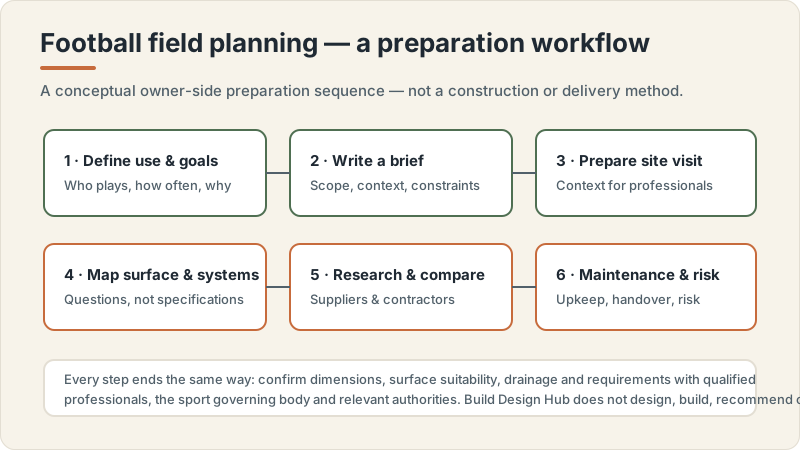
Football field planning workflow concept
Conceptual editorial diagram — not a construction drawing, specification, to-scale plan or proof of a real project. It is not engineering, structural, fire/life-safety, crowd-safety or accessibility-compliance guidance. Capacities, dimensions, standards, requirements and costs vary by facility type, audience, site, use case and governing body, and are confirmed with qualified professionals, relevant authorities and governing bodies. Build Design Hub does not design, build, inspect, certify, recommend or match anyone.
What this guide helps you prepare
This guide helps you turn a vague idea ("we want a football field") into a structured project brief you can take to qualified professionals. It walks you through clarifying who the field is for, how it will be used, who else is affected and what questions you need answered before any decisions are made. It is about preparation, documentation and asking better questions, not about design, engineering, turf systems, drainage or construction, which belong with qualified professionals, the relevant authorities and the applicable governing body.
The aim is to reduce surprises later by writing things down early: your intended use, your stakeholders, your constraints, your open questions and your assumptions. None of the items here should be treated as a requirement, specification or standard. Anything that looks like one is a prompt to confirm with the right professional, because requirements vary by location, use case, governing body, owner, site, surface system, maintenance plan, climate, authority and professional team.
- Record your core intent in plain language: who plays, how often, and at what level of organised activity
- List every stakeholder you can think of, from players and coaches to neighbours and local authorities
- Capture your open questions in one place so professionals can address them efficiently
- Note your assumptions explicitly, and flag each as "to confirm with a qualified professional"
- Separate "things we want" from "things we have confirmed" so the brief stays honest
- Identify which decisions are yours to make and which must be referred to authorities or a governing body
Private use intent and scope clarification
A "private" football field can mean very different things, and the difference shapes almost every later conversation. A family or single-owner training space, a club's members-only training ground, an academy's coaching facility, a school field with occasional community use and a developer's amenity pitch each carry different expectations around access, frequency of use, hours of activity and who may attend. Writing down exactly what you intend, in your own words, is the single most useful preparation step. Be specific about whether the field is purely for private practice, for organised club or academy sessions, for matches with visiting teams, or for any form of public or paid access, because these distinctions feed directly into questions for authorities, insurers and the relevant governing body.
Scope is where projects most often drift. A field rarely exists in isolation: people may ask about access routes, parking, changing or storage space, lighting for evening use, fencing, water for the surface, seating or spectator areas, and ongoing maintenance. You do not need answers to all of these now, and you should not attempt to specify any of them. What helps is listing which elements are in scope, which are explicitly out of scope, and which are undecided, so the professionals you speak with understand the boundaries of what you are asking about. Treat surface type, dimensions, lighting, fencing and drainage as topics to raise as questions, never as things to decide or describe yourself.
- State the primary use in one sentence, then list every secondary use you can foresee
- Distinguish clearly between private-only use and any organised, visiting-team, public or paid use
- Note the level of play you have in mind and flag it for confirmation with the relevant governing body
- List in-scope elements (access, lighting, fencing, storage, etc.) versus out-of-scope and undecided
- Record expected frequency, seasons and times of day as plain descriptions, not commitments
- Capture whether the field is standalone or part of a larger property or development scheme
Neighbour, community and professional-team considerations
A private field still sits in a wider context. Neighbouring residents, adjacent landowners, nearby businesses, local community groups and the relevant authority all have legitimate interests, and thinking about them early tends to make later conversations smoother. Common topics neighbours raise include noise from play and gatherings, evening lighting, traffic and parking, hours of use, fencing and overlooking, and how busy the site becomes on event days. You are not expected to resolve any of these alone, or to know what is permissible. The useful preparation is to list who your neighbours and community stakeholders are, anticipate the questions they may ask, and note which of those questions you will need to take to the relevant authority or a qualified professional.
Alongside neighbours, it helps to map the professional team you may eventually need to consult, without assuming who or what is required. Different projects involve different mixes of advisers, and the right combination depends on the site, the use case and the relevant authority. Build Design Hub does not recommend, rank, verify, introduce, broker or match any professional, supplier or contractor; this is purely about helping you identify the kinds of expertise a project like yours might involve so you can seek out and vet appropriately qualified people yourself. Record what each conversation is meant to clarify, so you arrive with questions rather than expecting the guide to provide answers that only a qualified professional can give for your specific situation.
- List adjacent residents, landowners, businesses and community groups who may have an interest
- Anticipate likely neighbour concerns (noise, lighting, traffic, hours, overlooking) and note who can address each
- Identify which community or authority engagement steps you should ask a qualified professional about
- Map the types of professional expertise your project might involve, without assuming what is required
- Keep a record of what each professional conversation is intended to clarify
- Note any shared-use, access or boundary arrangements that will need confirming with the relevant parties
Planning questions before speaking with professionals
Before you book time with any professional, it is worth working through a set of questions yourself so that the conversation is focused and the brief is clear. These are not questions with fixed answers; they are prompts to help you understand your own intent, constraints and unknowns. The clearer you are about what you want and what you do not yet know, the more useful a professional's time becomes. Write your answers down, mark anything uncertain, and bring the gaps with you rather than guessing at requirements, specifications or standards.
Many owners and clubs find that simply articulating the questions below changes how they think about the project, surfacing decisions they had not realised they needed to make and assumptions that turned out to be unfounded. Resist the urge to settle technical points such as surface type, drainage, lighting, dimensions or capacity at this stage. Those belong with qualified professionals, the relevant authorities and the applicable governing body, and confirming them prematurely tends to create rework later.
- Who exactly is this field for, and what would "success" look like for them?
- What use cases must it support, and which would be nice to have but are not essential?
- Who are the stakeholders and neighbours, and what concerns might each raise?
- What do I already know about the site and intended use, and what is still unknown?
- Which decisions feel like mine to make, and which clearly need authority or governing-body input?
- What is my honest list of assumptions, and which carry the most risk if they turn out wrong?
Questions for qualified professionals
When you do speak with qualified professionals, the most productive approach is to ask open questions about what applies to your specific site, use case and intentions, rather than seeking quick confirmation of something you have already assumed. Requirements, options and constraints vary by location, use case, governing body, owner, site, surface system, maintenance plan, climate, authority and professional team, so the right answers can only come from professionals who can assess your particular circumstances and from the relevant authorities and governing bodies. The questions below are starting points to adapt, not a checklist of things to verify.
Treat these conversations as a way to replace assumptions with informed guidance. Ask each professional what falls inside and outside their remit, what they would need from you to advise properly, who else you may need to involve and what the relevant authorities or governing body would expect for a project of your type. Build Design Hub does not provide these answers, recommend who should give them or verify anyone's qualifications; that vetting is yours to do.
- For my intended use and site, what considerations should I be aware of, and who determines them?
- Which authorities, approvals or governing-body requirements are relevant, and how do I confirm them?
- What information would you need from me to advise on scope, suitability and feasibility?
- What aspects of this project fall outside your remit, and what other expertise should I seek?
- What questions should I be asking that I have not thought to ask yet?
- How should neighbour, community, access and ongoing-maintenance considerations be factored into planning?
What this does not replace
This is an educational project-preparation resource only. It is not a construction manual and not engineering, architectural, turf-installation, drainage-engineering, sports-surface-specification, structural, fire or life-safety, crowd-safety, accessibility-compliance, permit, zoning, legal, tax or procurement advice. It does not design, specify, install, certify, inspect or approve anything, and it is not an estimate, quote, price, capacity recommendation or performance or lifespan guarantee. Requirements, standards, dimensions, surface systems and costs vary by location, use case, governing body, owner, site, climate, maintenance plan, authority and professional team, and are confirmed with qualified professionals, relevant authorities and the sport governing body.
Build Design Hub does not design, build, install, engineer, inspect, certify, recommend, rank, verify, introduce, broker or match suppliers or contractors, and HELPERG LLC is publisher/operator only. Use this resource to prepare your own thinking, then have qualified professionals you engage directly review your project. Decisions about engineering, surface specification, drainage, safety, compliance, procurement and suitability must rest on those professionals, the relevant authorities and the governing body for your sport and location.
- Not a construction manual and not engineering, turf-installation or drainage-engineering instructions
- Not sports-surface specification, structural, fire/life-safety, crowd-safety or accessibility-compliance advice
- Not permit, zoning, legal, tax or procurement advice
- Not a supplier or contractor recommendation, ranking, directory or matching service
- Not an estimate, price, capacity recommendation or performance/lifespan guarantee — requirements and costs vary
- Qualified professional review is required before any project decision
Private football field preparation worksheet
- 1Write a one-sentence statement of who the field is primarily for and why
- 2Record the intended level of play and note it for confirmation with the relevant governing body
- 3List every intended and possible use, marking each as essential, desirable or undecided
- 4Document whether use is private-only or includes organised, visiting-team, public or paid access
- 5Note expected frequency, seasons and times of day as plain descriptions, not commitments
- 6Compile a stakeholder list covering players, coaches, neighbours, community groups and authorities
- 7Write down anticipated neighbour concerns and which party or professional could address each
- 8Separate in-scope, out-of-scope and undecided elements (access, lighting, fencing, storage and similar)
- 9Record every assumption you are making and flag each as "to confirm with a qualified professional"
- 10List the open questions you want professionals and authorities to help answer
- 11Map the types of professional expertise your project might involve, without assuming what is required
- 12Note what each planned professional conversation is intended to clarify
- 13Gather any documents you already hold about the site, ownership and intended use in one place
- 14Identify which decisions are yours and which must be referred to authorities or a governing body
Common mistakes to avoid
- Treating "private" as a single fixed idea instead of defining exactly who uses the field and how
- Deciding on surface type, dimensions, lighting or drainage before consulting qualified professionals
- Assuming requirements or standards apply without confirming them with authorities and the governing body
- Leaving neighbours and community stakeholders out of early thinking until concerns arise later
- Letting scope drift by not separating in-scope, out-of-scope and undecided elements in writing
- Arriving at professional conversations without a clear brief or a documented list of open questions
- Confusing what the owner wants with what has actually been confirmed, and recording both as facts
- Overlooking ongoing operations and maintenance planning while focusing only on the initial idea
When to involve a professional
- When your intended use, level of play or access model needs confirming against governing-body or authority expectations
- When any neighbour, community, noise, lighting, traffic or hours-of-use concern arises
- When questions touch surface systems, drainage, lighting, fencing, dimensions or capacity in any way
- When approvals, permissions or other authority requirements may apply to your site or use case
- When you need to understand what falls inside and outside a given professional's remit
- When operations, maintenance, access or shared-use arrangements need to be planned in detail
Frequently asked questions
Questions readers ask about this topic
Does Build Design Hub recommend or connect me with suppliers or contractors for my field?
No. Build Design Hub is an educational publisher operated by HELPERG LLC and does not design, build, recommend, rank, verify, introduce, broker or match suppliers, contractors or professionals. It also does not provide costs, requirements or turf specifications. This guide only helps you prepare your own thinking and questions; sourcing and vetting qualified people is something you do yourself.
Will this guide tell me what size, surface or lighting my field needs?
No. Dimensions, surface systems, lighting, drainage and similar topics vary by location, use case, governing body, owner, site, surface system, maintenance plan, climate, authority and professional team. This guide deliberately frames all of these as questions to confirm with qualified professionals, the relevant authorities and the applicable governing body rather than stating any of them as facts.
What is the difference between a private field and one with public or club use?
The distinction affects who attends, how often the field is used, what hours and access apply and which stakeholders and authorities take an interest. This guide helps you describe your intended model clearly so you can raise the right questions; what is permissible or required for any given model is for the relevant authorities, governing body and qualified professionals to confirm.
How should I prepare for conversations with my neighbours and the local authority?
Start by listing who your neighbours and community stakeholders are and the concerns they may raise, such as noise, lighting, traffic or hours of use. Note which of those questions you will take to a qualified professional or the relevant authority. This guide helps you organise that preparation; it does not advise on what any authority will decide for your specific situation.
Keep reading