
Who this guide is for
- Club, academy or community-sport owners planning a new or upgraded football field who want to understand scope boundaries before engaging anyone
- School and education facility leaders preparing a brief for a pitch or training area on their grounds
- Municipal and parks decision-makers scoping a public football facility across multiple stakeholders and budgets
- Property developers including a football field or training ground within a larger site or masterplan
- Facility and operations managers inheriting or expanding a field who need to map who owns which interface
- Project sponsors and committee members assembling questions and a scope matrix before talking to qualified professionals
Planning diagram
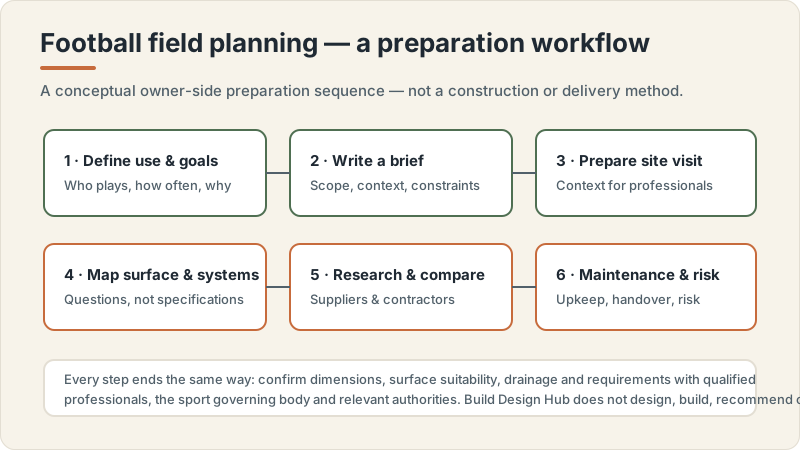
Football field planning workflow concept
Conceptual editorial diagram — not a construction drawing, specification, to-scale plan or proof of a real project. It is not engineering, structural, fire/life-safety, crowd-safety or accessibility-compliance guidance. Capacities, dimensions, standards, requirements and costs vary by facility type, audience, site, use case and governing body, and are confirmed with qualified professionals, relevant authorities and governing bodies. Build Design Hub does not design, build, inspect, certify, recommend or match anyone.
What this guide helps you prepare
This guide helps you prepare a structured view of scope for a football field or training ground: a working map of what your project is expected to include, what it deliberately excludes, and where the boundaries between work packages, suppliers and disciplines fall. The aim is to give you language and a structure you can take into early conversations, so that when you do speak with qualified professionals you can ask precise questions about ownership, interfaces and gaps rather than discovering them late. It is preparation for those conversations, not a substitute for the design, engineering, surfacing, drainage and authority advice that only suitably qualified people can give for your specific site and use case.
It also helps you separate scope from specification. Scope is the question of what is in and out and who owns each boundary; specification is the technical detail of how something is built, sized or certified, which this guide does not address. By keeping those two ideas apart, you can build a defensible inclusions-and-exclusions matrix and a list of open questions without straying into requirements, dimensions, surface systems, performance figures or standards. Treat every technical-sounding item as something to confirm with qualified professionals, the relevant authority and the applicable sport governing body, because requirements vary by location, use case, governing body, owner, site, surface system, maintenance plan, climate, authority and professional team.
- A simple in-scope / out-of-scope / undecided structure you can populate per package, rather than a single undifferentiated wish list
- A way to record assumptions explicitly so they can be tested with professionals instead of carried silently into the project
- Prompts that distinguish scope ownership from technical specification, keeping the conversation educational and within your role as owner
- A starting list of the packages a football-field project might touch, framed as areas to confirm, not a definitive breakdown
- A habit of naming interfaces — the seams between two scopes — as items that need an explicit owner
- Language for raising scope questions with qualified professionals without pre-judging the technical answers
Mapping inclusions, exclusions and the gaps between packages
A football field or training ground can involve several distinct areas of work that are easy to assume are part of 'the pitch' but may sit in separate packages: the playing surface itself, what lies beneath and around it, perimeter and access elements, supporting structures, services that cross the site, and the operational items needed once play begins. A useful preparation exercise is to list each area you think your project might touch and, for every one, record whether you currently believe it is in scope, out of scope, or undecided — and crucially, who you assume would own it. The value is not in getting the answer right alone, which professionals will help with, but in making your assumptions visible so the undecided and assumed items become explicit questions rather than silent gaps.
Scope gaps and overlaps live at the boundaries. A gap is an item that every package assumes another package covers, so nobody prepares for it; an overlap is an item two packages both assume they own, which can cause conflict or duplicated effort. Both are easier to spot when you lay packages side by side in a matrix and look specifically at the seams: where one scope ends and the next begins. You are not deciding the technical answer at these seams — that is for qualified professionals — but you are making sure each seam has a name and a question attached, so it is raised deliberately rather than discovered late. Keep all of this descriptive: avoid recording dimensions, surface types, drainage details, lighting levels, fencing heights or any specification as a fact, and instead note them as boundaries to confirm.
- List candidate packages and tag each as in-scope, out-of-scope or undecided, with the owner you currently assume
- For every boundary between two packages, write the seam as a question: 'Who is expected to prepare for the handover between A and B?'
- Flag items that sound like 'the pitch' but might sit elsewhere (surrounds, access, services, supporting structures) for confirmation
- Capture overlaps — items two packages both claim — separately from gaps, since they need different conversations
- Note any technical-sounding boundary as 'confirm with qualified professionals / authority / governing body', never as a fixed requirement
- Record what is explicitly excluded and why, so an exclusion is a decision on the record rather than an accidental omission
Building a scope-boundary matrix you can take to professionals
A scope-boundary matrix is simply a side-by-side layout of packages against the questions that matter at their edges: what each package is assumed to include, what it excludes, which other packages it touches, and who owns the interface between them. Preparing this as an owner gives you a single artefact to bring to qualified professionals, who can then correct your assumptions, identify packages you have missed, and advise on how interfaces should be handled for your specific site, use case and governing body. The matrix is a thinking and communication tool, not a contract, a specification or a design — it captures questions and assumptions, and it stays silent on technical answers, requirements and figures, which are not yours to set here.
To keep the matrix useful and compliant, focus each row on ownership and interface rather than on how something is built. For each package you might record: the boundary with adjacent packages, the assumption you are currently making, the open question you need answered, and a note on who you think should answer it. Resist the temptation to fill cells with dimensions, surface systems, drainage gradients, lux figures, fencing heights, capacities, lifespans, timelines or prices; those belong to qualified professionals, relevant authorities and the sport governing body, and treating them as confirmed at this stage undermines the whole exercise. A strong matrix leaves the technical cells as questions and concentrates your effort on naming every seam and assigning it an owner to confirm.
- Set up columns for: package, assumed inclusions, explicit exclusions, adjacent packages, interface owner (assumed), and open question
- Add a 'confidence' note per row so you can flag which assumptions are guesses to be tested with professionals
- Reserve a column for the authority or governing body whose confirmation a boundary may depend on, marked as 'to confirm'
- Keep technical cells empty or phrased as questions rather than populating them with specifications, figures or standards
- Include a row for items you are unsure belong anywhere yet — the 'parking lot' that prevents silent omissions
- Review the matrix specifically for gaps (no owner) and overlaps (two owners) before any professional conversation
Planning questions before speaking with professionals
Before you engage anyone, it helps to interrogate your own scope assumptions so the first professional conversation starts from a clear, honest baseline rather than a vague brief. Work through your draft matrix and challenge each package: do you actually know it belongs in this project, or are you assuming it? Is anything you have called 'out of scope' genuinely excluded, or simply forgotten? These are questions for you and your stakeholders to settle internally, distinct from the technical questions you will later put to qualified professionals. Keeping the two lists separate prevents you from accidentally asking a professional to validate a scope decision that is really an owner or stakeholder choice.
It also helps to align internally on how decisions get made and recorded, because scope shifts constantly as a project develops and undocumented changes are how gaps reappear. Agree who within your group can confirm an inclusion or exclusion, how changes will be captured, and which items you are deliberately leaving open for professional input. None of this requires you to predetermine any technical answer; it simply ensures that when a professional advises on an interface or a missing package, your side knows how to absorb that advice without losing track of the boundary it affects. Remember throughout that requirements vary by location, use case, governing body, owner, site, surface system, maintenance plan, climate, authority and professional team, and must be confirmed with qualified professionals.
- For each package, ask: is this an assumption or something we actually know belongs in our project?
- Which 'exclusions' are deliberate decisions, and which might be accidental omissions we should raise?
- Who among our stakeholders is allowed to confirm that an item is in or out of scope?
- How will we record a scope change so a new gap does not open quietly between packages?
- Which interfaces worry us most, and what specifically do we want a professional to advise on there?
- Have we separated owner/stakeholder scope decisions from the technical questions we will put to qualified professionals?
Questions for qualified professionals
Once your scope-boundary matrix is drafted, qualified professionals can help you test it against reality: confirming which packages a football-field or training-ground project of your type typically involves, identifying packages or interfaces you have missed, and advising on how the seams between scopes should be handled for your specific site, use case, authority and governing body. Bring your assumptions and open questions rather than asking for a generic answer; the more precisely you can point to a boundary you are unsure about, the more useful their guidance will be. Their role includes the technical and compliance dimensions — design, engineering, surfacing, drainage, services, safety and the applicable standards — that this guide deliberately does not address.
Frame your questions around ownership, interfaces, gaps and the process for confirming requirements, and let the professionals supply the technical and regulatory content. Because requirements vary by location, use case, governing body, owner, site, surface system, maintenance plan, climate, authority and professional team, expect their answers to be specific to your context and to evolve as the project develops. Build Design Hub does not provide that advice, does not recommend, rank, verify, introduce or match the professionals who do, and does not supply requirements, specifications, turf details or costs; those come only from suitably qualified people and the relevant authorities and governing bodies for your project.
- Which packages does a project like ours typically involve, and have we missed any in our matrix?
- Where do you see scope gaps or overlaps in how we have drawn the boundaries between packages?
- How should the interface between two adjacent packages be prepared for and owned on a project of this kind?
- Which boundaries depend on confirmation from a relevant authority or the applicable sport governing body?
- What assumptions in our matrix would you challenge, and what additional questions should we be asking?
- How might scope evolve as the project develops, and how should we capture those changes against our boundaries?
What this does not replace
This is an educational project-preparation resource only. It is not a construction manual and not engineering, architectural, turf-installation, drainage-engineering, sports-surface-specification, structural, fire or life-safety, crowd-safety, accessibility-compliance, permit, zoning, legal, tax or procurement advice. It does not design, specify, install, certify, inspect or approve anything, and it is not an estimate, quote, price, capacity recommendation or performance or lifespan guarantee. Requirements, standards, dimensions, surface systems and costs vary by location, use case, governing body, owner, site, climate, maintenance plan, authority and professional team, and are confirmed with qualified professionals, relevant authorities and the sport governing body.
Build Design Hub does not design, build, install, engineer, inspect, certify, recommend, rank, verify, introduce, broker or match suppliers or contractors, and HELPERG LLC is publisher/operator only. Use this resource to prepare your own thinking, then have qualified professionals you engage directly review your project. Decisions about engineering, surface specification, drainage, safety, compliance, procurement and suitability must rest on those professionals, the relevant authorities and the governing body for your sport and location.
- Not a construction manual and not engineering, turf-installation or drainage-engineering instructions
- Not sports-surface specification, structural, fire/life-safety, crowd-safety or accessibility-compliance advice
- Not permit, zoning, legal, tax or procurement advice
- Not a supplier or contractor recommendation, ranking, directory or matching service
- Not an estimate, price, capacity recommendation or performance/lifespan guarantee — requirements and costs vary
- Qualified professional review is required before any project decision
Football field scope-boundary worksheet
- 1List every package your project might touch (surface, surrounds, services, access, supporting structures, operations) and tag each in / out / undecided
- 2For each package, record the inclusions you are currently assuming, marked clearly as assumptions
- 3Record explicit exclusions per package, with a short note on why each is excluded
- 4Name the owner you currently assume for each package, even if that owner is 'unknown'
- 5List every interface — each seam where two packages meet — as its own line item
- 6For each interface, write the open question you need a professional to answer about how it is handled
- 7Flag gaps: interfaces or items where no package currently claims ownership
- 8Flag overlaps: items two packages both assume they own
- 9Note, per boundary, any authority or sport governing body whose confirmation it may depend on, marked 'to confirm'
- 10Keep a 'parking lot' list of items you are unsure belong anywhere, so nothing is silently dropped
- 11Record who in your group is authorised to confirm a scope inclusion or exclusion
- 12Capture how scope changes will be logged so new gaps do not reopen between packages
- 13Separate owner/stakeholder scope decisions from the technical questions reserved for qualified professionals
- 14Leave all technical cells (dimensions, surfaces, drainage, lighting, fencing, capacities, lifespans, timelines, costs) as questions to confirm, never as facts
Common mistakes to avoid
- Treating 'the pitch' as a single package and overlooking surrounds, access, services and supporting structures that may sit in separate scopes
- Leaving interfaces between packages unnamed, so gaps are discovered late instead of raised deliberately
- Recording assumptions as if they were confirmed facts, rather than flagging them as items to test with professionals
- Writing dimensions, surface systems, drainage details, lighting levels, fencing heights, capacities or costs into the matrix as fixed requirements
- Confusing scope decisions (what is in and out) with specification (how something is built), and asking the wrong party to resolve each
- Allowing scope to drift during the project without recording changes, which quietly reopens gaps between packages
- Assuming a relevant authority or sport governing body has no bearing on a boundary, instead of marking it 'to confirm'
- Failing to record exclusions explicitly, so an omitted item looks like an oversight rather than a decision
When to involve a professional
- When you are unsure which packages a football-field or training-ground project of your type should include, and need that confirmed for your site and use case
- When an interface between two packages has no clear owner and you need advice on how it should be prepared for and handled
- When a boundary appears to depend on a relevant authority or the applicable sport governing body and you need their requirements confirmed
- When your assumptions touch technical or compliance areas — design, engineering, surfacing, drainage, services or safety — that only qualified professionals can resolve
- When scope is changing as the project develops and you need help reassessing the boundaries and the gaps those changes may create
- When stakeholders disagree on what is in or out of scope and you need professional input to inform, though not replace, that decision
Frequently asked questions
Questions readers ask about this topic
Does this guide tell me what should be in scope for my football field?
No. It gives you a structure for recording what you assume is in and out of scope and where the boundaries sit, so you can test those assumptions with qualified professionals. It does not decide scope for you, and the packages it mentions are areas to confirm for your specific project, not a definitive list. Requirements vary by location, use case, governing body, owner, site, surface system, maintenance plan, climate, authority and professional team; confirm with qualified professionals.
Will Build Design Hub recommend or connect me with suppliers or contractors for my field?
No. Build Design Hub is an educational publisher operated by HELPERG LLC and does not design, build, install, engineer, inspect, certify, recommend, rank, verify, introduce, broker or match suppliers or contractors, and it does not provide costs, requirements, turf specifications or performance figures. This guide only helps you prepare your own questions and scope matrix; the technical answers and any sourcing decisions come from qualified professionals and your own research.
Why does the matrix leave the technical cells empty?
Because scope and specification are different things. This guide helps you map who owns each boundary and where the gaps are, which is your role as owner to prepare; the technical detail — dimensions, surface systems, drainage, lighting, fencing, capacities, lifespans, timelines, standards and costs — must come from qualified professionals, relevant authorities and the applicable sport governing body. Leaving those cells as questions keeps the exercise honest and within scope.
How do I tell the difference between a scope gap and an overlap?
A gap is an item every package assumes another package will cover, so nobody prepares for it; an overlap is an item two or more packages both assume they own. Laying packages side by side and examining each seam helps surface both. You are only naming and assigning a question to each; how the boundary should actually be resolved for your project is something to confirm with qualified professionals.
Keep reading