
Who this guide is for
- Club, academy or facility owners weighing whether to renovate or replace an existing football surface
- School and university administrators preparing a brief for a worn or ageing playing field
- Municipal and parks managers scoping a community or shared-use pitch project
- Property developers evaluating a football surface within a wider site or amenity plan
- Facility and grounds managers gathering information before engaging qualified professionals
- Club committees and trustees preparing for stakeholder discussions and budget conversations
Planning diagram
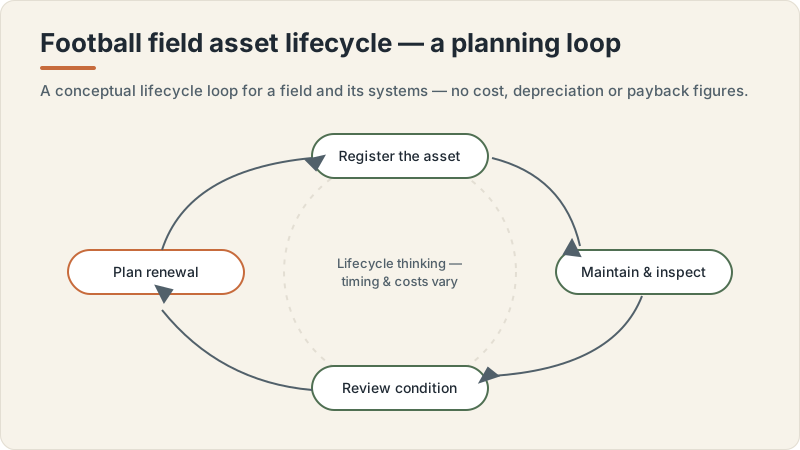
Football field asset lifecycle concept
Conceptual editorial diagram — not a construction drawing, specification, to-scale plan or proof of a real project. It is not engineering, structural, fire/life-safety, crowd-safety or accessibility-compliance guidance. Capacities, dimensions, standards, requirements and costs vary by facility type, audience, site, use case and governing body, and are confirmed with qualified professionals, relevant authorities and governing bodies. Build Design Hub does not design, build, inspect, certify, recommend or match anyone.
What this guide helps you prepare
This guide helps you assemble the information, questions and decision framing you will need before engaging qualified professionals about renovating or replacing a football field surface. It focuses on preparation: clarifying how the field is used, what you currently know about its condition, what your organisation is trying to achieve, and what questions remain open. The aim is to walk into early conversations with a clear brief rather than a blank page, so professionals can advise you efficiently and you can understand their advice.
It does not assess your surface, tell you whether to renovate or replace, or describe how any work should be carried out. Condition assessment, surface and drainage decisions, governing-body conformance and any construction are matters for qualified professionals, the relevant authorities and the appropriate sport governing bodies. What you can do now is gather records, frame the decision as questions, and define what a good outcome looks like for your users, your operations and your budget conversations.
- Define the purpose of the project in plain language: what problem you are trying to solve and for whom
- List who uses the field now (teams, age groups, schools, community hire) and how intensively
- Note what records you already hold about the field's history, previous works and recent issues
- Capture the open questions you cannot answer yourself and will need professionals to address
- Identify the decision-makers, approvers and stakeholders who should be involved early
- Separate what you know as fact from what you are assuming and should confirm
Framing renovation versus replacement as questions
The choice between renovating an existing surface and replacing it is rarely obvious from the touchline, and it is not one to settle by guesswork. Rather than deciding in advance, it helps to frame the decision as a set of questions that qualified professionals can investigate: what is genuinely driving the surface issues, whether the underlying systems are part of the picture, how the field is expected to be used in coming years, and what governing-body or authority considerations apply to your situation. The right path depends on factors that vary by site, use case, climate, surface system and the professional team's findings.
Preparing these questions in advance keeps the conversation productive and prevents you from anchoring on a solution before the problem is understood. It also helps you recognise where renovation and replacement involve different trade-offs for your organisation, such as disruption to play, operational continuity, future flexibility and ongoing maintenance commitments. None of these trade-offs should be assumed from this guide; they are prompts to explore with professionals who can examine your specific situation and the requirements that apply to it.
- What symptoms are prompting this project, and what might be causing them — to be investigated by professionals?
- Is this primarily a surface question, or could supporting systems be involved? Confirm with qualified professionals
- How might expected future use (more teams, longer seasons, new age groups) change the framing?
- What governing-body, league or authority considerations might apply, and who confirms them?
- What would 'renovation' versus 'replacement' each mean for disruption, operations and maintenance in your case?
- What information would professionals need from you before they can advise on the options?
Scoping the project and planning for operations and maintenance
Scoping is about drawing a clear boundary around what the project is and is not, so everyone shares the same understanding before detailed advice or quotes are sought. A clear scope covers the intended outcomes, the users and uses to be supported, the constraints you already know about (access, neighbouring uses, seasonal windows, existing commitments), and the things explicitly out of scope. Because requirements vary by location, use case, governing body, owner, site, surface system, maintenance plan, climate, authority and professional team, your scope should flag assumptions for professionals to confirm rather than fix specifications itself.
Operations and maintenance planning belongs in the conversation from the start, not as an afterthought. Different surface decisions carry different ongoing commitments, and your organisation's capacity to maintain a surface over time is part of the picture professionals will want to understand. Preparing notes on who would operate and care for the field, what your seasonal usage looks like, and how downtime during any works would affect users helps professionals tailor their advice and helps you compare proposals on a consistent basis.
- Write a one-page scope: intended outcomes, in-scope items, out-of-scope items, and known constraints
- Record access, neighbouring uses, and any seasonal or fixture windows that limit when work could happen
- Note your organisation's capacity to operate and maintain a surface, and who would be responsible
- List the stakeholders whose sign-off or input the scope depends on
- Capture how downtime during any works would affect teams, hire income and community users
- Mark every assumption in the scope as 'to be confirmed with qualified professionals'
Planning questions before speaking with professionals
Before you reach out to qualified professionals, it helps to work through questions you can answer internally. These are not technical questions about the surface; they are about your organisation's goals, constraints, governance and information. Clear internal answers make external conversations far more efficient, because professionals spend less time eliciting basic context and more time advising on your actual situation. They also reduce the risk of commissioning work that does not match what your stakeholders expected.
Use these questions to surface disagreement early. Different stakeholders often hold different unstated assumptions about what the project is for, how urgent it is, and what 'success' means. Resolving or at least naming those differences before professional engagement saves time, money and frustration later, and produces a brief that professionals can respond to with confidence.
- What outcomes does the project need to deliver, and how will we judge whether it succeeded?
- Who are all the users and stakeholders, and have we heard from each of them?
- What is our decision and approval process, and who has authority to commit the organisation?
- What records, drawings, warranties or past reports do we already hold, and where are the gaps?
- What is our realistic capacity to fund, operate and maintain the result over time?
- What constraints (timing, access, existing commitments, governance) are non-negotiable for us?
Questions for qualified professionals
When you do engage qualified professionals, a prepared list of questions helps you understand their advice and compare different specialists or proposals consistently. The questions below are framed to draw out how professionals would approach your situation, what they would need to investigate, and what considerations apply to your site and use case. They are deliberately open: the answers depend on factors specific to your project, and this guide does not supply them.
Ask professionals to be explicit about what falls to other specialists, authorities or governing bodies, and about what must be confirmed before any decision is made. Understanding the boundaries of each professional's role, and where independent verification or authority approval is required, helps you assemble the right team and avoid gaps. Treat every figure, requirement or specification they mention as theirs to stand behind and to confirm against the relevant standards and authorities, not something to lift from this guide.
- How would you approach assessing our current surface and its condition, and what would that involve?
- What would you need to investigate before advising on renovation versus replacement for our case?
- Which governing-body, league or authority requirements apply to us, and who confirms conformance?
- What ongoing operations and maintenance commitments would each option imply for our organisation?
- Which parts of this project fall outside your role, and which other specialists or authorities are needed?
- How should we structure quotes or proposals so we can compare them on a like-for-like basis?
What this does not replace
This is an educational project-preparation resource only. It is not a construction manual and not engineering, architectural, turf-installation, drainage-engineering, sports-surface-specification, structural, fire or life-safety, crowd-safety, accessibility-compliance, permit, zoning, legal, tax or procurement advice. It does not design, specify, install, certify, inspect or approve anything, and it is not an estimate, quote, price, capacity recommendation or performance or lifespan guarantee. Requirements, standards, dimensions, surface systems and costs vary by location, use case, governing body, owner, site, climate, maintenance plan, authority and professional team, and are confirmed with qualified professionals, relevant authorities and the sport governing body.
Build Design Hub does not design, build, install, engineer, inspect, certify, recommend, rank, verify, introduce, broker or match suppliers or contractors, and HELPERG LLC is publisher/operator only. Use this resource to prepare your own thinking, then have qualified professionals you engage directly review your project. Decisions about engineering, surface specification, drainage, safety, compliance, procurement and suitability must rest on those professionals, the relevant authorities and the governing body for your sport and location.
- Not a construction manual and not engineering, turf-installation or drainage-engineering instructions
- Not sports-surface specification, structural, fire/life-safety, crowd-safety or accessibility-compliance advice
- Not permit, zoning, legal, tax or procurement advice
- Not a supplier or contractor recommendation, ranking, directory or matching service
- Not an estimate, price, capacity recommendation or performance/lifespan guarantee — requirements and costs vary
- Qualified professional review is required before any project decision
Football field surface renovation preparation worksheet
- 1Record the project's purpose in one or two plain-language sentences, agreed by decision-makers
- 2Document current usage: teams, age groups, school sessions, community hire, and intensity by season
- 3Gather existing records: history, previous works, warranties, past reports and any drawings you hold
- 4List the symptoms or issues prompting the project, separating observations from assumed causes
- 5Write out the open questions only professionals or authorities can answer
- 6Name the decision-makers, approvers and stakeholders, and note each one's interest in the project
- 7Capture known constraints: access, neighbouring uses, seasonal windows and existing commitments
- 8Note which governing bodies, leagues or authorities may be relevant, to confirm with professionals
- 9Draft a one-page scope with in-scope, out-of-scope and assumptions-to-confirm clearly separated
- 10Record your organisation's capacity to fund, operate and maintain the result over time
- 11Outline how downtime during any works would affect users, fixtures and any hire arrangements
- 12Prepare a question list for professionals and a consistent structure for comparing their proposals
- 13Mark every requirement, figure or specification as 'to be confirmed with qualified professionals'
- 14Identify what verification or authority approval may be needed and who is responsible for obtaining it
Common mistakes to avoid
- Deciding to renovate or replace before any qualified professional has examined the situation
- Assuming requirements, dimensions, surface specifications or timelines from general sources rather than confirming them
- Briefing only on the surface while ignoring how the field is used and maintained over time
- Leaving key stakeholders out of early discussions and discovering disagreement after commitments are made
- Treating maintenance and operations as an afterthought rather than part of the scope
- Comparing proposals that are scoped differently, making like-for-like comparison impossible
- Overlooking governing-body, league or authority considerations until late in the process
- Failing to write down assumptions, so untested guesses get carried into decisions as if they were facts
When to involve a professional
- When you need any assessment of the current surface, drainage or supporting systems' condition
- When the renovation-versus-replacement decision must actually be made rather than just framed
- When governing-body, league or authority requirements or conformance need to be confirmed
- When the project moves toward design, specification, permitting, installation or certification
- When proposals involve figures, specifications or commitments you cannot independently verify
- When stakeholder, safety, accessibility or legal questions arise that fall outside your expertise
Frequently asked questions
Questions readers ask about this topic
Does Build Design Hub recommend or match suppliers, contractors or surface products?
No. Build Design Hub is an educational planning resource only. It does not design, build, install, inspect, certify, recommend, rank, verify, introduce, broker or match suppliers or contractors, and it does not provide costs, requirements, dimensions or turf or surface specifications. Use this guide to prepare your thinking and questions, then engage qualified professionals and the relevant authorities for any specific advice or decisions.
Can this guide tell me whether I should renovate or replace my field?
No. That decision depends on factors specific to your site, use case, climate, surface system, governing body and the findings of qualified professionals. This guide only helps you frame the question and gather the information needed so professionals can advise you. Confirm the right path with qualified professionals who can examine your situation.
Why does this guide avoid giving dimensions, specifications, standards or timelines?
Because requirements vary by location, use case, governing body, owner, site, surface system, maintenance plan, climate, authority and professional team. Stating any of these as facts could be misleading for your specific project. Confirm all such details with qualified professionals, the relevant authorities and the appropriate sport governing bodies.
What is the most useful thing I can do before contacting professionals?
Prepare a clear brief: define the project's purpose, document current and expected usage, gather existing records, name your stakeholders and constraints, and write down your open questions and assumptions. A clear brief helps professionals advise you efficiently and helps you compare their proposals consistently.
Keep reading