
Who this guide is for
- Owners and operators preparing to request and compare court delivery arrangements
- Project leads clarifying who handles offloading, storage and sequencing
- Club committees reviewing what a quote does and does not include
- Anyone planning a court on a site with tight or shared access
- Readers comparing imported kit logistics against locally supplied options
- Owners assembling questions before engaging qualified professionals
Planning diagram
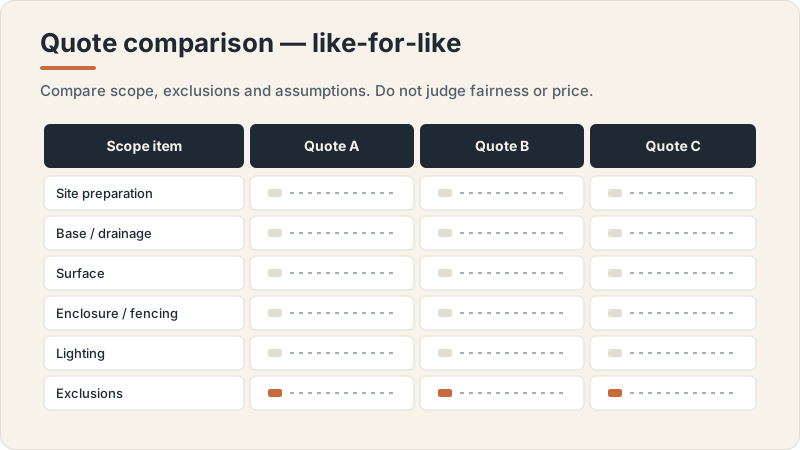
Quote comparison matrix concept
Conceptual editorial diagram — not a construction drawing, specification or to-scale plan. Official court dimensions, standards, drainage, structure and lighting requirements vary by sport, site and location and are confirmed with the relevant federation, supplier and qualified professionals.
What this research helps you prepare
This page helps you build a consistent set of delivery and logistics questions to ask each supplier and contractor, so you can compare answers on the same terms rather than comparing headline figures alone. It focuses on how goods reach the site, how they are offloaded and stored, how the work is sequenced, and where responsibility sits at each step.
Working through it gives you a clearer picture of the assumptions buried in a quote, the exclusions that might fall back on you, and the documentation you should expect. It does not tell you what anything should cost or how long it should take, and it does not judge whether an arrangement is reasonable. Those judgements belong to you and the qualified professionals you engage, informed by direct answers from suppliers.
- A common question set to ask every supplier and contractor
- A way to spot logistics assumptions and exclusions in a quote
- Prompts on access, offloading, storage and sequencing
- Documentation and warranty themes to clarify, not figures to assume
Site access, offloading and storage questions
Access is often the single biggest variable in court logistics, and it is easy to overlook until a vehicle cannot reach the site. Ask each supplier and contractor what access they assume, what vehicle size or type their plan depends on, and who is responsible if the real access differs. Clarify how materials and components are intended to be offloaded, what equipment that needs, and who provides it.
Storage matters just as much: court surfaces, glass, steel and other components may need to wait on site before they are installed, and where and how they are stored can affect both the work and the materials. Treat these as questions to confirm directly, since requirements and conditions vary by site, and avoid assuming a quote includes any of it unless stated.
- Ask what site access the plan assumes and who confirms it
- Ask what offloading equipment is needed and who supplies it
- Clarify where components are stored on site and who is responsible
- Ask what happens if real access differs from the assumption
- Confirm responsibility for protecting stored materials
Sequencing, coordination and logistics responsibility
A court project usually brings together several deliveries and trades that have to arrive in a workable order. Ask how deliveries are sequenced relative to the base, surface, enclosure, lighting and fencing work, and who coordinates that sequence when more than one supplier or contractor is involved. Mapping these dependencies helps you see where a hold-up in one delivery affects everything downstream.
Be clear about who carries responsibility for logistics at each step, including who handles unloading, who bears risk for damage in transit or on site, and how missing or damaged items are handled. These are questions to ask, not figures to estimate; sequencing realities vary by site, scope and supplier and should be confirmed directly and, where contracts are involved, reviewed independently.
- Ask how deliveries are sequenced against the construction stages
- Ask who coordinates logistics across multiple suppliers and trades
- Clarify who bears risk for transit and on-site damage
- Ask how missing, delayed or damaged items are handled
- Note dependencies where one delay would cascade
What to ask before comparing options
Before you place two quotes side by side, make sure each answers the same logistics questions, because differences in what is assumed about access, offloading, storage and sequencing can matter more than any headline figure. Ask each party to state their assumptions and exclusions in writing so you are comparing like with like rather than guessing at what is bundled in.
Resist the urge to assess fairness or price from these answers. This page does not judge whether a quote is reasonable; it helps you gather comparable information. Where cost or timing comes up, treat it as something to confirm directly with the supplier, noting that it varies by site, scope, access, route and local conditions.
- Ask every party to state delivery and logistics assumptions in writing
- Confirm what is excluded and who covers excluded logistics
- Ask whether site access, offloading and storage are in or out of scope
- Check that documentation and warranty terms cover delivered items
- Compare answers on the same basis rather than on figures alone
Questions for qualified professionals
Some delivery and logistics questions are better put to qualified professionals than answered from a checklist. A suitably qualified engineer, surveyor or project adviser can help you understand whether assumed access and offloading arrangements are realistic for your site, and how storage might affect materials or the works. Independent advice on contracts can clarify where logistics risk and responsibility actually sit.
These professionals can also help you frame the right questions for your specific site and scope, which vary in ways a general resource cannot anticipate. Use the prompts below to start those conversations rather than to replace them.
- Ask an adviser whether assumed site access is realistic for your site
- Ask how on-site storage could affect materials or the works
- Seek independent review of where logistics risk and responsibility sit in contracts
- Confirm any local requirements affecting deliveries, access or storage
- Ask which delivery and logistics terms are worth confirming in writing
What this does not replace
This page is an educational project-preparation resource only. It is not a supplier or contractor recommendation, not contractor matching, and not an estimate of any kind. It is not procurement, legal, tax, customs, engineering, design or construction advice, and it does not assess whether any quote or arrangement is fair, complete or competitively priced.
Requirements and costs vary by location, site, scope, supplier, access, route and local conditions, and must be confirmed directly with the relevant authorities, federations, suppliers and qualified professionals. Build Design Hub does not recommend, rank, verify, introduce or broker suppliers or contractors. HELPERG LLC is the publisher and operator only. Qualified professional review is required before you make any project, legal, tax, customs, engineering, construction or procurement decision.
Delivery and logistics research checklist
- 1Have you asked what site access each plan assumes and who confirms it?
- 2Have you asked what offloading equipment is needed and who provides it?
- 3Have you clarified where components are stored on site and who is responsible?
- 4Have you asked how deliveries are sequenced against the construction stages?
- 5Have you asked who coordinates logistics across suppliers and trades?
- 6Have you clarified who bears risk for transit and on-site damage?
- 7Have you asked how missing, delayed or damaged items are handled?
- 8Have you asked each party to state delivery assumptions and exclusions in writing?
- 9Have you confirmed whether access, offloading and storage are in or out of scope?
- 10Have you checked how warranty terms apply to delivered and stored items?
- 11Have you recorded which logistics points remain unconfirmed?
- 12Have you noted what to confirm directly with suppliers and qualified professionals?
Common mistakes to avoid
- Assuming a quote includes site access, offloading or storage when it is not stated
- Comparing headline figures without checking each party's logistics assumptions
- Overlooking who provides offloading equipment and labour on the day
- Treating delivery timelines or shipping costs as fixed rather than confirming them directly
- Ignoring how on-site storage of components could affect materials or the works
- Failing to clarify who bears risk for damage in transit or on site
- Not asking how missing or damaged items are handled before work proceeds
- Leaving sequencing and coordination undefined when several suppliers are involved
When to involve a professional
- Engage a qualified adviser to judge whether assumed site access and offloading are realistic for your specific site, since conditions vary.
- Seek independent advice on contracts to clarify where logistics risk and responsibility actually sit before you commit.
- Have qualified professionals confirm how on-site storage may affect materials, the base, surface or surrounding works.
- Confirm any local requirements affecting deliveries, access, road use or storage with the appropriate authorities, as they vary by location.
- Ask suppliers and qualified professionals to confirm timing, sequencing and cost factors directly, rather than relying on any figure here.
Frequently asked questions
Questions readers ask about this topic
Does this page tell me whether a delivery quote is fair or reasonable?
No. It does not assess fairness, completeness or price, and it gives no costs or timelines. It helps you gather comparable information by asking each supplier and contractor the same logistics questions, which you then confirm and weigh with qualified professionals.
Can you estimate shipping costs or delivery times for my court?
No. Shipping costs and delivery times vary by site, scope, supplier, access, route, season and local conditions, and must be confirmed directly with the suppliers you engage. This resource only helps you frame the questions to ask.
Who is responsible for offloading and storing materials on site?
That varies by arrangement and is exactly what to clarify in writing. Ask each supplier and contractor what they assume about offloading equipment, labour and storage, and who bears responsibility and risk at each step.
Do you recommend any suppliers or delivery companies?
No. Build Design Hub does not recommend, rank, verify or introduce suppliers, contractors or logistics providers. HELPERG LLC is publisher and operator only. This page offers research questions; selection and verification are your responsibility, ideally with independent advice.
How should I compare two suppliers on logistics?
Ask both the same questions and request their assumptions and exclusions in writing, so you compare on the same basis rather than on headline figures. Differences in assumed access, offloading, storage and sequencing often matter most, and should be confirmed directly.
Keep reading