
Who this guide is for
- Prospective court owners researching fencing and enclosure suppliers
- Operators comparing several fencing or enclosure suppliers on a like-for-like basis
- Anyone unsure what to ask a fencing supplier beyond headline price
- Project managers assembling a documentation request for supplier conversations
- Clubs adding or replacing court perimeter fencing who want a consistent question set
- Owners wanting to understand inclusions, exclusions and what must be confirmed independently
Planning diagram
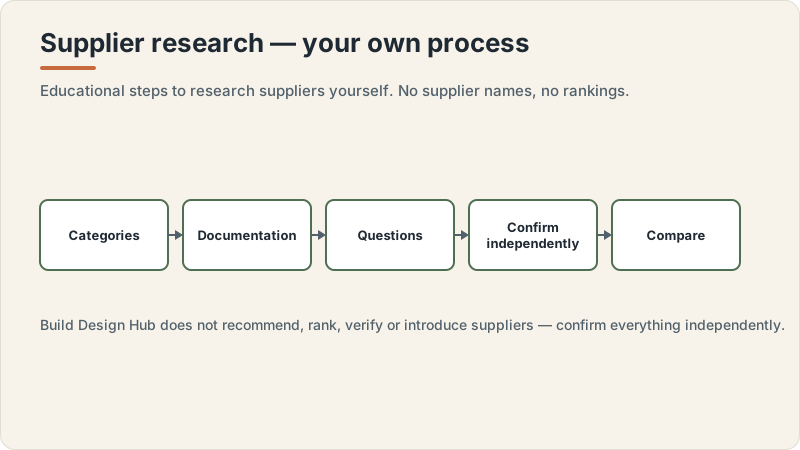
Supplier research process concept
Conceptual editorial diagram — not a construction drawing, specification or to-scale plan. Official court dimensions, standards, drainage, structure and lighting requirements vary by sport, site and location and are confirmed with the relevant federation, supplier and qualified professionals.
What this research helps you prepare
This resource helps you build a structured set of questions and a documentation request to take into conversations with sports court fencing and enclosure suppliers. It is organised around supplier categories, the documentation to request, the questions that reveal scope and approach, and what must be confirmed independently, so you can cover ground that is easy to skip.
Everything here stays at a planning and research level. The prompts are designed to help you listen for clarity and consistency and to record what you are told, not to provide technical answers, specifications or instructions. Requirements, costs and timelines vary by location, site, scope, surface, access, drainage, lighting, the chosen fencing system and the supplier, so the goal is informed conversation rather than fixed expectations.
Use it to prepare before meetings, to compare suppliers consistently, and to note where answers differ or stay vague so you can follow up with the relevant authorities, federations and qualified professionals where appropriate.
- A question set covering supplier category, documentation, scope and coordination
- A documentation request you can send to several suppliers consistently
- A way to notice where answers are vague, differ, or need independent confirmation
- Framing that keeps cost, timing and availability as drivers to confirm, not figures
Supplier categories worth researching
Court fencing is supplied and delivered by different kinds of businesses, and understanding which category you are talking to helps you read their answers. Some suppliers manufacture or distribute fencing and enclosure components, some focus on fabrication or galvanising and coating, some install on site, and some present a combined offer. Asking how a supplier describes themselves clarifies where their responsibility realistically begins and ends.
The point of mapping categories is not to decide which type is better, because that depends entirely on your project, but to avoid assuming one supplier covers everything. Where a supplier handles only part of the work, you will want to understand who carries the rest and how the parts connect, which is a coordination question rather than a request for engineering or construction guidance.
- How would you describe your business: manufacture, supply, fabrication, coating, installation, or a combination?
- Which parts of fencing and enclosure work do you carry out yourself, and which do you leave to others?
- Do you supply components only, supply and install, or coordinate a wider package?
- How do you work alongside the court surface, base, drainage and lighting providers?
- Where does your responsibility end on a typical project of this type?
- Can you set out, in writing, what your offer does and does not cover?
Documentation to request and what to confirm independently
Asking for documentation moves a conversation from reassurance to something you can review and verify. For fencing and enclosure work, it is reasonable to ask what a supplier can put in writing about scope, materials and coatings, components and fixings, coordination responsibilities, and any guarantee or warranty terms, together with care or handling guidance for what they supply.
Documentation is a starting point, not proof, so treat what you receive as something to confirm independently rather than as settled fact. Material descriptions, coating claims, dimensions, sport or federation requirements and any compliance points should be checked with the relevant supplier, authority, federation or qualified professional. This resource cannot state requirements or specifications as fact, because they vary by location, project and the system involved, and must be confirmed at source.
- What documentation can you provide on scope, materials, coatings and components?
- How are guarantee or warranty terms set out, and where are they written down?
- What care, handling or maintenance guidance comes with what you supply?
- Which claims in your documentation should I confirm directly with a manufacturer or authority?
- How do you record what is included, excluded and coordinated with other trades?
- What proof of compliance, where relevant, would you expect me to confirm independently?
What to ask before comparing options
Before you line suppliers up against each other, it helps to ask the questions that put them on a comparable footing. Differences in fencing systems, materials, coatings, heights, mesh or panel approaches, fixings and coordination responsibilities can make two offers look similar on paper while covering very different work, so consistent questions matter more than headline figures.
Ask each supplier the same questions and record the answers the same way. You are listening for clarity about what is included and excluded, how their part connects to surface, base, drainage and lighting work, and what they expect you to arrange or confirm separately. Cost, timing and availability vary by location, scope, supplier, access, surface, shipping and local conditions, so the useful question is what drives each of these and what could change them, never a number.
- What exactly is included in your fencing and enclosure offer, and what is excluded?
- How do you describe the system options you supply, and the trade-offs between them?
- What factors most affect cost, timing and availability on a site like mine?
- What must be in place, and arranged by others, before you can proceed?
- Which items are commonly assumed to be included but are not?
- How do you handle changes to scope once work is under way?
Questions for qualified professionals
Some questions sit better with independent professionals than with a fencing supplier, because they involve judgement, verification or specialist knowledge. Before and during supplier conversations, it helps to line up the people who can give neutral input on site conditions, structural and groundwork interfaces, drainage and lighting coordination, accessibility, and any legal, permit or federation matters.
Use the prompts below to plan who to involve and what to ask them. Requirements vary by location and project and must be confirmed with the relevant authority, federation and qualified professionals; this resource cannot state them as fact, and the prompts here are for your own conversations rather than instructions to follow.
- Designer or engineer: is the proposed fencing and enclosure approach suitable for my site and intended use?
- Site, base and groundwork specialists: are the foundations and fixings for fencing being planned soundly?
- Drainage and lighting specialists: how should fencing be coordinated with these around the court?
- Local authority and relevant federation: what permit, zoning, height, boundary and sport requirements apply here?
- Accessibility and legal advisors: what local obligations should I confirm before committing?
- Independent reviewer: do a supplier's scope, documentation and coordination hold up under scrutiny?
What this does not replace
This is an educational project-preparation resource, not a supplier or contractor recommendation, not contractor matching, not an estimate, and not procurement, legal, tax, customs, engineering, design or construction advice. It does not provide specifications, installation or construction instructions, and it does not tell you which supplier to choose.
Requirements and costs vary by location, site, scope, supplier, access, drainage, lighting, surface, shipping and local conditions, and official sport, federation, permit or boundary requirements must be confirmed with the relevant bodies. Consult qualified designers, engineers, groundwork, drainage and lighting specialists, local authorities and legal or professional advisors before making project, legal, tax, customs, engineering, construction or procurement decisions.
Build Design Hub does not recommend, rank, rate, verify, introduce or endorse any supplier or contractor, and does not design, build, estimate or manage projects. HELPERG LLC is the publisher and operator only. Research, verification and selection of any supplier remain your responsibility.
Fencing supplier research checklist
- 1Have you asked each supplier which category they fall into and what they carry out themselves?
- 2Have you asked what is included in their fencing and enclosure offer and what is excluded?
- 3Have you requested documentation on scope, materials, coatings, components and warranty?
- 4Have you noted which claims you need to confirm with a manufacturer, authority or federation?
- 5Have you asked what drives cost, timing and availability and what could change them?
- 6Have you asked how fencing coordinates with surface, base, drainage and lighting work?
- 7Have you identified which items are commonly assumed included but are not?
- 8Have you asked how changes to scope are identified, agreed and documented?
- 9Have you recorded answers consistently so suppliers can be compared like for like?
- 10Have you planned which questions to take to independent qualified professionals?
- 11Have you planned to verify what you are told independently before deciding?
Common mistakes to avoid
- Focusing on headline price and skipping questions about supplier category and scope
- Assuming every fencing supplier includes the same components, fixings and coordination
- Treating material, coating or compliance claims as fact instead of confirming them at source
- Taking quoted timelines or availability as fixed rather than asking what drives and could change them
- Not requesting documentation, or accepting a brochure in place of written scope
- Assuming a standard guarantee or warranty instead of reading the actual terms
- Overlooking how fencing connects to base, drainage and lighting handled by others
- Relying on one conversation without recording answers consistently or verifying independently
When to involve a professional
- Specialist site, base, groundwork, drainage, lighting and enclosure work should be carried out by qualified professionals in each trade.
- A qualified designer or engineer can review whether a supplier's proposed fencing and enclosure approach suits your site and intended use.
- Official court dimensions, sport, federation, height and boundary requirements vary and should be confirmed with the relevant authority, federation, supplier or designer.
- Permit, zoning, accessibility and other requirements vary by location and must be confirmed with the relevant authority and qualified professionals.
- Guarantee, warranty and contract terms should be reviewed, and legal or professional advice taken where the wording carries weight.
- Build Design Hub does not recommend, rank, verify or introduce suppliers; research, verification and selection remain your responsibility.
Frequently asked questions
Questions readers ask about this topic
What should I ask a court fencing supplier first?
Start with category and scope: how they describe their business, what they carry out themselves, and what is included or excluded. Fencing can involve manufacture, supply, coating and installation handled by different businesses, so understanding where a supplier's responsibility begins and ends matters more than any headline figure.
How should I handle questions about cost, timing and availability?
Ask what drives each one and what could change it, rather than expecting fixed numbers. Cost, timing and availability vary by location, scope, supplier, access, surface, shipping and local conditions, so focus on the drivers and confirm specifics in writing with the supplier and qualified professionals.
Does this resource recommend or match fencing suppliers?
No. It provides questions and a documentation request to frame your own research. Build Design Hub does not match, rank, rate, verify, introduce or endorse suppliers, and HELPERG LLC is the publisher and operator only. Research, verification and selection remain your responsibility.
What documentation is reasonable to request?
It is reasonable to ask what a supplier can put in writing about scope, materials, coatings, components, coordination responsibilities, and any guarantee or warranty terms, plus care guidance. Treat documentation as a starting point to confirm independently, not as proof, since details vary and must be checked at source.
Can I rely on a supplier's claims about materials and requirements?
Treat them as a starting point, not as fact. Material, coating, dimension, sport and compliance claims vary and should be confirmed with the relevant manufacturer, authority, federation or qualified professional. Listen for whether a supplier references that nuance rather than stating fixed certainties.
Keep reading