
Who this guide is for
- Court owners or operators planning to engage an ongoing maintenance provider for the first time
- Facility managers reviewing or re-tendering an existing maintenance arrangement
- Clubs or schools wanting to organise their own provider research before any conversations
- Developers who want to define a clear maintenance scope at handover from construction
- Owners comparing several providers who need a consistent question set and worksheet
Planning diagram
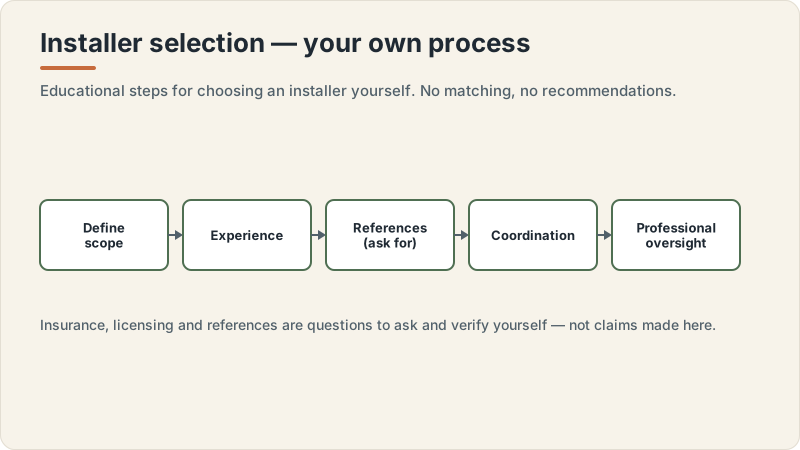
Installer selection process concept
Conceptual editorial diagram — not a construction drawing, specification or to-scale plan. Official court dimensions, standards, drainage, structure and lighting requirements vary by sport, site and location and are confirmed with the relevant federation, supplier and qualified professionals.
What this research helps you prepare
This resource helps you get organised before you speak to any potential maintenance provider. The goal is not to tell you who to choose, but to help you describe your own court, your site conditions and the kind of ongoing service you are looking for, so that every conversation starts from the same clear brief. When your brief is consistent, the responses you gather become easier to compare on your own terms.
Preparing in advance also helps you separate what you genuinely need from what may simply be offered. A maintenance arrangement can cover very different things depending on the surface, the climate, the level of use and your own in-house capability. Writing down what you expect a provider to handle, and what you intend to keep doing yourself, gives you a basis for honest and comparable discussions.
Use the prompts here to build your own notes. Nothing on this page is an instruction on how to maintain a court, a recommendation of any provider, or a statement of what your project requires. Those points belong to your suppliers, your providers and the qualified professionals you choose to involve.
- A written description of your court, surface and site that you can share consistently
- A clear statement of the maintenance scope you want a provider to cover
- A structured question set you can use in every conversation
- A list of the documentation you would like to receive and retain
- A simple worksheet to record answers and compare them yourself
Defining the scope of service you want
A maintenance arrangement only makes sense once you have defined what it is meant to cover. Before comparing providers, it helps to write down the tasks you expect to be included, how often you think they may be needed, and where the boundary sits between the provider's responsibilities and your own. The appropriate scope varies by surface type, climate, usage intensity and many other factors, so treat this as your own working definition rather than a fixed standard.
Consider whether you are looking for routine upkeep, periodic deeper attention, seasonal preparation, or some combination, and whether occasional or reactive work would be handled under the same arrangement or quoted separately. Being explicit about these distinctions early helps avoid gaps or overlaps later, and gives every provider the same picture to respond to.
It can also help to note what you do not want included, and what you intend to keep doing in-house. The clearer your scope, the easier it is to understand differences between providers' responses and to identify where a proposal may be assuming more or less than you intended.
- List the routine tasks you expect to be covered and roughly how often
- Note any seasonal or periodic attention your surface may need, to confirm with suppliers
- Decide whether reactive or occasional work is included or quoted separately
- Mark the boundary between the provider's tasks and your own in-house work
- Record what you specifically do not want in scope to avoid assumptions
Experience, coordination and site-specific review
When you talk to a potential provider, it helps to focus questions on relevant experience and on how they would approach your specific court rather than on general claims. Ask how they would familiarise themselves with your surface and site, whether they would want to see the court before committing to a scope, and how they would adapt their approach to your conditions. A provider who wants to review the actual site before agreeing on scope is giving you useful information about how they work.
Coordination is a common source of problems on ongoing arrangements, so it is worth asking how scheduling around your usage would work, who your point of contact would be, and how they would handle access, parking, storage of any materials and working around bookings. If more than one party may be involved over time, such as a surface supplier or the original installer, ask how responsibilities would be kept clear between them so nothing falls into a gap.
You can also ask whether they can provide references for similar ongoing work that you may follow up yourself. Never rely on any reference, rating or testimonial invented or implied by a third party, including this page. Build Design Hub does not verify providers, and any references you gather should be checked directly by you.
- Ask how they would review your specific surface and site before agreeing scope
- Ask how scheduling would work around your bookings and access constraints
- Ask who your single point of contact would be for the arrangement
- Ask how responsibilities would stay clear if other parties are involved
- Ask whether they can supply references for similar ongoing work to check yourself
What to ask before comparing options
Comparing providers fairly depends on asking each of them the same questions in the same way. Before you start, decide which points matter most to you and write them into a single question set, so that you are recording comparable answers rather than impressions. Costs, timings and availability will vary by provider, scope, site and conditions, so capture them as the provider's own figures to confirm in writing, never as numbers you assume or carry over from elsewhere.
Insurance and licensing are best treated as questions to ask, not as claims to accept at face value. You might ask what cover a provider carries, what registrations or qualifications apply to the work in your location, and how they would evidence these. Whether any particular cover or registration is required, and what is appropriate, varies by jurisdiction and project, so confirm the position with the relevant authorities and qualified professionals rather than assuming it.
Finally, ask how each provider would document the arrangement, what a written agreement would cover, and how changes to scope would be handled. The aim is to leave each conversation with a consistent set of answers you can lay side by side in your own worksheet.
- Use one identical question set for every provider you contact
- Record any costs, timings and availability as the provider's figures to confirm in writing
- Ask what insurance cover the provider carries, as a question rather than an assumption
- Ask what licensing, registration or qualifications apply in your location, to verify independently
- Ask how scope changes and additional work would be agreed and documented
Questions for qualified professionals
Some questions are better directed to qualified professionals than to a maintenance provider you are evaluating. Independent input can help you understand what your particular surface and site genuinely need, whether a proposed scope looks complete, and whether the contractual and insurance arrangements are appropriate for your circumstances. This is your own due diligence, separate from any provider's proposal.
Depending on your situation, the relevant professionals might include a surface or sports-facility specialist, a legal adviser for the agreement, an insurance adviser for cover questions, and your surface supplier or original installer for guidance specific to your court. Asking them to review your scope and the responses you have gathered can highlight gaps before you commit.
This page cannot tell you which professionals you need or what they will advise. Use the prompts below to decide who to involve and what to ask them, and rely on their guidance rather than on anything stated here.
- Which qualified professional can review whether my maintenance scope looks complete?
- What does my specific surface and climate genuinely require, confirmed with a specialist or supplier?
- What should a maintenance agreement cover for my situation, reviewed by a legal adviser?
- What insurance and licensing position is appropriate here, confirmed with the relevant adviser or authority?
- How should responsibilities be split if my surface supplier or installer also has a role?
Documentation and handover to keep
Whatever you eventually agree, it helps to decide in advance what records you want to receive and retain. Clear documentation makes the arrangement easier to manage, supports future comparisons, and gives you a trail if you ever change providers. Note the documents you would like before work begins, during the arrangement and at any handover, and treat these as items to request rather than as a fixed legal requirement.
Useful records often include a written scope of service, the agreement itself, evidence of the cover and registrations you asked about, a record of work carried out over time, and any product or material information relevant to your surface. Keeping these organised in one place means you are not relying on memory or on a single individual's knowledge.
If you are taking over a newly built court, ask about handover documentation from construction as well, so that maintenance guidance, warranty conditions and any supplier instructions are passed across cleanly. Confirm warranty and product specifics directly with the relevant supplier or installer rather than assuming them.
- A written scope of service describing what is and is not included
- The agreement itself and how scope changes would be recorded
- Evidence of the insurance and registrations you asked about
- A running record of work carried out, kept in one organised place
- Surface, product and warranty information confirmed with the supplier or installer
What this does not replace
This page is an educational, project-preparation resource only. It is not a recommendation of any maintenance provider and not a directory, ranking, rating or matching service. Build Design Hub does not recommend, rank, verify, endorse, introduce or broker providers or contractors, and HELPERG LLC is the publisher and operator only.
It is not an estimate and contains no prices, costs, timings, availability or other figures. It is not procurement, legal, tax, customs, insurance, engineering, design or construction advice, and it does not tell you what your project requires. Requirements vary by location and project, and costs vary by site, scope, surface, access, climate, conditions and professional requirements.
Use it to organise your own research and questions, then confirm official requirements with the relevant authorities, federations, suppliers and providers, and consult qualified professionals before making any project, legal, tax, insurance, procurement or construction decisions. Final responsibility for choosing a provider rests with you.
Maintenance provider research and comparison worksheet
- 1Write a short, shareable description of your court, surface and site conditions
- 2Define the maintenance scope you want covered, and what you will keep in-house
- 3Note any seasonal or periodic attention to confirm with your surface supplier
- 4List the identical questions you will ask every provider you contact
- 5Prepare questions about insurance cover, framed as questions not assumptions
- 6Prepare questions about licensing, registration or qualifications for your location
- 7Ask each provider how they would review your specific surface and site first
- 8Ask how scheduling, access and a single point of contact would work
- 9Request references for similar ongoing work that you can follow up yourself
- 10List the documentation you want before, during and at handover of the arrangement
- 11Record each provider's answers in one place to compare on your own terms
- 12Identify which qualified professionals you will ask to review your scope
Common mistakes to avoid
- Approaching providers before defining your own scope, so responses are not comparable
- Treating any cost, timing or availability figure as fixed instead of confirming it in writing
- Accepting insurance or licensing claims at face value rather than asking and verifying them
- Leaving the boundary between provider tasks and your own in-house work undefined
- Skipping a site review and agreeing scope without anyone seeing the actual court
- Relying on ratings, awards or testimonials instead of references you check yourself
- Failing to agree how scope changes and reactive work would be documented and priced
- Keeping no organised record of the agreement, cover and work carried out over time
When to involve a professional
- Engage a surface or sports-facility specialist to help confirm what your court genuinely needs
- Ask a legal adviser to review the maintenance agreement and scope-change terms for your situation
- Consult an insurance adviser about what cover questions to ask and how to interpret answers
- Confirm licensing, registration and any official requirements with the relevant authority for your location
- Involve your surface supplier or original installer where their guidance affects warranty or care
- Seek professional input before committing if responsibilities span several parties or the scope is unclear
Frequently asked questions
Questions readers ask about this topic
Does this page recommend or match me with a maintenance provider?
No. This is an educational preparation resource only. It does not name, rank, rate, verify, recommend, introduce or broker any provider. Build Design Hub does not match owners with providers, and HELPERG LLC is the publisher and operator only. Choosing a provider is entirely your own decision.
Can you tell me what ongoing maintenance will cost?
No. Costs vary by site, surface, scope, access, climate, conditions and provider, and this resource contains no figures. Treat any cost, timing or availability information as something each provider gives you, to confirm in writing, rather than as a number you assume in advance.
How should I handle insurance and licensing questions?
Treat them as questions to ask, not claims to accept. You can ask what cover a provider carries and what registrations or qualifications apply, then verify the answers and confirm what is appropriate or required with the relevant authorities and qualified professionals for your location.
Should I ask for references?
You can ask whether a provider can supply references for similar ongoing work, and follow them up yourself. Do not rely on any reference, rating or testimonial implied by a third party, including this page. All checking is your own responsibility, as Build Design Hub does not verify providers.
When should I involve a qualified professional?
Consider independent input when you want to confirm what your surface genuinely needs, check whether a proposed scope looks complete, or review the agreement and insurance position. Qualified professionals can review your scope and the responses you gather before you commit.
Keep reading