
Who this guide is for
- Facility owners and developers planning a new indoor sports hall, gym or multi-purpose training space
- Sports clubs and community groups scoping changing and support areas for members and visitors
- Schools and academies preparing a brief for sports hall changing rooms used by mixed age groups
- Municipalities and public-body project teams coordinating stakeholder input on accessible facilities
- Project managers and facility managers assembling questions for architects and accessibility specialists
- Trustees, committees and steering groups reviewing a draft changing room brief before professional engagement
Planning diagram
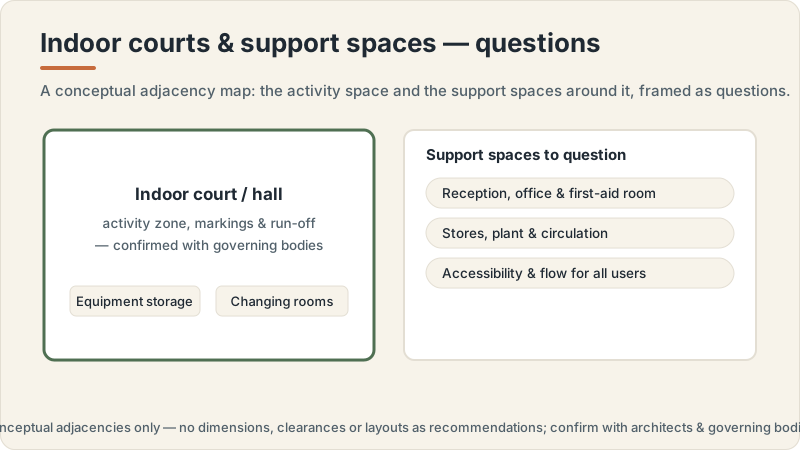
Indoor court and support-space planning concept
Conceptual editorial diagram — not a construction drawing, specification, to-scale plan or proof of a real project. It is not engineering, structural, fire/life-safety, crowd-safety or accessibility-compliance guidance. Capacities, dimensions, standards, requirements and costs vary by facility type, audience, site, use case and governing body, and are confirmed with qualified professionals, relevant authorities and governing bodies. Build Design Hub does not design, build, inspect, certify, recommend or match anyone.
What this guide helps you prepare
This guide helps you turn vague intentions about changing rooms into a written set of questions and descriptions that a professional team can work from. Rather than deciding how many spaces you need or how large they should be, you describe who will use the facility, when, and in what patterns, and you list the concerns you want an architect or accessibility specialist to address. That description becomes part of your project brief and gives everyone a shared starting point. It also makes stakeholder discussions more productive, because participants react to a concrete draft instead of debating in the abstract.
The material is deliberately limited to preparation. It does not size rooms, set capacities, specify fittings or make accessibility or compliance judgements, because those depend on your location, facility type, use case, governing body, owner, site, authority, professional team and project scope. What it does is help you gather the inputs professionals will ask for, record your open questions, and structure supplier and contractor research and quote comparisons so that you can compare responses on a like-for-like basis. Confirm every technical or regulatory point with qualified professionals and the relevant authorities.
- Draft a plain-language description of your intended user groups and typical use patterns
- Record which changing room questions matter most to your owners, users and stakeholders
- Assemble the background information an architect or accessibility specialist is likely to request
- Capture open questions and assumptions to test with qualified professionals
- Structure supplier and contractor research prompts around your priorities
- Prepare a consistent framework for comparing professional responses and quotes
Mapping user groups, use patterns and privacy expectations
The starting point for changing room planning is understanding who will use the facility and how. Different user groups, such as adults, children and young people, mixed teams, visiting opponents, officials, coaches, spectators and staff, may arrive in overlapping waves or at separated times, and their expectations around privacy and supervision can differ significantly. Before speaking with professionals, it helps to describe these groups in your own words: who they are, roughly when they arrive and leave, whether groups overlap, and what privacy expectations your organisation and stakeholders hold. This is descriptive work, not a set of decisions; the professional team will interpret it against the requirements that apply to your project.
Privacy and dignity considerations are frequently central to changing room discussions, particularly where children, young people, mixed groups or people with different comfort levels share a facility. Rather than deciding on a particular arrangement, prepare questions about how privacy could be approached, what options exist, and how supervision and safeguarding concerns might interact with layout. These are matters to confirm with architects, accessibility specialists and, where relevant, safeguarding or governing-body advisors, because appropriate approaches vary by location, facility type, user group, governing body, owner, site, authority and project scope.
- Who are the distinct user groups, and how might their needs and expectations differ?
- When do groups arrive and leave, and where might overlapping use create pressure points?
- What privacy and dignity expectations do our owners, users and stakeholders hold?
- How might safeguarding or supervision concerns interact with changing room layout?
- Are there visiting teams, officials or staff whose needs should be described separately?
- What questions about privacy options should we put to an architect or specialist?
Accessibility, inclusion and flow considerations to raise as questions
Accessibility and inclusion are central to changing room planning and are areas where professional input is essential. Build Design Hub does not give accessibility-compliance advice or make any accessibility claims; instead, this section helps you prepare the questions to put to an accessibility specialist and to record the documentation you may wish to request. You can describe the range of people you expect to use the facility, including people with disabilities, families, carers, assistants and people with a range of mobility and sensory needs, and then ask how their journeys through changing and support areas could be considered. Whether any particular approach is appropriate or required is a matter for qualified professionals and the relevant authorities to confirm.
Flow, the way people move from entrance to changing area to activity space and out again, often influences how well changing rooms work in practice. Rather than designing routes yourself, prepare questions about how people, including those with accessibility needs and those moving between wet and dry areas, might circulate, where congestion could occur, and how visiting and home groups might be separated where that matters. Recording these questions, along with your observations about the site and its constraints, gives the professional team the context they need without you having to make technical judgements that fall outside your role.
- Who among our expected users has accessibility needs we should describe to a specialist?
- What questions should we ask about how people move between entrance, changing and activity areas?
- Which documentation could we request from an accessibility specialist to inform the brief?
- How might routes for home, visiting, officiating and support roles be considered?
- Where do we anticipate congestion, and how should we frame that as a question?
- What site or building constraints should professionals be made aware of early?
Planning questions before speaking with professionals
Before you engage an architect, an accessibility specialist or other professionals, it is worth working through the questions you can answer internally so that your brief is as clear as possible. These are not technical questions; they are questions about your organisation's intentions, users and priorities. Clarifying them among your own stakeholders reduces the risk of contradictory instructions later and helps you recognise where you genuinely need professional input. Record your answers, and note explicitly where your group disagrees or is unsure, because those are exactly the points a professional discussion can help resolve.
As you work through these questions, keep separating description from decision. Your role at this stage is to describe your users, your priorities and your constraints, and to list open questions, not to determine dimensions, capacities, arrangements or compliance positions. Those depend on your location, facility type, use case, governing body, owner, site, authority, professional team and project scope, and they should be confirmed with qualified professionals. A well-prepared brief makes the later professional conversations shorter, clearer and more useful.
- Have we described our user groups, use patterns and priorities in writing?
- Do our stakeholders agree on what matters most, and where do they disagree?
- What privacy, dignity and safeguarding concerns should we flag for professional input?
- What site information, drawings or constraints can we gather in advance?
- Which decisions are ours to describe, and which clearly belong to professionals?
- Have we recorded our open questions and assumptions so nothing is lost?
Questions for qualified professionals
When you meet an architect, an accessibility specialist or other qualified professionals, use your prepared brief to structure the conversation and to ask the questions that fall outside your expertise. This is where you confirm how requirements, appropriate approaches and documentation apply to your specific project. Frame your questions openly and ask professionals to explain how location, facility type, user groups, governing body, owner, site, authority and project scope shape their answers. Ask what documentation they will produce, what approvals or authority engagement may be involved, and how their scope relates to accessibility, safeguarding and other specialists you may need.
Because requirements and appropriate solutions vary and can change, treat professional responses as the authoritative input and your brief as the context that helps them respond well. Ask each professional what they need from you, what falls outside their scope, and who else should be involved. Keeping a record of these answers, and of the documentation you request, gives you a defensible basis for comparing proposals and for coordinating the wider project team, without Build Design Hub or this guide making any technical, accessibility or compliance judgements on your behalf.
- How do requirements for changing and support rooms apply to our specific project and location?
- What documentation, drawings or reports will you produce, and what do they cover?
- Which aspects of privacy, accessibility and flow fall inside and outside your scope?
- What authority engagement, approvals or specialist input might our project involve?
- What information do you need from us to respond to our brief accurately?
- How should we coordinate your work with accessibility, safeguarding and other specialists?
What this does not replace
This is an educational planning resource only. It is not an indoor sports facility construction manual and not structural or architectural design, HVAC/ventilation, lighting or acoustic engineering, fire or life-safety, or accessibility-compliance advice, and it is not permit, zoning, inspection, certification, legal, tax, insurance or procurement advice. It does not design, build, engineer, specify, size, certify, inspect or approve anything, gives no capacities, dimensions, clearances, lux, air-change rates, acoustic or temperature thresholds, revenue, ROI or costs, and offers no warranty interpretation or estimate. Requirements, standards, capacities and costs vary by location, facility type, use case, governing body, owner, site, authority, professional team and project scope, and are confirmed with qualified professionals, relevant authorities and governing bodies.
Build Design Hub does not design, build, engineer, inspect, certify, recommend, rank, verify, introduce, broker or match suppliers, contractors, consultants or professionals, and HELPERG LLC is publisher/operator only. Use this resource to prepare your own thinking and briefs, then have the qualified professionals you engage directly — architects, structural and building-services engineers, lighting, acoustic, accessibility and fire/life-safety specialists, and legal or procurement advisors where appropriate — review your project. Decisions about design, engineering, systems, safety, accessibility, compliance, capacity, procurement and cost must rest on those professionals, the relevant authorities and the governing bodies for your sport and location.
- Not an indoor sports facility construction manual and not structural or architectural design
- Not HVAC/ventilation, lighting or acoustic engineering, fire/life-safety or accessibility-compliance advice
- Not permit/zoning, inspection, certification, warranty-interpretation, legal, tax, insurance or procurement advice
- Not a supplier, contractor, consultant or professional recommendation, ranking, directory or matching service
- Not an estimate and gives no capacity, dimension, system-performance, revenue, ROI or cost figures — requirements and costs vary
- Qualified professional review is required before any indoor sports facility project decision
Changing Room Planning Preparation Worksheet
- 1Record a plain-language description of each intended user group and their typical arrival and departure patterns
- 2Note where user groups overlap and where separation between home, visiting, officiating or support roles may matter
- 3Gather and file any available site plans, existing drawings and known building or site constraints
- 4Write down the privacy and dignity expectations held by your owners, users and stakeholders
- 5List safeguarding or supervision concerns that should be flagged for professional and, where relevant, governing-body input
- 6Describe the range of accessibility needs you expect among users, for discussion with an accessibility specialist
- 7Capture your open questions about flow between entrance, changing, activity and exit areas
- 8Record points where stakeholders disagree or are unsure, to raise in professional discussions
- 9List the documentation you plan to request from an architect and an accessibility specialist
- 10Note which questions you can answer internally and which clearly require qualified professionals
- 11Prepare a consistent set of prompts for supplier and contractor research aligned to your priorities
- 12Set up a like-for-like framework for comparing professional and supplier responses and quotes
- 13Log all assumptions so they can be tested and confirmed rather than treated as facts
- 14Identify which authorities, governing bodies or specialists your project team may need to engage
Common mistakes to avoid
- Stating a room size, capacity or number of changing spaces as fixed instead of leaving it for professionals to determine
- Assuming requirements from another facility, region or governing body apply to your own project without confirmation
- Treating privacy or accessibility arrangements as owner decisions rather than matters for qualified professionals and authorities
- Skipping accessibility-specialist and professional review because a layout looks workable on a sketch
- Leaving privacy, dignity and safeguarding concerns out of the brief until layouts are hard to change
- Ignoring how people flow between entrance, changing and activity areas until problems appear in use
- Describing only one user group and overlooking visiting teams, officials, families, carers or staff
- Recording assumptions as facts, so open questions are never confirmed with the relevant professionals
When to involve a professional
- When you need to understand how requirements for changing and support rooms apply to your specific project, engage an architect and the relevant authorities
- When accessibility, inclusion or the needs of users with disabilities are involved, involve a qualified accessibility specialist
- When safeguarding, supervision or the needs of children and young people affect layout, involve appropriate safeguarding or governing-body advisors
- When site or building constraints, existing structures or conversions raise design questions, involve qualified design professionals
- When flow, separation of user groups or circulation could affect how the facility works, ask an architect to review your assumptions
- Whenever your brief moves from describing intentions toward technical, dimensional or compliance decisions, hand those questions to qualified professionals
Frequently asked questions
Questions readers ask about this topic
Does Build Design Hub design, build or review changing rooms for my facility?
No. Build Design Hub is an educational resource and does not design, build, engineer, inspect, certify or review facilities. It does not design HVAC, lighting or acoustic systems, does not recommend, rank, verify or match suppliers, contractors or professionals, and gives no capacities, dimensions, costs or requirements. It helps you prepare questions and briefs to discuss with qualified professionals.
How many changing rooms and what size should we plan for?
This guide cannot answer that, and no fixed figure would be reliable. Appropriate numbers, sizes and arrangements depend on your location, facility type, user groups, governing body, owner, site, authority, professional team and project scope. Describe your users and priorities, then confirm these matters with qualified professionals and the relevant authorities.
Can this guide tell me whether our changing rooms will meet accessibility requirements?
No. This guide does not give accessibility-compliance advice or make any compliance claims. It helps you prepare questions and documentation requests for a qualified accessibility specialist, who can advise on how requirements apply to your specific project and location. Confirm all accessibility matters with that specialist and the relevant authorities.
What should we do before contacting an architect or accessibility specialist?
Describe your user groups, use patterns and priorities in writing, gather any site information and drawings you have, record privacy, safeguarding and flow concerns as open questions, and note where stakeholders disagree. A clear brief helps professionals respond to your project accurately without you making technical decisions.
Who is responsible for decisions about privacy, layout and compliance?
Those decisions belong to qualified professionals and the relevant authorities, informed by your brief. Your role is to describe your users, priorities and constraints and to ask questions. Treat any technical, dimensional, accessibility or compliance point as something to confirm with the appropriate professional rather than to finalise yourself.
Keep reading