
Who this guide is for
- Clubs and community groups exploring an indoor court or sports hall and gathering questions before approaching professionals
- Schools and education teams scoping a multi-purpose sports space and preparing stakeholder discussions
- Municipalities and public bodies developing an early brief for an indoor facility
- Developers and property owners assessing an indoor court as part of a wider project
- Facility managers reviewing how an existing hall might accommodate additional sports or markings
- Project teams and owner representatives assembling questions and documentation requests for consultants
Planning diagram
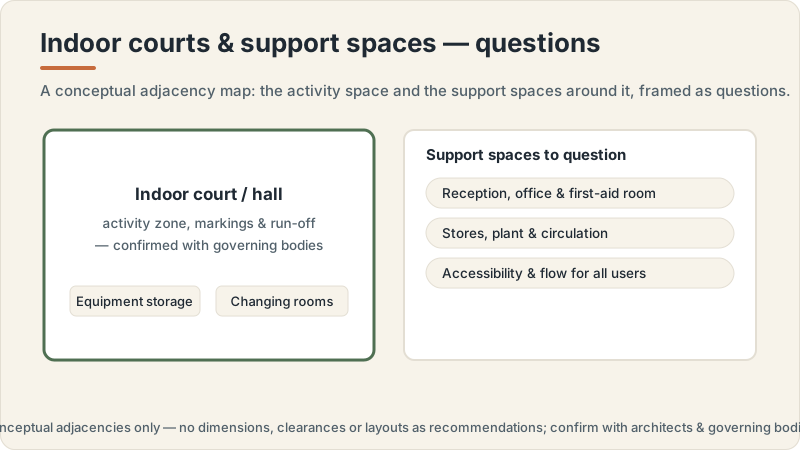
Indoor court and support-space planning concept
Conceptual editorial diagram — not a construction drawing, specification, to-scale plan or proof of a real project. It is not engineering, structural, fire/life-safety, crowd-safety or accessibility-compliance guidance. Capacities, dimensions, standards, requirements and costs vary by facility type, audience, site, use case and governing body, and are confirmed with qualified professionals, relevant authorities and governing bodies. Build Design Hub does not design, build, inspect, certify, recommend or match anyone.
What this guide helps you prepare
This guide helps you assemble the raw material of an indoor court project brief: what sports and activities you hope the space will host, who will use it and when, and the questions you cannot yet answer. It is preparation work, not design work. By the time you sit down with a qualified professional, you want a written record of your intentions, your constraints and the open questions that only a specialist, a governing body or an authority can resolve. That record makes early conversations shorter and clearer, and helps professionals understand your priorities before anyone commits to a direction.
Crucially, this guide keeps you on the owner's side of the line. It does not tell you how big a court should be, how much clearance a sport needs, how markings should be arranged, or what any code or standard requires, because those are determinations for qualified professionals and governing bodies, and they vary by location, facility type, use case, governing body, owner, site, authority, professional team and project scope. Instead, it helps you frame every one of those items as a question to raise, along with the documentation you might request so you can compare responses on a consistent basis.
- Capture the primary and secondary sports or activities you hope the space might accommodate, without assuming any of them will fit
- Record who the intended users are (age groups, ability levels, community, school, club) and how the space is expected to be used across a week
- List the open questions you cannot answer yourself and want to put to professionals, governing bodies and authorities
- Note the site and building constraints you already know about so professionals can react to real information
- Prepare a documentation wish-list so responses from professionals can be compared on a like-for-like basis
- Separate what is genuinely an owner decision (goals, priorities, budget appetite discussions) from what is a professional determination
Deciding which sports and activities the space should accommodate
The single most influential early decision for an indoor court is the range of sports and activities you hope it will support, because that intention shapes almost every conversation that follows. A space imagined only for one activity leads to very different professional discussions than a multi-sport or multi-purpose hall intended to host several sports, training, events or community use. At this stage your task is not to confirm that any given combination is feasible, which is a professional and governing-body question, but to be honest and specific about your ambitions and to rank them, so professionals understand which uses are essential and which are aspirational.
Multi-use ambitions create trade-offs, and naming them early is more useful than pretending they do not exist. Different sports may have different expectations around the playing surface, layout and markings, and combining them can raise questions that only qualified professionals and the relevant governing bodies can answer. Rather than guessing how those trade-offs resolve, write them down as questions. A clear, prioritized list of intended activities, distinguished between must-have and nice-to-have, gives the people you eventually engage a solid brief to respond to and reduces the risk of misunderstandings later.
- Which single sport or activity, if any, is the non-negotiable primary use, and which are secondary or occasional?
- Are you imagining competitive play, training, recreation, school use, community hire, events, or some combination, and in what priority order?
- Which governing bodies are associated with the sports you hope to host, and have you noted them as parties to consult rather than sources you can interpret yourself?
- How might seasonal or timetabled demand shift the mix of activities across a typical week or year (as an intention to confirm, not a demand figure to state)?
- Are there activities you would like to keep as future options even if they are not part of the initial brief?
- Have you flagged, as open questions, any combinations that you suspect may involve trade-offs for surface, layout or markings?
Run-off, clearance and markings questions to frame as owner queries
Run-off, clearances and markings are exactly the kind of topics where owners are tempted to reach for a number, and exactly where doing so is a mistake. This guide does not state any run-off distance, clearance, height, court size or marking arrangement, because those are determinations for qualified professionals and the relevant governing bodies, and they vary by location, facility type, use case, governing body, owner, site, authority, professional team and project scope. Your job in preparation is to turn each of these into a well-framed question and to identify who is the right party to answer it, whether that is a professional, an authority or a governing body.
Markings deserve particular attention in a multi-sport context because a single floor may be asked to carry the lines for several activities, and how that is approached raises questions rather than owner decisions. Instead of specifying how lines should be laid out or colored, prepare to ask how the intended combination of sports affects marking questions, what governing-body confirmation would be needed, and what documentation you should request so you understand what has been proposed and why. Keeping these as questions, backed by a request for written explanations, keeps you on the owner's side of the line and gives you material you can compare across professionals.
- What run-off and clearance questions arise from the specific sports we hope to host, and who is the right party to confirm the answers?
- What should we ask the relevant governing bodies to confirm for each intended sport, rather than assuming any figure ourselves?
- How does the intended combination of sports affect questions about markings, and what documentation should we request about the proposed approach?
- What existing site or building features should we ask professionals to assess against our intended uses?
- What written confirmations or drawings should we request so that clearance and marking decisions are documented and comparable?
- Have we recorded every clearance, run-off or marking assumption we are tempted to make as a question to confirm rather than a fact?
Planning questions before speaking with professionals
Before you approach any professional, it helps to interrogate your own brief so that the questions you bring are grounded in real intentions and constraints rather than vague hopes. This means writing down what you actually know about the site, the building or the space, your users, your timeframe appetite and your priorities, and being clear about what remains uncertain. Professionals can work far more effectively when they are reacting to a specific, honest brief than when they are trying to extract goals in the meeting itself. The aim is not to have answers to technical questions but to have sharp questions and a clear picture of your own priorities.
It also helps to decide, in advance, how you will keep track of what you learn and how you will compare responses. Different professionals may frame the same issue differently, and without a consistent structure it is hard to compare what you hear. Preparing a simple way to record questions, answers, assumptions and documentation requests, and agreeing internally on who owns the brief, protects you from drifting into treating a professional determination as though it were an owner decision. Everything technical, from surfaces to systems, should leave your side of the table as a question.
- Have we written down everything we already know about the site, building or space, and separated it from what we are guessing?
- Have we listed our intended sports and activities in priority order, and marked which are essential and which are aspirational?
- Have we turned every temptation to state a dimension, clearance, capacity, requirement or cost into a question to confirm with the right party?
- Do we know which topics belong to governing bodies, which to authorities, and which to qualified professionals?
- Have we prepared a consistent way to record questions, answers, assumptions and documentation requests so responses can be compared?
- Have we agreed internally who owns the brief and who will speak for the owner in professional conversations?
Questions for qualified professionals
When you do engage qualified professionals, the value of your preparation shows in the quality of the questions you can ask and the documentation you can request. Rather than asking a professional to validate a number you have already fixed, ask them to explain what your intended sports and activities imply, what they would need confirmed by governing bodies or authorities, and what they recommend you clarify before committing to a direction. This keeps the technical determinations where they belong and gives you a paper trail you can compare across different professionals and revisit as the project develops.
Building-systems topics such as lighting, ventilation, acoustics, temperature, accessibility and safety are outside the scope of owner decision-making and outside the scope of this guide beyond knowing what to ask and what documentation to request. For each of these, your role is to ask the relevant qualified professional what applies to your intended uses, what they would confirm and how, and what written outputs they will provide, without expecting this guide or yourself to determine calculations, thresholds, sizing or compliance. Framing every such topic as a question, paired with a documentation request, keeps the project on solid ground.
- What do our intended sports and activities imply, and what would you need confirmed by governing bodies or authorities before advising on a direction?
- What run-off, clearance and marking questions would you raise for our specific mix of uses, and how would you document the answers?
- For lighting, ventilation, acoustics, temperature, accessibility and safety, what applies to our intended uses, who determines it, and what written outputs will you provide?
- What documentation, drawings or written confirmations should we expect to receive, and at what stages?
- What assumptions in our brief would you challenge, and what should we confirm with authorities or governing bodies rather than assume?
- What risks or open questions do you see in our brief that we have not yet captured, and how should we track them?
What this does not replace
This is an educational planning resource only. It is not an indoor sports facility construction manual and not structural or architectural design, HVAC/ventilation, lighting or acoustic engineering, fire or life-safety, or accessibility-compliance advice, and it is not permit, zoning, inspection, certification, legal, tax, insurance or procurement advice. It does not design, build, engineer, specify, size, certify, inspect or approve anything, gives no capacities, dimensions, clearances, lux, air-change rates, acoustic or temperature thresholds, revenue, ROI or costs, and offers no warranty interpretation or estimate. Requirements, standards, capacities and costs vary by location, facility type, use case, governing body, owner, site, authority, professional team and project scope, and are confirmed with qualified professionals, relevant authorities and governing bodies.
Build Design Hub does not design, build, engineer, inspect, certify, recommend, rank, verify, introduce, broker or match suppliers, contractors, consultants or professionals, and HELPERG LLC is publisher/operator only. Use this resource to prepare your own thinking and briefs, then have the qualified professionals you engage directly — architects, structural and building-services engineers, lighting, acoustic, accessibility and fire/life-safety specialists, and legal or procurement advisors where appropriate — review your project. Decisions about design, engineering, systems, safety, accessibility, compliance, capacity, procurement and cost must rest on those professionals, the relevant authorities and the governing bodies for your sport and location.
- Not an indoor sports facility construction manual and not structural or architectural design
- Not HVAC/ventilation, lighting or acoustic engineering, fire/life-safety or accessibility-compliance advice
- Not permit/zoning, inspection, certification, warranty-interpretation, legal, tax, insurance or procurement advice
- Not a supplier, contractor, consultant or professional recommendation, ranking, directory or matching service
- Not an estimate and gives no capacity, dimension, system-performance, revenue, ROI or cost figures — requirements and costs vary
- Qualified professional review is required before any indoor sports facility project decision
Indoor court planning preparation worksheet
- 1Record the primary sport or activity, if any, that the space must accommodate, and mark it as an intention to confirm for feasibility
- 2List all secondary and aspirational sports or activities, in priority order, marked must-have or nice-to-have
- 3Note the intended user groups (ages, ability levels, school, club, community) and how the space is expected to be used across a week
- 4Write down everything you already know about the site, building or space, and separate it from assumptions
- 5Capture each run-off, clearance, height, size and marking topic as a question, never as a stated figure
- 6List the governing bodies associated with each intended sport, marked as parties to consult
- 7List the authorities whose confirmation may be relevant, marked as parties to confirm with
- 8Prepare a documentation wish-list (drawings, written confirmations, explanations) to request from professionals
- 9Draft the questions you want to put to lighting, ventilation, acoustics, temperature, accessibility and safety professionals, at the what-to-ask level only
- 10Set up a consistent way to record questions, answers, assumptions and documentation requests for comparison
- 11Identify which decisions are genuinely owner decisions and which are professional or governing-body determinations
- 12Agree internally who owns the brief and who will represent the owner in professional conversations
- 13Note any future-use options you want to keep open, distinct from the initial brief
- 14Compile a register of open questions and risks you have not yet resolved, with the party responsible for answering each
Common mistakes to avoid
- Stating a court size, run-off, clearance or ceiling height as a fixed fact instead of a question to confirm with governing bodies and professionals
- Assuming a set of sports can share one space and one set of markings without confirming with qualified professionals
- Treating governing-body rules as something you can interpret yourself rather than confirm directly with the governing body
- Fixing a capacity, usage-demand figure or timeline early and presenting it to professionals as settled
- Treating a building-systems decision (lighting, ventilation, acoustics, temperature) as an owner choice rather than a professional determination
- Skipping professional and authority review because an idea seems simple or obviously feasible
- Bringing vague goals to a professional meeting instead of a prioritized, written brief with clear open questions
- Failing to request written documentation, so responses from different professionals cannot be compared consistently
When to involve a professional
- When intended sports and activities need to be assessed against a specific site, building or space for feasibility
- When run-off, clearance, height, size or marking questions arise for any intended use
- When multiple sports are to share one space or one floor and markings must be considered together
- When any building system is involved, including lighting, ventilation, acoustics, temperature, accessibility or safety
- When governing-body confirmation, authority sign-off, permits, codes or accessibility questions are in play
- Before committing to any direction, budget appetite or timeline that depends on technical determinations
Frequently asked questions
Questions readers ask about this topic
Does Build Design Hub design, build or plan indoor courts, or recommend suppliers and contractors?
No. Build Design Hub is an educational resource only. It does not design, build, engineer, inspect, certify or plan indoor courts, does not design lighting, ventilation, acoustic or other building systems, and does not recommend, rank, verify or match suppliers, contractors or professionals. It also gives no capacities, dimensions, clearances, costs or requirements. This guide only helps you prepare questions and documentation requests for qualified professionals, authorities and governing bodies.
Why won't this guide tell me the run-off, clearance or court size for a sport?
Because those are determinations for qualified professionals and the relevant governing bodies, and they vary by location, facility type, use case, governing body, owner, site, authority, professional team and project scope. Stating a figure here could mislead your planning. Instead, this guide helps you frame each one as a question to confirm with the right party and to document.
How should I handle markings if I want several sports on one floor?
Treat it as a set of questions rather than an owner decision. Record the sports you hope to host in priority order, then ask qualified professionals how that combination affects marking questions and what governing-body confirmation would be needed, and request written explanations of any proposed approach so you can compare responses. This guide does not specify how markings should be arranged.
What is the most useful thing to prepare before speaking with professionals?
A clear, prioritized written brief: the sports and activities you hope to accommodate, your intended users and uses, what you already know about the site, and a list of the open questions you cannot answer yourself. Pair it with a documentation wish-list so responses from different professionals can be compared consistently.
Keep reading