
Who this guide is for
- Owners, clubs, schools and municipalities exploring a shared indoor space that must serve several sports
- Facility managers scoping how one hall or court can be programmed across multiple activities
- Developers and project teams assembling a brief before commissioning qualified professionals
- Community and leisure operators preparing stakeholder discussions about multi-use overlay marking
- Sports club committees and school estates leads researching what questions to raise with governing bodies
- Anyone comparing supplier or contractor proposals and wanting a neutral structure for questions
Planning diagram
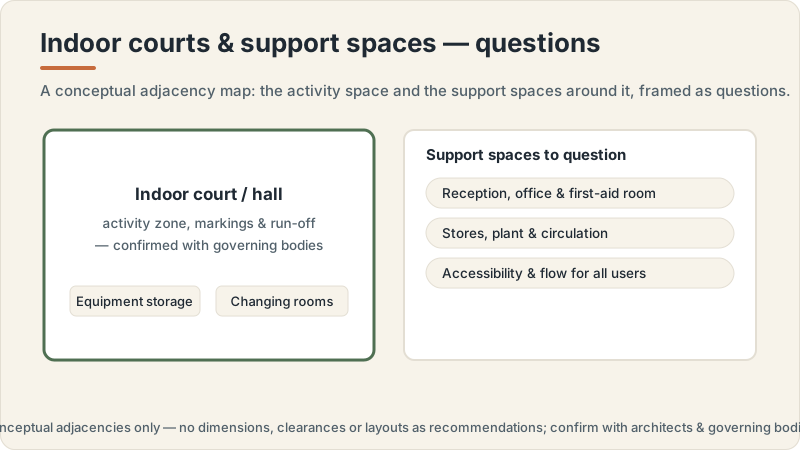
Indoor court and support-space planning concept
Conceptual editorial diagram — not a construction drawing, specification, to-scale plan or proof of a real project. It is not engineering, structural, fire/life-safety, crowd-safety or accessibility-compliance guidance. Capacities, dimensions, standards, requirements and costs vary by facility type, audience, site, use case and governing body, and are confirmed with qualified professionals, relevant authorities and governing bodies. Build Design Hub does not design, build, inspect, certify, recommend or match anyone.
What this guide helps you prepare
This guide helps you assemble the raw material for a multi-sport court project before any professional is engaged: a written list of the sports you hope to accommodate, the priority order among them, the user groups who will share the space, and the operational patterns that will drive how often the room changes activity. Having these captured in plain language lets you brief architects, sports consultants, marking specialists and governing-body contacts efficiently, and lets you compare proposals against a consistent set of stated intentions rather than against a moving target in your head.
It also helps you separate decisions that are genuinely yours as the owner or operator from decisions that belong to qualified professionals and governing bodies. Which sports matter most and how the space will be programmed are owner-side inputs; whether a given overlay is acceptable for competition, how markings must be configured, and whether a floor or fit-out is suitable are questions for the appropriate specialists and authorities. The aim is to arrive at those conversations organised, honest about what you do not yet know, and ready to ask rather than assume.
- A written, prioritised list of every sport you want the space to host, and which are essential versus aspirational
- The user groups involved (school, community, club, competitive, casual) and how their needs may differ
- Your expectations for how frequently the room changes between activities during a typical week
- A record of open questions you cannot answer yourself and intend to confirm with professionals or governing bodies
- A neutral structure for comparing supplier or contractor proposals against the same stated intentions
- Notes on which stakeholders must be consulted before any layout direction is settled
Sharing one floor across sports: overlay and marking questions
An overlay court means several sports are marked on, or configured for, the same floor, so the central planning tension is legibility: how do multiple sets of markings coexist without confusing players, officials or spectators, and which sport's layout takes visual priority when they overlap. These are not questions to resolve from a template. Colour conventions, permitted marking arrangements, and what a governing body will accept for its sport vary by sport, by level of play and by the specific authority, so every marking assumption should be logged as a question for the relevant governing body and a qualified marking or sports-flooring specialist rather than decided in the brief.
It also helps to think early about tolerance for compromise. A space that hosts many sports may serve none of them in exactly the configuration each purist would prefer, and different governing bodies may have different views on shared or overlaid markings. Recording where you are willing to accept trade-offs, and where a sport is non-negotiable for your programme, gives professionals the information they need to advise you honestly and gives you a basis for realistic expectations. Do not treat any specific colour, arrangement, dimension or acceptability as settled until it is confirmed by the appropriate governing body and specialist.
- Which sports must be playable for competition versus which only need a training or recreational configuration?
- For each sport, which governing body's guidance should be confirmed, and who will make that contact?
- How will overlapping markings be kept legible, and whose sign-off does the marking approach depend on?
- Where is compromise acceptable, and which sport (if any) is non-negotiable for your programme?
- What documentation should be requested from a marking or flooring specialist to record what was agreed?
- Have colour, arrangement and acceptability assumptions been logged as questions rather than stated as facts?
Changeover, compatibility and operating the shared space
Beyond markings, a multi-sport court has to change from one activity to the next in real operating conditions, and how smoothly that happens shapes daily life for the people running the facility. Changeover involves equipment being moved, stored, set up and put away, and the practical questions are about who does that work, how long the space is out of use during transitions, where equipment lives when it is not deployed, and how the schedule absorbs the switching. These are operational and programming questions for you and your team to think through, and equipment-handling or storage suitability questions to raise with the appropriate professionals.
Compatibility is the quieter risk. Two sports that each work well alone may conflict when they share a floor because of how they mark, how they use the space, or how their governing bodies view overlay. Rather than assume compatibility, treat every pairing as something to test with the relevant specialists and governing bodies, and keep a simple record of which combinations have been confirmed workable, which are still open, and which have been ruled out. This turns a vague hope that everything will fit into a documented set of decisions your professional team can review and challenge.
- Who is responsible for changeover between activities, and how does that affect the weekly schedule?
- Where will equipment be stored when not in use, and is that arrangement being confirmed with a professional?
- Which sport pairings have been confirmed compatible, which are open, and which are ruled out?
- How much downtime between activities is acceptable for your programme, and who validated that assumption?
- What handling, storage or setup questions should be directed to qualified professionals rather than assumed?
- Is there a written record of compatibility decisions that professionals and governing bodies can review?
Planning questions before speaking with professionals
Before engaging an architect, sports consultant, marking specialist or governing-body contact, it is worth working through the questions you can answer yourself so that professional time is spent on genuine expertise rather than on gathering basics you could have supplied. This means being clear about your sports mix and its priority order, your user groups, your programming intentions, and the constraints you already know about the space or the project. The stronger this internal preparation, the sharper the advice you receive and the easier it is to compare one proposal against another.
It also means being honest about what you cannot answer and must confirm externally. Anything touching rules, acceptable markings, competition suitability, or building systems belongs with the appropriate professional or governing body, and should be carried into those conversations as an explicit question. Resisting the urge to guess at these points, and instead logging them for confirmation, is one of the most useful things a project team can do at the preparation stage.
- Have you written down every sport, in priority order, and distinguished essential from aspirational?
- Have you identified every user group and noted where their needs may pull in different directions?
- Have you captured what you already know about the space and the project constraints in plain language?
- Have you separated owner-side decisions from decisions that belong to professionals and governing bodies?
- Have you listed the assumptions you must confirm, rather than treating any of them as settled fact?
- Have you decided who on your side owns each governing-body and specialist conversation?
Questions for qualified professionals
When you reach qualified professionals, the goal is to ask focused questions and request documentation, not to arrive expecting this guide to have pre-answered technical matters. Overlay acceptability, marking configuration, floor and fit-out suitability, and anything involving building systems such as lighting, ventilation, acoustics, temperature, accessibility or safety are all matters for the relevant specialists and authorities to determine for your specific project. Keep your questions at the level of what to ask and what to request in writing, and let the professional supply the calculations, thresholds, specifications and compliance positions.
Requirements vary by location, facility type, use case, governing body, owner, site, authority, professional team and project scope, and must be confirmed with qualified professionals. Ask each professional to state clearly what they are and are not taking responsibility for, what governing-body or authority sign-offs your project depends on, and what documentation they will hand over so that decisions are recorded rather than remembered. That documentation trail is what protects your project through handover and its later life.
- Which governing bodies and authorities must sign off elements of this project, and who confirms that?
- What is your professional judgement on the overlay and marking approach for the sports we have listed?
- What documentation will you provide recording what was agreed, and what remains the owner's decision?
- Which building-systems questions (lighting, ventilation, acoustics, temperature, accessibility, safety) fall to which specialist?
- What are you explicitly not taking responsibility for on this project, so we can direct that elsewhere?
- What should we request in writing at handover to support the facility's later operation and lifecycle?
What this does not replace
This is an educational planning resource only. It is not an indoor sports facility construction manual and not structural or architectural design, HVAC/ventilation, lighting or acoustic engineering, fire or life-safety, or accessibility-compliance advice, and it is not permit, zoning, inspection, certification, legal, tax, insurance or procurement advice. It does not design, build, engineer, specify, size, certify, inspect or approve anything, gives no capacities, dimensions, clearances, lux, air-change rates, acoustic or temperature thresholds, revenue, ROI or costs, and offers no warranty interpretation or estimate. Requirements, standards, capacities and costs vary by location, facility type, use case, governing body, owner, site, authority, professional team and project scope, and are confirmed with qualified professionals, relevant authorities and governing bodies.
Build Design Hub does not design, build, engineer, inspect, certify, recommend, rank, verify, introduce, broker or match suppliers, contractors, consultants or professionals, and HELPERG LLC is publisher/operator only. Use this resource to prepare your own thinking and briefs, then have the qualified professionals you engage directly — architects, structural and building-services engineers, lighting, acoustic, accessibility and fire/life-safety specialists, and legal or procurement advisors where appropriate — review your project. Decisions about design, engineering, systems, safety, accessibility, compliance, capacity, procurement and cost must rest on those professionals, the relevant authorities and the governing bodies for your sport and location.
- Not an indoor sports facility construction manual and not structural or architectural design
- Not HVAC/ventilation, lighting or acoustic engineering, fire/life-safety or accessibility-compliance advice
- Not permit/zoning, inspection, certification, warranty-interpretation, legal, tax, insurance or procurement advice
- Not a supplier, contractor, consultant or professional recommendation, ranking, directory or matching service
- Not an estimate and gives no capacity, dimension, system-performance, revenue, ROI or cost figures — requirements and costs vary
- Qualified professional review is required before any indoor sports facility project decision
Multi-sport court preparation worksheet
- 1Record every sport the space should host, in priority order, marking each essential or aspirational
- 2List all user groups (school, club, community, competitive, casual) and note where their needs diverge
- 3Write down what you already know about the space and project constraints in plain language
- 4For each sport, note which governing body should be consulted and who owns that conversation
- 5Log every marking, colour and overlay assumption as a question to confirm, not as a stated fact
- 6Record your expected weekly changeover frequency and who is responsible for transitions
- 7Note where equipment will be stored and which storage questions need professional input
- 8Build a compatibility register: pairings confirmed, pairings open, pairings ruled out
- 9Gather the documentation you intend to request from marking, flooring and other specialists
- 10List building-systems topics (lighting, ventilation, acoustics, temperature, accessibility, safety) to route to the right professional
- 11Note where you are willing to compromise and which sport, if any, is non-negotiable
- 12Prepare a neutral question set so supplier and contractor proposals can be compared consistently
- 13Record what each professional will and will not take responsibility for
- 14List the handover documentation you want in writing to support later operation and lifecycle
Common mistakes to avoid
- Stating a specific court dimension, clearance, capacity or marking colour as fixed instead of confirming it with a governing body and specialist
- Assuming two sports are compatible on one floor without testing the pairing with the relevant professionals and governing bodies
- Treating a building-systems decision (lighting, ventilation, acoustics, temperature) as the owner's call rather than a professional's determination
- Believing overlay markings are acceptable for competition without confirming with each sport's governing body
- Locking in a sports mix without a priority order, so professionals cannot advise where to compromise
- Skipping the compatibility and changeover questions and discovering conflicts only after the space is in use
- Proceeding without professional review because the plan looks simple on paper
- Failing to record decisions and documentation, so agreements live only in memory rather than in writing
When to involve a professional
- When the acceptability of any overlay or marking arrangement for competition needs confirming with a governing body or specialist
- When a floor, surface or fit-out's suitability for multiple sports must be assessed rather than assumed
- When building-systems questions (lighting, ventilation, acoustics, temperature, accessibility, safety) arise and need specialist determination
- When two or more sports' requirements appear to conflict and the trade-off needs professional judgement
- When permits, codes, zoning, inspection, certification or governing-body sign-off may apply to the project
- When comparing supplier or contractor proposals that make technical claims you cannot independently verify
Frequently asked questions
Questions readers ask about this topic
Does Build Design Hub design, build, mark or certify a multi-sport court for me?
No. Build Design Hub is an educational resource. It does not design, build, engineer, inspect, certify, mark or convert any facility, and it does not design lighting, ventilation, acoustic, temperature or accessibility systems. It also does not recommend, rank, verify, introduce, broker or match suppliers, contractors or professionals. This guide only helps you prepare questions and a brief to take to qualified professionals and the relevant governing bodies.
Can this guide tell me the correct dimensions, marking colours or how many sports can share one floor?
No. This guide states no dimensions, clearances, capacities, marking rules, colours, timelines or costs as fact. Those depend on your location, facility type, use case, governing body, owner, site, authority, professional team and project scope, and must be confirmed with qualified professionals and the applicable governing bodies. Treat every such figure as a question to raise, not an answer to adopt.
How do I know whether two sports can genuinely share the same court?
Treat compatibility as something to test rather than assume. Record each sport pairing you are considering, then raise it with the relevant governing bodies and qualified specialists who can assess overlay, marking and floor suitability for your specific project. Keep a written register of which pairings have been confirmed, which are still open and which have been ruled out.
Who decides the building-systems questions like lighting, ventilation or acoustics?
Those are matters for qualified professionals, not for you to settle in a brief and not for this guide to specify. Use this material to prepare what to ask and what documentation to request; let the appropriate specialist supply any calculations, thresholds, specifications and compliance positions for your project and site.
Keep reading