
Who this guide is for
- Owners and developers scoping an indoor sports hall or multi-purpose training space and preparing an early project brief
- Sports clubs and community organisations planning a shared hall who need to describe how they intend to use it
- Schools and education bodies preparing to brief architects on a teaching and activity hall
- Municipalities and public-sector project teams gathering layout questions before consultant appointments
- Facility managers and operators who will run the building and want circulation and support-space issues raised early
- Project managers and steering groups assembling stakeholder input ahead of design workshops
Planning diagram
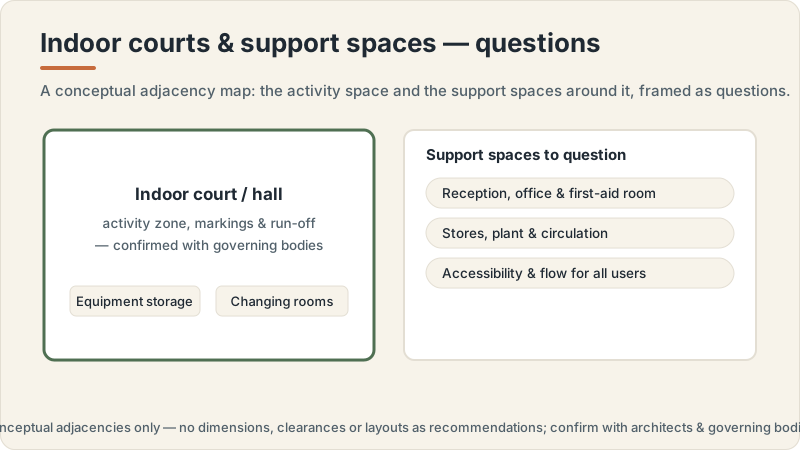
Indoor court and support-space planning concept
Conceptual editorial diagram — not a construction drawing, specification, to-scale plan or proof of a real project. It is not engineering, structural, fire/life-safety, crowd-safety or accessibility-compliance guidance. Capacities, dimensions, standards, requirements and costs vary by facility type, audience, site, use case and governing body, and are confirmed with qualified professionals, relevant authorities and governing bodies. Build Design Hub does not design, build, inspect, certify, recommend or match anyone.
What this guide helps you prepare
This guide helps you arrive at layout conversations able to describe how you expect the hall to work, so the professionals you appoint can respond to a clear picture rather than reconstruct one. It focuses on the relationships between spaces — the activity zone, the routes people take, the lines of sight from one area to another, and the support rooms that need to sit near the action — and turns each into something you can ask about. It does not tell you how those relationships should be resolved; that is design work for a qualified architect and wider team, informed by your site, your intended uses and the requirements that apply to you.
The aim is a better brief and better questions, not a layout. By separating what you know (how you intend to use the hall, who the users are, when it is busy) from what must be confirmed by professionals (arrangements, sizes, clearances, compliance), you make it easier for your design team to test options and explain trade-offs. Treat everything below as prompts to discuss and confirm with qualified professionals, relevant authorities and governing bodies, whose input governs the actual decisions.
- Record the activities you expect the hall to host and the user groups for each, without assuming any of them sets a fixed layout.
- List the times of day and typical patterns of use you anticipate, and note where several activities may need to coexist.
- Note which support functions (changing, storage, reception, officials, first-aid-provision space) you expect to be needed, as items to discuss — not sized.
- Capture questions about how zones, routes and sightlines should relate, framed for your architect rather than answered yourself.
- Keep a running list of matters you have been told must be confirmed with qualified professionals, authorities or governing bodies.
- Distinguish your operational intentions from any technical decision, so nothing you record is mistaken for a design instruction.
Framing activity zones, circulation and sightlines as questions
An indoor sports hall's layout is largely a story about zones and the movement between them: where activity happens, how people reach it, and what can be seen from where. Owners often find it helpful to describe their intended zones in plain terms — a main activity area, spaces that may need to be divided or shared, spectator or waiting positions, and the routes connecting them — and then hand those descriptions to the design team as questions. How zones are arranged, whether and how a space can be subdivided, and what that implies for circulation are design questions, and any dimensions, clearances or run-offs involved must be confirmed with qualified professionals and the relevant governing bodies, because requirements vary by facility type, use case, authority and project scope.
Circulation and sightlines deserve their own prompts because they shape daily experience and are easy to overlook in an early brief. You might want to describe how you imagine users, spectators, officials and staff moving through the building, and where being able to see the activity matters — for supervision, for spectating, or for coordinating shared use. Those are things to raise, not resolve. Whether a described flow works, whether a sightline is achievable, and how any of it interacts with fire, life-safety, accessibility or governing-body requirements are matters for your professional team and the relevant authorities; this guide only helps you ask.
- Which activities do you expect in the main space, and which of those might need the space to be divided or shared at the same time?
- How do you imagine different groups — participants, spectators, officials, staff — arriving at and moving through the hall on a busy day?
- Where does being able to see the activity matter to you, and who needs that line of sight (supervision, spectating, coordination)?
- Are there arrival, waiting or spectator positions you want the architect to consider, framed as intentions rather than fixed locations?
- What questions should you put to your architect about how zones and routes relate, without proposing dimensions, clearances or arrangements yourself?
- Which of these zoning and circulation ideas has a professional told you must be confirmed against governing-body or authority requirements?
Support-space adjacencies and shared-use flexibility
Much of how a sports hall runs comes down to what sits next to what. Changing spaces, storage for equipment, reception or control positions, officials' and first-aid-provision areas, and access for deliveries all have relationships to the activity zone and to each other that an owner can describe long before any layout exists. It is useful to note which adjacencies you believe matter — for example, that you would like to discuss how storage relates to the activity area, or how changing and entry routes interact — and to carry those as questions. Whether an adjacency is achievable, advisable or required is a matter for your architect and the relevant authorities; this guide does not state that any particular arrangement is correct, and any sizes or provisions must be confirmed with qualified professionals and governing bodies.
Shared and flexible use is where support-space thinking pays off, and where owners can add the most value to a brief by being clear about intent. If you expect the hall to switch between activities, host simultaneous groups, or serve both a club and a school, say so and let the design team work out what that implies for the arrangement of supporting spaces and routes. Flexibility itself is a design outcome, not something to specify here. Describe the operating patterns you foresee, list the adjacencies you want examined, and treat every implied dimension, capacity or compliance point as something to confirm with qualified professionals and the relevant authorities and governing bodies.
- Which support spaces (changing, storage, reception/control, officials, first-aid provision, deliveries) do you expect the hall to need, listed as topics not sizes?
- Which adjacencies do you want your architect to examine — for example how storage, changing or entry routes relate to the activity zone?
- How do you expect the hall to switch between activities or host simultaneous groups, described as operating intent for the team to interpret?
- If a club, school or community use share the building, what access or separation questions do you want raised for the design team?
- What documentation would you ask a professional to provide about how support-space and accessibility matters have been addressed?
- Which adjacency or shared-use assumptions have you been advised must be verified against authority, governing-body or accessibility requirements?
Planning questions before speaking with professionals
Before you meet architects or other professionals, it helps to organise what only you can supply: how the hall is meant to be used, by whom, and when. This is the material a design team cannot invent — your activity mix, your user groups, your busy periods, the identities that will share the building, and the operational irritations you want to avoid. Gathering it into a clear, honest picture, without slipping into proposed dimensions or arrangements, gives your later conversations a firm starting point. Keep in mind that none of it sets a requirement: everything technical remains to be confirmed with qualified professionals, authorities and governing bodies.
It also helps to separate settled intentions from open questions and to flag where you already suspect professional input is essential. Being explicit that a topic is a question rather than a decision keeps the brief honest and keeps you from anchoring the design prematurely. The prompts below are for your own preparation and stakeholder discussions; they are not a design exercise, and any figure, arrangement or compliance point they touch on should be treated as something to confirm rather than assume.
- Have you written down every activity and user group you expect the hall to serve, without assigning any of them a fixed layout?
- Have you described your busy periods and any moments when several activities must coexist, as intent rather than requirement?
- Have you listed the support functions you anticipate and the adjacencies you want discussed, as topics for the design team?
- Have you noted where sightlines, supervision or spectating matter to you, framed as questions for your architect?
- Have you separated your settled operating intentions from the open questions you know need professional input?
- Have you gathered stakeholder views (club, school, operator, community) into a single brief so trade-offs can be discussed openly?
Questions for qualified professionals
When you engage architects, engineers and other qualified professionals, your role shifts from describing intent to asking well-formed questions and requesting the right documentation. The most useful questions ask how proposed arrangements relate to your intended uses, what options exist, what trade-offs each carries, and how the design addresses the requirements that apply to your project — rather than asking the professional to confirm a layout you have drawn yourself. Requirements vary by location, facility type, use case, governing body, owner, site, authority, professional team and project scope, so the answers you receive belong to your professionals and the relevant authorities, not to this guide.
Building-systems and compliance matters — fire and life-safety, accessibility, ventilation, lighting, acoustics and structure — should stay at the level of what to ask and what documentation to request. It is reasonable to ask how each has been considered, who is responsible, what standards or authorities govern them, and how they interact with the layout; it is not the owner's place to specify thresholds, sizes or system designs, and this guide makes no such claims. Use the prompts below to structure those conversations, and record the responses and documents so your team and any authority can trace how decisions were reached.
- How does the proposed arrangement of zones, circulation and sightlines respond to the intended uses I described, and what options and trade-offs exist?
- How have fire, life-safety and accessibility matters been considered in the layout, who is responsible for them, and which authorities or standards govern them?
- How do support-space adjacencies and any shared-use flexibility in the design relate to the operating patterns I set out?
- What documentation can you provide showing how ventilation, lighting, acoustic and structural matters have been addressed, and what remains to be confirmed with authorities?
- Which decisions depend on governing-body, authority or code requirements that I should not assume, and how will those be verified?
- What should I record at each stage so the reasoning behind layout and support-space decisions is traceable through design, approvals and handover?
What this does not replace
This is an educational planning resource only. It is not an indoor sports facility construction manual and not structural or architectural design, HVAC/ventilation, lighting or acoustic engineering, fire or life-safety, or accessibility-compliance advice, and it is not permit, zoning, inspection, certification, legal, tax, insurance or procurement advice. It does not design, build, engineer, specify, size, certify, inspect or approve anything, gives no capacities, dimensions, clearances, lux, air-change rates, acoustic or temperature thresholds, revenue, ROI or costs, and offers no warranty interpretation or estimate. Requirements, standards, capacities and costs vary by location, facility type, use case, governing body, owner, site, authority, professional team and project scope, and are confirmed with qualified professionals, relevant authorities and governing bodies.
Build Design Hub does not design, build, engineer, inspect, certify, recommend, rank, verify, introduce, broker or match suppliers, contractors, consultants or professionals, and HELPERG LLC is publisher/operator only. Use this resource to prepare your own thinking and briefs, then have the qualified professionals you engage directly — architects, structural and building-services engineers, lighting, acoustic, accessibility and fire/life-safety specialists, and legal or procurement advisors where appropriate — review your project. Decisions about design, engineering, systems, safety, accessibility, compliance, capacity, procurement and cost must rest on those professionals, the relevant authorities and the governing bodies for your sport and location.
- Not an indoor sports facility construction manual and not structural or architectural design
- Not HVAC/ventilation, lighting or acoustic engineering, fire/life-safety or accessibility-compliance advice
- Not permit/zoning, inspection, certification, warranty-interpretation, legal, tax, insurance or procurement advice
- Not a supplier, contractor, consultant or professional recommendation, ranking, directory or matching service
- Not an estimate and gives no capacity, dimension, system-performance, revenue, ROI or cost figures — requirements and costs vary
- Qualified professional review is required before any indoor sports facility project decision
Indoor sports hall layout preparation worksheet
- 1Record every activity you expect the hall to host and the user group tied to each, without assigning any fixed layout or size.
- 2Note the times of day and use patterns you anticipate, flagging any moments when activities must coexist.
- 3List the support functions you expect (changing, storage, reception/control, officials, first-aid provision, deliveries) as topics, not dimensions.
- 4Write down the support-space adjacencies you want your architect to examine, framed as questions.
- 5Describe how you imagine participants, spectators, officials and staff moving through the building on a busy day.
- 6Note where sightlines matter to you and who needs them (supervision, spectating, coordination), as prompts for the design team.
- 7Capture how you expect the hall to switch between activities or serve shared club, school or community use.
- 8Gather stakeholder views into a single brief so trade-offs between groups can be discussed openly.
- 9Separate your settled operating intentions from the open questions you know require professional input.
- 10Keep a running register of matters you have been told must be confirmed with qualified professionals, authorities or governing bodies.
- 11Prepare questions asking how proposed arrangements relate to your uses, rather than proposing arrangements yourself.
- 12List the documentation you intend to request from professionals about building-systems and accessibility considerations.
- 13Record who is responsible for each building-systems and compliance topic as the design team clarifies it.
- 14Maintain a decision log so the reasoning behind layout and support-space choices stays traceable through design and handover.
Common mistakes to avoid
- Writing dimensions, clearances, run-offs or capacities into the brief as if they were fixed, rather than questions to confirm with qualified professionals and governing bodies.
- Assuming a particular zone arrangement or support-space location is correct before any design work or authority input has taken place.
- Treating a building-systems decision — ventilation, lighting, acoustics, structure — as the owner's to specify instead of a professional's to design.
- Presenting an activity mix or usage pattern as a requirement rather than as operational intent for the design team to interpret.
- Skipping professional and authority review of fire, life-safety, accessibility or code matters and assuming a layout is compliant.
- Locking in a sightline, adjacency or circulation route as a decision before the design team has tested whether it is achievable.
- Collecting stakeholder wishes without separating settled intentions from open questions, which anchors the design prematurely.
- Assuming shared or flexible use will simply work without raising it as a question about supporting spaces and routes.
When to involve a professional
- When any layout question touches dimensions, clearances, run-offs, capacities or spatial arrangements — these belong to qualified professionals and governing bodies.
- When fire, life-safety, accessibility, structural, ventilation, lighting or acoustic matters arise — involve the relevant qualified professionals and authorities.
- When you need to know which codes, authorities or governing-body requirements apply to your facility type, use case and location.
- When shared, flexible or multi-user operation raises questions about support-space arrangements and circulation that affect the design.
- When you are ready to translate your brief into an actual layout, feasibility or compliance assessment for the site.
- When documentation, approvals or handover records must demonstrate how layout and building-systems decisions were reached and verified.
Frequently asked questions
Questions readers ask about this topic
Does this guide tell me how to lay out my indoor sports hall or how big each space should be?
No. It offers questions to raise with your design team about zones, circulation, sightlines and support-space adjacencies. It states no dimensions, clearances, capacities or arrangements. Requirements vary by location, facility type, use case, governing body, owner, site, authority, professional team and project scope, and must be confirmed with qualified professionals.
Does Build Design Hub design, build, engineer, inspect or certify sports halls, or recommend suppliers and contractors?
No. Build Design Hub is an educational publisher operated by HELPERG LLC. It does not design, build, engineer, inspect or certify facilities; it does not design HVAC, lighting or acoustic systems; and it does not recommend, rank, verify or match suppliers, contractors or professionals. It provides no capacities, dimensions, costs or requirements. Appoint qualified professionals for all such work.
Can I use this guide to decide the ventilation, lighting or acoustics for the hall?
No. Those are building-systems matters for qualified professionals to design. This guide only helps you prepare what to ask and what documentation to request. It does not provide calculations, thresholds, sizing, product specifications, system designs or compliance claims for any building system.
How should I treat the layout ideas I bring to my architect?
Treat them as intentions and questions, not decisions. Describe how you expect the hall to be used and which adjacencies and sightlines matter to you, then let qualified professionals determine what is achievable and compliant. Confirm anything involving figures, arrangements or codes with your professional team and the relevant authorities and governing bodies.
Keep reading