
Who this guide is for
- Owners, clubs, and community groups scoping an indoor sports hall, gym, or multi-purpose space
- Schools, colleges, and municipalities planning shared or multi-sport indoor facilities
- Facility managers preparing to renew, refurbish, or re-scope an existing indoor surface
- Developers and project teams assembling an early brief for professional and supplier engagement
- Trustees, committees, and finance decision-makers structuring stakeholder discussions and quote comparisons
- Anyone preparing supplier and specialist research questions before commissioning any work
Planning diagram
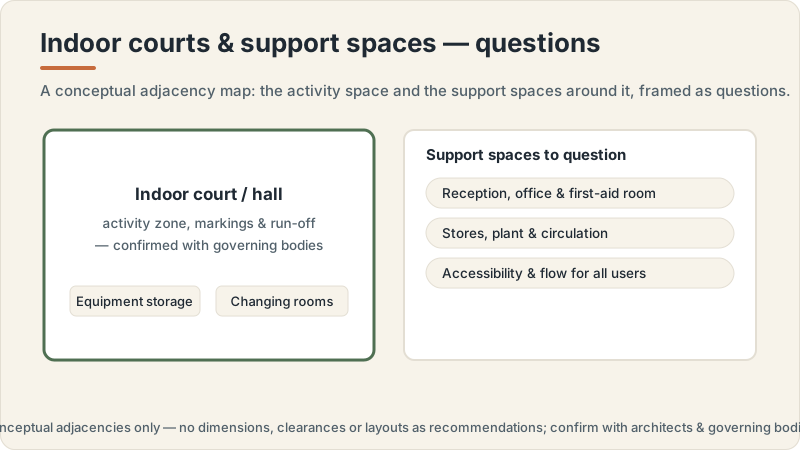
Indoor court and support-space planning concept
Conceptual editorial diagram — not a construction drawing, specification, to-scale plan or proof of a real project. It is not engineering, structural, fire/life-safety, crowd-safety or accessibility-compliance guidance. Capacities, dimensions, standards, requirements and costs vary by facility type, audience, site, use case and governing body, and are confirmed with qualified professionals, relevant authorities and governing bodies. Build Design Hub does not design, build, inspect, certify, recommend or match anyone.
What this guide helps you prepare
This guide helps you turn a vague intention such as "we need a floor for the sports hall" into a structured, question-led brief that a professional team and prospective suppliers can respond to meaningfully. It focuses on the preparation stage: clarifying who will use the space, what activities need to coexist, how the surface must be cleaned and maintained, and which decisions belong to qualified specialists rather than to the owner. A well-prepared brief tends to produce clearer conversations, more comparable quotes, and fewer surprises later.
It is important to be clear about the boundary. This guide does not select a surface, does not state which category performs best, and does not provide performance figures, tolerances, dimensions, or maintenance schedules. Those depend on your specific activities, governing-body expectations, site conditions, and professional assessment. Instead, this guide gives you the vocabulary and the questions so that you can brief architects, specifiers, flooring specialists, and other professionals well, and so that you can compare their responses on a consistent basis.
- Record the primary sports and secondary activities the space must accommodate, and note any that conflict
- Capture who the stakeholders are: users, staff, maintenance teams, hire groups, and decision-makers
- List the questions you cannot answer yourself and flag them for professional input
- Note whether this is new-build, refurbishment, or renewal, since that shapes who you consult
- Gather any existing governing-body guidance your sports may reference, to raise with specialists
- Decide what a comparable quote from a supplier would need to contain to be useful to you
High-level categories of indoor sports surface
At an owner-brief level it helps to understand that indoor sports surfaces fall into broad families rather than a single product. Commonly discussed categories include timber and engineered wood systems, resilient synthetic sheet or poured systems, modular or interlocking panel systems, textile or carpet-style surfaces, and combination build-ups that layer a wear surface over a resilient sub-construction. Each family is described differently by different suppliers, and the same word can mean different things, so part of your preparation is simply learning which category a supplier is proposing and why.
These categories differ in how they are generally talked about in terms of feel, durability, cleaning approach, sensitivity to moisture or environment, and suitability for mixed use. This guide does not assign performance ratings or declare one category superior, because suitability depends entirely on your activities, your site, your maintenance capacity, and professional assessment. The goal here is to recognise the categories so you can ask a supplier to state clearly which family their proposal belongs to, and to have a qualified professional evaluate whether it fits your brief.
- Ask each supplier to state plainly which surface category or build-up their proposal falls into
- Ask how that category is typically described for feel, wear, and mixed-use, without treating claims as guarantees
- Note where the same term is used differently by different suppliers and ask them to define it
- Ask what environmental sensitivities (moisture, temperature, humidity) the category is said to have, to confirm with professionals
- Record which categories your governing bodies or user groups already reference, and raise these with specialists
- Avoid ranking categories yourself; capture the trade-offs each supplier describes and route them to professional review
Performance, maintenance, and suitability questions to explore
Once you understand the categories, the more useful work is framing the performance, maintenance, and suitability questions that a surface decision hinges on. Performance covers how a surface is described in relation to the activities you plan, but any figure, rating, or claim should be confirmed with qualified professionals and read against the expectations of your governing bodies rather than accepted at face value. Suitability is not a property of the surface alone; it is the fit between the surface, your intended uses, your site, your environmental conditions, and how the space will actually be operated day to day.
Maintenance is often underweighted at the brief stage and then dominates the lived experience of a facility. Different categories are cleaned and cared for differently, and the labour, equipment, and frequency implied by a surface can shape whether it stays fit for purpose. Rather than assuming a maintenance regime or accepting a schedule as fixed, prepare to ask suppliers and specialists what ongoing care a surface is said to need, what documentation they will provide, and how the surface behaves over its life. Keep all of this framed as questions to confirm, not as settled facts.
- Ask how a proposed surface is described for your specific mix of activities, and what evidence supports that
- Ask what ongoing cleaning and maintenance the category is said to need, and who is expected to carry it out
- Ask what documentation, care guidance, and handover materials will accompany the surface
- Ask how the surface is described as behaving over time, and what affects its longevity, to confirm with professionals
- Ask which claims are supplier statements versus governing-body or independent references you should verify
- Record who on your team will own maintenance, and whether that capacity realistically matches the category
Planning questions before speaking with professionals
Before you engage a professional team, it pays to answer the questions only you can answer, because these define the brief that everyone else responds to. This is internal preparation: understanding your activities, your users, your operating model, your constraints, and your decision-making process. The clearer you are here, the more focused and comparable the professional and supplier responses will be, and the less likely you are to pay for rework caused by a moving brief.
Work through these prompts with your own stakeholders first and write the answers down. Where you find you cannot answer something, that is not a gap to guess at but a question to route to the right professional. Keep a running list of open items, assumptions you have not verified, and decisions you suspect belong to specialists rather than to you, so that your first professional conversation starts from a position of clarity.
- What sports and activities must share this space, and which combinations are non-negotiable?
- Who are the primary and secondary user groups, and how often and intensively will they use it?
- Who will clean and maintain the surface, with what equipment, and how frequently is realistic?
- Is this new construction, a refurbishment, or a like-for-like renewal, and what constraints does that impose?
- What governing-body guidance do our sports reference that we should hand to professionals to interpret?
- What internal decisions, approvals, and budget-holders sit between us and committing to a surface?
Questions for qualified professionals
When you move from internal preparation to professional conversations, your role shifts to asking well and listening for what belongs to the specialist. Architects, specifiers, flooring specialists, and relevant engineers assess your site, your build-up, your environmental conditions, and the applicable requirements. Requirements vary by location, facility type, use case, governing body, owner, site, authority, professional team and project scope, so ask professionals to confirm what applies to you rather than relying on any figure, tolerance, or claim you have read elsewhere, including in this guide.
Use these questions to draw out the reasoning behind a recommendation, the documentation you should receive, and the boundaries of each professional's responsibility. A strong professional relationship is one where the specialist explains what they are assessing, what they are not, and where another discipline or authority must be involved. Capture their answers alongside supplier claims so your comparison rests on confirmed professional input rather than marketing statements.
- Which surface category do you consider suitable for our brief, and what specifically drives that judgement?
- What site, environmental, and sub-construction factors must be assessed before a surface can be confirmed?
- What requirements, standards, or governing-body expectations apply to us, and who confirms them for our project?
- What documentation, testing, and handover records should we expect, and who is responsible for each?
- Which decisions are yours as the professional, and which remain ours as the owner?
- Where does your responsibility end, and which other specialists or authorities must we also involve?
What this does not replace
This is an educational planning resource only. It is not an indoor sports facility construction manual and not structural or architectural design, HVAC/ventilation, lighting or acoustic engineering, fire or life-safety, or accessibility-compliance advice, and it is not permit, zoning, inspection, certification, legal, tax, insurance or procurement advice. It does not design, build, engineer, specify, size, certify, inspect or approve anything, gives no capacities, dimensions, clearances, lux, air-change rates, acoustic or temperature thresholds, revenue, ROI or costs, and offers no warranty interpretation or estimate. Requirements, standards, capacities and costs vary by location, facility type, use case, governing body, owner, site, authority, professional team and project scope, and are confirmed with qualified professionals, relevant authorities and governing bodies.
Build Design Hub does not design, build, engineer, inspect, certify, recommend, rank, verify, introduce, broker or match suppliers, contractors, consultants or professionals, and HELPERG LLC is publisher/operator only. Use this resource to prepare your own thinking and briefs, then have the qualified professionals you engage directly — architects, structural and building-services engineers, lighting, acoustic, accessibility and fire/life-safety specialists, and legal or procurement advisors where appropriate — review your project. Decisions about design, engineering, systems, safety, accessibility, compliance, capacity, procurement and cost must rest on those professionals, the relevant authorities and the governing bodies for your sport and location.
- Not an indoor sports facility construction manual and not structural or architectural design
- Not HVAC/ventilation, lighting or acoustic engineering, fire/life-safety or accessibility-compliance advice
- Not permit/zoning, inspection, certification, warranty-interpretation, legal, tax, insurance or procurement advice
- Not a supplier, contractor, consultant or professional recommendation, ranking, directory or matching service
- Not an estimate and gives no capacity, dimension, system-performance, revenue, ROI or cost figures — requirements and costs vary
- Qualified professional review is required before any indoor sports facility project decision
Indoor sports surface brief preparation worksheet
- 1Record every sport and activity the space must host, and flag combinations that may conflict
- 2Note the primary and secondary user groups and how intensively each will use the surface
- 3Capture the operating model: opening hours, hire arrangements, and expected utilisation patterns
- 4Write down who will clean and maintain the surface, with what equipment and at what realistic frequency
- 5State whether the project is new-build, refurbishment, or renewal, and list the constraints that follow
- 6Gather any governing-body or sport-specific guidance your users reference, to hand to professionals
- 7List the surface categories suppliers have raised, and ask each to define the terms they use
- 8Record open questions you cannot answer yourself and mark them for professional input
- 9Note assumptions you have not verified so they can be confirmed rather than relied upon
- 10Ask suppliers what documentation, care guidance, and handover materials they will provide
- 11Ask which of their statements are claims versus governing-body or independent references to verify
- 12Map internal approvals, budget-holders, and decision points between now and any commitment
- 13Decide what a comparable quote must contain so responses can be assessed on a consistent basis
- 14Keep a register of which decisions you suspect belong to specialists rather than to the owner
Common mistakes to avoid
- Stating a surface dimension, tolerance, or capacity as a fixed fact instead of confirming it with professionals and governing bodies
- Assuming a maintenance regime or lifespan for a category rather than asking what care it is said to need
- Treating the choice of surface build-up or system as an owner decision when it depends on professional site assessment
- Accepting supplier performance claims at face value without routing them to professional and governing-body review
- Ranking surface categories yourself instead of capturing trade-offs for qualified specialists to evaluate
- Writing a brief that keeps changing, so professional and supplier responses cannot be compared consistently
- Underweighting who will actually clean and maintain the surface and whether that capacity exists
- Skipping professional review of environmental, site, and sub-construction factors before confirming a surface
When to involve a professional
- When you need to confirm which surface category or build-up genuinely suits your activities and site
- When environmental, moisture, or sub-construction conditions could affect surface behaviour and must be assessed
- When governing-body, standard, or authority requirements need to be identified and interpreted for your project
- When you are comparing supplier proposals and need an independent professional to evaluate the claims
- When decisions touch structure, services, safety, accessibility, or code matters outside owner competence
- When documentation, testing, and handover records must be defined, requested, and verified by a specialist
Frequently asked questions
Questions readers ask about this topic
Does Build Design Hub choose, design, install, or inspect indoor sports surfaces, or recommend suppliers?
No. Build Design Hub is an educational resource. It does not design, build, install, engineer, inspect, certify, or verify surfaces; it does not design HVAC, lighting, or acoustic systems; and it does not recommend, rank, introduce, or match suppliers, contractors, or professionals. It also gives no capacities, dimensions, costs, or requirements. This guide only helps you prepare questions and a brief to discuss with qualified professionals and suppliers you engage independently.
Which indoor sports surface is best for a multi-purpose hall?
This guide does not answer that, and no responsible source can answer it in the abstract. Suitability depends on your specific activities, user intensity, site and environmental conditions, maintenance capacity, and applicable governing-body expectations. The best next step is to prepare a clear brief using the prompts here and ask qualified professionals to assess your particular situation and confirm what applies to you.
Can you tell me the dimensions, tolerances, or maintenance schedule I need?
No. Requirements vary by location, facility type, use case, governing body, owner, site, authority, professional team and project scope, so this guide states no figures, tolerances, schedules, or thresholds as facts. Treat any number you encounter as something to confirm with qualified professionals and the relevant governing bodies for your project rather than as a settled requirement.
How should I use the questions in this guide?
Answer the internal preparation questions first with your own stakeholders and write the answers down. Then use the professional and supplier questions to structure conversations, capture responses, and compare proposals on a consistent basis. Anything you cannot answer yourself is a question to route to the appropriate professional or authority, not a gap to fill with an assumption.
Keep reading