
Who this guide is for
- Municipal officers, councils and parks or recreation departments exploring a community venue
- School, college and district administrators considering a shared sports facility
- Community sports club committees, boards and volunteer organisers
- Developers and project teams scoping a multi-use community venue
- Facility managers who will operate or maintain a venue after handover
- Community groups and steering committees preparing to consult professionals
Planning diagram
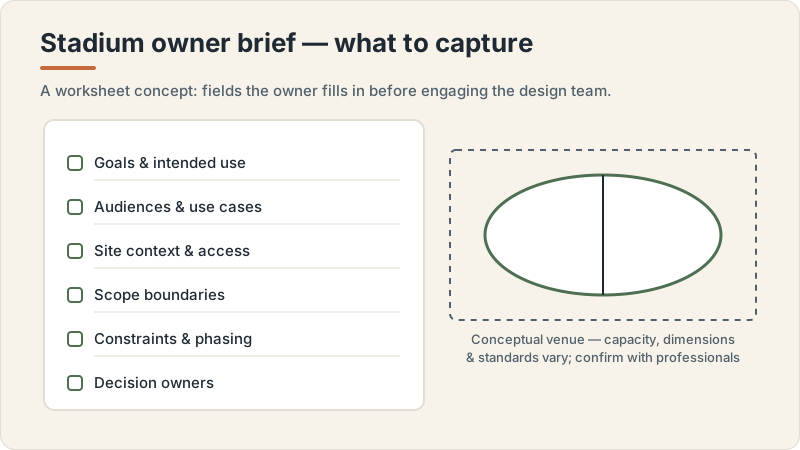
Stadium owner brief worksheet concept
Conceptual editorial diagram — not a construction drawing, specification, to-scale plan or proof of a real project. It is not engineering, structural, fire/life-safety, crowd-safety or accessibility-compliance guidance. Capacities, dimensions, standards, requirements and costs vary by facility type, audience, site, use case and governing body, and are confirmed with qualified professionals, relevant authorities and governing bodies. Build Design Hub does not design, build, inspect, certify, recommend or match anyone.
What this guide helps you prepare
This guide helps you assemble the raw material of a community stadium project brief: a written statement of why the venue is wanted, who it serves, what it might host, and what questions still need qualified answers. A good brief is not a design and not a decision to build - it is an organised summary of intent, constraints and open questions that a professional team, an authority or a governing body can respond to. Preparing it well tends to shorten later conversations, reduce misunderstandings between stakeholders, and make quote comparisons and scope discussions far easier to hold on a like-for-like basis.
It is important to be clear about what this guide is not. It is not a construction manual, structural or seating guidance, crowd-flow or evacuation design, fire or life-safety advice, accessibility-compliance advice, architectural design, or any statement of permits, codes, capacities, dimensions or costs. Build Design Hub does not design, build, engineer, inspect, certify, recommend, rank, verify, introduce, broker or match any supplier, contractor, consultant or professional. Everything technical is framed as something to confirm with qualified professionals, relevant authorities and governing bodies, because requirements vary by location, facility type, use case, governing body, owner, site, authority, professional team and project scope.
- Write a one-paragraph statement of purpose you could read aloud to a stakeholder meeting
- List the specific problems or gaps the venue is meant to address in your community
- Note which decisions are already made, which are open, and which need professional input
- Record who has authority to approve the brief and who must be consulted before it is finalised
- Capture questions you cannot answer yourselves so they are ready for qualified professionals
- Keep a running log of assumptions to be confirmed rather than stated as facts
Defining multi-use goals and the primary and secondary purposes
Community venues rarely have a single use, and the tension between uses is usually where projects run into trouble later. A school may want reliable weekday access for physical education while a club wants evenings and weekends; the municipality may want the space available for community events, markets or ceremonies; and neighbours may care most about parking, noise and the hours of operation. Writing down a clear hierarchy - what the venue is primarily for, what it is secondarily for, and what it is explicitly not for - gives everyone a shared reference point and helps qualified professionals understand the trade-offs you are asking them to weigh.
As you draft this section, separate the uses you are committing to from the uses you are merely hoping to accommodate. A multi-use ambition is easier for a professional team to respond to when it is expressed as prioritised scenarios rather than a wish list. Avoid stating any capacity, event size, surface, dimension or scheduling standard as a fact; these depend on the site, the governing bodies involved and the professional assessment, and they belong in your list of questions to confirm rather than in your assumptions. Keeping goals in plain language - who, when, how often, and how important - keeps the brief usable for non-technical stakeholders too.
- List every intended use and mark each as primary, secondary or aspirational
- Note any use that is explicitly excluded, and record why, so it is not reintroduced later
- Describe typical weekly patterns in words (school hours, club evenings, community weekends) without assuming any capacity
- Flag where two uses may conflict over timing, surface, storage or access for a professional to assess
- Record which governing bodies or associations relate to each intended sport or activity, to confirm with them directly
- Capture whether occasional larger events are a genuine requirement or a nice-to-have, since this changes many downstream questions
Community engagement and funding-readiness conversations
Because a community venue is accountable to people beyond the project team, engagement is not a formality - it shapes the brief itself. Preparing for engagement means deciding who needs to be heard (residents, members, parents, existing user groups, neighbouring landowners, local businesses), what you will ask them, and how you will record and reflect what you hear. Capturing this input in the brief - including objections and constraints, not just support - gives professionals and authorities a realistic picture and reduces the risk of late surprises. This guide does not tell you how to run a consultation or what the outcome should be; it helps you prepare the questions and the record.
Funding-readiness is the parallel conversation, and this guide treats it strictly as preparation, not financial advice. It is about being ready to have credible discussions with whoever may fund, grant, sponsor or approve spending - which usually means having your goals, uses, stakeholders and open questions documented, and knowing which financial, legal and procurement questions must go to qualified professionals and the relevant authorities. Build Design Hub gives no figures, budgets, costs, revenue, funding sources or return assumptions, and nothing here should be read as tax, legal, insurance or procurement advice. The value is in organising what you know so that qualified advisers can do their work efficiently.
- List the stakeholder groups to engage and what specific input you need from each
- Prepare neutral questions that invite constraints and concerns, not only support
- Decide in advance how you will record, summarise and reflect community input in the brief
- Note which approvals, mandates or member votes are needed before the project can proceed, to confirm with the right authorities
- List the financial, legal, insurance and procurement questions to route to qualified professionals rather than answering internally
- Gather your goals, uses and open questions into a form a potential funder or approver could review, without stating any budget or return
Planning questions before speaking with professionals
Before you sit down with architects, engineers, planners, cost consultants or a governing body, it is worth working through the questions you can reasonably answer yourselves. These are the questions about intent, priorities, constraints and readiness that shape a brief - not the technical questions that require a qualified assessment. Answering them first means the professional conversations start from a clear position rather than a blank page, and it helps you notice where your own stakeholders disagree before a professional has to surface it for you.
Keep these self-directed questions separate from the technical questions in the next section. The point of this stage is to arrive at your first professional meeting knowing what you want, who you answer to, what you have already decided, and what you genuinely do not know. Where a question touches capacity, dimensions, standards, safety, accessibility, permits, codes or cost, note it as something to confirm with qualified professionals and relevant authorities rather than trying to settle it internally - requirements vary by location, facility type, use case, governing body, owner, site, authority, professional team and project scope.
- What is the single most important thing this venue must achieve, in one sentence everyone agrees on?
- Who are the decision-makers, and who must be consulted before the brief is signed off?
- Which uses are non-negotiable, and which would we drop if trade-offs became necessary?
- What do we already know about the site or existing facility, and what is still unknown?
- What community concerns or objections do we already anticipate, and how will we document them?
- Which questions are we tempted to answer ourselves that we should actually take to a professional?
Questions for qualified professionals
Once your brief captures your goals, uses, stakeholders and open questions, the next step is to bring the technical and specialist questions to the people qualified to answer them. These questions are deliberately framed as prompts to raise, not as things this guide can answer. A professional team can help you understand which questions apply to your situation, in what order, and which authorities or governing bodies you need to involve. Bring your written brief so the discussion is grounded in your actual intent rather than a generic template.
Use the prompts below as a starting point for conversations with qualified professionals such as architects, engineers, planning and permitting specialists, cost consultants, accessibility specialists, safety professionals, and the relevant authorities and governing bodies - and expand them for your specific context. Do not treat any answer as universal: what applies to another venue may not apply to yours, because requirements vary by location, facility type, use case, governing body, owner, site, authority, professional team and project scope. Record who said what, and confirm anything material in writing with the appropriate authority.
- Given our brief, which professionals, authorities and governing bodies should be involved, and in what sequence?
- What site, planning, permitting or zoning questions apply to our location, and who confirms them?
- Which safety, crowd-management and accessibility matters must be assessed professionally rather than assumed by us?
- How should our multi-use goals be interpreted, and where do they create technical trade-offs we should understand?
- What scope, phasing and handover considerations should shape how we structure supplier and contractor conversations?
- What information would you need from our brief to give a considered opinion, and what remains outside your remit?
What this does not replace
This is an educational planning resource only. It is not a stadium construction manual and not structural, architectural, seating or stand engineering, crowd-safety, crowd-flow, evacuation, fire or life-safety, or accessibility-compliance advice, and it is not permit, zoning, inspection, certification, legal, tax, insurance or procurement advice. It does not design, build, engineer, specify, certify, inspect or approve anything, gives no capacities, dimensions, loads, revenue, ROI or costs, and offers no warranty interpretation or estimate. Requirements, standards, capacities and costs vary by location, facility type, use case, governing body, owner, site, authority, professional team and project scope, and are confirmed with qualified professionals, relevant authorities and governing bodies.
Build Design Hub does not design, build, engineer, inspect, certify, recommend, rank, verify, introduce, broker or match suppliers, contractors, consultants or professionals, and HELPERG LLC is publisher/operator only. Use this resource to prepare your own thinking and briefs, then have qualified professionals you engage directly review your project. Decisions about design, engineering, structure, crowd safety, fire and life safety, accessibility, compliance, capacity, procurement and cost must rest on those professionals, the relevant authorities and the governing bodies for your sport and location.
- Not a stadium construction manual and not structural, architectural or seating/stand engineering
- Not crowd-safety, crowd-flow, evacuation, fire/life-safety or accessibility-compliance advice
- Not permit/zoning, inspection, certification, warranty-interpretation, legal, tax, insurance or procurement advice
- Not a supplier, contractor, consultant or professional recommendation, ranking, directory or matching service
- Not an estimate and gives no capacity, dimension, revenue, ROI or cost figures — requirements and costs vary
- Qualified professional review is required before any stadium project decision
Community stadium project brief preparation worksheet
- 1Record a one-paragraph statement of purpose for the venue that all core stakeholders agree on
- 2List every intended use and mark each as primary, secondary or aspirational
- 3Note any explicitly excluded uses and the reason each is excluded
- 4Identify the decision-makers and everyone who must be consulted before sign-off
- 5List the community and stakeholder groups to engage and what input you need from each
- 6Prepare neutral engagement questions that invite constraints and concerns, not just support
- 7Decide how community input will be recorded, summarised and reflected in the brief
- 8Gather what is already known about the site or existing facility, and flag what is unknown
- 9Write down every assumption about capacity, size, surface, standards, timing or cost as a question to confirm - never as a fact
- 10List the financial, legal, insurance and procurement questions to route to qualified professionals
- 11Note which approvals, mandates or votes are required before the project can proceed
- 12Record which governing bodies or associations relate to each intended activity, to confirm with them directly
- 13Assemble goals, uses, stakeholders and open questions into a form a funder or approver could review, without any figures
- 14Keep a running log of open questions to raise with qualified professionals and authorities
Common mistakes to avoid
- Stating a capacity, dimension, surface or standard as a fact in the brief instead of flagging it as a question for professionals and governing bodies
- Assuming requirements from another venue or another town apply to your site without confirming with the relevant authority
- Treating multi-use ambitions as a flat wish list rather than a prioritised hierarchy of primary, secondary and aspirational uses
- Running or planning engagement only to gather support, and failing to record objections, constraints and concerns
- Confusing funding-readiness preparation with financial advice, and putting budgets, costs or return assumptions into the brief
- Deferring stakeholder disagreement to the professional stage instead of surfacing and documenting it in the brief first
- Skipping professional and authority review of safety, accessibility, planning and permitting questions by answering them internally
- Finalising the brief without recording who has authority to approve it and who must be consulted first
When to involve a professional
- Before any assumption about capacity, dimensions, surfaces, loads, safety or accessibility is relied on, take it to a qualified professional and the relevant authority
- When planning, permitting, zoning or code questions arise, involve a qualified planning or permitting specialist and the appropriate authority
- Before funding, grant, sponsorship or procurement conversations move beyond preparation, involve qualified financial, legal and procurement professionals
- When multi-use goals create technical trade-offs, involve architects and engineers to interpret them rather than resolving them internally
- When crowd-management, life-safety or accessibility matters are in scope, involve the appropriate safety and accessibility professionals
- Before structuring supplier, contractor or quote-comparison conversations, involve qualified professionals to help define scope, phasing and handover
Frequently asked questions
Questions readers ask about this topic
Does Build Design Hub design, build, engineer, inspect or certify community stadiums, or recommend suppliers and contractors?
No. Build Design Hub is an educational resource published and operated by HELPERG LLC. It does not design, build, engineer, inspect, certify, recommend, rank, verify, introduce, broker or match any supplier, contractor, consultant or professional, and it provides no capacities, dimensions, costs or requirements. This guide only helps you prepare a project brief and questions; every technical, safety, accessibility, permitting and cost matter must be confirmed with qualified professionals, relevant authorities and governing bodies.
What size or capacity should a community stadium be?
This guide cannot tell you, and you should be cautious of any source that states a fixed answer. Capacity, size, surfaces and standards vary by location, facility type, use case, governing body, owner, site, authority, professional team and project scope. Record your intended uses and priorities in the brief, mark any size assumption as a question, and confirm what applies to your situation with qualified professionals and the relevant governing bodies.
Can this guide help us with funding, budgets or return on investment?
It can help you prepare for those conversations, but it gives no financial advice. This guide contains no figures, budgets, costs, funding sources or return assumptions. Funding-readiness here means organising your goals, uses, stakeholders and open questions so that qualified financial, legal, insurance and procurement professionals - and any relevant authorities - can advise you. Any figure you encounter should be confirmed with those professionals, not assumed from this guide.
How is a project brief different from a design or a construction plan?
A brief is a written statement of intent, priorities, stakeholders and open questions; it is prepared before design and engineering, and it does not contain construction, structural, seating, crowd-safety or sequencing instructions. Its purpose is to give qualified professionals and authorities a clear starting point. This guide helps you prepare that brief only - it is not a design, a construction manual, or a substitute for professional work.
Keep reading